Tag: cad drafter

  • How Much Does CAD Drafting Cost? 2026 Pricing Guide

    How Much Does CAD Drafting Cost? 2026 Pricing Guide

    One of the most common questions engineering managers, architects, and small business owners ask when a new project lands on their desk is deceptively simple: what is this going to cost in drafting?

    The honest answer is that CAD drafting costs span a wide range, from under $50 for a basic conversion task to well over $50,000 for a complex commercial construction drawing package. The range is not arbitrary. It reflects real differences in drawing complexity, drafter experience, project discipline, delivery speed, and where in the world the work is being done.

    Most pricing articles on this topic give you a number and move on. This guide goes deeper. We break down costs by drawing type, discipline, pricing model, and provider category. We explain every factor that moves the price up or down. We include a practical budget-planning section and a red flag list for quotes that do not pass the smell test. By the end, you will know not just what CAD drafting costs, but why it costs what it does, and how to get better value from every dollar you spend.

    Quick Answer: CAD Drafting Cost at a Glance
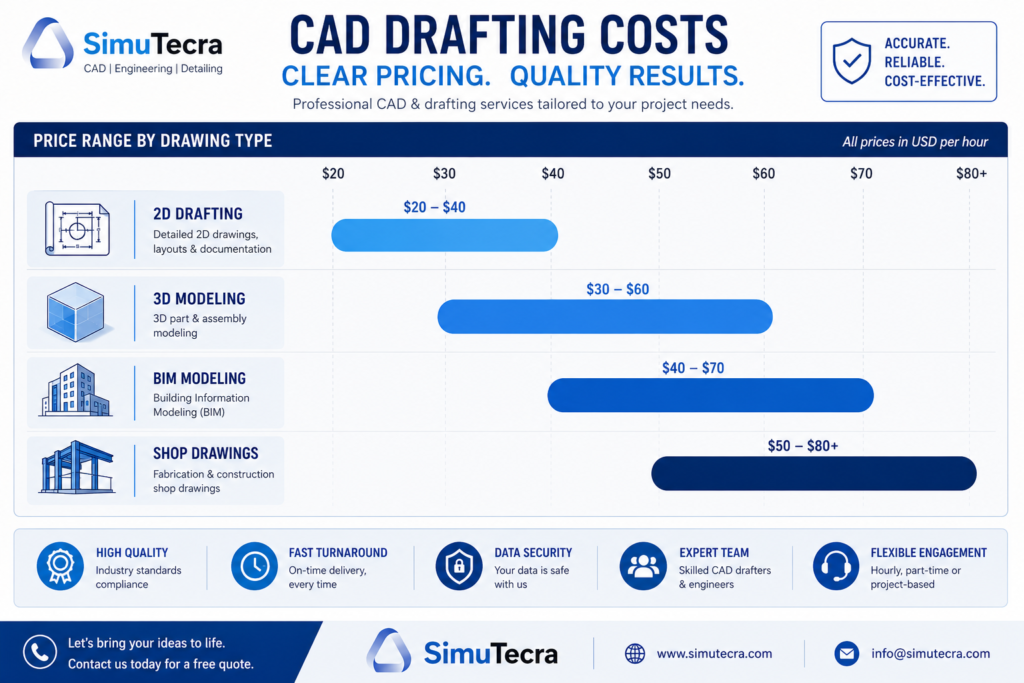
    If you need a number right now, here is where most CAD drafting projects land based on current market data compiled from vendor pricing pages, industry surveys, and published rate data for 2026-2026:
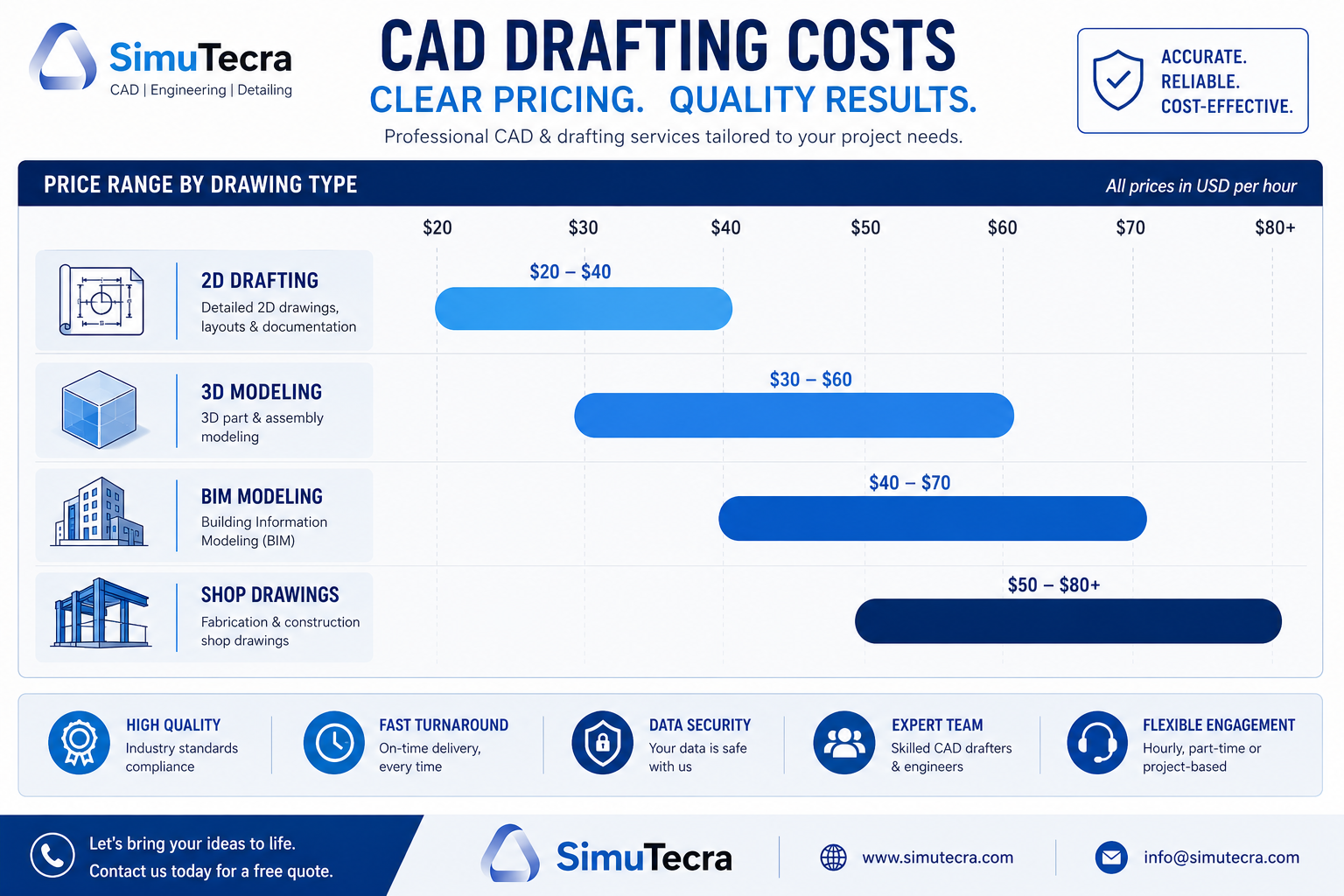
    CAD drafting cost comparison chart showing price ranges for 2D drafting, 3D modeling, BIM services, and shop drawings in 2026
    Pricing MetricTypical RangeNotes
    Hourly rate (domestic freelancer)$45 – $95/hrVaries by discipline and experience
    Hourly rate (domestic firm)$75 – $150/hrIncludes overhead, QA, account management
    Hourly rate (offshore firm)$8 – $35/hrVaries significantly by region and quality tier
    Per-sheet rate (2D CAD conversion)$45 – $250/sheetRush turnaround doubles or triples cost
    Simple 2D drawing package$150 – $800Single-page layouts, basic floor plans
    Standard residential drawing set$800 – $3,500Full permit-ready plans for a home
    Commercial drafting package$5,000 – $30,000+Multi-discipline, multi-sheet sets
    3D CAD model (single component)$300 – $2,500Complexity and tolerance precision drive cost
    BIM model (full building)$8,000 – $50,000+Depends on LOD and number of disciplines
    Monthly retainer (outsourced)$1,200 – $6,000/moDedicated or shared resource block
     Important framing:  These ranges reflect real market data, not optimistic estimates. The bottom of each range represents straightforward work from lower-cost providers. The top reflects complex, high-stakes deliverables from experienced domestic firms. Most real projects land somewhere in the middle.

    2. What Determines CAD Drafting Pricing? The 7 Core Variables

    CAD drafting is not a commodity where one price fits all. Every quote you receive reflects a specific combination of the following factors. Understanding each one helps you assess whether a quote is fair, and gives you tools to control your costs.
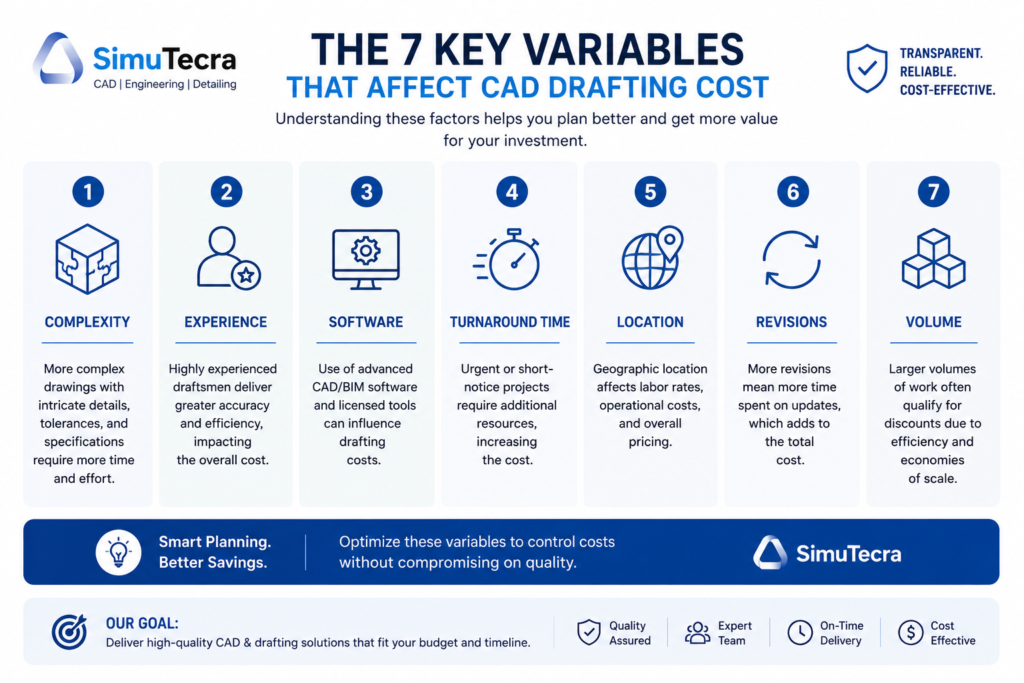
    Infographic showing seven variables that determine CAD drafting cost complexity, drafter experience, software, turnaround time, provider location, revisions, and project volume

    Variable 1: Drawing Complexity

    Complexity is the single biggest cost driver in CAD drafting. A simple 2D floor plan redraw with clean linework and basic dimensions might take a skilled drafter three to five hours. The same space drawn with structural details, MEP coordination, material specifications, and permit-ready annotation can take fifteen to thirty hours. That difference directly multiplies your cost.

    Complexity factors include the number of distinct components or rooms, the level of annotation and dimensioning required, whether the drawing needs to meet code compliance or permit submission standards, how many layers and disciplines must be coordinated, and whether 3D modeling or BIM data is involved alongside 2D output.

    Variable 2: Drafter Experience and Specialization

    An entry-level drafter working in AutoCAD LT will produce basic 2D layouts accurately and affordably. A senior mechanical engineer who also drafts will charge three to four times more per hour, but may deliver a complete SolidWorks assembly package with GD&T annotations, BOM, and manufacturing notes in a fraction of the time. Specialization commands a premium. Structural steel detailing, medical device drafting, aerospace documentation, and MEP coordination drawings all require expertise that general drafters do not have, and the market rates for specialists reflect that.

    Variable 3: Software and Deliverable Format

    The software platform matters both for capability and cost. An AutoCAD 2D drawing is the most common and typically the least expensive output. SolidWorks or CATIA 3D models involve more complex workflows and higher-cost software licenses, which factor into quoted rates. Revit BIM deliverables require BIM-trained professionals and carry a premium over standard CAD. If you require deliverables in a specific format (native DWG, STEP, IFC, PDF, DXF), or need files structured to a specific standard like ISO or AIA layering, mention this upfront, as non-standard requirements affect time and cost.

    Variable 4: Turnaround Time

    Rush work costs more, often significantly more. Most CAD drafting providers have tiered pricing based on delivery speed. Standard turnaround (5 to 10 business days) is typically the baseline rate. Three-day delivery often carries a 25 to 50 percent premium. Same-day or next-day delivery, when available, can double the base price. If your timeline is flexible, communicate that clearly. Some providers discount work with relaxed deadlines, using it to fill gaps between priority projects.

    Variable 5: Provider Location

    Where the drafting is done dramatically affects what you pay. A domestic US firm in a major metropolitan area will charge two to five times what an equivalent-quality offshore firm in India or the Philippines charges for the same drawing. The cost difference is real, but so are the tradeoffs in communication, time zone overlap, and IP handling. The pricing section on domestic versus offshore providers covers this in detail.

    Variable 6: Number of Revisions

    Revisions are a significant and often underestimated cost driver. Most drawing packages include a defined number of revision rounds in the base quote (commonly one or two rounds of minor changes). Changes beyond that scope are billed at the hourly rate, which can substantially increase total project cost. Poor upfront briefing is the main cause of excessive revision cycles. The clearer and more complete your design intent and specifications are at the start, the fewer revision rounds you will need.

    Variable 7: Project Scale and Volume

    Volume pricing is real. A single drawing sheet costs proportionally more than a batch of fifty similar sheets. If you have an ongoing, high-volume drafting need, most firms will offer a reduced per-sheet or per-hour rate in exchange for a committed volume or retainer arrangement. Conversely, minimum project charges (typically $150 to $250 for most firms) mean that very small one-off requests are often not worth outsourcing individually.

    3. CAD Drafting Hourly Rates: A Realistic Breakdown

    Hourly billing is the most transparent and flexible pricing model for CAD drafting, and it is the dominant model for iterative or undefined-scope work. Here is what the market looks like in 2026-2026 across provider types and experience levels.
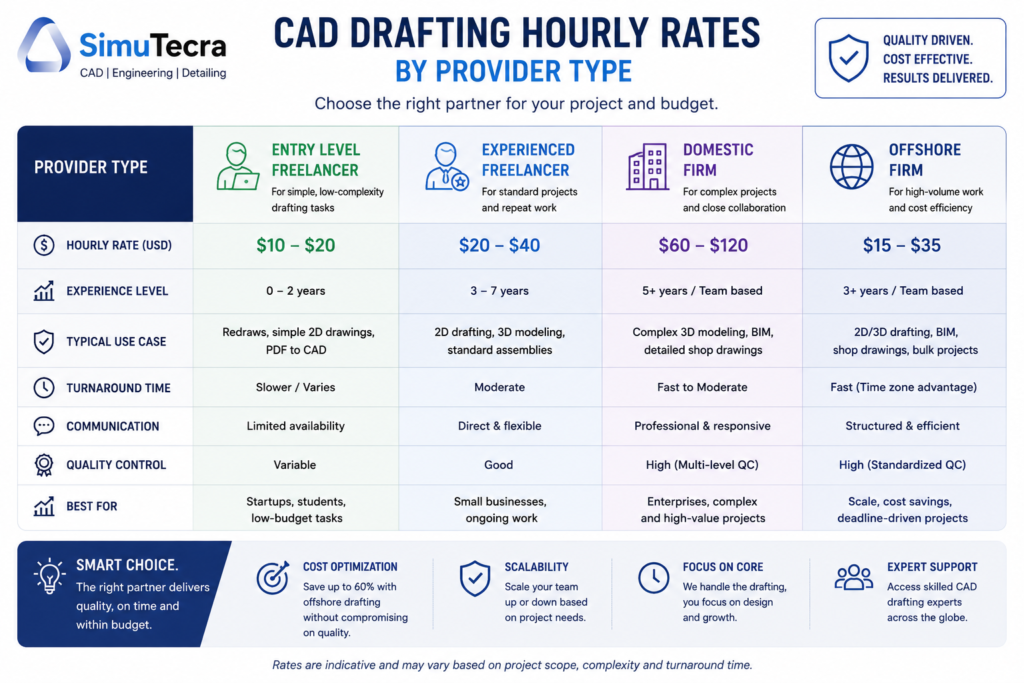
    Bar chart comparing CAD drafting hourly rates by provider type from entry-level freelancers to domestic firms in 2026
    Provider TypeEntry LevelMid LevelSenior / SpecialistNotes
    US Domestic Freelancer$30 – $45/hr$45 – $75/hr$75 – $120/hrRates vary by discipline; structural and MEP specialists at the top
    US Domestic Firm$60 – $80/hr$80 – $120/hr$100 – $175/hrIncludes project management, QA, software overhead
    UK / Western Europe Firm£45 – £65/hr£65 – £100/hr£95 – £150/hrComparable to US in GBP; EU regulations familiarity a plus
    Eastern Europe (Poland, Romania)$20 – $35/hr$35 – $55/hr$50 – $80/hrStrong technical quality; growing for BIM and complex drafting
    India-Based Firm$8 – $15/hr$15 – $25/hr$22 – $40/hrLargest offshore talent pool; quality varies significantly
    Philippines-Based Firm$10 – $18/hr$18 – $30/hr$25 – $45/hrStrong English proficiency; good AEC and MEP drafting capability

    What Is Included in an Hourly Rate?

    When you hire a domestic firm at $100 per hour, you are not just paying for the drafter’s hands on a mouse. That rate typically covers:

    • The drafter’s time and expertise
    • Software license costs (AutoCAD at $1,975/year, Revit at $2,310/year, SolidWorks at $4,000+ per year)
    • Internal quality review before delivery
    • File management and delivery infrastructure
    • Project management and communication overhead
    • The firm’s business overhead including insurance, office, and administrative staff

    When you hire a solo freelancer at $55 per hour, most of those costs are lower or absent, which explains the rate difference. Neither is inherently better — the right choice depends on your project’s complexity and what level of process and oversight you need.

    4. Per-Sheet and Per-Project Pricing: When Each Makes Sense

    Per-Sheet Pricing

    Per-sheet pricing is common for CAD conversion work, PDF-to-DWG conversion, permit drawing sets, and other tasks where each sheet is a discrete, standardized deliverable. It is popular with clients because it is predictable: you know how many sheets you need, you multiply by the rate, and you have your budget.

    Drawing Sheet TypeTypical Per-Sheet RateRush MultiplierNotes
    PDF to CAD conversion (basic)$45 – $90/sheet2 – 3xSimple linework, minimal annotation
    PDF to CAD conversion (detailed)$90 – $180/sheet2 – 4xFull annotation, dimensions, notation
    Architectural floor plan (new draw)$150 – $350/sheet1.5 – 2xOriginal drafting from sketches or notes
    Structural detail sheet$200 – $450/sheet1.5 – 2.5xIncludes member sizing, connection details
    MEP (mechanical/electrical/plumbing)$175 – $400/sheet1.5 – 3xCoordination complexity adds cost
    Shop drawing (fabrication)$150 – $350/sheet1.5 – 2xWeld symbols, tolerances, BOM
    Civil site plan$250 – $600/sheet1.5 – 2xSurvey data integration, grading, utilities
    On rush pricing:  One published provider (CAD/CAM Services) lists a flat rate of $185 per D or E size AutoCAD 2D sheet at standard turnaround. The same work at rush turnaround (24 hours) typically runs $370 to $550. Plan your deadlines accordingly.

    Per-Project (Fixed Fee) Pricing

    Fixed-fee pricing works well when the scope is clearly defined and the deliverables are well-understood. The drafter agrees to produce a specific set of outputs for a set price. You get budget certainty; the drafter accepts the risk if the job takes longer than estimated.

    Fixed-fee pricing is common for residential drawing packages, permit submission sets, and defined industrial or manufacturing drawing packages. It is less common for complex commercial or industrial projects where scope evolves during the engagement.

    Project TypeTypical Fixed-Fee RangeWhat Is Usually Included
    Simple 2D drawing (single sheet)$150 – $400Line conversion or basic redraw, one revision round
    Small residential renovation drawings$800 – $2,700Floor plans, elevations, basic sections for permit
    Full custom home drawing set$3,500 – $10,000+Full architectural set: plans, sections, elevations, details
    Small commercial building (permit set)$5,000 – $15,000Multi-discipline permit package, ADA compliance
    Medium commercial / industrial$15,000 – $35,000Full structural, MEP, architectural coordination
    Large commercial or industrial project$35,000 – $100,000+Multiple disciplines, extensive coordination, BIM deliverables
    Product design (simple mechanical part)$300 – $1,5003D model, 2D drawing package, BOM
    Product design (complex assembly)$2,000 – $15,000+Multi-component assembly, GD&T, manufacturing drawings

    5. Cost by Drawing Type and Discipline

    CAD drafting costs vary significantly across disciplines. The differences are not arbitrary: they reflect the level of specialized knowledge required, the complexity of applicable standards and codes, and the typical time investment per drawing.

    Architectural CAD Drafting Costs

    Architectural drafting is one of the most common CAD services and covers a wide range of work from basic floor plans to complex construction document sets. Costs are driven by the number of sheets, the level of detail, and whether permit submission formatting is required.

    • Basic floor plan (single level): $300 – $800
    • Full residential permit set (plans, elevations, sections, details): $1,500 – $5,000
    • Commercial permit-ready drawing package: $8,000 – $30,000+
    • As-built drawings (measured and drawn): $500 – $3,000 depending on size and complexity
    • PDF to AutoCAD conversion (per sheet): $45 – $180

    Architectural drafting rates for domestic freelancers average $75 to $125 per hour. This is substantially less than hiring a licensed architect, whose hourly rates run $200 to $400 per hour. For pure drafting work (translating a design into accurate CAD output), a skilled architectural drafter is the appropriate choice, not an architect.

    Mechanical Engineering CAD Drafting Costs

    Mechanical CAD drafting is where precision is paramount. Drawings must convey exact dimensions, tolerances, material specifications, and surface finish requirements in a format that machinists and fabricators can execute without ambiguity. This level of precision requires experienced drafters and commands higher rates than basic architectural work.

    • Simple machined part (2D drawing): $150 – $600
    • Complex machined part with GD&T: $400 – $1,500
    • 3D solid model (single component): $300 – $2,000
    • Sub-assembly drawing package: $800 – $4,000
    • Full product assembly with BOM and exploded views: $2,000 – $15,000+

    Mechanical CAD specialists in AutoCAD Mechanical, SolidWorks, or CATIA typically bill $65 to $120 per hour domestically. The premium over general drafting rates reflects the knowledge of manufacturing processes, GD&T standards (ASME Y14.5), and the criticality of getting tolerances right.

    Structural Engineering CAD Drafting Costs

    Structural drafting covers foundation plans, framing plans, structural steel details, rebar layouts, and connection details. It sits at the intersection of engineering judgment and drafting skill, meaning the best structural drafters have a solid understanding of structural behavior, not just drafting technique.

    • Foundation plan: $400 – $1,200
    • Structural steel shop drawings (per sheet): $200 – $450
    • Rebar detailing drawings (per sheet): $150 – $350
    • Full structural drawing package for a residential project: $1,500 – $4,000
    • Commercial structural documentation package: $8,000 – $40,000+

    Structural shop drawings are a category where outsourcing to specialized overseas firms is extremely common. Firms in India and the Philippines have built strong capabilities specifically in steel detailing and rebar drawings for US and UK markets, typically charging $15 to $30 per hour for what domestic firms bill at $90 to $150 per hour.

    Civil Engineering CAD Drafting Costs

    Civil CAD drafting covers site plans, grading plans, utility layouts, road designs, and land development drawings. Civil work often involves integration with survey data, GIS systems, and regulatory formatting requirements that vary by municipality.

    • Basic site plan: $500 – $1,500
    • Full land development drawing package: $3,000 – $15,000
    • Road design drawings (per sheet): $300 – $700
    • Utility layout drawings (per sheet): $200 – $500
    • Civil 3D model (grading and drainage): $1,500 – $8,000

    MEP (Mechanical, Electrical, Plumbing) Drafting Costs

    MEP drafting is among the most complex and expensive CAD work because it requires coordination between three distinct systems, all of which must occupy the same physical building space without conflict. MEP drawings are increasingly produced in BIM to enable clash detection.

    • HVAC layout drawing (per floor): $600 – $2,000
    • Electrical layout drawing (per floor): $400 – $1,500
    • Plumbing riser diagram: $300 – $900
    • Full MEP coordination package for a commercial building: $15,000 – $60,000+
    • BIM model with MEP coordination and clash detection: $20,000 – $80,000+

    BIM Modeling Costs

    Building Information Modeling (BIM) represents the highest tier of CAD-related drafting cost. BIM is not just drawing: it is a data-rich 3D model that carries information about every component in a building, including material properties, manufacturer data, maintenance requirements, and spatial relationships. The Level of Development (LOD) spec required significantly determines cost.

    BIM Level of DevelopmentWhat It IncludesTypical Cost Impact
    LOD 100 (Conceptual)Massing and overall form onlyLowest cost; schematic only
    LOD 200 (Approximate Geometry)Generic elements, approximate sizesModerate cost; early design phase
    LOD 300 (Specific Geometry)Accurate dimensions, coordination-readyStandard for permit/construction use
    LOD 350 (Construction)Interfaces with adjacent elements includedHigh cost; needed for fabrication coordination
    LOD 400 (Fabrication)Full fabrication and installation detailVery high cost; used for prefab and shop drawing production
    LOD 500 (As-Built)Verified field conditions, actual installed stateHighest cost; full as-built documentation

    6. Domestic vs Offshore CAD Drafting: The Real Cost Comparison

    The cost gap between domestic and offshore CAD drafting is large, and it is worth examining honestly rather than in generalities.

    Cost FactorDomestic (US/UK)Offshore (India/Philippines)Notes
    Hourly rate$65 – $150/hr$8 – $30/hr4 – 10x difference in base rate
    Time zone overlapFull overlapMinimal (8 – 12 hrs difference)Offshore requires asynchronous workflow
    Communication frictionLowModerate to HighDepends on provider’s English proficiency and process maturity
    Revision cycle timeHours1 – 2 daysTime zone gap extends correction loops
    IP risk levelLowModerateManageable with proper contracts; not eliminated
    Drawing quality ceilingVery highHigh for standardized work, variable for complexBest offshore firms deliver excellent output
    Total effective cost (with mgmt overhead)$75 – $160/hr est.$20 – $55/hr est.Offshore savings real but not as large as rate gap suggests

      💰 The real saving:  If a domestic firm charges $100/hr and an offshore firm charges $18/hr, your raw cost savings are 82%. But management overhead, revision cycles, and QA review typically consume 30 to 50% of those savings. Real net savings for well-managed offshore arrangements typically run 40 to 60% compared to equivalent domestic work. Still significant, but calibrate expectations honestly.

    7. Freelancer vs Firm vs Outsourcing Agency: Pricing Differences

    Beyond geography, the type of provider you hire shapes both cost and experience significantly.

    Provider ModelHourly Range (Domestic)Best ForRisk Factors
    Solo freelancer$30 – $95/hrWell-defined projects, cost-conscious budgetsSingle point of failure; limited capacity; inconsistent availability
    Small specialist firm (2-10 people)$65 – $130/hrMid-complexity projects needing some team depthLimited surge capacity; still owner-dependent
    Established CAD firm$85 – $175/hrComplex, multi-sheet, regulated-industry workHighest cost; best process and accountability
    Offshore outsourcing firm$8 – $35/hrVolume drafting, standardized work, cost reductionCommunication overhead; QA management required
    Freelance platform (Upwork, Freelancer)$15 – $80/hrQuick tasks, price testing, low-stakes projectsHighly variable quality; no accountability structure
    Retainer / dedicated resourceNegotiated monthly rateOngoing high-volume needsRequires volume commitment; not flexible for sporadic work

    8. The Hidden Costs No One Talks About

    The quoted price for a CAD drafting project is often not the final price. These additional costs catch clients off guard repeatedly, and they deserve direct attention.

    Revision Costs Beyond Scope

    Most quotes include one or two rounds of minor revisions. Changes beyond that, whether driven by a design change on your end or a misunderstanding in the brief, are billed at the hourly rate. On a complex drawing package, multiple out-of-scope revision cycles can easily add 20 to 40 percent to the original quote. The solution is a comprehensive brief at the start, not a fight with your provider at the end.

    Format Conversion and File Compatibility

    If your provider works in one software platform and you need files in another, expect conversion fees. DWG to DXF is simple. AutoCAD to CATIA native format is not. File format requirements should be specified clearly in the brief and confirmed as included in the quote. Discovering at delivery that your machine shop needs a STEP file when you were expecting DWG files is a costly surprise.

    Minimum Project Fees

    Most professional CAD drafting providers have minimum fees, typically between $150 and $250. A five-minute correction that takes 30 minutes of a drafter’s time, including file handling and delivery, may still cost you the minimum. For very small, frequent requests, a retainer arrangement or in-house capability is usually more economical than individual project billing.

    Rush Premiums

    Rush fees are real and significant. A drawing that costs $500 at standard turnaround may cost $800 to $1,200 at two-day delivery. For same-day or next-day delivery (when available), premiums of 100 percent or more are not unusual. If you find yourself frequently paying rush rates, the root problem is usually project planning and timeline management, not drafting capacity.

    Back-and-Forth Communication Time

    This cost is invisible but real. Every email thread chasing clarification, every video call to explain a markup, every iteration of a brief that was not clear the first time represents time you are paying for indirectly (in management overhead) or paying for directly (in revision billing). Investing 30 to 60 minutes in a thorough project brief almost always saves more time and money than it costs.

    Software License Fees (When Applicable)

    Some specialized deliverables require proprietary software licenses. If you need a Revit model and your preferred firm works in AutoCAD, either the firm will need to bring in a Revit resource (which costs more) or you will need to engage a different firm. Similarly, if you require CATIA or Creo deliverables, expect a reduced pool of providers and higher rates. Always specify required software in your brief.

     Cost trap:  The single most expensive mistake in CAD drafting procurement is providing an incomplete brief and assuming the drafter will figure out the rest. Ambiguity in scope almost always resolves at your expense.

    9. How to Budget for a CAD Drafting Project

    Accurate budget planning for CAD drafting requires more than looking up a price range. Here is a practical process that experienced project managers use.

    Step 1: Define Your Deliverables Before You Ask for a Quote

    Write down exactly what you need: how many drawing sheets, what views (plan, section, elevation, detail, isometric, 3D model), what software format, what layering standard, what annotation level, and what the final use will be (permit submission, fabrication, client presentation, internal reference). The more specific your scope, the more accurate your quote will be.

    Step 2: Identify Your Drawing Type and Discipline

    Use the cost ranges in Section 5 as your starting benchmark. Are you buying architectural, mechanical, structural, civil, or MEP drawings? Simple 2D or 3D? BIM or CAD? Each discipline and output type has a different cost baseline.

    Step 3: Add a Revision Buffer

    Whatever your base quote is, budget an additional 15 to 25 percent as a revision contingency. This is not pessimism; it is realistic planning. Design changes, client feedback, and engineering review comments are normal, and they generate revision work. If you use the full contingency, you accounted for it. If you do not, it is a pleasant surprise.

    Step 4: Get Multiple Quotes and Compare Apples to Apples

    Price alone does not tell you which quote is the best value. When comparing quotes, confirm that each includes the same deliverables (number of sheets, revision rounds, file formats), the same software, the same turnaround window, and the same QA process. A quote that looks 30 percent cheaper may include fewer revision rounds or exclude file format delivery in your required standard.

    Step 5: Consider the Total Engagement Cost, Not Just the Hourly Rate

    If you are evaluating an offshore option, account for your management time. If a $20/hr offshore provider requires three hours of your team’s coordination time per week that would not be needed with a domestic provider at $90/hr, the real cost difference is smaller than the rates suggest. Factor in communication overhead, QA review time, and revision cycle duration when comparing total engagement costs.

    Budget example:  A small manufacturing firm needs a product redesign: 3D model of a new bracket assembly plus 2D manufacturing drawings for five components. Based on current market data, a domestic mid-level freelancer at $65/hr would likely complete this in 15 to 22 hours, putting total cost at $975 to $1,430. An offshore firm at $18/hr for similar complexity would quote $270 to $396, but factor in 4 to 6 hours of your team’s coordination and review time at your internal cost rate. The real offshore cost is likely $450 to $650, still a significant saving, but not the 80% discount the headline rate implies.

    10. Red Flags in CAD Drafting Quotes

    Not every low quote is a bargain, and not every high quote is unjustified. These warning signs in a quote or provider relationship deserve attention before you commit.

    • Vague scope acceptance: A provider who accepts your project brief without asking any clarifying questions does not fully understand the scope. Good providers ask about software requirements, layering standards, revision expectations, and deliverable formats upfront.
    • Unusually low rates without explanation: If a quote is 50 percent below the market rate, ask why. It may reflect genuinely lower overhead (offshore team, minimal QA), or it may reflect inexperience, substandard software, or a plan to bill extensively for revisions.
    • No portfolio in your discipline: A general CAD firm that has never done structural shop drawings is probably not the right choice for your structural shop drawing project. Ask for samples of work similar to yours before committing.
    • No defined revision terms: If the quote does not specify how many revision rounds are included and what constitutes a billable change, you have no budget protection once the project starts.
    • Resistance to NDA: Any provider that hesitates to sign a non-disclosure agreement for a project involving proprietary designs is a serious IP risk. A reputable firm will have a standard NDA ready.
    • No QC process described: Ask directly: who reviews the drawings before they are delivered to you? If the answer is unclear or does not involve a second set of eyes, your QA burden just landed entirely on you.
    • No example of their actual layering standards: A firm that cannot show you a sample drawing in their preferred layering convention before you commit may not have consistent standards, which means more rework aligning their output to your workflow.

    11. How to Reduce Your CAD Drafting Costs Without Cutting Quality

    There are legitimate ways to get better value from your CAD drafting budget. None of them involve choosing the cheapest provider regardless of capability.

    • A thorough brief reduces revision cycles, which is the most controllable cost lever you have. Specify drawing types, view counts, standards, format, software, and final use. Drawings produced to a clear brief require fewer corrections.Write a complete project brief before requesting quotes
    • Disorganized sketches, conflicting markup sets, and unclear source files slow the drafter down, and you pay for that time. Organize your inputs, resolve conflicts internally, and present a clear package.Provide organized input files
    • Rush premiums are avoidable if you plan ahead. Build drafting time into your project schedule rather than treating it as a last-minute activity.Be flexible on turnaround when you can
    • If you have a regular, predictable drafting volume, negotiate a monthly retainer rate. Most providers offer 10 to 20 percent below standard hourly rates for committed volume.Use retainer pricing for ongoing needs
    • Keep complex, IP-sensitive, or fast-turnaround work with a domestic provider. Send standardized, well-defined, lower-risk work offshore. This captures most of the cost savings from offshore pricing while protecting your most sensitive projects.Consider a hybrid sourcing model
    • Volume discounts are real. Instead of requesting five individual drawings one at a time, batch them into a single package. Per-unit cost drops, and provider efficiency increases.Batch similar work together
    • A well-organized title block, layer standard, and annotation template that you provide to your provider eliminates the time they spend inferring or guessing your preferences. This speeds production and reduces errors.Invest in a good drawing standards template

    Frequently Asked Questions

    The following questions represent the most common cost-related queries from engineering managers, project owners, and business leaders evaluating CAD drafting services.

    How much does a CAD drafter charge per hour?

    In the United States, domestic freelance CAD drafters typically charge between $45 and $95 per hour depending on their experience and specialization. Established domestic firms charge $75 to $175 per hour inclusive of overhead, QA, and project management. Offshore firms in India and the Philippines charge $8 to $35 per hour for equivalent skill levels. Hourly rates for specialized disciplines (structural detailing, medical device documentation, aerospace drawings) fall at the upper end of each range.

    How much does a single CAD drawing cost?

    A single CAD drawing can cost anywhere from $45 for a simple PDF-to-DWG conversion to $600 or more for a complex mechanical drawing with full GD&T annotation and 3D model. A standard architectural floor plan sheet typically costs $150 to $350. Structural and MEP sheets generally run $175 to $450 each. The cost per sheet drops meaningfully when you order a full set rather than individual sheets.

    How long does it take to produce a CAD drawing?

    Time varies dramatically with complexity. A simple 2D layout redraw takes 3 to 6 hours. A standard architectural floor plan with annotation and dimensions takes 8 to 15 hours. A complex mechanical assembly model with associated 2D drawings can take 20 to 60 hours. A full construction document set for a residential project typically takes 40 to 120 hours of drafting time. Turnaround time in calendar days depends on how many hours the drafter can dedicate per day and their current workload.

    Is it cheaper to hire a freelancer or a CAD firm?

    A freelancer will almost always be cheaper on an hourly basis. But cheaper per hour does not always mean lower total project cost. Firms bring process discipline, QA review, project management, and the ability to replace a resource if your dedicated drafter is unavailable. For high-stakes, complex, or ongoing work, the overhead of a firm is often worth the premium. For well-defined, contained projects without regulatory requirements, a skilled freelancer can deliver excellent value.

    Why do CAD drafting prices vary so much?

    Because the work itself varies enormously. A simple 2D redraw of a clean sketch and a BIM coordination package for a 10-story commercial building are both called ‘CAD drafting,’ but they involve completely different skill levels, software platforms, time investments, and risk profiles. The price range reflects the reality of the work, not inconsistency in the market. When you understand which of the seven variables in Section 2 apply to your project, the price range for your specific situation narrows considerably.

    What is the cheapest way to get CAD drafting done?

    The cheapest option is typically an offshore firm in India or the Philippines with published hourly rates of $8 to $15 per hour. However, the cheapest option is not always the most cost-effective. Poor quality or misunderstood drawings that require extensive rework can cost more than a higher-priced provider who got it right the first time. The most cost-effective approach combines a well-written project brief (which you control), a provider who has experience with your drawing type, clear revision terms in the contract, and a defined QA review step before the drawings enter production.

    Do CAD drafting services include revision rounds?

    Most professional providers include one or two rounds of minor revisions in their base quote. ‘Minor revisions’ typically means corrections to the existing scope (fixing a dimension that was marked incorrectly, adjusting an annotation). Scope changes (adding a view that was not in the original brief, redesigning a component) are almost always billed additionally at the hourly rate. Clarify exactly what revision terms are included before you sign off on a quote.

    Conclusion:

    CAD drafting costs are not mysterious, but they are not one-size-fits-all either. The wide price range you encounter when researching this topic is real, and it reflects real differences in scope, discipline, complexity, provider type, and geography.

    The most important insight in this guide is this: the cost of your CAD drafting project is more controllable than most clients realize. The biggest cost variable is not the provider’s rate. It is the clarity of your brief. An ambiguous or incomplete brief generates revision cycles, and revision cycles are the primary mechanism by which a well-priced project becomes an expensive one.

    Invest time in defining your scope clearly. Match your provider choice to your project’s actual requirements rather than just choosing the cheapest rate. Build a revision buffer into your budget. And review the drawings before they enter your production workflow, not after they have already been used.

    Do those things consistently, and you will get better results from every CAD drafting dollar you spend.

    Ready to plan your next CAD drafting project?

    Explore our related guides on in-house versus outsourced CAD drafting, version control for engineering drawings, and how to select the right CAD software platform for your team.
  • In-House vs Outsourced CAD Drafting: How to Decide

    In-House vs Outsourced CAD Drafting: How to Decide

    A mid-size mechanical engineering firm in Ohio recently found itself in a familiar bind. Their one full-time CAD drafter was maxed out, a large product redesign project had just landed, and the choice was either hire someone new or send overflow work to an outside firm. The owner asked what most business leaders eventually ask: which model actually makes more sense for us?

    It is a question that sounds simple but gets complicated fast. The answer changes depending on how much drafting work you have, how sensitive your designs are, whether your projects are continuous or cyclical, and what your long-term business strategy looks like. Most articles on this topic give you a pros and cons list and leave the decision entirely to you. This guide does something different.

    We have researched real salary benchmarks, actual outsourcing cost structures, and the practical operational realities that both models create. By the end, you will have a concrete framework for making the right call for your specific business, including a decision scorecard you can apply immediately.

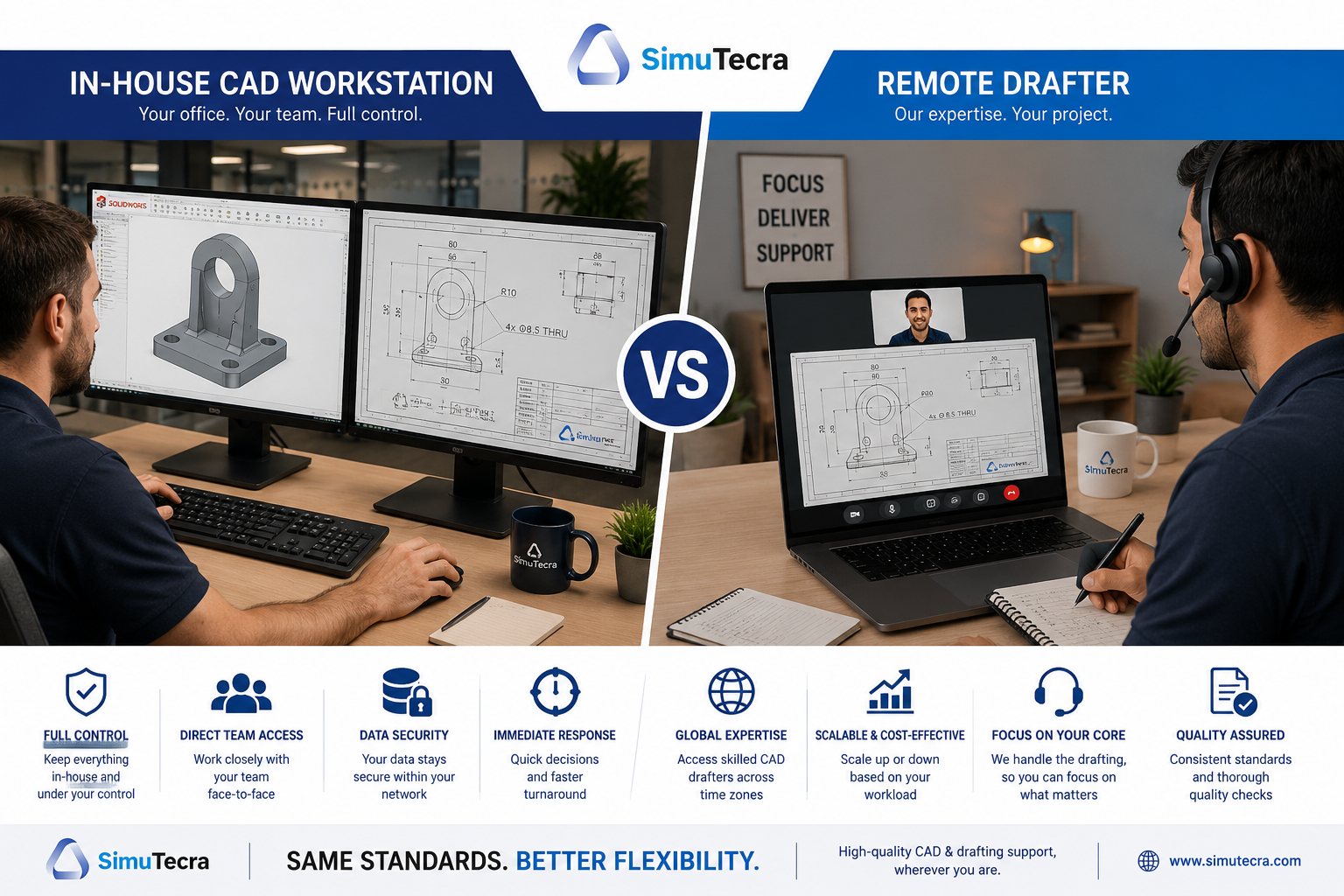
    Side-by-side comparison of in-house CAD drafting workstation versus outsourced remote CAD team on video call

    1. What Is CAD Drafting and Why the Sourcing Decision Matters

    CAD drafting is the process of creating precise technical drawings and 2D or 3D models using computer-aided design software such as AutoCAD, SolidWorks, Revit, CATIA, or MicroStation. These drawings serve as the authoritative technical language between designers, engineers, fabricators, contractors, and clients. A floor plan, a mechanical assembly drawing, an HVAC layout, a structural detail sheet: all of these are products of CAD drafting.

    For most businesses in engineering, architecture, construction, and manufacturing, CAD drafting is not an optional activity. It underpins every project. The question is not whether to do it, but how to staff it.

    Getting this decision wrong is expensive. Hire a full-time drafter when your workload does not justify it, and you are paying for idle capacity. Outsource when you should not, and you risk IP exposure, communication failure, and quality inconsistency. The right answer depends on a careful analysis of your workload pattern, budget, project complexity, and strategic direction.

    2. What the Top-Ranking Articles on This Topic Miss

    Before building this guide, we reviewed the articles currently ranking at the top of search results for this topic. They share a consistent set of weaknesses that leave business owners without the information they actually need to make this decision.

    • No real cost data: Most articles say outsourcing ‘saves money’ without citing any salary figures, hourly rates, or total cost calculations. We have included current 2025-2026 market data from salary.com, Glassdoor, and Indeed.
    • No hybrid model: Every top-ranking article treats this as a binary either/or choice. The reality is that most growing engineering businesses use a hybrid approach, and we cover exactly how that works.
    • No decision framework: Readers get a list of advantages and disadvantages but no structured way to weigh them against their specific situation. This guide includes a scored decision matrix you can actually use.
    • No vetting guidance: Articles that recommend outsourcing give no practical advice on how to find, evaluate, and manage an outsourcing partner responsibly.
    • No IP protection strategies: Intellectual property risk is mentioned as a concern but never addressed with actionable solutions like NDAs, data handling standards, or contractual protections.
    • No transition guidance: None of the top-ranking articles address what happens when your business needs to change models, either adding in-house capacity or transitioning to outsourcing.

    This guide fills those gaps directly.

    3. The Real Cost of In-House CAD Drafting

    The most common mistake businesses make when evaluating in-house CAD staffing is looking only at salary. Salary is the largest line item, but the true cost of an in-house employee runs significantly higher when you account for the full cost stack.

    Current CAD Drafter Salary Benchmarks (United States, 2025-2026)

    Based on data from Salary.com, Glassdoor, and Indeed as of early 2026:

    Experience LevelAnnual Salary RangeMedianHourly Rate
    Entry Level (0-2 years)$51,675 – $75,848$66,200~$32/hr
    Mid-Level (3-6 years)$65,000 – $90,000$75,335~$36/hr
    Senior / Experienced$75,433 – $105,809$91,290~$44/hr
    Specialist / Expert$100,000 – $138,000+$117,900~$57/hr

    Source: Salary.com, Glassdoor (May 2026). Rates vary by geography. California and Massachusetts average 10-15% above national median.

    The Full Cost of an In-House Employee: Beyond Salary

    When businesses calculate ‘what it costs to hire a drafter,’ they almost always undercount. A commonly accepted rule of thumb in HR is that the fully loaded cost of an employee runs 1.25 to 1.4 times their base salary, accounting for:

    • Benefits (health, dental, vision): Typically 15-30% of base salary for employer contributions.
    • Payroll taxes (FICA, FUTA, SUTA): Approximately 7.65% federal, plus state unemployment taxes.
    • Paid time off: 10-15 days PTO plus holidays represents roughly 5-7% of total work capacity that is paid but non-productive.
    • Software licenses: AutoCAD seats run $2,500 to $4,500 per year. SolidWorks with PDM ranges from $4,000 to $10,000+ per year. CATIA and similar enterprise platforms cost considerably more.
    • Hardware: A capable CAD workstation costs $2,000 to $5,000 upfront with a typical 3-4 year refresh cycle.
    • Training and onboarding: Industry estimates place onboarding costs at one to three months of salary. Ongoing training for software updates, new standards, or skill development adds further cost.
    • Recruitment: Recruiting fees (if using an agency) run 15-20% of first-year salary. Internal recruiting time has an opportunity cost even without an agency.
    Real-world example : A business that hires a mid-level CAD drafter at $75,000/year salary is likely incurring a true annual cost of $94,000 to $105,000 when all the above factors are included. A senior drafter at $91,000 salary likely costs $113,000 to $127,000 fully loaded.

    Overhead and Utilization: The Hidden Efficiency Problem

    In-house drafters have a fixed cost whether they are fully occupied or not. For businesses with cyclical project loads, this means paying for underutilized capacity during slow periods. If your drafting demand fluctuates significantly across quarters, the periods of low utilization are essentially a cost with no corresponding revenue-generating output.

    At the same time, if a key drafter leaves the company, you face recruiting, onboarding, and knowledge transfer costs all over again. Industry data suggests the cost of replacing a technical employee runs between 50% and 200% of annual salary when you factor in lost productivity, recruiting fees, and training time.

    4. The Real Cost of Outsourced CAD Drafting

    The appeal of outsourcing is straightforward: you pay only for the work you actually need, with no payroll overhead, benefits, or idle capacity. The reality is nuanced. Outsourcing costs vary enormously depending on the provider’s location, specialization level, and engagement model.

    Outsourced CAD Drafting Rate Ranges

    Provider Type / RegionTypical Hourly RateStrengthsConsiderations
    Domestic US freelancer$45 – $95/hrTime zone alignment, no language barrierHigher cost, limited scale
    Domestic US firm$65 – $150/hrAccountability, quality standardsMost expensive outsource option
    India-based firm$8 – $25/hrLarge talent pool, established industryTime zone gap, quality varies
    Philippines-based firm$10 – $30/hrEnglish proficiency, cultural alignmentStill requires vetting
    Eastern Europe (Poland, Romania)$25 – $55/hrHigh technical quality, EU complianceHigher than Asian rates
    Latin America (Mexico, Colombia)$20 – $45/hrNear-shore, time zone proximity to USGrowing but smaller talent pool
    Note: Rates as of 2025-2026. Actual pricing depends on project complexity, drawing type, software required, and contract structure (hourly vs. per-sheet vs. dedicated resource).

    Hidden Costs in Outsourcing That Are Rarely Discussed

    The advertised hourly rate is only part of the total outsourcing cost. Businesses that do not plan for these additional factors often find that their outsourcing savings are smaller than expected:

    • Management overhead: Someone on your internal team must coordinate with the outsourcing partner, review deliverables, and manage revisions. This is real labor time with a real cost.
    • Rework and revision cycles: If the outsourcing partner misunderstands your standards or specifications, correction cycles add time and cost. Proper brief writing and QC processes are essential.
    • Onboarding new partners: Every time you switch providers or onboard a new firm, there is a learning curve. They need to understand your drawing standards, title block formats, layer conventions, and project context.
    • Legal and compliance setup: NDAs, data handling agreements, and IP transfer clauses require legal review upfront.
    • Data transfer and file management: Secure file sharing platforms, version control, and format compatibility all have costs in time and sometimes in software.
    • Quality assurance: Building or buying a QA process for outsourced drawings adds cost that in-house work often absorbs implicitly. 
    Key insight : A project-based outsourced drawing that appears to cost $500 may actually cost $700 or more once management time, revision cycles, and QA are accounted for. This does not make outsourcing a bad choice – it simply means the comparison to in-house cost needs to be honest and complete on both sides.

    5. In-House CAD Drafting: Advantages and Honest Disadvantages

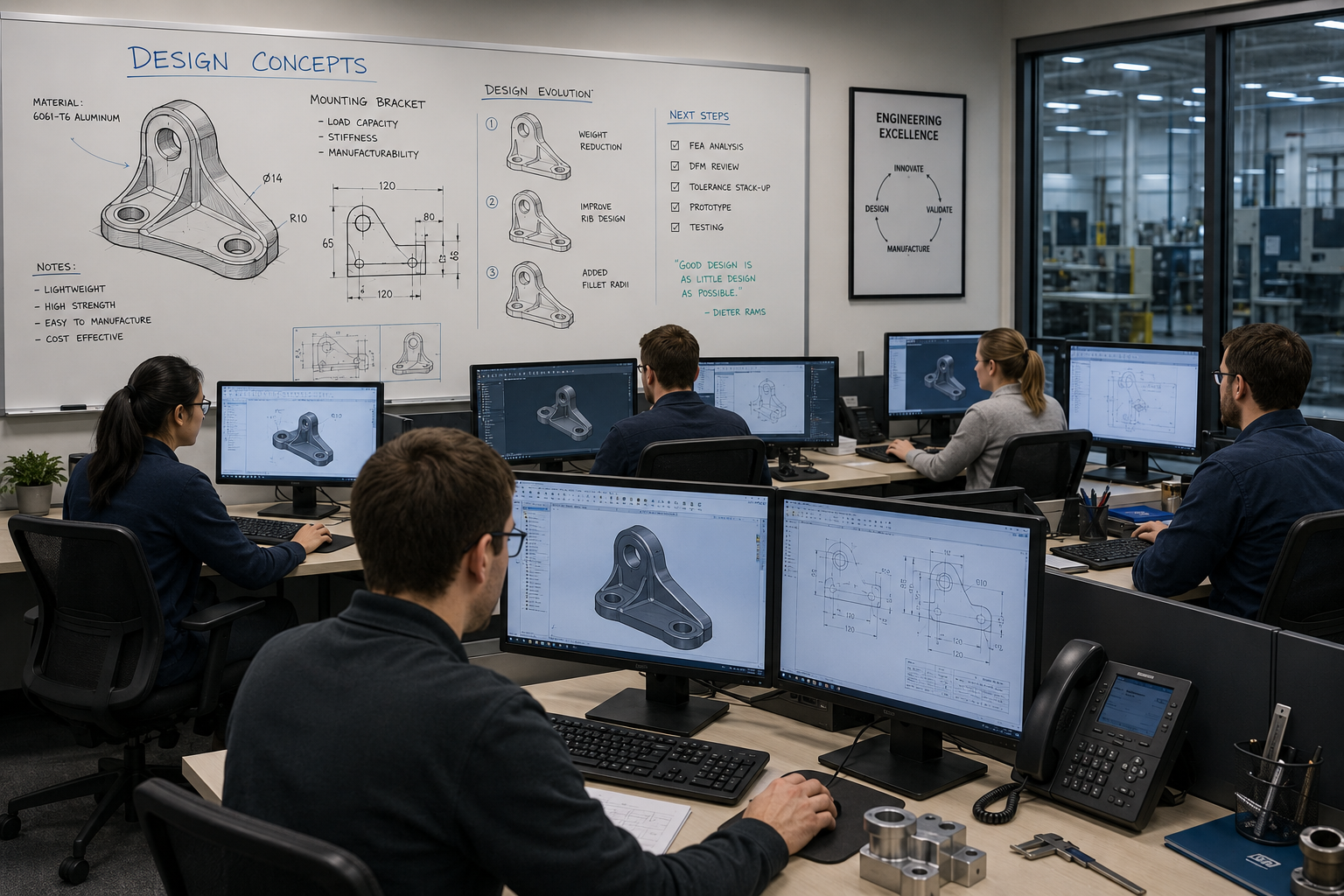
    'In-house CAD drafting team working at dual-monitor workstations with technical drawings displayed

    Genuine Advantages of an In-House Team

    • Contextual knowledge: An in-house drafter who has worked with your team for two years understands your design standards, preferred tolerances, drawing conventions, and client preferences without being told. This institutional knowledge has real value and is genuinely difficult to replicate with an outside provider.
    • Speed on urgent requests: When a last-minute client change comes in at 4 PM, an in-house drafter can respond immediately. Outsourcing introduces a communication and handoff step that adds time, even with the best partners.
    • Collaboration and iteration: When engineering design and CAD drafting happen in the same room (or on the same Slack channel), iteration cycles are faster. Engineers can sketch something on a whiteboard and a drafter can model it in real time.
    • Quality consistency: In-house teams develop consistent habits and standards over time. Drawing quality tends to be predictable once onboarding is complete.
    • IP security: Proprietary designs and sensitive technical data stay within your organization’s own infrastructure, under your own security policies.
    • Career investment: Building an in-house team allows you to develop people who grow with the business, take on more responsibility, and become genuine technical assets.

    Honest Disadvantages (That Articles Rarely Acknowledge)

    • Skills ceiling: A small in-house team’s expertise is bounded by who you hired. If a project requires specialized skills in, say, pressure vessel detailing or complex assembly animation, your team may simply not have that capability.
    • Single point of failure: One-person CAD teams are surprisingly common in small and mid-size firms. When that person is sick, on vacation, or resigns, the entire drafting workflow stops. This is a serious operational vulnerability.
    • Technology lag: Keeping an in-house team current on the latest CAD software versions, new BIM standards, and emerging tools requires dedicated investment in training. Busy teams often fall behind because there is never a ‘good time’ to upskill.
    • Recruiting difficulty: Skilled CAD drafters, particularly those with mechanical or structural specializations, are not always easy to hire. In markets with strong engineering employment, competition for qualified drafters is real.
    • Scalability limit: If a large project suddenly doubles your drafting workload for six months, an in-house team has limited ability to absorb the surge without significant overtime or delays.

    6. Outsourced CAD Drafting: Advantages and Honest Disadvantages

    Genuine Advantages of Outsourcing CAD Drafting

    • Cost flexibility: You pay only for the work performed, with no fixed overhead during slow periods. For businesses with irregular drafting workloads, this is a genuine and significant financial benefit.
    • Immediate access to specialization: Need BIM coordination drawings for a complex MEP project? Structural steel shop drawings for a one-off job? Outsourcing firms often have specialists in these areas ready to go, without the cost of maintaining those skills in-house year-round.
    • Scalability on demand: A reputable outsourcing firm can deploy multiple drafters to a large project simultaneously, compressing timelines in ways that a small in-house team simply cannot.
    • Around-the-clock production: Offshore partners in India or Southeast Asia can work while your team sleeps, creating a true follow-the-sun workflow that can significantly reduce project cycle times on deadline-driven engagements.
    • Access to current software: Established CAD outsourcing firms maintain current licenses across multiple platforms. You get access to those tools without carrying the license cost yourself.
    • Reduced management complexity: With a fixed-scope outsourcing arrangement, the provider manages their own team, quality control, and delivery. You own the brief and the outcome.

    Honest Disadvantages (That Deserve Direct Acknowledgment)

    • Communication overhead: Every instruction must be clearly documented. Ambiguities that would be resolved in 30 seconds face-to-face can become multi-day email chains with an offshore team. This is a manageable problem with good process, but it is a real one.
    • Time zone challenges: A 12-hour time zone difference means that a question asked at the end of your day may not be answered until the next morning. For fast-moving projects, this rhythm can create friction.
    • Knowledge transfer loss: Every time you use a new outsourcing partner, you start from scratch on standards and context. Switching partners frequently is inefficient and error-prone.
    • Quality control responsibility: With in-house work, quality problems surface naturally through daily interaction. With outsourcing, you need a deliberate QC process for every deliverable, or problems may not be caught until late in the project.
    • IP exposure: Proprietary designs are transmitted to external systems and sometimes to individuals in jurisdictions with different IP law frameworks. This is manageable but requires contractual and technical safeguards.
    • Dependency risk: If a key outsourcing partner loses staff, changes ownership, or closes, you may face a sudden gap in your drafting capability with no internal fallback.

    7. The Hybrid Model: Why the Best Answer Is Often ‘Both’

    One of the most significant gaps in the existing literature on this topic is the failure to address the hybrid model seriously. The framing of ‘in-house versus outsourced’ suggests these are mutually exclusive choices. They are not, and treating them as such leads many businesses to a suboptimal decision.

    The hybrid model involves maintaining a core in-house CAD capability while using outsourcing partners for specific, well-defined needs. This approach is increasingly common among mid-size engineering and architecture firms, and it often delivers better results than either pure model.

    What the Hybrid Model Looks Like in Practice

    • Core team for context-sensitive work: The in-house drafter or drafting team handles complex or confidential drawings, works directly with engineers and clients, manages document control, and builds institutional knowledge.
    • Outsourcing for volume overflow: During peak periods or large project surges, the outsourcing partner handles defined, standardized drafting tasks with a clear brief. This avoids overtime burn and hiring cycles.
    • Outsourcing for specialty disciplines: When a project requires a skill set not maintained in-house (BIM clash detection, 3D rendering, structural steel detailing), the outsourcing partner fills that gap without requiring permanent headcount.
    • In-house oversight of outsourced work: The in-house team serves as QC reviewers and project coordinators for the outsourced output, ensuring it meets your standards before it enters your workflow.
    Real-world example : A UK-based architectural firm maintains two in-house CAD technicians who handle all permit drawings and client-facing documentation. During planning submission seasons, they engage an outsourcing partner in the Philippines for as-built drawing production and drawing set formatting, reducing turnaround time by approximately one week without hiring additional permanent staff.

    When the Hybrid Model Makes the Most Sense

    • Workload pattern: If your drafting workload peaks predictably (end of quarter, permitting seasons, product launch cycles), hybrid is usually more cost-effective than pure in-house.
    • Confidentiality stratification: If some of your work is highly sensitive and some is routine, keeping the sensitive work in-house while outsourcing routine production is a natural and efficient division.
    • Growth stage: If your business is growing but not yet large enough to justify a full drafting department, a hybrid approach bridges the gap while you scale.

    8. Industry-Specific Guidance

    The right model varies by industry. The following guidelines reflect the practical norms and specific pressures of different sectors.

    IndustryTypical Best FitKey ReasonCommon Outsource Use Case
    Architecture / AECHybridHigh project volume with cyclical peaksAs-builts, permit sets, BIM modeling
    Mechanical / Product MfgIn-house or HybridIP sensitivity, tolerance precision, iteration speedOverflow drafting, 3D rendering
    Structural EngineeringHybridSpecialty detailing needs + standard productionSteel shop drawings, rebar detailing
    Civil EngineeringHybrid or OutsourceHigh drawing volume, standardized deliverablesSite plans, survey drawings, grading plans
    Defense / AerospaceIn-house onlyITAR and security restrictions (see below)N/A – regulatory prohibition
    MEP ContractingOutsource or HybridHigh drawing volume, tight marginsFabrication drawings, coordination drawings
    Medical DeviceIn-houseFDA design control, quality system requirementsTypically not outsourced for IP and regulatory reasons
    Construction ManagementOutsource or HybridProject-based, no sustained in-house needShop drawing review, record drawings

    A Note on ITAR and Export Control

    For US companies in defense, aerospace, or any program involving export-controlled technical data under ITAR (International Traffic in Arms Regulations), outsourcing CAD drafting to foreign nationals or overseas firms can constitute a violation of federal law without proper export licenses. ITAR restrictions apply to the sharing of technical drawings, not just physical items. If your projects involve defense hardware, munitions, or space systems, consult your legal counsel before considering any form of offshore outsourcing. The penalties for ITAR violations are severe.

    9. The Decision Framework: A Practical Scorecard

    Rather than leaving you with a list of considerations, this section gives you a structured scoring approach. Rate your business against each factor below using the scale provided, then total your score to see which model best fits your current situation.

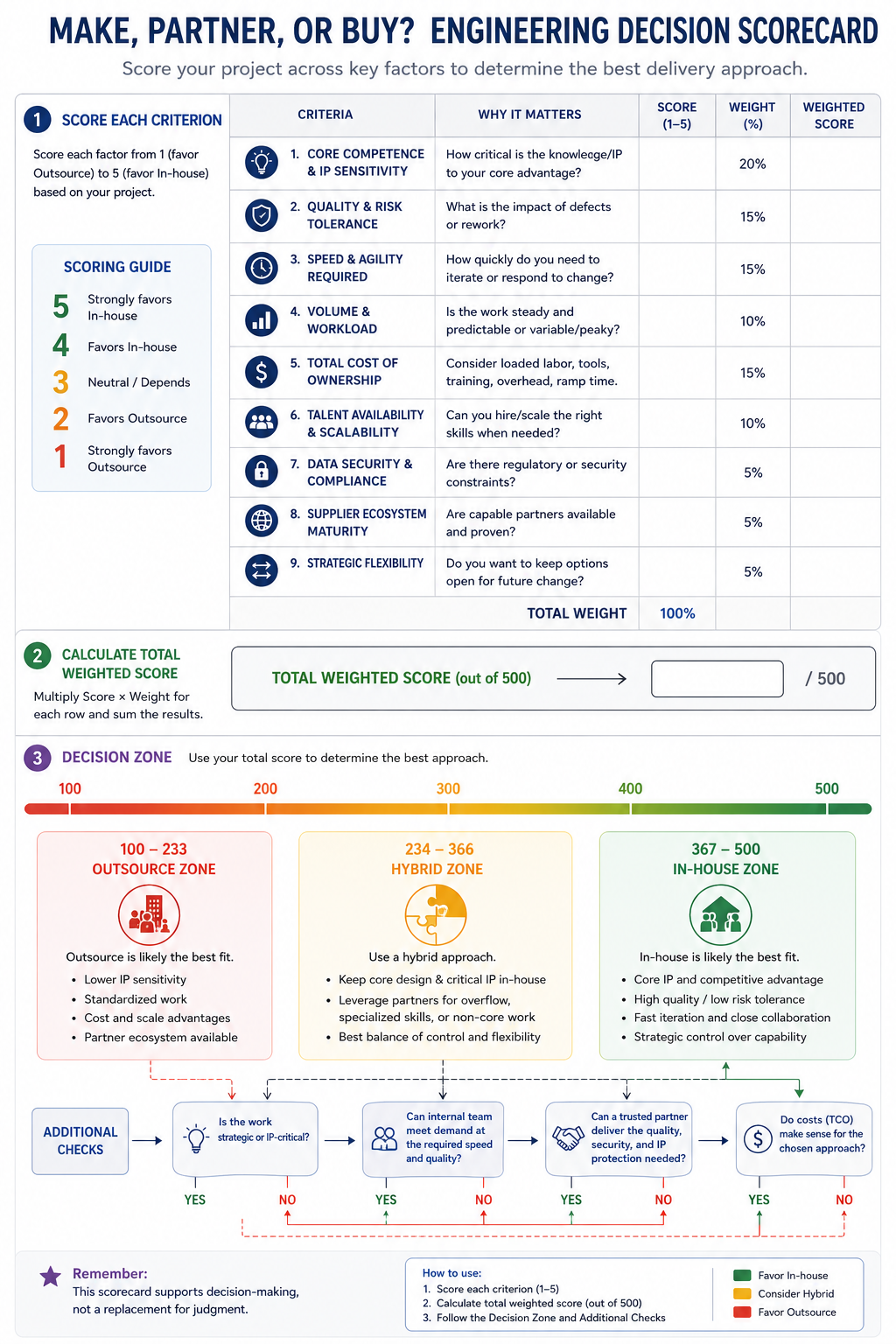
    CAD drafting decision scorecard flowchart showing in-house, hybrid, and outsourced zones based on business scoring'

    Scoring Guide: Rate Each Factor 1-3

    FactorScore 1 (Points to Outsource)Score 2 (Neutral / Hybrid)Score 3 (Points to In-House)
    Monthly drafting volumeLow (less than 40 hrs/month)Medium (40-120 hrs/month)High (120+ hrs/month)
    Workload consistencyHighly variable / project-basedSeasonal peaks and valleysConsistent year-round
    IP sensitivityLow sensitivity, generic drawingsMixed sensitivity levelsHigh sensitivity, proprietary designs
    Drawing complexityStandardized, repeatable tasksMixed complexityComplex, iterative, specialized
    Response time needsDays or weeks acceptableSame-day to 48 hoursHours – face-to-face access needed
    Budget constraintMinimize fixed overheadBalance cost and qualityCan justify fixed headcount cost
    Industry regulationNo special restrictionsSome compliance needsITAR / FDA / AS9100 restricted
    Internal oversight capacityLimited (no one to manage outsourcing)Some management bandwidthSufficient to manage internal team
    Interpretation: Total scores of 8-13 suggest outsourcing is likely the better fit. Scores of 14-19 suggest a hybrid model. Scores of 20-24 suggest in-house staffing makes the most business sense. Use this as a starting framework, not an absolute answer.

    The One Question That Clarifies Most Decisions

    If you find the scorecard ambiguous, ask yourself this: Is CAD drafting a core competency of our business, or is it a support function?

    If drafting is core to your value proposition (a custom fabrication shop that differentiates on drawing quality, a design-build firm that competes on speed-to-drawing), in-house capability is a strategic asset worth the investment. If drafting is a support function that enables your core work but is not the reason clients choose you, it is a strong candidate for outsourcing or hybrid treatment.

    10. How to Vet and Manage an Outsourcing Partner

    If your decision scorecard points toward outsourcing or a hybrid model, the quality of your outsourcing partner will determine whether the arrangement succeeds or fails. These are the criteria that experienced firms use when evaluating CAD outsourcing providers.

    Vetting Criteria

    1. Portfolio and samplesReview actual deliverables from previous clients in your industry. Look for drawing quality, layering conventions, title block formatting, and annotation standards. Generic portfolio samples that do not reflect your type of work are a warning sign.
    2. Industry specializationA firm that does mechanical engineering shop drawings every day will outperform a general drafting service on mechanical work. Ask specifically about their experience with your drawing type and industry.
    3. Software capabilitiesConfirm the firm uses current, licensed versions of the CAD software your workflow requires. Ask about file format delivery (DWG, DXF, STEP, native CAD, PDF). Mismatched file formats create unnecessary friction.
    4. Communication practicesAsk how they handle questions during a project. What is their typical response time? Do they assign a dedicated project manager or coordinator? Good communication infrastructure is predictive of successful engagements.
    5. Quality control processAsk specifically: what does your internal QC process look like before drawings are delivered? A firm that cannot describe its QC process does not have one.
    6. Data security practicesAsk about their data handling protocols. Do they use encrypted file transfer? Do they have NDAs with their own staff? Are drawings stored on isolated servers or on shared infrastructure?
    7. ReferencesAsk for references from clients with similar project types and follow up with at least one call. A simple 10-minute reference conversation reveals more than any portfolio.

    Managing an Outsourcing Partner Effectively

    • Create a drawing standards brief: Document your layer conventions, title block requirements, dimension and annotation standards, and file naming rules. Share this at the start of every new engagement and update it when your standards change.
    • Start with a paid pilot project: Do not commit to a large engagement without first running a smaller, lower-stakes project to evaluate the partner’s actual output quality. This is worth the extra time investment.
    • Establish clear communication rhythms: Agree on communication channels (email, Slack, a project management tool), response time expectations, and who the point of contact is on both sides.
    • Build a review and approval step: No outsourced drawing should enter your production workflow without a QC review by someone on your team. Build this step into your project schedule explicitly.
    • Define escalation paths: If a drawing is wrong, who gets contacted? What is the correction turnaround commitment? Agree on this upfront, before problems occur.

    11. Protecting Your Intellectual Property When You Outsource

    IP risk is the most frequently cited concern about CAD outsourcing, and the least frequently addressed in practical terms. Here is what actually needs to happen to protect your designs.

    Contractual Protections

    • Non-Disclosure Agreement (NDA): Require a signed NDA before sharing any project files. The NDA should explicitly cover technical drawings, design concepts, specifications, and client information. Verify that the NDA is enforceable in the jurisdiction of both parties.
    • IP ownership clause: Your contract should explicitly state that all drawings produced by the outsourcing partner are work-for-hire and that IP ownership transfers to your organization upon delivery and payment. Do not assume this by default.
    • Data handling and deletion clause: Specify that the outsourcing partner must delete all project files from their systems within a defined period after project completion (typically 30-60 days). Request confirmation of deletion.
    • Subcontracting restriction: Some outsourcing firms subcontract work to additional third parties without disclosure. Require written approval for any subcontracting, and ensure that subcontractors are bound by the same IP and confidentiality terms.

    Technical Protections

    • Use secure file transfer: Avoid emailing design files as attachments. Use encrypted file sharing platforms (ShareFile, Box with enterprise encryption, or a dedicated engineering file exchange portal).
    • Watermark preliminary files: For early-stage drawings shared for review or briefing, consider using visible or embedded watermarks that identify the recipient. This does not prevent copying, but it creates a paper trail.
    • Limit access to what is needed: Share only the files required for the specific task at hand. Do not provide access to your full project file library, BOM data, or client information unless directly necessary.
    • Consider physical data security requirements: For highly sensitive projects, some firms require outsourced drafters to work in isolated virtual desktop environments where files cannot be downloaded locally. This is common among defense-adjacent commercial work.

    12. Transition Tips: Changing Models Without Disruption

    Businesses change. An outsourcing arrangement that made sense when you were a 12-person firm may need to evolve when you grow to 50 people. An in-house team built during a period of strong growth may become difficult to justify during a contraction. Here is how to manage transitions well.

    Transitioning from Outsourcing to In-House

    • Capture standards documentation before you hire: Use your outsourcing period to develop and document your drawing standards, approval workflows, and file management processes. This documentation becomes the onboarding foundation for your first in-house hire.
    • Overlap the transition: Keep your outsourcing relationship active for 90-120 days after your in-house drafter starts. This provides overflow coverage while your new hire comes up to speed and ensures no projects are disrupted.
    • Transfer institutional knowledge: Request that your outsourcing partner provide organized project file archives in a format your new hire can navigate. A clean handover file structure is worth negotiating as part of the contract wind-down.

    Transitioning from In-House to Outsourcing

    • Document before departure: If an in-house drafter is leaving and you are transitioning to outsourcing, ensure that all drawing standards, template files, project archives, and process documentation are organized and preserved before they leave.
    • Run a parallel period: Engage your outsourcing partner while your in-house drafter is still available, even if only for a few weeks. This allows the outgoing drafter to review and provide feedback on the outsourced output quality before you are fully dependent on the new arrangement.
    • Rebuild standards documentation for external use: Standards that live in a drafter’s head need to be externalized. Invest time in creating a clear drawing standards package that can be shared with any outsourcing partner.

    FAQ: In-House vs Outsourced CAD Drafting

    Is outsourced CAD drafting cheaper than hiring in-house?

    In most cases, outsourcing is cheaper on a per-drawing or per-hour basis, particularly when comparing offshore rates to fully-loaded domestic employee costs. However, the total cost comparison is more complex than the hourly rate gap suggests. You need to account for management overhead, revision cycles, onboarding, and QA processes on the outsourcing side, and set this against the true all-in cost (not just salary) of an in-house hire. For businesses with consistent, high-volume drafting needs, in-house may reach cost parity with a well-managed outsourcing arrangement, with the added benefit of institutional knowledge and faster turnaround.

    What types of CAD work should never be outsourced?

    Defense and aerospace work covered by ITAR, medical device design subject to FDA design control requirements, and drawings containing highly sensitive proprietary technology (novel processes, pending patent designs, core product innovations) are strong candidates for in-house-only handling. Beyond regulatory requirements, any work where the feedback iteration cycle is so rapid and context-dependent that external handoffs would be genuinely disruptive is also better suited for in-house treatment.

    How do I maintain drawing quality standards with an outsourcing partner?

    Quality management with an outsourcing partner requires three things: a clear, documented drawing standards brief that is shared at the start of every engagement; an internal QC review step built into your project schedule before outsourced drawings enter production; and a consistent, respectful feedback loop that helps the partner improve their understanding of your expectations over time. The firms that struggle with outsourcing quality are usually those that provide inadequate briefing, skip the review step, or change partners too frequently to build institutional knowledge.

    Can a small business benefit from outsourcing CAD drafting?

    Yes, and small businesses are often the best-suited candidates for CAD outsourcing. A 10-person engineering consultancy rarely has enough consistent drafting work to justify a full-time drafter, but needs high-quality drawings regularly. Outsourcing allows small firms to access professional drafting on a project basis, with no fixed overhead, while keeping their limited capital focused on revenue-generating work. The key is finding a reliable partner and investing in the brief and QC process, which takes effort upfront but pays off repeatedly.

    What is the typical turnaround time for outsourced CAD drawings?

    Turnaround varies significantly by complexity, drawing type, and provider. For straightforward 2D AutoCAD drawings (floor plans, layouts, simple mechanical details), turnaround from a good offshore provider is typically 24 to 72 hours after briefing. Complex assembly drawings, 3D models, or BIM deliverables may take several days. Offshore time zones can work in your favor for turnaround: a brief sent at 5 PM US Eastern Time may be answered with draft drawings by 8 AM the next morning.

    How do I handle a situation where my outsourcing partner’s work is consistently below standard?

    First, review whether the quality problem is caused by inadequate briefing on your side or poor execution on theirs. Many quality disputes are actually briefing failures. If the brief is clear and comprehensive and the work is still falling short, have a direct conversation with the firm’s project manager citing specific examples. A good outsourcing firm will take quality feedback seriously and make corrections. If the problem persists across multiple projects and conversations, it is time to find a different partner. Do not continue to invest in a relationship that is not delivering consistent results.

    Conclusion: The Right Answer for Your Business

    There is no universal correct answer to the in-house versus outsourced CAD drafting question. What there is, is a correct answer for your specific business, your workload pattern, your budget structure, your IP sensitivity, and your growth stage.

    If your drafting work is consistent, confidential, fast-turnaround, and central to your competitive value, invest in building a strong in-house team. If your workload is variable, your sensitivity levels are mixed, and your need for specialized skills exceeds what a small team can maintain, a hybrid model will likely serve you better than either pure approach.

    The businesses that consistently succeed with outsourcing are not those who went looking for the cheapest option. They are those who treated their outsourcing partner as a professional relationship, invested in clear communication and standards, and built a QC process that caught problems early. The businesses that succeed with in-house teams are those who planned for the full cost of employment, built redundancy against the single-point-of-failure risk, and invested in keeping their team’s skills current.

    Use the scorecard in Section 9 as your starting point. Re-evaluate your model every one to two years as your business evolves. And if you are considering a change, the transition guidance in Section 12 will help you make the switch without disrupting the projects that depend on you.

    Ready to make the right call for your business?

    Explore our related guides on CAD document management, version control for engineering drawings, and PLM system selection to build a complete engineering operations framework for your organization.