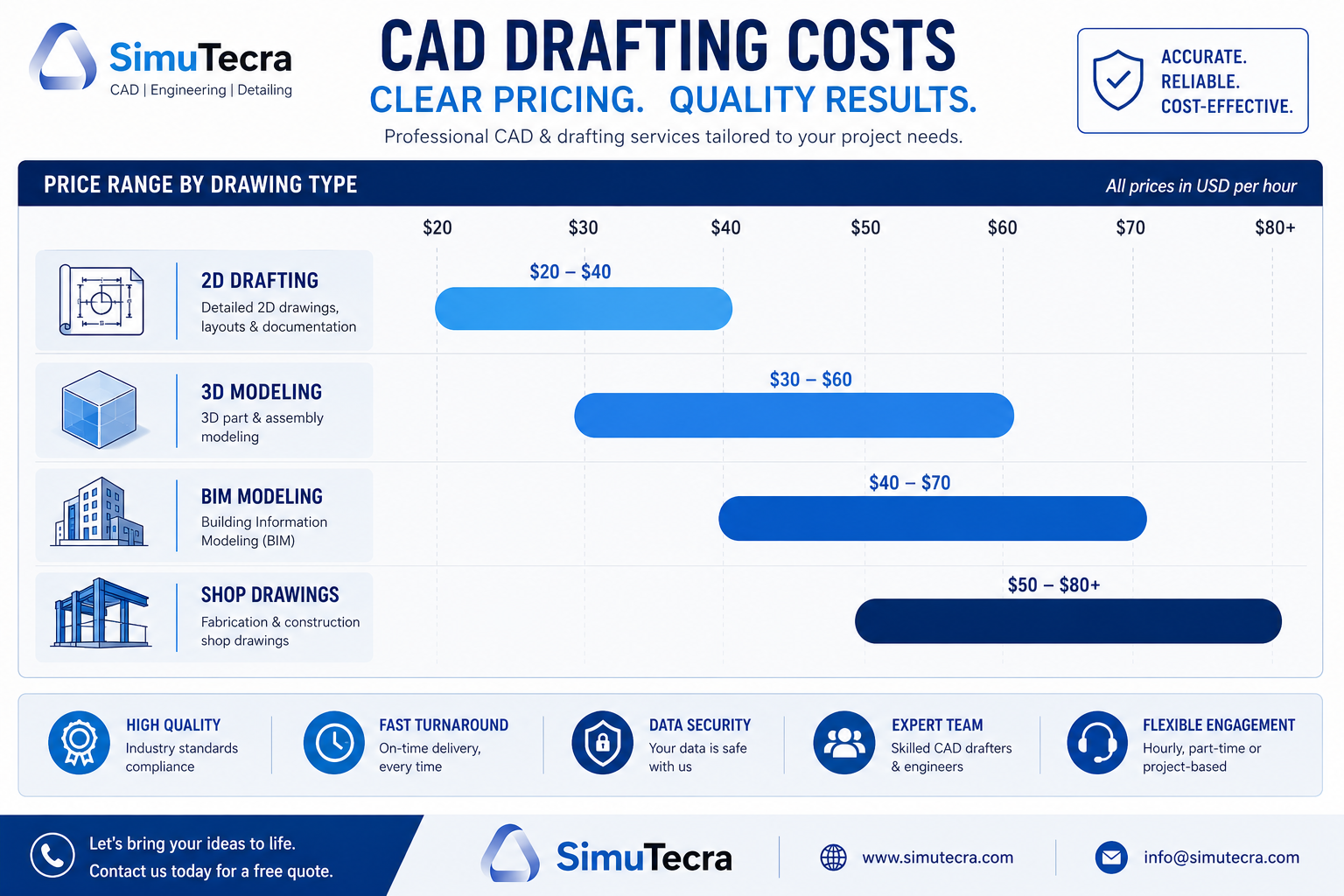
One of the most common questions engineering managers, architects, and small business owners ask when a new project lands on their desk is deceptively simple: what is this going to cost in drafting?
The honest answer is that CAD drafting costs span a wide range, from under $50 for a basic conversion task to well over $50,000 for a complex commercial construction drawing package. The range is not arbitrary. It reflects real differences in drawing complexity, drafter experience, project discipline, delivery speed, and where in the world the work is being done.
Most pricing articles on this topic give you a number and move on. This guide goes deeper. We break down costs by drawing type, discipline, pricing model, and provider category. We explain every factor that moves the price up or down. We include a practical budget-planning section and a red flag list for quotes that do not pass the smell test. By the end, you will know not just what CAD drafting costs, but why it costs what it does, and how to get better value from every dollar you spend.
| Quick Answer: CAD Drafting Cost at a Glance If you need a number right now, here is where most CAD drafting projects land based on current market data compiled from vendor pricing pages, industry surveys, and published rate data for 2026-2026: |
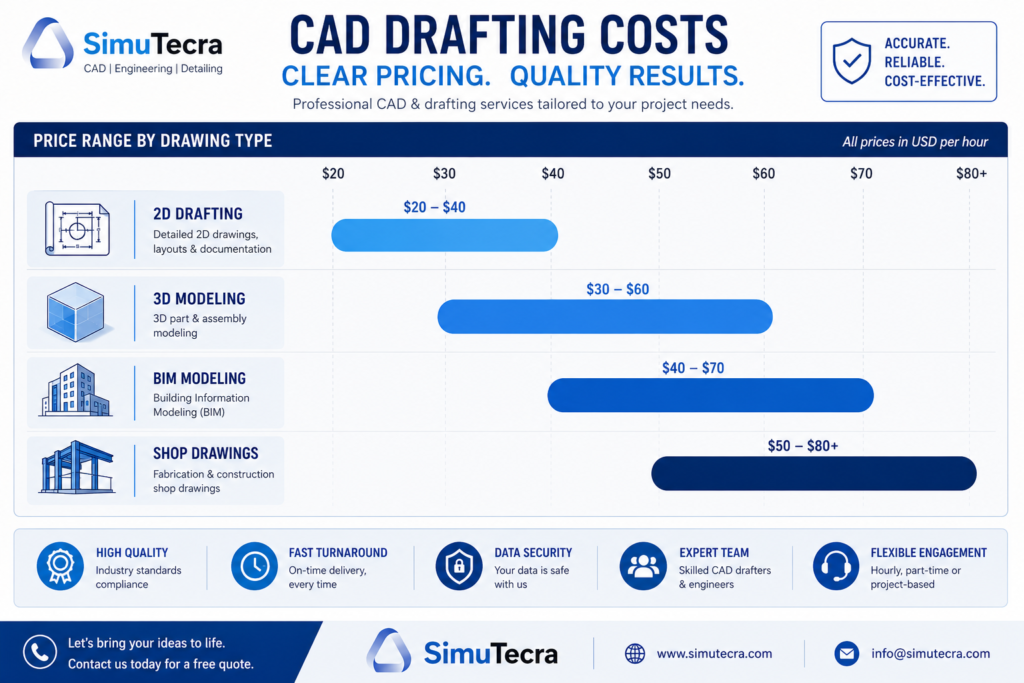
| Pricing Metric | Typical Range | Notes |
|---|---|---|
| Hourly rate (domestic freelancer) | $45 – $95/hr | Varies by discipline and experience |
| Hourly rate (domestic firm) | $75 – $150/hr | Includes overhead, QA, account management |
| Hourly rate (offshore firm) | $8 – $35/hr | Varies significantly by region and quality tier |
| Per-sheet rate (2D CAD conversion) | $45 – $250/sheet | Rush turnaround doubles or triples cost |
| Simple 2D drawing package | $150 – $800 | Single-page layouts, basic floor plans |
| Standard residential drawing set | $800 – $3,500 | Full permit-ready plans for a home |
| Commercial drafting package | $5,000 – $30,000+ | Multi-discipline, multi-sheet sets |
| 3D CAD model (single component) | $300 – $2,500 | Complexity and tolerance precision drive cost |
| BIM model (full building) | $8,000 – $50,000+ | Depends on LOD and number of disciplines |
| Monthly retainer (outsourced) | $1,200 – $6,000/mo | Dedicated or shared resource block |
| Important framing: These ranges reflect real market data, not optimistic estimates. The bottom of each range represents straightforward work from lower-cost providers. The top reflects complex, high-stakes deliverables from experienced domestic firms. Most real projects land somewhere in the middle. |
2. What Determines CAD Drafting Pricing? The 7 Core Variables
CAD drafting is not a commodity where one price fits all. Every quote you receive reflects a specific combination of the following factors. Understanding each one helps you assess whether a quote is fair, and gives you tools to control your costs.
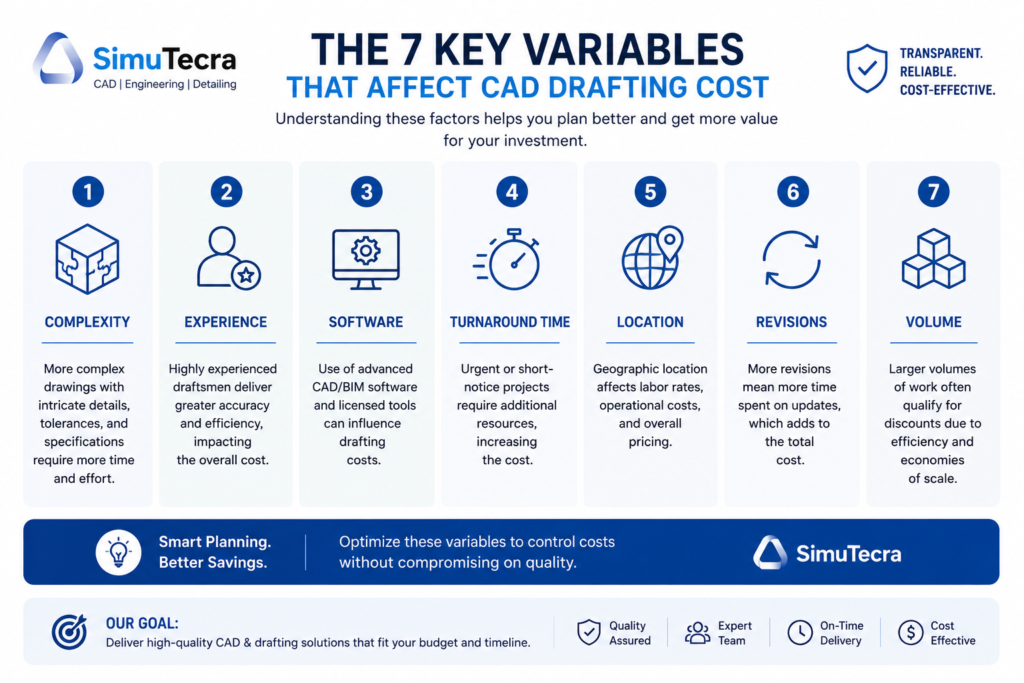
Variable 1: Drawing Complexity
Complexity is the single biggest cost driver in CAD drafting. A simple 2D floor plan redraw with clean linework and basic dimensions might take a skilled drafter three to five hours. The same space drawn with structural details, MEP coordination, material specifications, and permit-ready annotation can take fifteen to thirty hours. That difference directly multiplies your cost.
Complexity factors include the number of distinct components or rooms, the level of annotation and dimensioning required, whether the drawing needs to meet code compliance or permit submission standards, how many layers and disciplines must be coordinated, and whether 3D modeling or BIM data is involved alongside 2D output.
Variable 2: Drafter Experience and Specialization
An entry-level drafter working in AutoCAD LT will produce basic 2D layouts accurately and affordably. A senior mechanical engineer who also drafts will charge three to four times more per hour, but may deliver a complete SolidWorks assembly package with GD&T annotations, BOM, and manufacturing notes in a fraction of the time. Specialization commands a premium. Structural steel detailing, medical device drafting, aerospace documentation, and MEP coordination drawings all require expertise that general drafters do not have, and the market rates for specialists reflect that.
Variable 3: Software and Deliverable Format
The software platform matters both for capability and cost. An AutoCAD 2D drawing is the most common and typically the least expensive output. SolidWorks or CATIA 3D models involve more complex workflows and higher-cost software licenses, which factor into quoted rates. Revit BIM deliverables require BIM-trained professionals and carry a premium over standard CAD. If you require deliverables in a specific format (native DWG, STEP, IFC, PDF, DXF), or need files structured to a specific standard like ISO or AIA layering, mention this upfront, as non-standard requirements affect time and cost.
Variable 4: Turnaround Time
Rush work costs more, often significantly more. Most CAD drafting providers have tiered pricing based on delivery speed. Standard turnaround (5 to 10 business days) is typically the baseline rate. Three-day delivery often carries a 25 to 50 percent premium. Same-day or next-day delivery, when available, can double the base price. If your timeline is flexible, communicate that clearly. Some providers discount work with relaxed deadlines, using it to fill gaps between priority projects.
Variable 5: Provider Location
Where the drafting is done dramatically affects what you pay. A domestic US firm in a major metropolitan area will charge two to five times what an equivalent-quality offshore firm in India or the Philippines charges for the same drawing. The cost difference is real, but so are the tradeoffs in communication, time zone overlap, and IP handling. The pricing section on domestic versus offshore providers covers this in detail.
Variable 6: Number of Revisions
Revisions are a significant and often underestimated cost driver. Most drawing packages include a defined number of revision rounds in the base quote (commonly one or two rounds of minor changes). Changes beyond that scope are billed at the hourly rate, which can substantially increase total project cost. Poor upfront briefing is the main cause of excessive revision cycles. The clearer and more complete your design intent and specifications are at the start, the fewer revision rounds you will need.
Variable 7: Project Scale and Volume
Volume pricing is real. A single drawing sheet costs proportionally more than a batch of fifty similar sheets. If you have an ongoing, high-volume drafting need, most firms will offer a reduced per-sheet or per-hour rate in exchange for a committed volume or retainer arrangement. Conversely, minimum project charges (typically $150 to $250 for most firms) mean that very small one-off requests are often not worth outsourcing individually.
3. CAD Drafting Hourly Rates: A Realistic Breakdown
Hourly billing is the most transparent and flexible pricing model for CAD drafting, and it is the dominant model for iterative or undefined-scope work. Here is what the market looks like in 2026-2026 across provider types and experience levels.
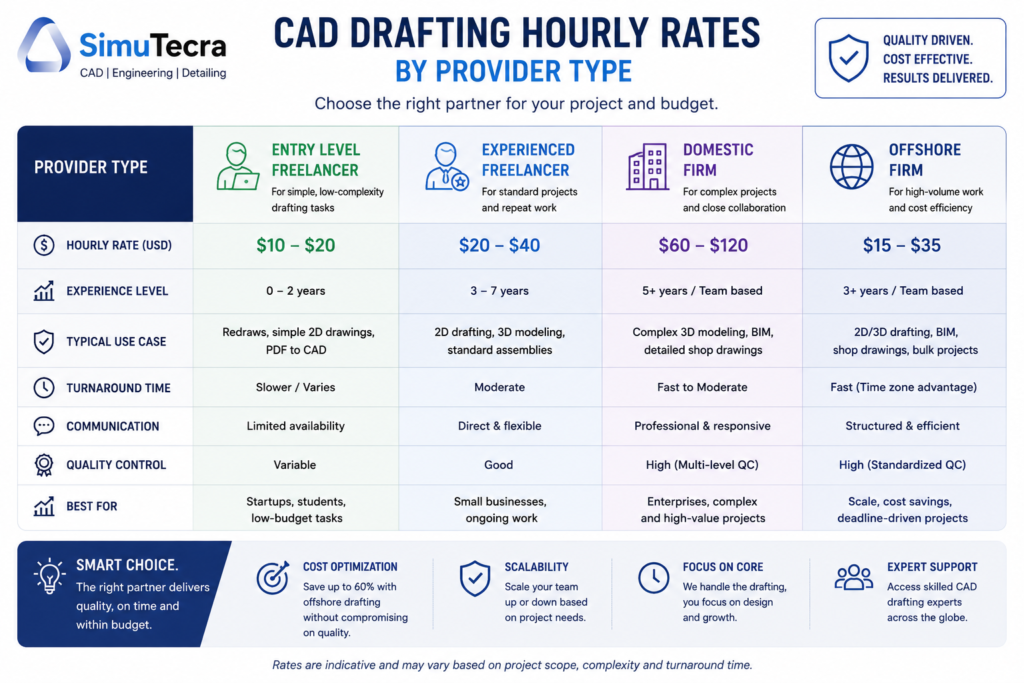
| Provider Type | Entry Level | Mid Level | Senior / Specialist | Notes |
|---|---|---|---|---|
| US Domestic Freelancer | $30 – $45/hr | $45 – $75/hr | $75 – $120/hr | Rates vary by discipline; structural and MEP specialists at the top |
| US Domestic Firm | $60 – $80/hr | $80 – $120/hr | $100 – $175/hr | Includes project management, QA, software overhead |
| UK / Western Europe Firm | £45 – £65/hr | £65 – £100/hr | £95 – £150/hr | Comparable to US in GBP; EU regulations familiarity a plus |
| Eastern Europe (Poland, Romania) | $20 – $35/hr | $35 – $55/hr | $50 – $80/hr | Strong technical quality; growing for BIM and complex drafting |
| India-Based Firm | $8 – $15/hr | $15 – $25/hr | $22 – $40/hr | Largest offshore talent pool; quality varies significantly |
| Philippines-Based Firm | $10 – $18/hr | $18 – $30/hr | $25 – $45/hr | Strong English proficiency; good AEC and MEP drafting capability |
What Is Included in an Hourly Rate?
When you hire a domestic firm at $100 per hour, you are not just paying for the drafter’s hands on a mouse. That rate typically covers:
- The drafter’s time and expertise
- Software license costs (AutoCAD at $1,975/year, Revit at $2,310/year, SolidWorks at $4,000+ per year)
- Internal quality review before delivery
- File management and delivery infrastructure
- Project management and communication overhead
- The firm’s business overhead including insurance, office, and administrative staff
When you hire a solo freelancer at $55 per hour, most of those costs are lower or absent, which explains the rate difference. Neither is inherently better — the right choice depends on your project’s complexity and what level of process and oversight you need.
4. Per-Sheet and Per-Project Pricing: When Each Makes Sense
Per-Sheet Pricing
Per-sheet pricing is common for CAD conversion work, PDF-to-DWG conversion, permit drawing sets, and other tasks where each sheet is a discrete, standardized deliverable. It is popular with clients because it is predictable: you know how many sheets you need, you multiply by the rate, and you have your budget.
| Drawing Sheet Type | Typical Per-Sheet Rate | Rush Multiplier | Notes |
|---|---|---|---|
| PDF to CAD conversion (basic) | $45 – $90/sheet | 2 – 3x | Simple linework, minimal annotation |
| PDF to CAD conversion (detailed) | $90 – $180/sheet | 2 – 4x | Full annotation, dimensions, notation |
| Architectural floor plan (new draw) | $150 – $350/sheet | 1.5 – 2x | Original drafting from sketches or notes |
| Structural detail sheet | $200 – $450/sheet | 1.5 – 2.5x | Includes member sizing, connection details |
| MEP (mechanical/electrical/plumbing) | $175 – $400/sheet | 1.5 – 3x | Coordination complexity adds cost |
| Shop drawing (fabrication) | $150 – $350/sheet | 1.5 – 2x | Weld symbols, tolerances, BOM |
| Civil site plan | $250 – $600/sheet | 1.5 – 2x | Survey data integration, grading, utilities |
| On rush pricing: One published provider (CAD/CAM Services) lists a flat rate of $185 per D or E size AutoCAD 2D sheet at standard turnaround. The same work at rush turnaround (24 hours) typically runs $370 to $550. Plan your deadlines accordingly. |
Per-Project (Fixed Fee) Pricing
Fixed-fee pricing works well when the scope is clearly defined and the deliverables are well-understood. The drafter agrees to produce a specific set of outputs for a set price. You get budget certainty; the drafter accepts the risk if the job takes longer than estimated.
Fixed-fee pricing is common for residential drawing packages, permit submission sets, and defined industrial or manufacturing drawing packages. It is less common for complex commercial or industrial projects where scope evolves during the engagement.
| Project Type | Typical Fixed-Fee Range | What Is Usually Included |
|---|---|---|
| Simple 2D drawing (single sheet) | $150 – $400 | Line conversion or basic redraw, one revision round |
| Small residential renovation drawings | $800 – $2,700 | Floor plans, elevations, basic sections for permit |
| Full custom home drawing set | $3,500 – $10,000+ | Full architectural set: plans, sections, elevations, details |
| Small commercial building (permit set) | $5,000 – $15,000 | Multi-discipline permit package, ADA compliance |
| Medium commercial / industrial | $15,000 – $35,000 | Full structural, MEP, architectural coordination |
| Large commercial or industrial project | $35,000 – $100,000+ | Multiple disciplines, extensive coordination, BIM deliverables |
| Product design (simple mechanical part) | $300 – $1,500 | 3D model, 2D drawing package, BOM |
| Product design (complex assembly) | $2,000 – $15,000+ | Multi-component assembly, GD&T, manufacturing drawings |
5. Cost by Drawing Type and Discipline
CAD drafting costs vary significantly across disciplines. The differences are not arbitrary: they reflect the level of specialized knowledge required, the complexity of applicable standards and codes, and the typical time investment per drawing.
Architectural CAD Drafting Costs
Architectural drafting is one of the most common CAD services and covers a wide range of work from basic floor plans to complex construction document sets. Costs are driven by the number of sheets, the level of detail, and whether permit submission formatting is required.
- Basic floor plan (single level): $300 – $800
- Full residential permit set (plans, elevations, sections, details): $1,500 – $5,000
- Commercial permit-ready drawing package: $8,000 – $30,000+
- As-built drawings (measured and drawn): $500 – $3,000 depending on size and complexity
- PDF to AutoCAD conversion (per sheet): $45 – $180
Architectural drafting rates for domestic freelancers average $75 to $125 per hour. This is substantially less than hiring a licensed architect, whose hourly rates run $200 to $400 per hour. For pure drafting work (translating a design into accurate CAD output), a skilled architectural drafter is the appropriate choice, not an architect.
Mechanical Engineering CAD Drafting Costs
Mechanical CAD drafting is where precision is paramount. Drawings must convey exact dimensions, tolerances, material specifications, and surface finish requirements in a format that machinists and fabricators can execute without ambiguity. This level of precision requires experienced drafters and commands higher rates than basic architectural work.
- Simple machined part (2D drawing): $150 – $600
- Complex machined part with GD&T: $400 – $1,500
- 3D solid model (single component): $300 – $2,000
- Sub-assembly drawing package: $800 – $4,000
- Full product assembly with BOM and exploded views: $2,000 – $15,000+
Mechanical CAD specialists in AutoCAD Mechanical, SolidWorks, or CATIA typically bill $65 to $120 per hour domestically. The premium over general drafting rates reflects the knowledge of manufacturing processes, GD&T standards (ASME Y14.5), and the criticality of getting tolerances right.
Structural Engineering CAD Drafting Costs
Structural drafting covers foundation plans, framing plans, structural steel details, rebar layouts, and connection details. It sits at the intersection of engineering judgment and drafting skill, meaning the best structural drafters have a solid understanding of structural behavior, not just drafting technique.
- Foundation plan: $400 – $1,200
- Structural steel shop drawings (per sheet): $200 – $450
- Rebar detailing drawings (per sheet): $150 – $350
- Full structural drawing package for a residential project: $1,500 – $4,000
- Commercial structural documentation package: $8,000 – $40,000+
Structural shop drawings are a category where outsourcing to specialized overseas firms is extremely common. Firms in India and the Philippines have built strong capabilities specifically in steel detailing and rebar drawings for US and UK markets, typically charging $15 to $30 per hour for what domestic firms bill at $90 to $150 per hour.
Civil Engineering CAD Drafting Costs
Civil CAD drafting covers site plans, grading plans, utility layouts, road designs, and land development drawings. Civil work often involves integration with survey data, GIS systems, and regulatory formatting requirements that vary by municipality.
- Basic site plan: $500 – $1,500
- Full land development drawing package: $3,000 – $15,000
- Road design drawings (per sheet): $300 – $700
- Utility layout drawings (per sheet): $200 – $500
- Civil 3D model (grading and drainage): $1,500 – $8,000
MEP (Mechanical, Electrical, Plumbing) Drafting Costs
MEP drafting is among the most complex and expensive CAD work because it requires coordination between three distinct systems, all of which must occupy the same physical building space without conflict. MEP drawings are increasingly produced in BIM to enable clash detection.
- HVAC layout drawing (per floor): $600 – $2,000
- Electrical layout drawing (per floor): $400 – $1,500
- Plumbing riser diagram: $300 – $900
- Full MEP coordination package for a commercial building: $15,000 – $60,000+
- BIM model with MEP coordination and clash detection: $20,000 – $80,000+
BIM Modeling Costs
Building Information Modeling (BIM) represents the highest tier of CAD-related drafting cost. BIM is not just drawing: it is a data-rich 3D model that carries information about every component in a building, including material properties, manufacturer data, maintenance requirements, and spatial relationships. The Level of Development (LOD) spec required significantly determines cost.
| BIM Level of Development | What It Includes | Typical Cost Impact |
|---|---|---|
| LOD 100 (Conceptual) | Massing and overall form only | Lowest cost; schematic only |
| LOD 200 (Approximate Geometry) | Generic elements, approximate sizes | Moderate cost; early design phase |
| LOD 300 (Specific Geometry) | Accurate dimensions, coordination-ready | Standard for permit/construction use |
| LOD 350 (Construction) | Interfaces with adjacent elements included | High cost; needed for fabrication coordination |
| LOD 400 (Fabrication) | Full fabrication and installation detail | Very high cost; used for prefab and shop drawing production |
| LOD 500 (As-Built) | Verified field conditions, actual installed state | Highest cost; full as-built documentation |
6. Domestic vs Offshore CAD Drafting: The Real Cost Comparison
The cost gap between domestic and offshore CAD drafting is large, and it is worth examining honestly rather than in generalities.
| Cost Factor | Domestic (US/UK) | Offshore (India/Philippines) | Notes |
|---|---|---|---|
| Hourly rate | $65 – $150/hr | $8 – $30/hr | 4 – 10x difference in base rate |
| Time zone overlap | Full overlap | Minimal (8 – 12 hrs difference) | Offshore requires asynchronous workflow |
| Communication friction | Low | Moderate to High | Depends on provider’s English proficiency and process maturity |
| Revision cycle time | Hours | 1 – 2 days | Time zone gap extends correction loops |
| IP risk level | Low | Moderate | Manageable with proper contracts; not eliminated |
| Drawing quality ceiling | Very high | High for standardized work, variable for complex | Best offshore firms deliver excellent output |
| Total effective cost (with mgmt overhead) | $75 – $160/hr est. | $20 – $55/hr est. | Offshore savings real but not as large as rate gap suggests |
The real saving: If a domestic firm charges $100/hr and an offshore firm charges $18/hr, your raw cost savings are 82%. But management overhead, revision cycles, and QA review typically consume 30 to 50% of those savings. Real net savings for well-managed offshore arrangements typically run 40 to 60% compared to equivalent domestic work. Still significant, but calibrate expectations honestly.
7. Freelancer vs Firm vs Outsourcing Agency: Pricing Differences
Beyond geography, the type of provider you hire shapes both cost and experience significantly.
| Provider Model | Hourly Range (Domestic) | Best For | Risk Factors |
|---|---|---|---|
| Solo freelancer | $30 – $95/hr | Well-defined projects, cost-conscious budgets | Single point of failure; limited capacity; inconsistent availability |
| Small specialist firm (2-10 people) | $65 – $130/hr | Mid-complexity projects needing some team depth | Limited surge capacity; still owner-dependent |
| Established CAD firm | $85 – $175/hr | Complex, multi-sheet, regulated-industry work | Highest cost; best process and accountability |
| Offshore outsourcing firm | $8 – $35/hr | Volume drafting, standardized work, cost reduction | Communication overhead; QA management required |
| Freelance platform (Upwork, Freelancer) | $15 – $80/hr | Quick tasks, price testing, low-stakes projects | Highly variable quality; no accountability structure |
| Retainer / dedicated resource | Negotiated monthly rate | Ongoing high-volume needs | Requires volume commitment; not flexible for sporadic work |
8. The Hidden Costs No One Talks About
The quoted price for a CAD drafting project is often not the final price. These additional costs catch clients off guard repeatedly, and they deserve direct attention.
Revision Costs Beyond Scope
Most quotes include one or two rounds of minor revisions. Changes beyond that, whether driven by a design change on your end or a misunderstanding in the brief, are billed at the hourly rate. On a complex drawing package, multiple out-of-scope revision cycles can easily add 20 to 40 percent to the original quote. The solution is a comprehensive brief at the start, not a fight with your provider at the end.
Format Conversion and File Compatibility
If your provider works in one software platform and you need files in another, expect conversion fees. DWG to DXF is simple. AutoCAD to CATIA native format is not. File format requirements should be specified clearly in the brief and confirmed as included in the quote. Discovering at delivery that your machine shop needs a STEP file when you were expecting DWG files is a costly surprise.
Minimum Project Fees
Most professional CAD drafting providers have minimum fees, typically between $150 and $250. A five-minute correction that takes 30 minutes of a drafter’s time, including file handling and delivery, may still cost you the minimum. For very small, frequent requests, a retainer arrangement or in-house capability is usually more economical than individual project billing.
Rush Premiums
Rush fees are real and significant. A drawing that costs $500 at standard turnaround may cost $800 to $1,200 at two-day delivery. For same-day or next-day delivery (when available), premiums of 100 percent or more are not unusual. If you find yourself frequently paying rush rates, the root problem is usually project planning and timeline management, not drafting capacity.
Back-and-Forth Communication Time
This cost is invisible but real. Every email thread chasing clarification, every video call to explain a markup, every iteration of a brief that was not clear the first time represents time you are paying for indirectly (in management overhead) or paying for directly (in revision billing). Investing 30 to 60 minutes in a thorough project brief almost always saves more time and money than it costs.
Software License Fees (When Applicable)
Some specialized deliverables require proprietary software licenses. If you need a Revit model and your preferred firm works in AutoCAD, either the firm will need to bring in a Revit resource (which costs more) or you will need to engage a different firm. Similarly, if you require CATIA or Creo deliverables, expect a reduced pool of providers and higher rates. Always specify required software in your brief.
| Cost trap: The single most expensive mistake in CAD drafting procurement is providing an incomplete brief and assuming the drafter will figure out the rest. Ambiguity in scope almost always resolves at your expense. |
9. How to Budget for a CAD Drafting Project
Accurate budget planning for CAD drafting requires more than looking up a price range. Here is a practical process that experienced project managers use.
Step 1: Define Your Deliverables Before You Ask for a Quote
Write down exactly what you need: how many drawing sheets, what views (plan, section, elevation, detail, isometric, 3D model), what software format, what layering standard, what annotation level, and what the final use will be (permit submission, fabrication, client presentation, internal reference). The more specific your scope, the more accurate your quote will be.
Step 2: Identify Your Drawing Type and Discipline
Use the cost ranges in Section 5 as your starting benchmark. Are you buying architectural, mechanical, structural, civil, or MEP drawings? Simple 2D or 3D? BIM or CAD? Each discipline and output type has a different cost baseline.
Step 3: Add a Revision Buffer
Whatever your base quote is, budget an additional 15 to 25 percent as a revision contingency. This is not pessimism; it is realistic planning. Design changes, client feedback, and engineering review comments are normal, and they generate revision work. If you use the full contingency, you accounted for it. If you do not, it is a pleasant surprise.
Step 4: Get Multiple Quotes and Compare Apples to Apples
Price alone does not tell you which quote is the best value. When comparing quotes, confirm that each includes the same deliverables (number of sheets, revision rounds, file formats), the same software, the same turnaround window, and the same QA process. A quote that looks 30 percent cheaper may include fewer revision rounds or exclude file format delivery in your required standard.
Step 5: Consider the Total Engagement Cost, Not Just the Hourly Rate
If you are evaluating an offshore option, account for your management time. If a $20/hr offshore provider requires three hours of your team’s coordination time per week that would not be needed with a domestic provider at $90/hr, the real cost difference is smaller than the rates suggest. Factor in communication overhead, QA review time, and revision cycle duration when comparing total engagement costs.
| Budget example: A small manufacturing firm needs a product redesign: 3D model of a new bracket assembly plus 2D manufacturing drawings for five components. Based on current market data, a domestic mid-level freelancer at $65/hr would likely complete this in 15 to 22 hours, putting total cost at $975 to $1,430. An offshore firm at $18/hr for similar complexity would quote $270 to $396, but factor in 4 to 6 hours of your team’s coordination and review time at your internal cost rate. The real offshore cost is likely $450 to $650, still a significant saving, but not the 80% discount the headline rate implies. |
10. Red Flags in CAD Drafting Quotes
Not every low quote is a bargain, and not every high quote is unjustified. These warning signs in a quote or provider relationship deserve attention before you commit.
- Vague scope acceptance: A provider who accepts your project brief without asking any clarifying questions does not fully understand the scope. Good providers ask about software requirements, layering standards, revision expectations, and deliverable formats upfront.
- Unusually low rates without explanation: If a quote is 50 percent below the market rate, ask why. It may reflect genuinely lower overhead (offshore team, minimal QA), or it may reflect inexperience, substandard software, or a plan to bill extensively for revisions.
- No portfolio in your discipline: A general CAD firm that has never done structural shop drawings is probably not the right choice for your structural shop drawing project. Ask for samples of work similar to yours before committing.
- No defined revision terms: If the quote does not specify how many revision rounds are included and what constitutes a billable change, you have no budget protection once the project starts.
- Resistance to NDA: Any provider that hesitates to sign a non-disclosure agreement for a project involving proprietary designs is a serious IP risk. A reputable firm will have a standard NDA ready.
- No QC process described: Ask directly: who reviews the drawings before they are delivered to you? If the answer is unclear or does not involve a second set of eyes, your QA burden just landed entirely on you.
- No example of their actual layering standards: A firm that cannot show you a sample drawing in their preferred layering convention before you commit may not have consistent standards, which means more rework aligning their output to your workflow.
11. How to Reduce Your CAD Drafting Costs Without Cutting Quality
There are legitimate ways to get better value from your CAD drafting budget. None of them involve choosing the cheapest provider regardless of capability.
- A thorough brief reduces revision cycles, which is the most controllable cost lever you have. Specify drawing types, view counts, standards, format, software, and final use. Drawings produced to a clear brief require fewer corrections.Write a complete project brief before requesting quotes
- Disorganized sketches, conflicting markup sets, and unclear source files slow the drafter down, and you pay for that time. Organize your inputs, resolve conflicts internally, and present a clear package.Provide organized input files
- Rush premiums are avoidable if you plan ahead. Build drafting time into your project schedule rather than treating it as a last-minute activity.Be flexible on turnaround when you can
- If you have a regular, predictable drafting volume, negotiate a monthly retainer rate. Most providers offer 10 to 20 percent below standard hourly rates for committed volume.Use retainer pricing for ongoing needs
- Keep complex, IP-sensitive, or fast-turnaround work with a domestic provider. Send standardized, well-defined, lower-risk work offshore. This captures most of the cost savings from offshore pricing while protecting your most sensitive projects.Consider a hybrid sourcing model
- Volume discounts are real. Instead of requesting five individual drawings one at a time, batch them into a single package. Per-unit cost drops, and provider efficiency increases.Batch similar work together
- A well-organized title block, layer standard, and annotation template that you provide to your provider eliminates the time they spend inferring or guessing your preferences. This speeds production and reduces errors.Invest in a good drawing standards template
Frequently Asked Questions
How much does a CAD drafter charge per hour?
In the United States, domestic freelance CAD drafters typically charge between $45 and $95 per hour depending on their experience and specialization. Established domestic firms charge $75 to $175 per hour inclusive of overhead, QA, and project management. Offshore firms in India and the Philippines charge $8 to $35 per hour for equivalent skill levels. Hourly rates for specialized disciplines (structural detailing, medical device documentation, aerospace drawings) fall at the upper end of each range.
How much does a single CAD drawing cost?
A single CAD drawing can cost anywhere from $45 for a simple PDF-to-DWG conversion to $600 or more for a complex mechanical drawing with full GD&T annotation and 3D model. A standard architectural floor plan sheet typically costs $150 to $350. Structural and MEP sheets generally run $175 to $450 each. The cost per sheet drops meaningfully when you order a full set rather than individual sheets.
How long does it take to produce a CAD drawing?
Time varies dramatically with complexity. A simple 2D layout redraw takes 3 to 6 hours. A standard architectural floor plan with annotation and dimensions takes 8 to 15 hours. A complex mechanical assembly model with associated 2D drawings can take 20 to 60 hours. A full construction document set for a residential project typically takes 40 to 120 hours of drafting time. Turnaround time in calendar days depends on how many hours the drafter can dedicate per day and their current workload.
Is it cheaper to hire a freelancer or a CAD firm?
A freelancer will almost always be cheaper on an hourly basis. But cheaper per hour does not always mean lower total project cost. Firms bring process discipline, QA review, project management, and the ability to replace a resource if your dedicated drafter is unavailable. For high-stakes, complex, or ongoing work, the overhead of a firm is often worth the premium. For well-defined, contained projects without regulatory requirements, a skilled freelancer can deliver excellent value.
Why do CAD drafting prices vary so much?
Because the work itself varies enormously. A simple 2D redraw of a clean sketch and a BIM coordination package for a 10-story commercial building are both called ‘CAD drafting,’ but they involve completely different skill levels, software platforms, time investments, and risk profiles. The price range reflects the reality of the work, not inconsistency in the market. When you understand which of the seven variables in Section 2 apply to your project, the price range for your specific situation narrows considerably.
What is the cheapest way to get CAD drafting done?
The cheapest option is typically an offshore firm in India or the Philippines with published hourly rates of $8 to $15 per hour. However, the cheapest option is not always the most cost-effective. Poor quality or misunderstood drawings that require extensive rework can cost more than a higher-priced provider who got it right the first time. The most cost-effective approach combines a well-written project brief (which you control), a provider who has experience with your drawing type, clear revision terms in the contract, and a defined QA review step before the drawings enter production.
Do CAD drafting services include revision rounds?
Most professional providers include one or two rounds of minor revisions in their base quote. ‘Minor revisions’ typically means corrections to the existing scope (fixing a dimension that was marked incorrectly, adjusting an annotation). Scope changes (adding a view that was not in the original brief, redesigning a component) are almost always billed additionally at the hourly rate. Clarify exactly what revision terms are included before you sign off on a quote.
Conclusion:
CAD drafting costs are not mysterious, but they are not one-size-fits-all either. The wide price range you encounter when researching this topic is real, and it reflects real differences in scope, discipline, complexity, provider type, and geography.
The most important insight in this guide is this: the cost of your CAD drafting project is more controllable than most clients realize. The biggest cost variable is not the provider’s rate. It is the clarity of your brief. An ambiguous or incomplete brief generates revision cycles, and revision cycles are the primary mechanism by which a well-priced project becomes an expensive one.
Invest time in defining your scope clearly. Match your provider choice to your project’s actual requirements rather than just choosing the cheapest rate. Build a revision buffer into your budget. And review the drawings before they enter your production workflow, not after they have already been used.
Do those things consistently, and you will get better results from every CAD drafting dollar you spend.
Ready to plan your next CAD drafting project?
Explore our related guides on in-house versus outsourced CAD drafting, version control for engineering drawings, and how to select the right CAD software platform for your team.