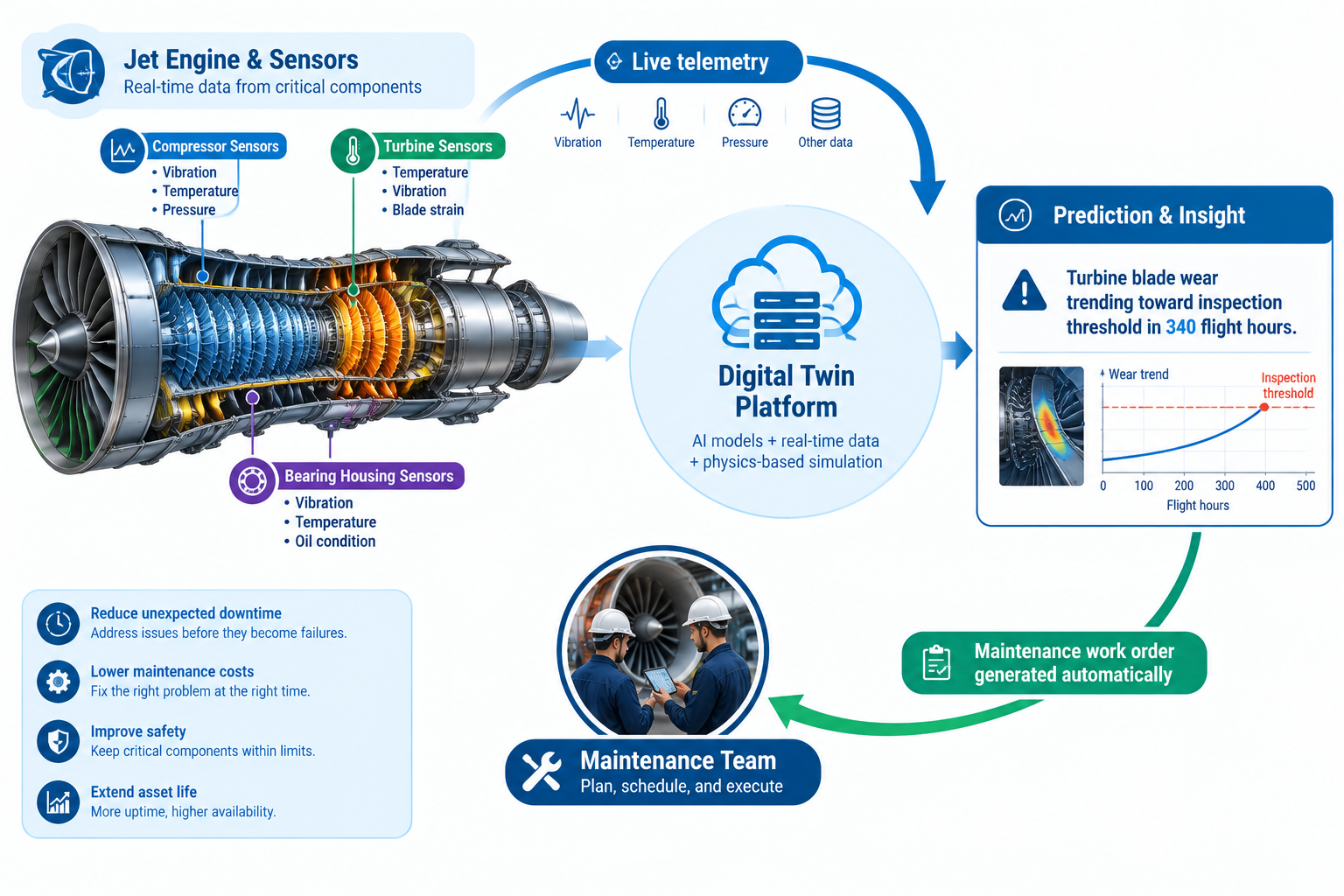
In 2016, an airline operating a fleet of wide-body aircraft began receiving automated alerts from its engine manufacturer’s digital twin platform. The alert flagged a specific engine, based on its individual vibration and temperature trend data, as likely to need a turbine inspection within roughly three hundred flight hours, well before any conventional maintenance trigger would have called for one.
The engine showed no fault codes, no crew-reported anomaly, and no single measurement outside normal operating limits. What the digital twin had detected was a subtle multi-variable trend, a gradual combination of slightly rising exhaust gas temperature and a slowly shifting vibration signature, that matched a pattern its analytics had learned from thousands of hours of fleet-wide historical data. That pattern typically preceded a specific type of turbine blade wear.
| Quick answer: The airline scheduled the inspection during a planned maintenance visit rather than waiting for the next scheduled overhaul. The inspection found blade wear consistent with the twin’s prediction, caught early enough for a routine repair instead of a far more extensive, costly intervention. This is the pattern that recurs across every engineering discipline covered here: a digital twin’s value comes not from modelling an asset in general, but from continuously comparing one specific, individually calibrated asset’s live behaviour against a model precise enough to catch deviations no fixed-threshold alarm or scheduled inspection would catch as early. |
What began as a specialised aerospace application has, over the past decade, spread across manufacturing, automotive, energy, process industries, medical devices, and civil infrastructure, each adapting the same underlying pattern to its own physical assets and failure modes. This article surveys those applications across six major engineering disciplines, the different scopes a digital twin can take, the technologies that make the pattern possible, and how the value shifts across an asset’s full lifecycle.
Digital Twin Applications Across Six Engineering Disciplines
The digital twin concept, a live, continuously updated model connected to a physical asset’s real operating data, applies across nearly every engineering discipline that produces or operates complex physical equipment.
| Industry | Typical Application | What Is Modelled | Value Delivered |
|---|---|---|---|
| Aerospace and jet engines | Individual engine performance twins tracking each serialised engine’s actual history against its design model | Turbine blade temperature, vibration signatures, fuel flow, bearing wear, thrust performance | Predictive maintenance that extends time-on-wing while reducing unplanned in-service failure risk |
| Automotive manufacturing and fleets | Production line twins; vehicle twins tracking individual or fleet-wide performance after sale | Robotic station cycle times and OEE; battery health, drivetrain performance, software state | Production throughput optimisation before physical changes are committed; predictive battery/component maintenance |
| Wind and renewable energy | Individual turbine twins modelling blade loading, gearbox condition, and generator performance | Blade strain, gearbox vibration/temperature, generator output, yaw/pitch control performance | Reduced unplanned downtime, extended gearbox/blade life, optimised energy yield |
| Oil, gas, and process manufacturing | Plant-wide process twins modelling pipelines, reactors, separators, and rotating equipment | Pressure, temperature, flow rates, and equipment condition for pumps, compressors, heat exchangers | Early detection of process upsets and equipment degradation before unplanned shutdown |
| Medical devices and healthcare equipment | Device-level twins tracking performance and remaining service life of individual clinical equipment | Usage cycles, calibration drift, component wear, fault codes per serialised device | Predictive maintenance reducing unplanned clinical equipment downtime |
| Civil infrastructure (bridges, rail, buildings) | Structural health monitoring twins tracking condition over operating life | Structural strain, vibration, displacement, and corrosion/fatigue at monitored points | Condition-based maintenance and inspection prioritisation; early warning of structural degradation |
Why Aerospace Led This Trend
Jet engines are extremely expensive individual assets, an unplanned in-service failure carries severe safety and cost consequences, engines are already densely instrumented for flight safety, and manufacturers typically retain a long-term maintenance relationship with each engine throughout its service life. That combination gave aerospace both the incentive and the data access to build a genuinely individualised twin for each serialised unit.
The 2016 turbine wear detection was only possible because the manufacturer had years of fleet-wide historical data across thousands of engines to train its predictive models against, a data advantage that took a decade of instrumented fleet operation to accumulate.
Wind energy, where turbines are similarly expensive, remotely located, and already instrumented for control purposes, adopted predictive digital twins relatively early for largely the same reasons. Industries with less individually expensive assets or a more fragmented ownership relationship have generally adopted more slowly, not because the technology doesn’t apply, but because the economic case and data foundation take longer to establish.
Five Scopes of Engineering Digital Twin: From Component to Fleet
Choosing the right scope for a given engineering problem is as important as choosing the right technology.
| Twin Scope | Description | Typical Example | Primary Use |
|---|---|---|---|
| Component twin | A single, individual component or part, tracking that specific unit’s condition and remaining life | A single turbine blade, a specific bearing, an individual battery cell | Life extension decisions and failure prediction for high-value or safety-critical components |
| Asset twin | A complete piece of equipment or product unit, integrating all component-level behaviour into one model | A specific jet engine, wind turbine, CT scanner, or vehicle | Predictive maintenance, warranty planning, performance benchmarking against fleet peers |
| System twin | A connected group of assets working together as a functional system | A production line, a power substation, a building’s HVAC system | System-level optimisation, bottleneck identification, coordinated maintenance planning |
| Process twin | An entire operational or manufacturing process spanning multiple systems and locations | A production facility’s full process, a refinery’s process flow, a hospital’s patient flow | End-to-end process optimisation, capacity planning, what-if scenario testing |
| Fleet / portfolio twin | Many individual assets of the same type, aggregating data to identify patterns across the population | An airline’s entire engine fleet, a utility’s wind farm portfolio | Fleet-wide maintenance strategy, comparative benchmarking, finding design/manufacturing issues |
Fleet Twins Reveal What Individual Asset Twins Cannot
A fleet or portfolio twin enables an insight no individual asset twin, however sophisticated, can produce alone: comparing many nominally identical assets against each other to find patterns only visible in aggregate. An individual wind turbine’s twin can tell an operator that a gearbox’s vibration signature has changed. Only a fleet-wide twin, comparing that signature against every other turbine of the same model, can reveal whether the change is part of a pattern affecting an entire manufacturing batch rather than an isolated unit issue, a distinction that fundamentally changes the appropriate response, from a single-unit repair to a fleet-wide inspection campaign.
The Technologies That Make Engineering Digital Twins Possible
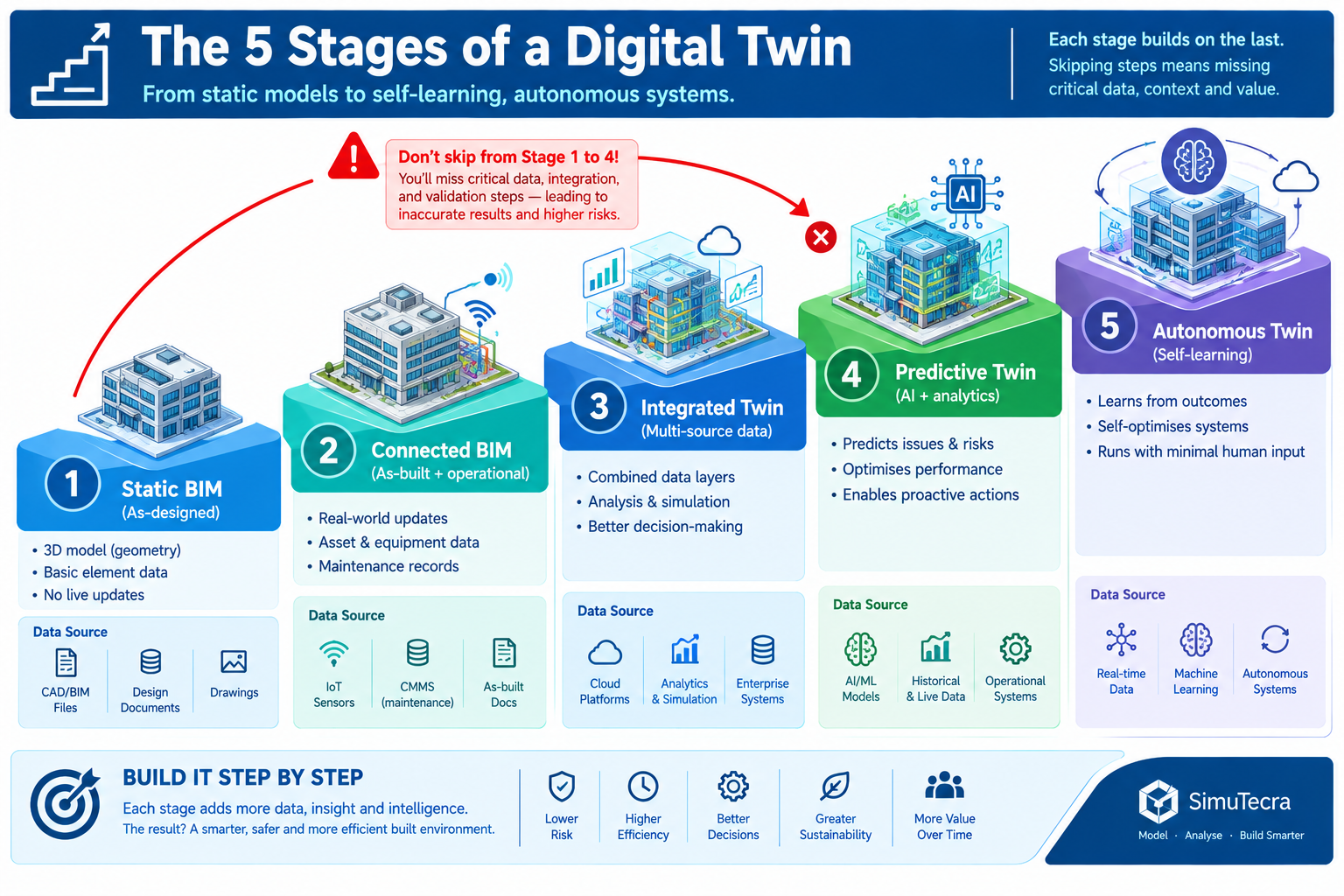
A digital twin is an integration of several distinct technologies, each contributing a different part of the sensor-to-prediction-to-action loop.
| Technology | Role | Why It Matters |
|---|---|---|
| IoT sensors and edge devices | Capture real-time physical data (temperature, vibration, pressure, strain, position) | Without sensor data, a twin is a simulation running on assumed conditions, not actual reality |
| Physics-based simulation models | Model how the asset should behave under given conditions, against which live data is compared | Can predict behaviour even in conditions not previously observed, which purely data-driven models can’t reliably do |
| AI and machine learning analytics | Identify patterns indicating developing faults and predict remaining useful life | Detects subtle, multi-variable degradation patterns no single sensor threshold would reveal |
| Cloud and edge computing infrastructure | Process and store the large data volumes a twin generates, and run analytics at the required speed | Fleet-scale twins generate demands that exceed what on-premises infrastructure alone typically supports |
| Digital thread and data integration platforms | Connect data across design, manufacturing, and operations | Supplies manufacturing context a twin with only operational data couldn’t access on its own |
| AR/VR visualisation | Gives technicians an immersive interface to interact with twin data in physical context | Reduces the interpretation gap between a data dashboard and a hands-on maintenance task |
Physics-Based Models and Machine Learning Are Complementary, Not Competing
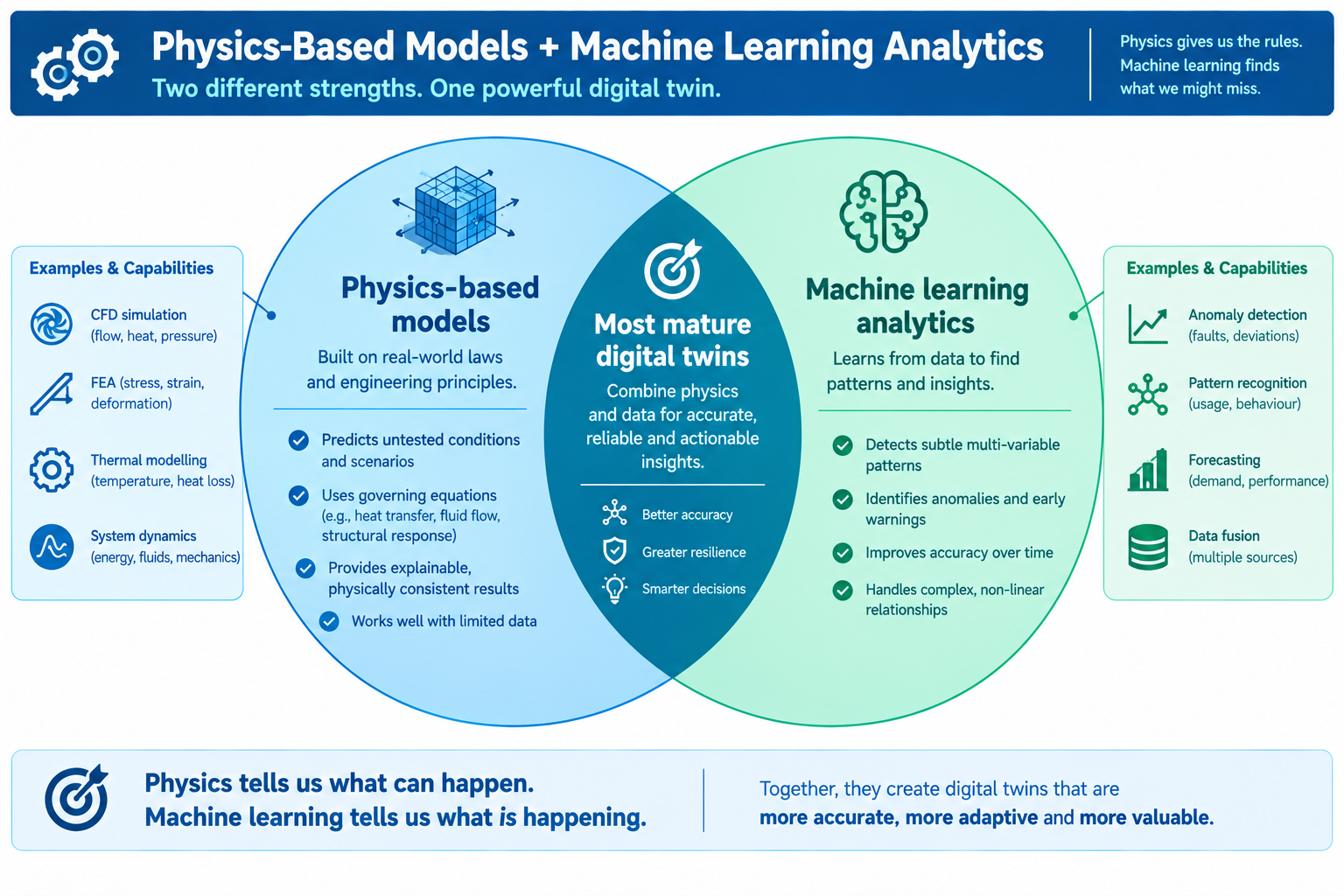
A common misconception treats physics-based simulation and machine learning as alternatives to choose between, when the most capable engineering twins use both together. Physics-based models, grounded in actual structural mechanics, thermodynamics, or fluid dynamics, predict behaviour reliably even under conditions the asset hasn’t previously experienced, essential for safety-critical prediction where waiting for a failure to occur in historical data first isn’t acceptable.
Machine learning, trained on accumulated sensor data, excels at detecting subtle, multi-variable patterns, like the combined exhaust temperature and vibration trend in the opening example, that would be extremely difficult to derive from first-principles physics alone. The most mature twins use a physics-based model as the foundation, with machine learning layered on top to surface patterns the physics model alone wouldn’t catch.
Digital Twin Value Across the Product Lifecycle
A digital twin’s value isn’t limited to operations and maintenance. A well-implemented strategy delivers distinct value at every stage of an asset’s life, from initial design through decommissioning.
| Lifecycle Stage | Digital Twin Use | Benefit |
|---|---|---|
| Design and engineering | A virtual prototype twin simulates performance under a wide range of conditions before any physical prototype is built | Reduces costly physical prototypes and catches issues while design changes are still inexpensive |
| Manufacturing and production | A process twin simulates and monitors the manufacturing line itself | Identifies bottlenecks and validates process changes before committing capital to physical reconfiguration |
| Commissioning and qualification | The twin is validated against the asset’s actual as-built and as-tested performance, establishing a baseline | Calibrates predictive models to the specific unit’s actual characteristics from day one |
| Operations and maintenance | The twin monitors live condition data and supports condition-based rather than purely time-based maintenance | Reduces unplanned downtime and avoids both premature and delayed interventions |
| Performance optimisation | Aggregated fleet or process data identifies underperforming assets or common failure modes | Surfaces systemic issues not visible from any single asset’s data alone |
| End-of-life and decommissioning | Accumulated condition history informs decommissioning, refurbishment, or life-extension decisions | Supports data-driven decisions based on verified condition rather than an assumed design life |
The Digital Thread: Connecting Value Across Lifecycle Stages
The full value of a digital twin strategy comes from connecting lifecycle stages through the digital thread: a continuous chain of data linking an asset’s design model, manufacturing and quality data, commissioning test results, and ongoing operational twin, all referencing the same specific unit. A digital thread lets an operations-stage anomaly be investigated against that exact unit’s original manufacturing data, not just a generic design spec, and lets lessons from operational data feed back into future design iterations. Organisations that implement digital twins at only one lifecycle stage, most commonly operations and maintenance, capture real value there but miss the larger, compounding value available from a continuous digital thread.
Worked Examples
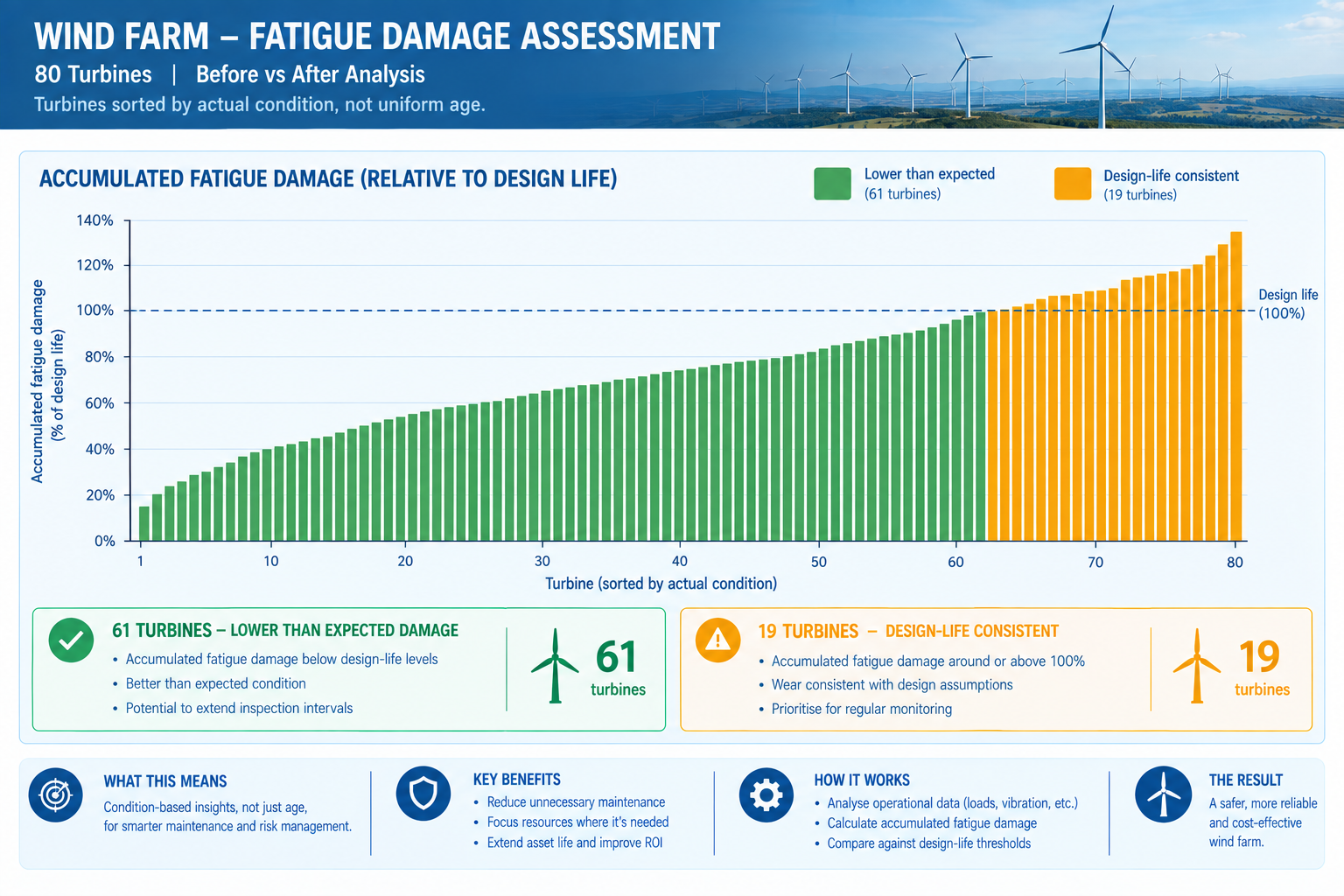
A wind farm operator’s gearbox life extension programme: An offshore wind farm operator managing 80 turbines faced a difficult economic decision midway through the farm’s operating life. The turbines’ gearboxes were approaching their original design life, and replacing them offshore, requiring a specialised heavy-lift vessel, was extremely expensive. Continuing to operate past design life without evidence of actual condition carried unacceptable failure risk on remote, hard-to-access equipment.
The operator implemented an asset-level predictive twin for each turbine’s gearbox, combining a physics-based fatigue model calibrated to each unit’s actual historical operating loads with vibration and oil-debris sensor data collected over the gearboxes’ operating history. The analysis found that 61 of the 80 gearboxes had accumulated meaningfully less fatigue damage than the original design-life assumption predicted, since actual site wind conditions were less severe than the conservative design assumption, while 19 showed elevated wear consistent with the original estimate.
The operator used this asset-by-asset evidence to extend the service life of the 61 lower-wear gearboxes by several years while prioritising the expensive heavy-lift vessel mobilisation specifically for the 19 turbines the data showed genuinely needed it, avoiding a costly farm-wide replacement programme based on a generic design-life assumption the twin’s individualised data showed was overly conservative for most of the fleet.
An automotive manufacturer’s production line reconfiguration: An automotive manufacturer needed to reconfigure an existing production line to build a new electric vehicle model alongside its existing internal-combustion model, a change carrying significant capital cost and schedule risk if the reconfigured line’s throughput missed the production targets the business case depended on.
The manufacturing engineering team built a system-level process twin of the proposed reconfigured line, combining a discrete-event simulation of the proposed station layout and cycle times with actual throughput and downtime data from the existing line’s current operation, calibrating the simulation against real, not assumed, station performance.
The simulation identified that the proposed reconfiguration would create a bottleneck at the battery pack installation station, reducing overall throughput enough to miss the production target, a finding the team addressed by relocating one buffer station and adjusting sequencing before any physical construction began. Testing the change in the process twin rather than discovering the bottleneck after physical reconfiguration avoided what the team estimated as a costly mid-programme rework of the physical line layout.
Frequently Asked Questions
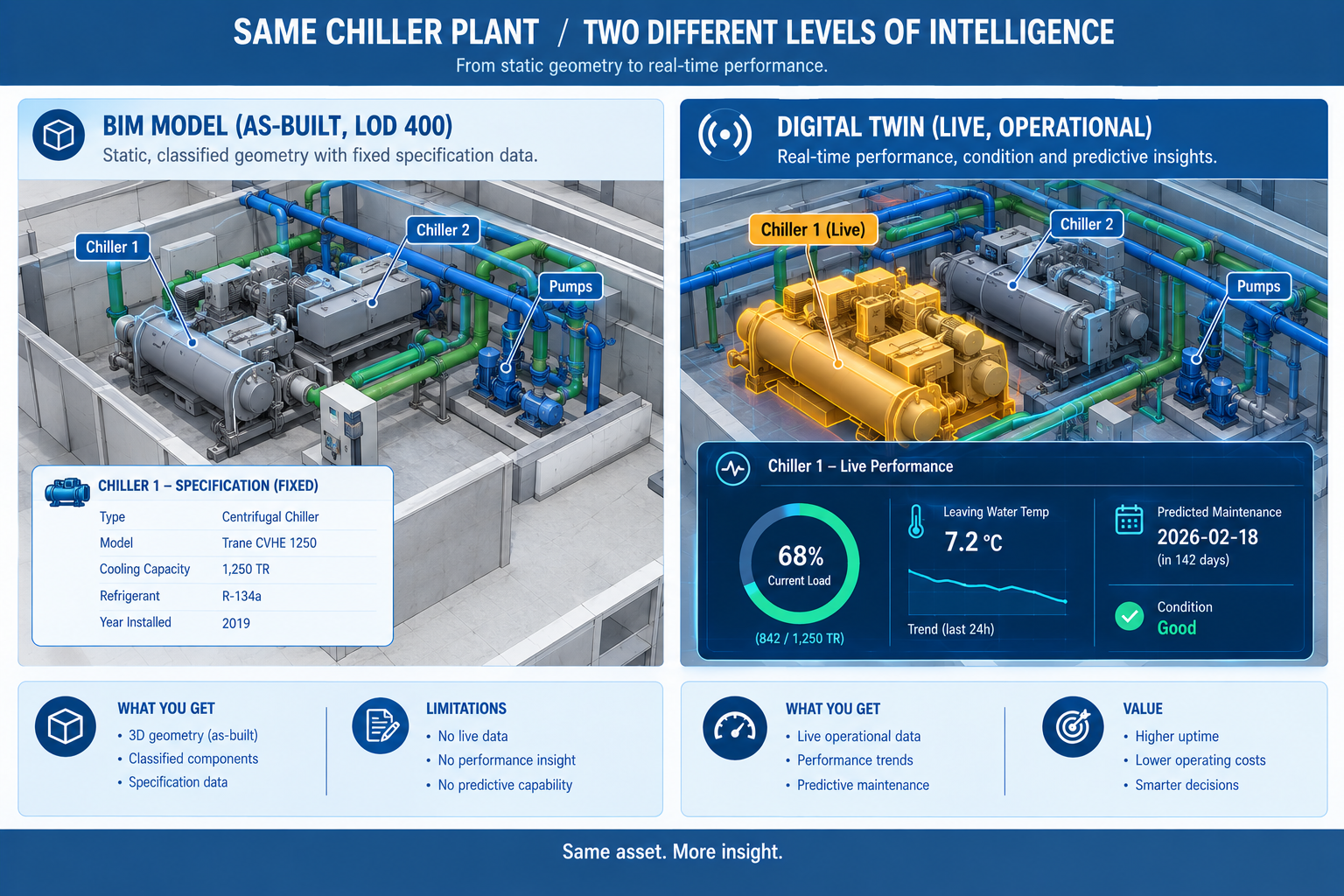
What is the difference between a digital twin and a traditional engineering simulation? A traditional simulation models a generic representative design under assumed conditions, run once or periodically. A digital twin is tied to a specific, individual physical asset, continuously updated with that asset’s actual live operating data throughout its operating life, not a single point-in-time analysis.
Which industries benefit most from digital twin technology? Industries with individually expensive or safety-critical assets, meaningful consequences from unplanned failure, feasible sensor instrumentation, and a long enough asset life to justify the investment. Aerospace, wind energy, process manufacturing, and medical devices score highly on all four factors.
Do digital twins require a huge upfront data science investment to get started? Not necessarily. Meaningful value can be captured starting with a monitored twin, live data visualisation and threshold-based alerting, well before investing in machine learning. Many successful programmes start with a narrow, high-value pilot and expand as the programme demonstrates value.
How is a digital twin kept accurate over an asset’s operating life? Through ongoing calibration, not a one-time setup. As an asset ages or is repaired, its behaviour can drift from the twin’s original model unless periodically recalibrated against verified real-world measurements, such as post-repair commissioning tests. Twins combining physics-based models with machine learning have some self-correcting capacity, but major recalibration points should still be actively managed.
What is the biggest obstacle to scaling a digital twin from a pilot to a full fleet? Data integration and standardisation, not the modelling technology itself. A pilot twin often depends on sensor configurations and manual calibration steps specific to that one asset, which don’t scale cleanly to hundreds of additional assets without a standardised data architecture. Organisations that plan for fleet-wide deployment from the start of the pilot scale more successfully.
Key Takeaways
The 2016 turbine wear detection, the wind farm’s gearbox life extension programme, and the automotive manufacturer’s production line reconfiguration all rest on the same underlying mechanism: live data from a specific physical asset, compared continuously against a model precise enough to detect meaningful deviation, feeding a prediction that changes a real engineering decision before an unplanned failure or costly rework occurs.
What differs across the six industries surveyed here isn’t the mechanism but its application, turbine blades instead of gearbox teeth, exhaust gas temperature instead of vibration signature, each industry adapting the same sensor-to-model-to-action loop, a concept formalised by the Digital Twin Consortium, to its own physical assets and failure modes.
This is why digital twin technology has spread so quickly from its aerospace origins into manufacturing, energy, process industries, medical devices, and civil infrastructure: the underlying pattern is genuinely general-purpose, and the industries adopting it earliest are simply the ones where the economic case, expensive assets, severe failure consequences, available instrumentation, was clearest first.
As sensor costs continue to fall and machine learning tooling matures, that same economic case extends to a widening range of assets and industries, following the same progression from monitored to predictive twins, at a pace set by each industry’s own asset economics rather than any inherent limit in the technology.
Engineering organisations evaluating where to apply digital twin technology are best served by starting where this article’s examples started: a specific, individually significant asset or process, a clear failure mode or optimisation problem worth solving, and a realistic assessment of what data is already available versus what instrumentation investment would be needed, rather than pursuing a digital twin as a general technology initiative disconnected from a concrete engineering problem it’s meant to solve.