Tag: engineering mechanics

  • Mechanical Engineering Careers and Industries (2026)

    Mechanical Engineering Careers and Industries (2026)

    Few engineering disciplines can match the career versatility of mechanical engineering. A mechanical engineer can begin their career designing automotive powertrains, spend a decade in oil and gas, transition into renewable energy, consult across multiple industries, and retire as a technical director in medical devices, all with the same foundational degree. No other engineering qualification opens as many doors across as many industries.

    The challenge, for students and early-career engineers especially, is navigating that breadth intelligently. With so many mechanical engineering career paths available, and with the profession changing faster than at any point in the past century, making informed decisions about which industry to enter, which specialisation to develop, and how to progress strategically requires reliable, current, and comprehensive information.

    This guide provides exactly that. It covers all 12 major industries that employ mechanical engineers, with real salary data from the U.S. Bureau of Labor Statistics (BLS), typical roles, work environments, growth outlook, and major employers. It maps the complete career progression from graduate engineer to engineering director. It compares salaries globally. It explains how to pivot between industries. And it answers the questions engineers actually ask when planning their careers.

    Key Data Point:  According to the U.S. Bureau of Labor Statistics, 293,000+ mechanical engineers are currently employed in the United States. The profession is projected to grow 9 percent from 2024 to 2034 (much faster than average), generating approximately 18,100 new job openings annually. The median annual wage was $102,320 in May 2024, with the top 10 percent earning over $161,240. The highest-paying single industry for mechanical engineers is oil and gas extraction at a median of $195,700 per year.

    Why Mechanical Engineering Career Choice Matters More Than Most Engineers Realise

    The industry you enter as a mechanical engineer shapes far more than your immediate salary. It determines the technical problems you work on, the pace of professional development, the stability of your income through economic cycles, the ceiling on your long-term earnings, and even your quality of life outside of work. Industry choice is arguably the single most consequential career decision a mechanical engineer makes, yet it is often made almost casually, based on which company happened to offer an internship or which graduate scheme had the best signing bonus.

    The data tells a clear story: median mechanical engineer salaries vary by a factor of nearly two across industries, from around $93,000 to $180,000+ in the US, depending on sector. A mechanical engineer who spends 20 years in a lower-paying sector, even with strong performance and regular promotions, may never reach the starting salary of a counterpart who chose a premium industry from the outset.

    At the same time, higher pay is not always the right metric. Some of the highest-paying industries (oil and gas, nuclear) also have the most demanding work environments, the most geographic constraints, and the greatest exposure to commodity price cycles. Some of the most personally rewarding specialisations (medical devices, educational robotics, sustainable engineering) do not top the salary tables. Understanding the full picture, across pay, growth, stability, work environment, and personal fit, is what this guide is designed to provide.

    Salary by Industry: The Master Table Every ME Should Study

    The following table presents mechanical engineer salary data by industry sourced from the U.S. Bureau of Labor Statistics (BLS) Occupational Employment and Wage Statistics survey, May 2024. This is the most authoritative and comprehensive salary dataset available for the US engineering job market.
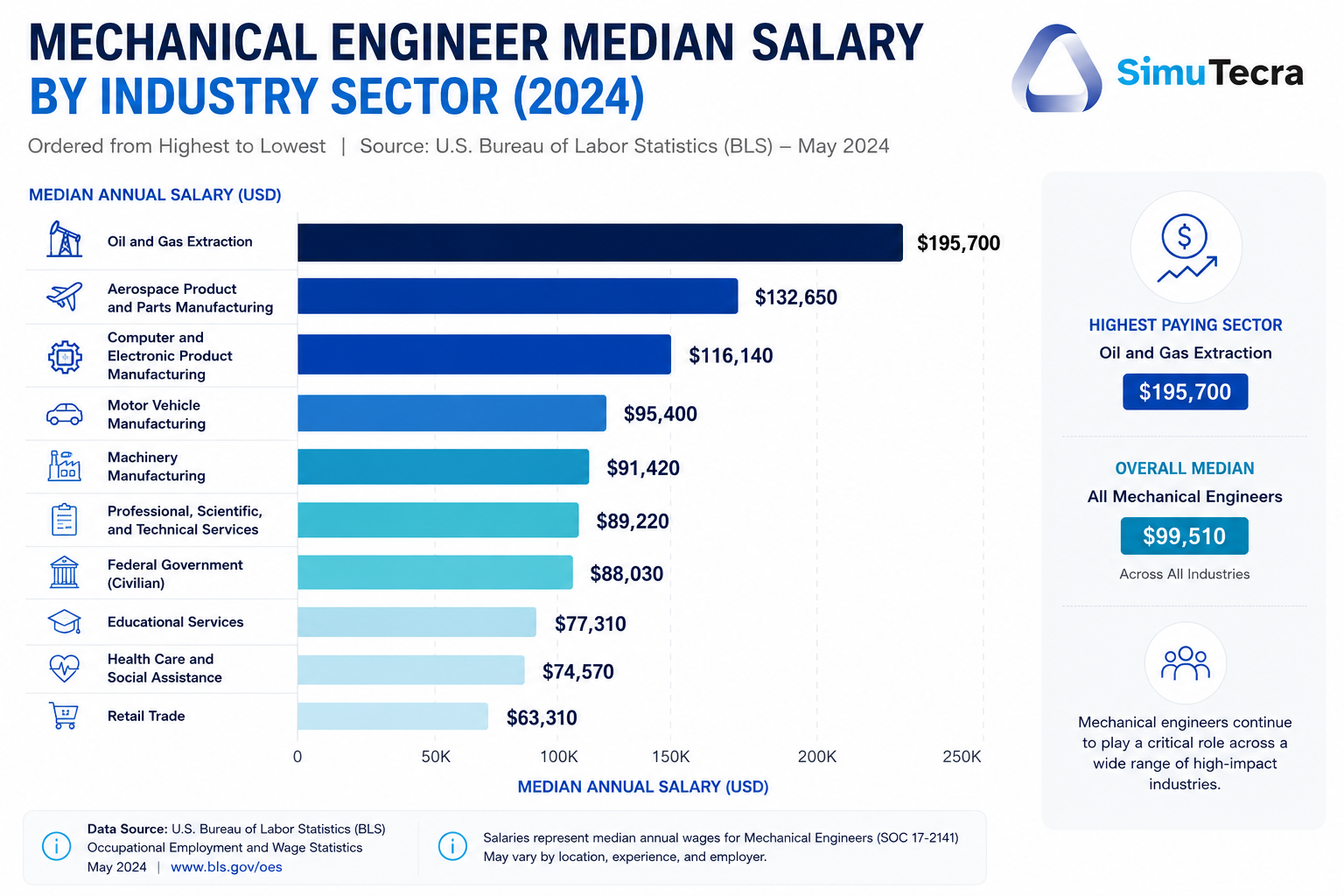
    Bar chart showing mechanical engineer median annual salary by industry from highest-paying oil and gas sector to manufacturing, based on BLS 2024 data
    Industry SectorMedian Annual Wage (US, 2024)Employment Level10-Year Growth OutlookEntry-Level Salary Range
    Oil and Gas Extraction$195,700~4,800 MEsModerate; offset by energy transition risk$85,000 – $105,000
    Solar Electric Power Generation$167,170Growing rapidlyVery strong through 2035$72,000 – $90,000
    Natural Gas Distribution$145,920StableModerate; transitioning to hydrogen$75,000 – $92,000
    Nuclear Electric Power Generation$137,810Stable to growing (new reactor programmes)Strong with nuclear renaissance$78,000 – $95,000
    Semiconductor and Electronic Components$107,890~14,000+ MEsStrong: CHIPS Act investment driving growth$75,000 – $92,000
    Transportation Equipment Manufacturing$103,210~29,000 MEsStrong; EV transition reshaping roles$68,000 – $82,000
    Aerospace and Defence$100,000 – $115,000*~50,000+ MEsSteady; commercial space driving new demand$70,000 – $85,000
    Architecture, Engineering Services$102,990~52,000 MEs (largest single employer)Strong; multi-industry consulting growth$65,000 – $80,000
    Medical Devices and Instruments$95,000 – $110,000*~20,000 MEsVery strong; ageing population and robotics$68,000 – $82,000
    Machinery Manufacturing$96,690~41,000 MEsSteady; automation integration driving change$62,000 – $76,000
    HVAC and Building Services$85,000 – $98,000*~15,000 MEsStrong; net-zero building requirements$58,000 – $72,000
    Robotics and Automation OEMs$95,000 – $115,000*Rapidly growingVery strong; fastest growing sector$68,000 – $82,000

    *Ranges marked with asterisk are estimated from BLS industry-adjacent codes and ASME salary survey data where specific BLS codes do not precisely match these sectors. All other figures are BLS OEWS May 2024 data for SOC 17-2141 (Mechanical Engineers).

    Important Context:  US salary data does not translate directly to other markets. A mechanical engineer earning $103,000 in the US might earn GBP 55,000 in the UK, EUR 75,000 in Germany, or AUD 110,000 in Australia. Each market has different cost-of-living profiles, tax structures, and industry concentrations. The international comparison section later in this article covers these differences in detail.

    Industry 1: Automotive Engineering

    The automotive industry is one of the largest and most historically prominent employers of mechanical engineers, and it is currently in the middle of its most significant transformation since the invention of the internal combustion engine. Automotive mechanical engineering is simultaneously losing traditional ICE roles and creating new ones in EV powertrain, battery thermal management, lightweighting, and autonomous systems engineering at a rate that is reshaping the entire talent landscape.

    What Automotive MEs Work On

    • Powertrain engineering: Engine and transmission design (ICE), electric motor and inverter integration, hybrid system development
    • Chassis and suspension: Structural design, ride and handling optimisation, NVH (noise, vibration, harshness) analysis
    • Battery thermal management: Cooling system design for lithium-ion and solid-state battery packs
    • Lightweighting: Advanced aluminium alloys, carbon fibre composites, topology-optimised structures to offset EV battery mass
    • Safety and crashworthiness: FEA-based crash simulation, regulatory homologation (NCAP, FMVSS)

    Work Environment and Culture

    Automotive engineering ranges from fast-paced, competitive OEM environments (Ford, GM, Stellantis, Toyota, BMW, Volkswagen) to Tier 1 supplier roles (Bosch, Continental, Aptiv, BorgWarner) and fast-growing EV startups (Tesla, Rivian, Lucid, NIO). OEM roles tend to offer structured development programs, defined processes, and exposure to complex multi-disciplinary projects. Startup automotive roles offer more autonomy, faster learning, and equity upside at higher personal risk.

    By 2030, 40 percent of automotive engineering jobs are projected to require expertise in EV powertrains and AI-driven diagnostics according to industry analysis. Engineers who understand both mechanical fundamentals and battery electrochemistry basics, thermal management, and electric motor integration are in the strongest position.

    Industry 2: Aerospace and Defence

    Aerospace engineering is widely regarded as the most technically demanding and professionally prestigious application of mechanical engineering. It consistently ranks among the highest-paying industries for mechanical engineers and offers exposure to the most rigorous structural analysis, thermal engineering, and precision manufacturing challenges in the profession.

    What Aerospace MEs Work On

    • Structural analysis: FEA-based stress and fatigue analysis of airframes, wings, and pressure vessels to meet FAA/EASA airworthiness standards
    • Propulsion systems: Gas turbine component design, combustor development, turbine blade cooling, additive manufactured engine parts
    • Thermal management: Aircraft environmental control systems, avionics cooling, re-entry thermal protection systems for space vehicles
    • Mechanisms and actuation: Landing gear, flight control surfaces, cargo handling systems, docking mechanisms for space vehicles
    • Reusable launch vehicles: Structural design, propellant system engineering, thermal protection, and landing system design for commercial space

    Key Employers and Locations

    Major aerospace employers include Boeing, Airbus, Lockheed Martin, Northrop Grumman, Raytheon, BAE Systems, Rolls-Royce, GE Aerospace, Safran, SpaceX, Blue Origin, and hundreds of Tier 1 and Tier 2 suppliers. Geographic concentrations in the US include Seattle, Southern California, Houston, and Huntsville. In Europe, Toulouse, Hamburg, Bristol, and Munich are primary aerospace hubs.

    The commercial space sector, valued at approximately $630 billion in 2024, is creating a new category of aerospace mechanical engineering jobs focused on reusable rockets, satellite constellations, and in-orbit servicing, areas with significant demand for engineers who combine structural and thermal expertise with an appetite for rapid development cycles.

    Industry 3: Energy (Oil, Gas, and Renewables)

    The energy sector is the single highest-paying industry for mechanical engineers in the US and one of the most rapidly transforming. Oil and gas extraction pays a median of $195,700 for MEs, while solar electric power generation pays a median of $167,170. Both figures significantly exceed the all-industry ME median of $102,320, reflecting the technical complexity, physical remoteness, and high-consequence nature of energy engineering work.

    Oil and Gas: Still the Highest Payer

    Mechanical engineers in oil and gas work on drilling systems, wellhead equipment, pipeline integrity, compression and processing facilities, and offshore platform structures. The premium pay reflects demanding work environments (offshore rotation, remote onshore facilities), high safety requirements, and the commercial value of engineering decisions in an industry measured in billions of dollars. Required expertise includes ASME pressure vessel codes, API standards, corrosion engineering, and rotating equipment design. Engineers considering this path should weigh the premium pay against long-term career risk as the energy transition progresses.

    Renewables: The Fastest Growing Energy Sector

    The renewable energy sector employed mechanical engineers at 35 percent of its total workforce according to 2026 industry data, with solar alone supporting approximately 263,000 engineering jobs in the US. Mechanical engineers in renewables work on wind turbine structural design and drivetrain engineering, solar tracker mechanisms and mounting system structures, offshore wind foundation design, energy storage thermal management, and hydrogen production and storage systems. Federal clean energy investment is driving sustained and rapidly growing demand, with the IEA projecting renewable energy investment to reach $1.74 trillion in 2026.

    Industry 4: Manufacturing and Industrial Automation

    Manufacturing employs more mechanical engineers than any other single sector, accounting for approximately 50 percent of all ME employment in the US according to the BLS. Within manufacturing, machinery manufacturing alone employs 41,000 mechanical engineers and transportation equipment manufacturing employs a further 29,000. Industrial automation, driven by the reshoring of manufacturing to the US and Europe and by Industry 4.0 investment, is one of the fastest-growing sub-sectors.

    What Manufacturing MEs Work On

    • Process engineering: Designing and optimising production processes, selecting and specifying manufacturing equipment, implementing lean manufacturing
    • Tooling and fixture design: CNC machining fixtures, press tools, injection moulding tools, assembly jigs
    • Quality engineering: Statistical process control, measurement system analysis, GD&T, coordinate measuring machine (CMM) programming
    • Automation integration: Robotic cell design, cobot integration, conveyor and handling system engineering
    • DFM/DFA consultation: Reviewing designs from product development for manufacturability and assembly efficiency

    The manufacturing industry is projected to have 2.1 million unfilled jobs by 2030 due to a skills gap, according to Deloitte and the Manufacturing Institute. Mechanical engineers with automation and robotics integration skills are particularly scarce and command premiums of 10 to 20 percent above conventional manufacturing ME roles.

    Industry 5: Medical Devices and Biomedical Engineering

    The medical device industry is one of the most technically demanding and personally rewarding sectors for mechanical engineers. Products must meet the same level of structural and functional reliability as aerospace components, operate in the most hostile chemical environment possible (the human body), navigate complex regulatory pathways including FDA 510(k) and PMA submissions in the US and CE marking in Europe, and often be designed to the smallest possible size and mass.

    What Medical Device MEs Work On

    • Implantable device design: Orthopaedic implants, cardiovascular devices (stents, heart valves, pacemaker housings), spinal implants
    • Surgical instrument and robot design: Laparoscopic tools, surgical robot mechanisms, robotic actuator systems (da Vinci, Medtronic Hugo)
    • Diagnostic equipment: MRI bore structures, CT gantry mechanisms, ultrasound transducer housings
    • Wearable and ingestible devices: Drug delivery systems, continuous monitoring devices, remote patient monitoring hardware
    • Verification and validation (V&V): Mechanical testing to FDA standards, fatigue life testing, accelerated aging

    Major employers include Medtronic, Boston Scientific, Abbott, Stryker, Zimmer Biomet, BD (Becton Dickinson), Intuitive Surgical, Edwards Lifesciences, and Philips Healthcare. Geographic hubs include the Minneapolis-St Paul medical device corridor, Boston’s Route 128 corridor, and the San Francisco Bay Area. Knowledge of FDA Design Controls (21 CFR Part 820) and ISO 13485 quality management is essentially mandatory for experienced roles in this sector and adds a meaningful salary premium.

    Industry 6: Robotics and Advanced Automation

    Robotics is the fastest-growing employer of mechanical engineers globally, driven by the convergence of falling component costs, expanding AI capabilities, and mounting demand for automation in logistics, healthcare, agriculture, and construction. The global industrial robotics market reached $48 billion in 2024 and is projected to exceed $100 billion by 2030 according to the International Federation of Robotics (IFR).

    What Robotics MEs Work On

    • Robot structural design: Frame and link design for articulated, SCARA, delta, and collaborative robots
    • Actuator and joint engineering: Harmonic drives, torque sensors, cable-driven mechanisms, soft pneumatic actuators
    • End effector design: Grippers, tool changers, welding torches, dispensing heads
    • AMR design: Autonomous mobile robot chassis, wheel modules, suspension systems, LiDAR mounting structures
    • Mechanism design: Four-bar linkages, cam mechanisms, compliant mechanisms for precision motion

    The World Economic Forum’s Future of Jobs Report 2026 identified robotics, automation, and mechatronics as the most important knowledge areas for manufacturing sector engineers over the next 10 years. Mechanical engineers with Python programming skills alongside mechanical design expertise command salary premiums of 15 to 25 percent.

    Industry 7: HVAC and Building Services Engineering

    Heating, Ventilation, and Air Conditioning (HVAC) engineering applies thermodynamics and fluid mechanics to control the thermal environment of buildings, data centres, hospitals, industrial facilities, and transportation systems. Given that buildings account for approximately 40 percent of global energy consumption, HVAC engineers are at the front line of the global decarbonisation effort.

    HVAC roles generally offer some of the best work-life balance in mechanical engineering: work is predominantly office-based, projects follow predictable cycles, and demand is stable across economic cycles because buildings always require thermal management. Salary is below the top-paying industries but competitive, and demand is being boosted by net-zero building regulations that are requiring significant HVAC system upgrades across existing building stock globally.

    Key employers include major MEP (Mechanical, Electrical, Plumbing) consultancies including Arup, WSP, Jacobs, AECOM, Atkins, and Thornton Tomasetti, alongside equipment manufacturers including Carrier, Trane, Daikin, Johnson Controls, and Honeywell.

    Industry 8: Semiconductor and Electronics Manufacturing Equipment

    The semiconductor equipment industry is one of the most technically demanding and financially rewarding sectors for mechanical engineers, yet it is significantly under-represented in conventional career guidance resources. Mechanical engineers in this sector design the precision machines that make chips: photolithography systems, CVD reactors, ion implant equipment, wafer handling robots, and CMP tools. These are arguably the most precision-demanding mechanical systems built in any industry.

    Major employers include ASML, Applied Materials, Lam Research, KLA Corporation, and Tokyo Electron. The US CHIPS and Science Act, signed in 2022, committed $52 billion to domestic semiconductor manufacturing expansion, driving sustained demand for mechanical engineers in semiconductor equipment design and process engineering. Median ME salary in this sector is $107,890 (BLS May 2024), one of the highest across all manufacturing sub-sectors.

    Industry 9: Consumer Products and Durable Goods

    Consumer products engineering offers mechanical engineers broad design experience, fast development cycles, and the visible satisfaction of seeing their work on store shelves and in people’s homes. Companies including Dyson, Whirlpool, Black and Decker, Apple, Samsung, and dozens of smaller consumer product companies employ large numbers of mechanical engineers in product development, industrial design support, and manufacturing engineering roles.

    The work combines structural analysis (drop testing, durability), thermal management (electronics cooling), DFM optimisation, and supply chain engineering. Salaries in consumer products tend to sit in the mid-range compared to industrial and energy sectors, but the work environment, pace of development, and breadth of exposure make it an excellent launching pad for engineers early in their careers.

    Industry 10: Defence and Government Research

    Defence engineering offers mechanical engineers some of the most technically challenging and financially rewarding work in the profession, alongside the highest level of employment security available in any engineering sector. Defence budgets tend to be counter-cyclical: they increase or remain stable during economic downturns when private sector engineering contracts contract.

    Key areas include weapons systems structural design, armour and ballistic protection engineering, submarine pressure hull design, missile and rocket propulsion, unmanned vehicle systems, and directed energy weapon thermal management. Security clearances are typically required for classified work, which creates a significant barrier to entry but also a meaningful salary premium and reduced competition. Major employers include Lockheed Martin, Northrop Grumman, Raytheon Technologies (RTX), BAE Systems, L3 Harris, DARPA, and national laboratories including Sandia and Los Alamos.

    Industry 11: Marine and Offshore Engineering

    Marine and offshore engineering applies mechanical engineering to ships, submarines, offshore oil and gas platforms, floating production facilities, and the rapidly expanding offshore wind sector. It is one of the most specialised mechanical engineering disciplines, combining structural analysis for a fatigue environment (constant wave loading), corrosion management in saline environments, propulsion system design, and the engineering of systems that must operate without maintenance for extended periods in remote locations.

    The growth of offshore wind energy is creating significant new demand for marine mechanical engineers with expertise in floating foundation design, mooring systems, marine corrosion protection, and subsea cable management. The global offshore wind market is projected to grow from $57 billion in 2023 to over $150 billion by 2030.

    Industry 12: Consulting Engineering

    Engineering consulting is the most versatile career path in mechanical engineering: consulting engineers are paid for their specialised technical knowledge and apply it across multiple clients, industries, and projects simultaneously. Engineering services is the single largest employer of mechanical engineers in the US by sector, employing over 52,000 MEs at a median salary of $102,990.

    Consulting can take several forms: large multi-discipline consultancies (Arup, Jacobs, AECOM, Mott MacDonald), specialist boutique firms focusing on a specific technical area (FEA simulation, tribology, forensic engineering), and independent sole-trader consultants. The consulting career path rewards depth of specialist knowledge, excellent communication skills, and the ability to build and maintain client relationships. Senior consulting engineers can command very high day rates and have significant control over their working patterns.

    Career Progression Roadmap: Graduate Engineer to Director

    Understanding the typical mechanical engineering career progression at each stage helps engineers set realistic expectations, identify what they need to develop, and make strategic decisions about when and how to advance.
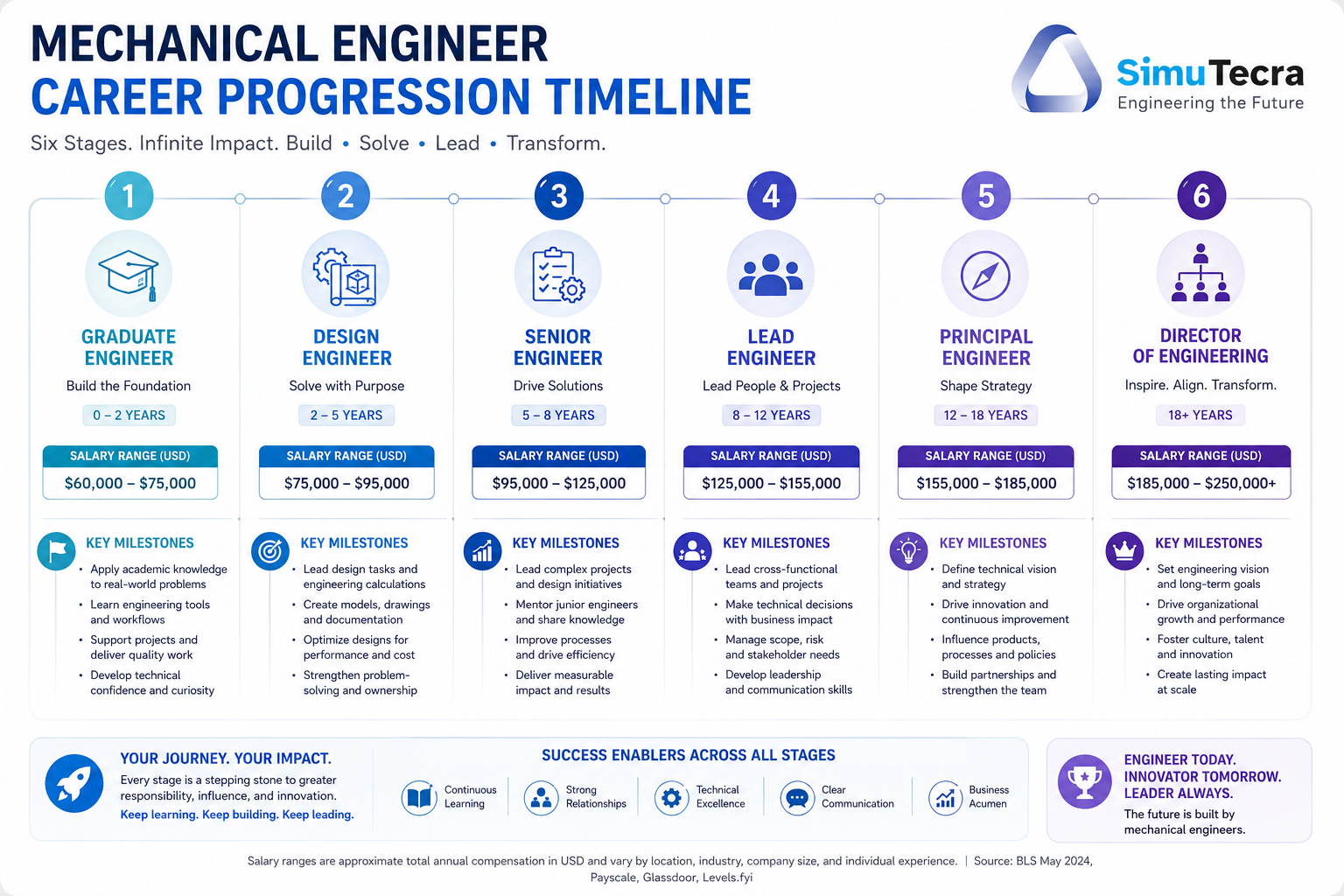
    Mechanical engineering career progression roadmap infographic showing stages from graduate engineer to engineering director with salary ranges and development milestones
    Career StageYears ExperienceTypical TitlesKey ResponsibilitiesTypical US Salary RangeWhat Drives Progression
    Graduate / Entry-Level0-3 yearsGraduate Engineer, Junior ME, Engineer ICAD modelling, analysis tasks directed by seniors, documentation, test support$65,000 – $82,000Technical depth, initiative, asking smart questions, building foundational skills
    Mid-Level Engineer3-8 yearsMechanical Engineer, Engineer II/III, Design EngineerOwning subsystems, running analysis independently, leading design reviews, mentoring juniors$82,000 – $110,000Independent judgement, communication, cross-functional leadership, specialisation depth
    Senior Engineer8-15 yearsSenior ME, Principal Engineer, Lead EngineerTechnical ownership of programs, setting design standards, customer/executive interaction, complex problem-solving$110,000 – $140,000Technical reputation, mentoring effectiveness, business awareness, breadth of impact
    Staff / Principal Engineer12-20 yearsStaff Engineer, Distinguished Engineer, Technical FellowDefining technology direction, cross-organisation influence, patents and publications, strategic R&D input$130,000 – $170,000Recognised expertise, thought leadership, internal and external reputation
    Engineering Management10+ yearsEngineering Manager, Director of Engineering, VP EngineeringTeam leadership, budget management, program oversight, talent development, strategic planning$130,000 – $200,000+People skills, business acumen, strategic thinking, successful team delivery
    Executive / Director Level15-25+ yearsChief Engineer, CTO, VP/SVP Engineering, Engineering DirectorTechnology strategy, organisational leadership, stakeholder management, P&L responsibility$180,000 – $300,000+Track record of delivery, executive presence, industry network, strategic vision
    Career Strategy Insight:  The most powerful career accelerator in mechanical engineering is developing a reputation as the person who solves problems that others cannot. Early in a career, this means going deep on a technical specialisation while maintaining broad fundamentals. From mid-career onward, it means adding cross-functional leadership, business awareness, and communication skills to that technical foundation. Engineers who remain purely technical specialists throughout their careers can still reach excellent compensation at the Staff/Principal level. Engineers who combine technical depth with leadership capability have the highest career ceiling.

    International Salary Comparison: US, UK, Germany, Australia, and Singapore

    For engineers considering international careers or comparing offers across markets, the following table provides a realistic comparison of mechanical engineer salaries by country at different career stages. All figures are approximate annual gross salaries in local currency and approximate USD equivalent.
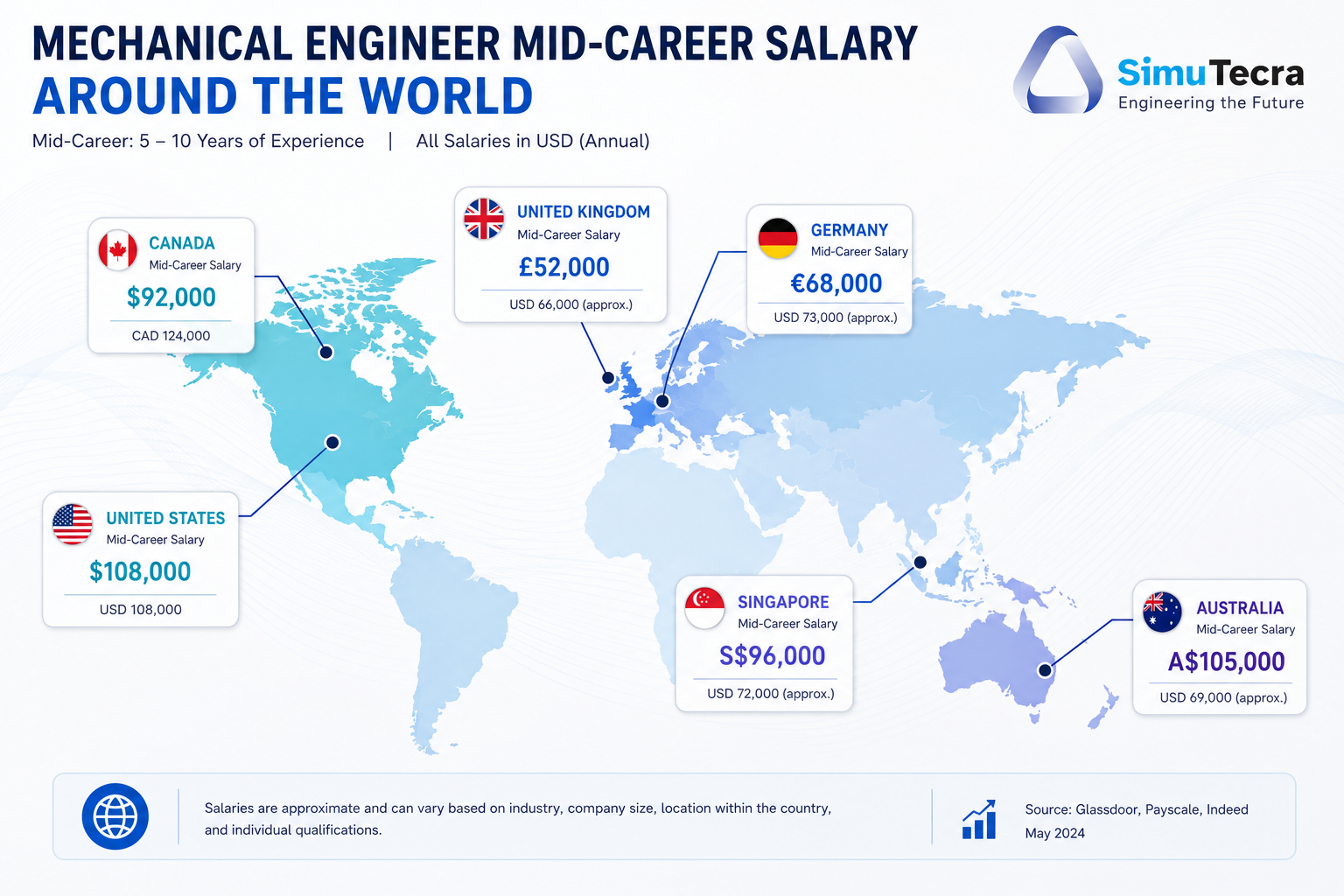
    World map showing mechanical engineer mid-career salaries by country including US, UK, Germany, Australia, Singapore, and Canada
    CountryEntry Level (0-3 yrs)Mid-Level (3-8 yrs)Senior (8-15 yrs)Highest-Paying Industry in Country
    United States$65,000 – $82,000$82,000 – $110,000$110,000 – $155,000Oil and gas ($195,700 median BLS 2024)
    United KingdomGBP 28,000 – 36,000 (~$35-45k)GBP 42,000 – 62,000 (~$53-78k)GBP 65,000 – 90,000 (~$82-113k)Aerospace and defence; oil and gas North Sea
    GermanyEUR 45,000 – 58,000 (~$49-63k)EUR 62,000 – 82,000 (~$68-90k)EUR 82,000 – 115,000 (~$90-126k)Automotive (BMW, Volkswagen, Mercedes-Benz); aerospace
    AustraliaAUD 65,000 – 82,000 (~$42-53k)AUD 90,000 – 120,000 (~$58-78k)AUD 120,000 – 165,000 (~$78-107k)Mining and resources; defence
    SingaporeSGD 48,000 – 62,000 (~$36-46k)SGD 70,000 – 100,000 (~$52-74k)SGD 100,000 – 145,000 (~$74-107k)Semiconductor equipment; aerospace MRO
    CanadaCAD 65,000 – 80,000 (~$48-59k)CAD 85,000 – 115,000 (~$63-85k)CAD 115,000 – 155,000 (~$85-115k)Oil sands (Alberta); aerospace (Bombardier, Pratt & Whitney Canada)

    USD equivalents are approximate based on exchange rates as of early 2026 and are provided for comparison purposes only. Purchasing power parity differs significantly between countries. Germany and Australia offer particularly strong value when cost of living is factored in.

    Mechanical Engineering Career Pivots: How to Switch Industries

    One of the most underappreciated advantages of a mechanical engineering career is the ability to pivot between industries. Because the underlying technical foundations (mechanics, thermodynamics, FEA, fluid mechanics, materials) are universal, a mechanical engineer can move between sectors more readily than most other engineering disciplines. However, successful pivots require understanding what transfers and what needs to be learned.

    From IndustryTo IndustryWhat Transfers DirectlyWhat You Need to LearnTypical Timeline to Full Competence
    AutomotiveAerospaceFEA, CAD, structural analysis, DFM, fatigue analysisFAA/EASA airworthiness standards, aerospace material specifications (AMS), safety case methodology12-24 months with target employer training
    Oil and GasRenewable EnergyPressure system design, rotating equipment, fluid mechanics, ASME codesWind turbine structural specifics or solar tracker mechanisms; IEC wind energy standards6-18 months; certification courses available
    ManufacturingRobotics and AutomationProcess knowledge, fixture design, quality engineering, DFMRobot kinematics, ROS basics, cobot programming, motion control systems12-18 months; supplement with online courses and personal projects
    Any IndustryMedical DevicesMechanical design, FEA, precision manufacturingFDA design controls (21 CFR 820), ISO 13485, verification and validation methodology, biocompatibility basics18-24 months; specific V&V experience critical
    EngineeringConsultingAll technical skills from previous industryClient management, proposal writing, multi-project juggling, commercial awareness, billing practicesImmediate on technical content; 2-3 years to build client relationships

    Certifications and Professional Development That Accelerate Careers

    Professional certifications and development activities that genuinely add career value in mechanical engineering fall into three categories: professional licensure, technical software certifications, and specialist knowledge qualifications.

    Professional Licensure

    • Professional Engineer (PE) License (US): Required for engineering work that affects public safety in infrastructure, government, and consulting roles. Pass FE exam, gain 4 years’ supervised experience, pass PE exam. Adds $10,000 to $20,000 to annual salary on average.
    • Chartered Engineer (CEng) Status (UK): The UK benchmark for senior engineering professionals. Awarded by IMechE on demonstration of competency and experience. Required for many senior roles in UK industry and opens doors internationally via IPEA mutual recognition.
    • Professional Engineer (P.Eng.) (Canada): Required to practise engineering independently in Canada. Province-regulated; requires accredited degree plus 48 months’ supervised work experience.

    Technical Software Certifications

    • SOLIDWORKS Certified Professional (CSWP) and Expert (CSWE): Widely recognised in product development and manufacturing. Validates proficiency in SOLIDWORKS 3D modelling and simulation. Entry-level engineers benefit most.
    • ANSYS Certifications: ANSYS offers certifications in Mechanical (FEA), Fluent (CFD), and other modules. Recognised by aerospace, automotive, and energy employers.
    • Autodesk Certified Professional (AutoCAD, Fusion 360): Valuable for drafting-heavy roles in manufacturing, construction, and consulting.

    Specialist Knowledge Qualifications

    • Certified Manufacturing Engineer (CMfgE): Awarded by SME (Society of Manufacturing Engineers). Validates manufacturing process knowledge for senior manufacturing ME roles.
    • Six Sigma Black Belt (SSBB): Valuable for manufacturing and quality engineering roles. Demonstrates advanced statistical process improvement expertise. Recognised across all manufacturing-heavy industries.
    • Project Management Professional (PMP): Not technically specific but adds significant value for engineers moving into project or program management. Recognised across all industries.
    • ISO 13485 Lead Auditor: Specific to medical devices but adds meaningful salary premium in that sector. Combined with FDA design controls training, it significantly strengthens medical device career progression.

    Read related blog on Frontiers of Mechanical Engineering

    Frequently Asked Questions (FAQ)

    What industries do mechanical engineers work in?

    Mechanical engineers work across virtually every industry that involves physical systems and products. The 12 major industries employing the most mechanical engineers are: automotive, aerospace and defence, energy (oil, gas, and renewables), manufacturing and industrial automation, medical devices, robotics and automation, HVAC and building services, semiconductor equipment, consumer products, defence and government research, marine and offshore, and consulting engineering. Manufacturing is the largest employer overall, accounting for around 50 percent of total ME employment, while oil and gas pays the highest median salary.

    What is the highest-paying industry for mechanical engineers?

    According to the U.S. Bureau of Labor Statistics (BLS) May 2024 data, the highest-paying industry for mechanical engineers is oil and gas extraction, with a median annual wage of $195,700. Rounding out the top five highest-paying industries are solar electric power generation ($167,170), natural gas distribution ($145,920), nuclear electric power generation ($137,810), and semiconductor and electronic product manufacturing ($107,890). These premiums reflect technical complexity, physical demands, and high-consequence operating environments.

    What is a good career path for a mechanical engineer?

    A good mechanical engineering career path combines strong foundational education with deliberate industry choice, early specialisation in a high-growth area, and progressive development of leadership and communication skills alongside technical depth. The typical progression runs from graduate engineer through mid-level, senior, and principal engineer to engineering management or technical director. The most financially rewarding and professionally fulfilling paths tend to involve entering a high-growth sector (renewable energy, medical devices, robotics, aerospace), developing genuine specialist depth, and adding cross-functional leadership capability from mid-career onward.

    Is mechanical engineering a good career in 2026?

    Yes, mechanical engineering is an excellent career in 2026 and beyond. The U.S. Bureau of Labor Statistics projects 9 percent job growth from 2024 to 2034, much faster than average, with approximately 18,100 new openings annually. The median salary of $102,320 is more than double the national median for all occupations. The World Economic Forum’s Future of Jobs Report 2026 identified environmental and renewable energy engineering, electrotechnology, and automation, all falling within the mechanical engineering umbrella, as the fastest-growing engineering subfields. The combination of strong demand, high pay, and broad industry applicability makes it one of the most resilient career choices available.

    Can mechanical engineers switch industries?

    Yes, mechanical engineers can and regularly do switch industries, making it one of the most portable engineering qualifications. The foundational skills (FEA, CAD, thermodynamics, fluid mechanics, materials science) transfer across industries with varying levels of supplementary learning required. The most common successful pivots are from automotive to aerospace, oil and gas to renewables, manufacturing to robotics, and any industry to medical devices (which requires learning FDA regulatory knowledge) or consulting (which requires developing client management skills). Most successful pivots take 12 to 24 months to achieve full competence in the new sector.

    How much do mechanical engineers earn globally?

    Mechanical engineer salaries vary significantly by country. In the US, the median is $102,320 (BLS 2024). In the UK, mid-career salaries range from GBP 42,000 to GBP 62,000. In Germany, mid-career ranges from EUR 62,000 to EUR 82,000. Australian mid-career ranges are AUD 90,000 to AUD 120,000. Singapore mid-career ranges from SGD 70,000 to SGD 100,000. Germany stands out for exceptional purchasing power: near-zero public university tuition, lower cost of living than equivalent UK and US cities, and strong salaries from world-class engineering employers including BMW, Volkswagen, Siemens, and Bosch.

    What certifications help mechanical engineers advance their careers?

    The certifications most reliably associated with salary increases and career advancement in mechanical engineering are: Professional Engineer (PE) license in the US (adds $10,000 to $20,000 to annual salary on average), Chartered Engineer (CEng) in the UK (required for senior roles in many sectors), SOLIDWORKS Certified Professional (CSWP) for product development roles, ANSYS certifications for analysis-heavy roles, Six Sigma Black Belt for manufacturing engineering, and ISO 13485 Lead Auditor for medical devices careers.

    What are the fastest-growing sectors for mechanical engineering jobs?

    The fastest-growing sectors for mechanical engineering employment in 2026 are renewable energy (solar and wind), robotics and automation, electric vehicle engineering, and medical devices. Renewable energy alone employs approximately 35 percent of its workforce in ME roles, with solar supporting 263,000 engineering jobs in the US. Industrial robotics is projected to double its market size to $100 billion by 2030. EV engineering is transforming automotive, with 40 percent of automotive jobs projected to require EV expertise by 2030. Medical devices benefit from ageing population demographics and surgical robotics adoption.

    Conclusion

    Mechanical engineering offers one of the most genuinely versatile career landscapes of any profession. The same foundational knowledge that allows an engineer to design automotive suspension systems also enables them to analyse offshore pipeline fatigue, optimise wind turbine drivetrains, develop surgical robot mechanisms, and lead engineering teams through industrial transformation programs.

    The data is clear and compelling: mechanical engineering careers are growing faster than average, paying significantly above the national median, and expanding into new sectors at a rate that creates continuous new opportunities for engineers at every career stage. The profession’s combination of problem-solving depth, practical impact, and career mobility is not matched by many other fields.

    What this guide has attempted to provide is not just the data, but the context to interpret it: understanding why industry choice is so consequential, what the work actually looks like in each sector, where the premium salaries come from, how careers progress at each stage, and what levers engineers have at their disposal to shape their own trajectory.

    The engineers who build the most rewarding careers are those who approach their mechanical engineering career with the same analytical rigour they apply to engineering problems: gathering the best available information, identifying the key variables, evaluating the options systematically, and making deliberate decisions rather than drifting. This guide is the information foundation for that approach.

    Continue building your knowledge. Read What Is Mechanical Engineering? for the foundational context, explore What Does a Mechanical Engineer Do? for the daily reality of the profession, and discover the Latest Advances in Mechanical Engineering to understand where the most exciting new opportunities are emerging.
  • Latest Advances in Mechanical Engineering (2026)

    Latest Advances in Mechanical Engineering (2026)

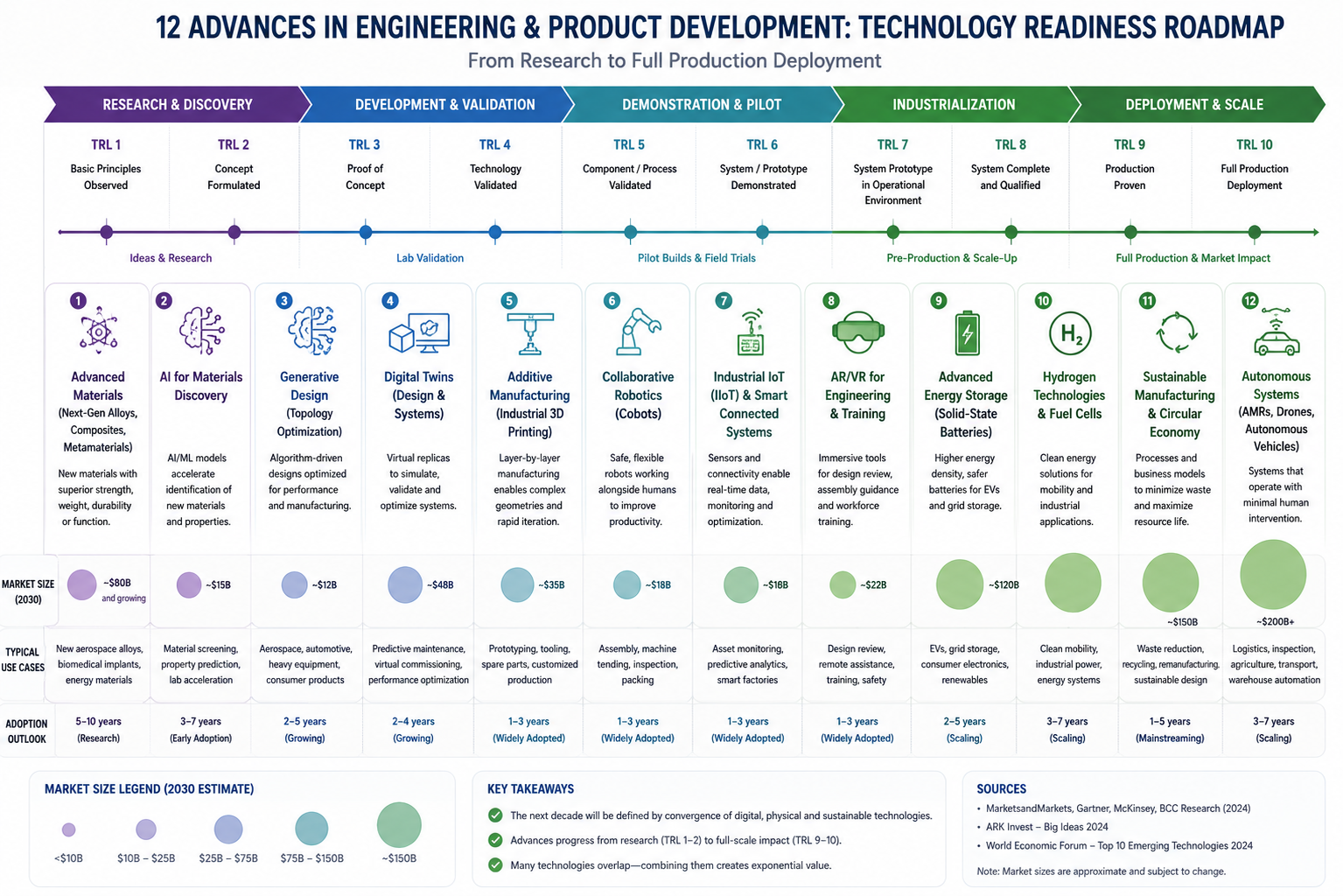
    Mechanical engineering has always been a discipline in motion, but the pace of change in 2026 is unlike anything the profession has experienced in living memory. In less than a decade, the field has absorbed artificial intelligence, quantum sensing, advanced soft robotics, 4D-printed metamaterials, hydrogen propulsion systems, and real-time digital twins, each transformative individually, and together reshaping what it means to be a mechanical engineer.

    This is not a list of futuristic concepts. These are technologies being deployed in factories, hospitals, laboratories, and energy systems right now. Mechanical engineers who understand them are commanding salary premiums of 15 to 25 percent above industry averages. Companies that have adopted them are reducing development timelines by 30 to 40 percent and cutting production costs significantly. The advances covered in this guide are not optional knowledge for the modern engineering professional. They are the new baseline.

    This article covers the 12 most significant latest advances in mechanical engineering as of 2026: what each one is, why it matters, the data behind its adoption, the industries it is transforming, and what it means for engineers building careers today. Every section includes market data, real-world application examples, and direct career implications, content that no competing article provides.

    Infographic showing 12 latest advances in mechanical engineering ranked by technology readiness level from research to industrial deployment with market size data
    Key Statistic:  The U.S. Bureau of Labor Statistics reports the median annual wage for mechanical engineers reached $102,320 in May 2024, more than double the national median for all occupations. Employment is projected to grow 11 percent from 2023 to 2033, described as ‘much faster than average’, generating approximately 19,800 new job openings annually. Specialisations in AI-integrated roles, renewable energy, and robotics are commanding premiums of 15 to 25 percent above manufacturing averages.

    Why 2026 Is a Pivotal Year for Mechanical Engineering

    Mechanical engineering has always evolved, but typically in cycles measured in decades. A new manufacturing process here, a new simulation method there. What is different now is the simultaneous convergence of multiple transformative technologies, each mature enough to deploy at industrial scale, each reinforcing and enabling the others.

    Artificial intelligence is accelerating the design phase. Metal 3D printing is enabling geometries that were previously impossible. Digital twins are closing the loop between virtual design and physical reality. Advanced materials are overturning decades-old assumptions about what is strong, light, and thermally stable. Robotics is no longer confined to cage-enclosed factory automation. Hydrogen and electrification are reshaping propulsion engineering from its foundations.

    The engineers who will thrive in this environment are not those who understand one of these shifts in isolation. They are those who understand how they connect, how mastery of AI-assisted generative design changes what additive manufacturing can achieve, how digital twins enable predictive maintenance, how soft robotics and metamaterials are creating new categories of mechanical devices that did not exist five years ago. This guide provides that connected view.

    Technology AreaMarket Size 2024/2026Projected GrowthPrimary Engineering Impact
    Factory Automation$227 billion (2026)$461 billion by 2031 (ASME)Cobots, adaptive manufacturing, AI-controlled production lines
    Additive Manufacturing (global)$21 billion (2024)$73 billion by 2031 (MarketsandMarkets)Metal AM for production parts; medical implants; aerospace structures
    Digital Twins Market$17 billion (2024)$110 billion by 2032 (Grand View Research)Real-time monitoring; predictive maintenance; virtual testing
    Industrial Robotics$48 billion (2024)$100+ billion by 2030 (IFR)Cobots, autonomous mobile robots, surgical robots
    Hydrogen Economy$260 billion (2023 investment)Projected $1+ trillion/year by 2050 (IEA)Fuel cell systems, hydrogen turbines, storage vessel design
    Nanomaterials Market$12.42 billion (2023)15% CAGR through 2030Lightweight composites, MEMS, energy storage, biomedical implants
    Soft Robotics Market$2.5 billion (2024)$10.7 billion by 2030 (Grand View Research)Medical devices, food handling, wearables, search-and-rescue

    Advance 1: AI-Driven Design and Generative Engineering

    Artificial intelligence has entered the mechanical engineering design process at multiple levels simultaneously, and its impact is already measurable. AI-driven design tools and generative design software are not replacing engineers. They are dramatically expanding the design space any engineer can explore in a given time.

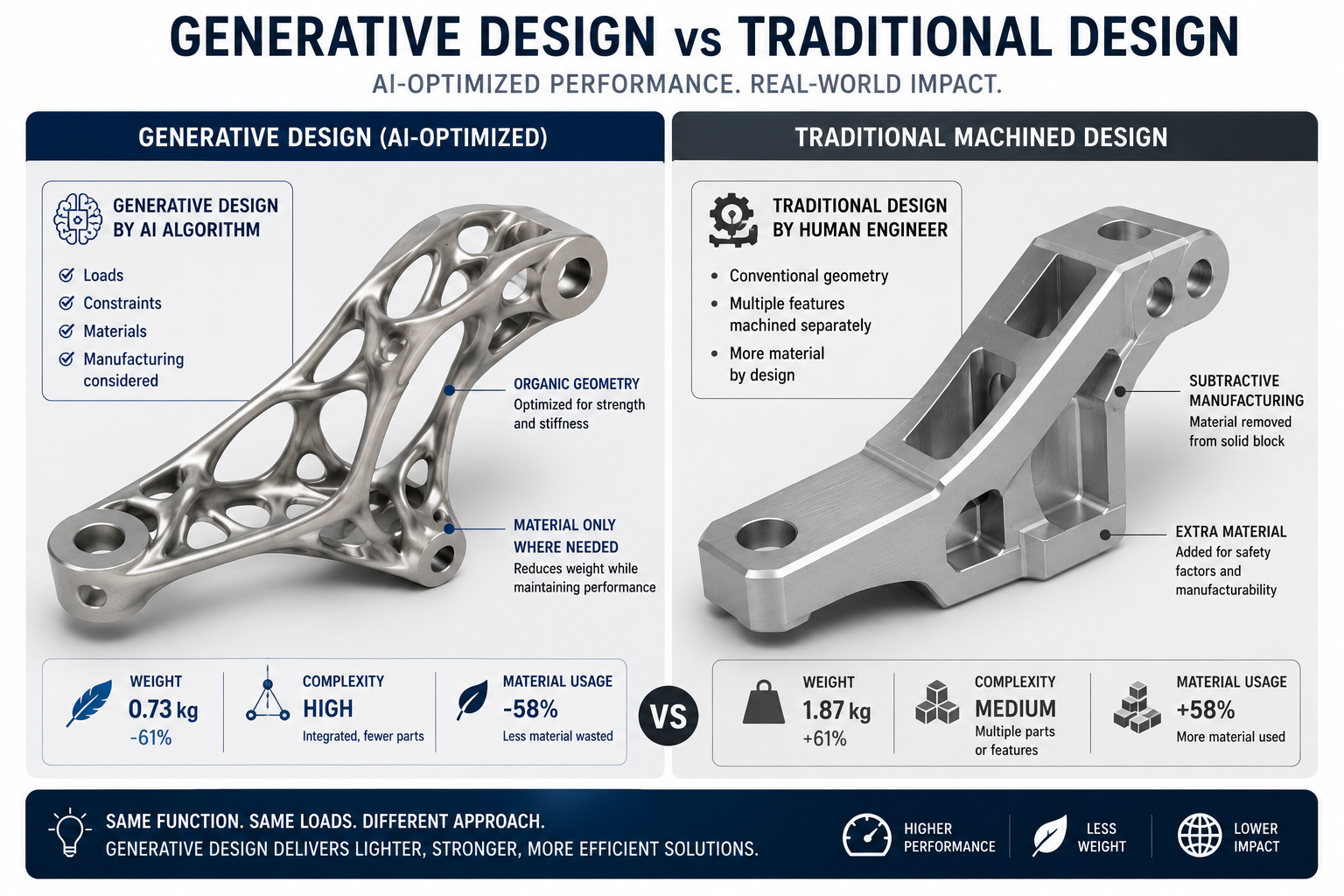
    Comparison of AI generative design component versus traditional machined component showing weight reduction and geometric complexity in mechanical engineering

    Generative Design: Exploring Thousands of Solutions Simultaneously

    Generative design uses AI algorithms to explore thousands of potential design geometries based on engineering constraints and objectives defined by the engineer: load cases, material constraints, manufacturing method, weight targets, and cost limits. The software produces optimised geometry candidates that are typically organic in shape, because they are mathematically optimised rather than geometrically intuited, and often achieve the same structural performance as a conventional design at 30 to 50 percent lower mass.

    Autodesk Fusion 360, SolidWorks with SOLIDWORKS Simulation, and nTop (formerly nTopology) are among the leading platforms offering generative design capabilities. SOLIDWORKS’ AI-powered co-pilot Aura, launched in 2026, adds conversational AI assistance directly into the design workflow, allowing engineers to query design performance, request automatic geometry modifications, and receive real-time suggestions.

    AI in Manufacturing: From Toolpath to Quality Control

    Beyond design, AI in manufacturing is being embedded into CNC machining, injection moulding, and additive manufacturing workflows. AI-driven toolpath optimisation in CAM software reduces machining time and tool wear. Computer vision systems on production lines detect surface defects in real time at accuracy levels that exceed human inspectors. Machine learning models monitor process parameters and adjust them automatically to maintain dimensional accuracy as tools wear.

    Career Impact:  The role of AI Systems Integration Engineer is already appearing on engineering job boards, requiring the ability to embed AI algorithms directly into mechanical systems while maintaining rigorous understanding of physical constraints. Engineers with combined mechanical and AI/ML competency are commanding premiums of 20 to 30 percent above peers without those skills.

    Advance 2: Metal Additive Manufacturing at Production Scale

    Metal additive manufacturing has crossed the threshold from prototyping tool to genuine production technology. This is arguably the single most structurally significant manufacturing advance of the past decade for mechanical engineers, because it removes geometric constraints that have governed component design since the invention of machining.

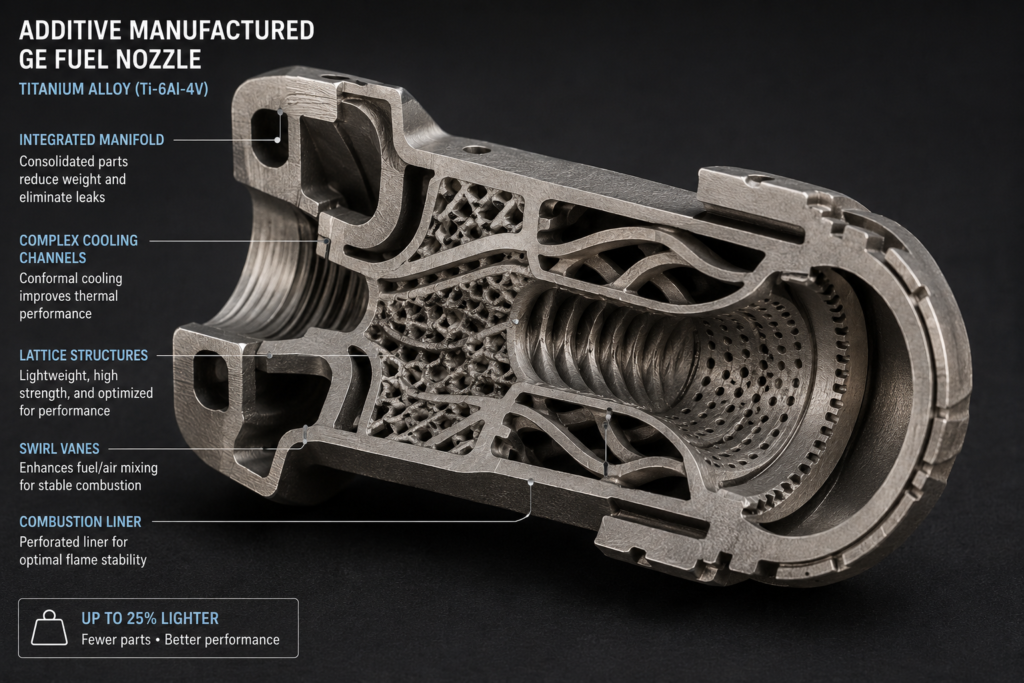
    Metal additive manufactured aerospace component cross-section showing internal lattice structure and complex cooling channels produced by laser powder bed fusion

    What Metal AM Enables That Machining Cannot

    Traditional subtractive manufacturing (machining) produces components by removing material from a solid block. This imposes fundamental geometric constraints: internal channels must be accessible to cutting tools, undercuts require special fixturing, and complex organic geometries are prohibitively expensive to machine. Metal additive manufacturing builds components layer by layer from metal powder or wire, removing virtually all geometric constraints. Internal lattice structures, conformal cooling channels, biomimetic organic geometries, and topology-optimised shapes can all be produced directly from CAD data.

    Key Metal AM Technologies in 2026

    • Laser Powder Bed Fusion (LPBF / SLM): The dominant technology for producing dense, high-accuracy metal parts in titanium, Inconel, stainless steel, and aluminium alloys. Used for aerospace brackets, medical implants, and tooling inserts.
    • Directed Energy Deposition (DED): Enables the addition of material onto existing components (repair and overhaul) and the production of large near-net-shape components. Used in aerospace repair, energy sector component refurbishment.
    • Binder Jetting: High-throughput, lower-cost process suited to high-volume production of smaller components in steel and copper alloys. Advancing rapidly toward automotive-scale deployment.
    • Wire Arc Additive Manufacturing (WAAM): Uses welding wire and an arc heat source to deposit large metallic structures at low cost. Suited for maritime and offshore structural components, large aerospace structural elements.

    The global additive manufacturing market was valued at approximately $21 billion in 2024 and is projected to reach $73 billion by 2031, with metal AM representing the fastest-growing segment. SpaceX’s Raptor engine uses 3D-printed metal components for its combustion chamber. GE Aviation produces more than 100,000 fuel nozzle tips annually using metal AM, achieving a component that is 25 percent lighter and five times more durable than its machined predecessor.

    Advance 3: Digital Twins Moving from Prototype to Standard Practice

    A digital twin is a real-time, high-fidelity virtual model of a physical system, continuously updated with live sensor data from its physical counterpart. The concept has existed in research for two decades. What is new is that the combination of affordable IoT sensors, cloud computing, and physics-based simulation has made digital twins practical and cost-effective at industrial scale.

    What Digital Twins Enable

    A well-implemented digital twin allows engineers to monitor asset health in real time, simulate the consequences of proposed changes before implementing them on the physical system, predict maintenance needs before failures occur, and optimise operational parameters continuously based on actual operating conditions rather than design assumptions. In industries where unplanned downtime is extremely costly, the return on investment is compelling: documented industrial deployments report reductions in unplanned downtime of 30 to 50 percent.

    Siemens, GE, and Rolls-Royce all operate digital twin programs for their turbine and engine products. Rolls-Royce’s IntelligentEngine initiative creates a digital twin for every engine it produces, enabling remote performance monitoring and predictive maintenance scheduling that has significantly reduced airline maintenance costs and in-service disruptions.

    Multi-Physics Simulation: Beyond Single-Domain Analysis

    Parallel to the digital twin advance, multi-physics simulation has become standard practice for complex mechanical systems. Where engineers once simulated structural, thermal, and fluid behaviour separately and sequentially, modern platforms such as ANSYS, Comsol Multiphysics, and Siemens NX allow simultaneous coupled simulation across multiple physics domains. For automotive power electronics cooling systems, for example, engineers now routinely model fluid flow, heat transfer, and structural stress simultaneously, a workflow that has been reported to reduce development time by 40 percent while improving design confidence.

    Advance 4: Collaborative Robotics and Adaptive Automation

    Industrial robotics is not new. What is new is collaborative robotics (cobots): robots designed to work alongside human workers in shared spaces, without safety cages, sensing proximity, adjusting force, and performing precision tasks in environments that are too hazardous or ergonomically demanding for humans.

    Why Cobots Are Changing Manufacturing

    Traditional industrial robots are programmed for highly repetitive tasks in precisely defined environments. They are expensive to reprogram, require significant safety infrastructure, and cannot safely share a workspace with humans. Cobots address all three limitations. They are force-limited, vision-guided, and easily reprogrammed by non-specialists through direct teaching (physically guiding the robot through a task). They are being deployed in small and medium manufacturers who could not previously justify robotic automation.

    The global industrial robotics market reached approximately $48 billion in 2024 and is projected to exceed $100 billion by 2030 according to the International Federation of Robotics (IFR). Autonomous Mobile Robots (AMRs), which navigate dynamically through warehouse and factory environments using LIDAR and computer vision, are now standard in logistics facilities operated by companies including Amazon, DHL, and Ocado.

    Engineering Reality Check:  Mechanical engineers are central to cobot and robot development, designing the structural frames, actuator systems, wrist mechanisms, and end effectors. The transition from rigid industrial robots to soft, compliant cobots requires deep mechanical engineering expertise in flexible mechanism design, contact mechanics, and force-controlled actuation, precisely the areas where mechanical engineers with robotics specialisation are most scarce and most valuable.

    Advance 5: Soft Robotics and Bio-Inspired Mechanical Systems

    Soft robotics represents one of the most philosophically significant departures from traditional mechanical engineering thinking. Conventional mechanical systems are built from rigid components: metal frames, hard actuators, stiff linkages. Soft robotics replaces rigid structures with compliant, deformable bodies made from elastomers, hydrogels, and pneumatically or thermally actuated smart materials, drawing direct inspiration from biological organisms.

    Why Soft Robots Solve Problems Rigid Robots Cannot

    Rigid robots interact with the world through precise, force-controlled contact. They excel at tasks with well-defined geometry and predictable environments. They struggle in unstructured environments, with fragile objects, in confined spaces, and in direct contact with human tissue. Soft robots, because they deform and conform rather than imposing rigid force, are inherently safer, more adaptable, and more capable in these scenarios.

    Applications are advancing rapidly: soft robotic grippers for food handling and agricultural harvesting (where fragile produce must be grasped without damage), soft robotic endoscopes and surgical tools that navigate the human body through natural orifices, wearable soft exosuits that augment human strength and assist post-stroke rehabilitation, and 4D-printed soft microrobots that change shape in response to temperature, magnetic fields, or chemical stimuli for targeted drug delivery and minimally invasive surgery.

    The soft robotics market was valued at approximately $2.5 billion in 2024 and is projected to reach $10.7 billion by 2030. Harvard’s Wyss Institute, MIT’s CSAIL, and a growing cohort of commercial startups are driving development, but the mechanical engineering principles at the heart of soft robotics, continuum mechanics, flexible beam theory, nonlinear elasticity, and fluid-structure interaction, are exactly the subjects covered in advanced ME programs.

    Advance 6: Mechanical Metamaterials and 4D Printing

    Mechanical metamaterials are engineered structures whose mechanical properties derive from their geometric architecture rather than the intrinsic properties of the material they are made from. By carefully designing the arrangement of unit cells at the micro or meso scale, engineers can produce structures with properties that no naturally occurring material possesses: negative Poisson’s ratio (expanding laterally when stretched), programmable stiffness, acoustic cloaking, and energy absorption profiles engineered to a specific crash event.

    From Lattice Structures to Programmable Matter

    The intersection of mechanical metamaterials and additive manufacturing has opened a new domain of engineering capability. Lattice-structured parts produced by metal LPBF can be designed to have tailored stiffness in specific directions, density distributions that match the load path through a component, and progressive crushing behaviour for energy absorption applications.

    4D printing extends this further by adding time as a design dimension. 4D-printed structures are made from stimuli-responsive materials (shape memory polymers, hydrogels, liquid crystal elastomers) that change shape, stiffness, or other properties in response to heat, moisture, light, or magnetic fields. Published research in 2026 and 2026 demonstrates 4D-printed metamaterials with programmable reconfiguration capability for applications including deployable aerospace structures, autonomous health-monitoring systems, biomimetic soft robotic actuators, and adaptive wearable devices.

    Research Frontier:  Magnetoactive metamaterials (MMs), which integrate magnetoactive soft composite materials with architected mechanical structures, can dynamically change their mechanical, acoustic, and elastic properties through the application of an external magnetic field. This enables tunable vibration dampers, shape-morphing medical devices, and remotely reconfigurable robotic systems, applications that were entirely in the realm of research science five years ago and are now moving toward early commercial deployment.

    Advance 7: Hydrogen Energy Systems and Mechanical Engineering

    Hydrogen is widely regarded as the most technically viable pathway to decarbonising industrial processes and long-distance transport that cannot be practically electrified. The mechanical engineering challenges of the hydrogen economy are enormous and diverse, spanning materials science, thermodynamics, fluid mechanics, and structural integrity.

    The Mechanical Engineering Challenges of Hydrogen

    Hydrogen is the smallest molecule in existence, which creates unique engineering challenges. It diffuses through many conventional materials, causing hydrogen embrittlement: a reduction in ductility and fracture toughness that can lead to unexpected failure in steel pressure vessels and pipelines. Mechanical engineers specialising in hydrogen systems engineering must select and qualify materials resistant to hydrogen embrittlement, design storage vessels that maintain structural integrity under cyclic pressurisation, and develop sealing systems capable of preventing the escape of a molecule that passes through most conventional seals.

    Cryogenic hydrogen storage (liquid hydrogen at -253 degrees Celsius) introduces a further set of thermal engineering challenges: insulation systems must prevent heat ingress at temperatures approaching absolute zero, and structural materials must maintain ductility and toughness at cryogenic temperatures where many metals become brittle.

    Hydrogen Turbines and Fuel Cell Mechanical Systems

    The adaptation of gas turbines to burn hydrogen rather than natural gas is a significant mechanical engineering undertaking. Hydrogen combustion produces higher flame temperatures and significantly different combustion dynamics than natural gas, requiring redesigned combustor liners, modified turbine blade cooling circuits, and new coating systems to handle the increased thermal load. Siemens Energy and GE Vernova are both conducting field trials of hydrogen-capable gas turbines, and the engineering demand for specialists in this area is projected to grow 45 percent by 2030 according to sector analysis.

    Advance 8: Electric Vehicle Powertrain and Thermal Engineering

    The global transition to electric vehicles is creating one of the largest structural shifts in automotive mechanical engineering since the introduction of computer-controlled fuel injection. By 2030, 40 percent of automotive engineering jobs are projected to require expertise in EV powertrain systems and AI-driven diagnostics, with traditional internal combustion engine roles transforming into energy optimisation and electromechanical systems engineering.

    Battery Thermal Management: The Critical Mechanical Engineering Problem in EVs

    Lithium-ion battery cells perform optimally within a narrow temperature range of approximately 15 to 35 degrees Celsius. Below this range, capacity drops sharply. Above it, degradation accelerates and thermal runaway (an uncontrolled exothermic reaction that can cause fire) becomes a risk. Battery thermal management system (BTMS) design is one of the most demanding thermal engineering challenges in current automotive work, requiring the design of cooling plates, phase-change material systems, and heat pipe networks that maintain uniform cell temperatures across a battery pack spanning hundreds of cells.

    Lightweight Structural Engineering for EVs

    Battery packs are heavy. A typical EV battery pack weighs 400 to 700 kilograms, placing significant mass at the vehicle’s base. Mechanical engineers working in EV structural design must offset this weight through aggressive lightweighting of the vehicle body and chassis using advanced aluminium alloys, carbon fibre composites, and topology-optimised structural components. Companies like Tesla and Rivian are prioritising lightweight material expertise, with composite engineers reportedly earning 20 percent higher salaries than equivalent conventional automotive roles.

    Advance 9: Advanced Composites and Smart Materials

    The materials available to mechanical engineers in 2026 are fundamentally more capable than those available a generation ago, and the pace of materials innovation is accelerating. Three areas are particularly significant: advanced composites, self-healing materials, and shape memory alloys.

    Carbon Fibre Reinforced Polymers (CFRP): Expanding from Aerospace to Mainstream

    Carbon fibre reinforced polymer composites offer specific stiffness and specific strength values that no metal alloy can match. Once confined to aerospace and motorsport, CFRP is now entering automotive, wind energy, medical devices, and consumer products as manufacturing processes have matured and costs have reduced. Automated Fibre Placement (AFP) and resin transfer moulding at scale are enabling the production of large composite structures at automotive production rates.

    Self-Healing Materials: Components That Repair Themselves

    Self-healing materials are a class of advanced engineering materials that can autonomously repair damage such as cracks, scratches, or delamination. They contain microencapsulated healing agents that release and polymerise when a crack propagates through the material, restoring structural integrity without human intervention. Published research from 2024 demonstrates self-healing polymer matrices for fibre composite structures with healing efficiency of 80 to 95 percent of original fracture toughness, opening potential applications in offshore wind turbine blades, pressure vessels, and aerospace panels that are difficult to inspect and repair conventionally.

    Shape Memory Alloys and Actuators

    Shape memory alloys (SMAs), most commonly Nitinol (nickel-titanium alloy), undergo a reversible phase transformation when heated or cooled, enabling them to recover a programmed shape after deformation. SMAs are used in stents, orthodontic wires, actuators in aerospace morphing structures, and thermal actuators in HVAC systems. Their capacity to serve simultaneously as structural material and actuation mechanism makes them particularly attractive for applications where conventional actuators (motors, hydraulics) are too heavy or too complex.

    Advance 10: Microelectromechanical Systems (MEMS) and Nanotechnology

    Microelectromechanical Systems (MEMS) are microscale devices that combine mechanical and electrical components on a single silicon or polymer chip, fabricated using semiconductor manufacturing processes. MEMS are not a new technology, but their capabilities, range of applications, and volume of deployment are expanding rapidly.

    MEMS Applications Transforming Industries

    MEMS accelerometers in every modern smartphone trigger airbags, enable screen rotation, and provide orientation data for augmented reality applications. MEMS pressure sensors monitor tyre pressure, blood pressure, and industrial process conditions continuously and wirelessly. MEMS microfluidic chips (lab-on-a-chip) perform medical diagnostic tests in minutes using a drop of blood, bringing laboratory-quality analysis to point-of-care settings globally.

    Nanomaterials: The Materials Science Frontier

    At the nanoscale, materials behave differently from their bulk counterparts, and this opens engineering opportunities that are not available at conventional scales. Graphene, carbon nanotubes (CNTs), and metallic nanoparticles are among the most engineered nanomaterials, offering extraordinary combinations of strength, electrical conductivity, and thermal conductivity. The global nanomaterials market, valued at $12.42 billion in 2023, is projected to grow at 15 percent annually through 2030, driven by demand from electronics, medical devices, energy storage, and structural composites.

    Advance 11: Space-Based Manufacturing and Extreme Environment Engineering

    The commercialisation of space is creating a new frontier for mechanical engineering that requires both extreme performance engineering and a fundamental rethinking of manufacturing logic. Space-based manufacturing is no longer purely speculative: NASA, ESA, and commercial operators are actively developing in-space manufacturing capabilities for structural components, optical fibres, pharmaceutical crystals, and semiconductor devices that can be produced with superior properties in the microgravity environment of orbit.

    Reusable Launch Systems: The Structural Engineering Achievement of the Decade

    The development of fully reusable launch vehicles by SpaceX (Falcon 9 and Starship) is perhaps the most demanding structural and thermal mechanical engineering achievement of the past decade. Rocket structures must survive launch loads, re-entry thermal gradients exceeding 1,600 degrees Celsius on heat shield surfaces, and precision propulsive landing, while being refurbishable and re-flyable with minimal inspection and maintenance. The fatigue analysis, thermal protection system design, and propellant system engineering required for reusable launch vehicle development represent the cutting edge of applied mechanical engineering.

    Extreme Environment Materials Engineering

    Beyond space, the demand for components that can survive extreme environments is growing in nuclear energy, deep-sea energy extraction, and high-performance aerospace. Next-generation nuclear reactors require structural materials that can maintain integrity under high-flux neutron bombardment, elevated temperatures, and corrosive coolants for decades without replacement. Oxide Dispersion Strengthened (ODS) steels and ceramic matrix composites (CMCs) are among the advanced materials being developed for these applications, both requiring sophisticated mechanical engineering analysis and manufacturing process development.

    Advance 12: Predictive Maintenance and Industrial IoT

    The combination of Industrial Internet of Things (IIoT) sensor networks and machine learning algorithms is transforming how mechanical systems are maintained. Traditional maintenance is either scheduled (replace after a fixed time or number of cycles regardless of actual condition) or reactive (repair after failure). Predictive maintenance uses continuous sensor data (vibration signatures, acoustic emissions, temperature distributions, oil particle counts) and machine learning models to predict when a component is approaching failure, allowing maintenance to be scheduled precisely when needed, not too early and not too late.

    What Predictive Maintenance Requires from Mechanical Engineers

    Implementing an effective predictive maintenance system requires mechanical engineers who understand both the physics of component degradation (which failure modes are occurring, why, and how they manifest in sensor signatures) and the data infrastructure for collecting, transmitting, and analysing large volumes of sensor data. This is precisely the cross-disciplinary skill set that defines the most sought-after mechanical engineers in 2026: deep domain knowledge of mechanical systems combined with data literacy and machine learning awareness.

    Rolls-Royce, Siemens, SKF, and dozens of industrial equipment manufacturers have deployed predictive maintenance systems that have documented reductions in unplanned downtime of 30 to 50 percent, maintenance cost reductions of 10 to 25 percent, and extensions in asset operating life. These are not marginal improvements: for a large industrial facility, they translate to savings of tens of millions of dollars annually.

    How These Advances Are Changing Mechanical Engineering Careers

    The latest advances in mechanical engineering are not abstract research topics for most of the profession. They are actively reshaping the skills that employers are looking for, the roles that are being created, and the salary premiums available to engineers who develop the right competencies.

    Technology AdvanceNew / Transformed RolesSkills RequiredSalary Premium (vs. Avg. ME)
    AI-Driven DesignAI Systems Integration Engineer; Generative Design SpecialistPython/ML basics, ANSYS/Fusion 360 with AI tools, topology optimisation+20 to 30%
    Metal Additive ManufacturingAM Process Engineer; DfAM Specialist; Powder MetallurgistLPBF/DED process knowledge, DfAM principles, metallurgy+15 to 25%
    Digital TwinsDigital Twin Engineer; Simulation Data EngineerIoT sensor integration, physics-based modelling, cloud platforms (Azure/AWS)+15 to 20%
    Cobots / RoboticsRobotics Mechanical Engineer; Cobot Integration SpecialistROS, robot kinematics, mechanism design, force-controlled actuation+15 to 25%
    Soft RoboticsSoft Robotics Engineer; Compliant Mechanism DesignerContinuum mechanics, elastomer materials, pneumatic actuation+20 to 30% (specialist scarcity)
    Hydrogen SystemsHydrogen Systems Engineer; Fuel Cell Mechanical EngineerHydrogen embrittlement, cryogenics, high-pressure vessel design, codes/standards+20 to 35%
    EV Powertrain / BTMSBTMS Engineer; EV Structural Engineer; Battery Integration EngineerThermal management, CFD, lightweight materials, battery cell chemistry basics+15 to 25%
    Predictive Maintenance / IIoTReliability Engineer with ML skills; IIoT Mechanical Systems EngineerVibration analysis, sensor systems, Python/MATLAB, machine learning basics+10 to 20%
    Strategic Career Advice:  The data is clear: mechanical engineers who develop depth in one or two of these advancing areas, while maintaining strong mechanical engineering fundamentals, are in the highest demand and command the strongest salary premiums. The most powerful combination in 2026 is strong classical ME foundations plus one high-growth specialisation (hydrogen, additive manufacturing, EV thermal systems, or AI-integrated design). Adding basic Python or MATLAB data skills amplifies the premium further in roles involving simulation, predictive maintenance, or digital twin development.

    Frequently Asked Questions (FAQ)

    What are the latest advances in mechanical engineering?

    The most significant latest advances in mechanical engineering in 2026 include AI-driven generative design, metal additive manufacturing at production scale, real-time digital twins, collaborative robotics and cobots, soft robotics and bio-inspired systems, mechanical metamaterials and 4D printing, hydrogen energy system engineering, electric vehicle thermal management, advanced composites and self-healing materials, MEMS and nanotechnology, space-based manufacturing, and IIoT-driven predictive maintenance. Each of these is being deployed at industrial scale and is creating new career opportunities for mechanical engineers.

    How is AI changing mechanical engineering?

    AI is changing mechanical engineering in several simultaneous ways: generative design algorithms explore thousands of optimised design geometries based on engineering constraints; AI-assisted CAM software optimises machining toolpaths and reduces tool wear; computer vision systems perform real-time quality inspection on production lines; machine learning models embedded in digital twins predict equipment failures before they occur; and AI-powered chatbot assistants in CAD platforms offer real-time design suggestions. Engineers with combined mechanical engineering and AI/ML competency are commanding salary premiums of 20 to 30 percent above peers without those skills.

    What is additive manufacturing in mechanical engineering?

    Additive manufacturing (3D printing) in mechanical engineering is a family of processes that build components layer by layer from digital design data, most commonly from metal powders, polymer filaments, or resins. For mechanical engineers, the most significant advance is metal additive manufacturing, which enables the production of complex geometries that cannot be machined, including internal lattice structures, conformal cooling channels, and topology-optimised organic shapes. The global additive manufacturing market was valued at $21 billion in 2024 and is projected to reach $73 billion by 2031.

    What is a digital twin in mechanical engineering?

    A digital twin in mechanical engineering is a real-time virtual model of a physical asset or system, continuously updated with live sensor data from its physical counterpart. It allows engineers to monitor asset health remotely, simulate the effect of proposed changes before implementing them, predict maintenance needs before failures occur, and optimise operational parameters based on actual conditions. Industrial deployments have documented reductions in unplanned downtime of 30 to 50 percent, and the digital twins market is projected to reach $110 billion by 2032.

    What is the future of mechanical engineering?

    The future of mechanical engineering is defined by the convergence of traditional physical engineering with digital intelligence, sustainable energy systems, and advanced materials. Key directions include: AI-assisted design becoming standard practice; metal additive manufacturing replacing machining for complex components; hydrogen and electrification reshaping energy and transport engineering; soft robotics expanding into healthcare and agriculture; and predictive maintenance transforming industrial operations. The U.S. BLS projects 11 percent employment growth from 2023 to 2033, with the highest demand in renewable energy, robotics, and AI-integrated engineering roles.

    What is soft robotics in mechanical engineering?

    Soft robotics in mechanical engineering is a sub-discipline that designs robots and actuators from compliant, deformable materials (elastomers, hydrogels, shape memory polymers) rather than rigid metal or plastic structures. Inspired by biological organisms, soft robots can safely interact with humans and delicate objects, navigate confined and unstructured environments, and change shape in response to environmental stimuli. Applications include surgical robots, agricultural harvesting systems, wearable exosuits, and 4D-printed microrobots for targeted drug delivery. The soft robotics market is projected to reach $10.7 billion by 2030.

    What are mechanical metamaterials?

    Mechanical metamaterials are engineered structures whose mechanical properties (stiffness, density, acoustic behaviour, Poisson’s ratio) derive from their geometric architecture rather than the intrinsic properties of their constituent material. By designing the arrangement of unit cells at the micro or meso scale, engineers can produce structures with properties not found in nature, such as negative Poisson’s ratio, programmable stiffness, and tailored energy absorption. Combined with 4D printing, mechanical metamaterials can be designed to change shape or properties in response to stimuli, enabling applications in deployable aerospace structures, adaptive wearables, and soft robotic actuators.

    How is mechanical engineering involved in the hydrogen economy?

    Mechanical engineering is central to the hydrogen economy across multiple technical dimensions: designing high-pressure storage vessels and pipelines that are resistant to hydrogen embrittlement, developing cryogenic insulation systems for liquid hydrogen storage, engineering combustor modifications to gas turbines for hydrogen firing, designing mechanical compression and liquefaction systems for hydrogen logistics, and developing fuel cell stack mechanical assemblies. The demand for hydrogen systems engineers is projected to grow 45 percent by 2030, with salary premiums of 20 to 35 percent above manufacturing averages.

    Conclusion

    The latest advances in mechanical engineering are not isolated innovations. They are interconnected, mutually reinforcing transformations that are collectively redefining what the discipline does, what tools it uses, what problems it can solve, and what it means to be competitively skilled as a practising engineer.

    AI-driven generative design changes what additive manufacturing can produce. Additive manufacturing enables mechanical metamaterial geometries that no other process can create. Digital twins close the loop between virtual design and physical reality, making predictive maintenance economically viable. Soft robotics and advanced materials are creating entirely new categories of mechanical devices. Hydrogen and electrification are reshaping propulsion engineering at its foundations.

    For students, the implication is clear: the most valuable mechanical engineering education in 2026 pairs rigorous classical engineering fundamentals with at least one of these advancing specialisations, plus data literacy sufficient to engage with AI tools, simulation platforms, and sensor-driven systems.

    For practising engineers, the message is equally direct: the engineers commanding the strongest salary premiums are those who have extended their classical training into these new domains. The field has never offered more opportunity for those willing to keep learning.

    Explore the broader context in our pillar guide What Is Mechanical Engineering?, understand the Frontiers of Mechanical Engineering for the research-level view, or review our guide to Mechanical Engineering Careers and Industries to see where these advances are creating the most new employment opportunities.

  • Engineering Mechanics Explained: Complete Guide 2026

    Engineering Mechanics Explained: Complete Guide 2026

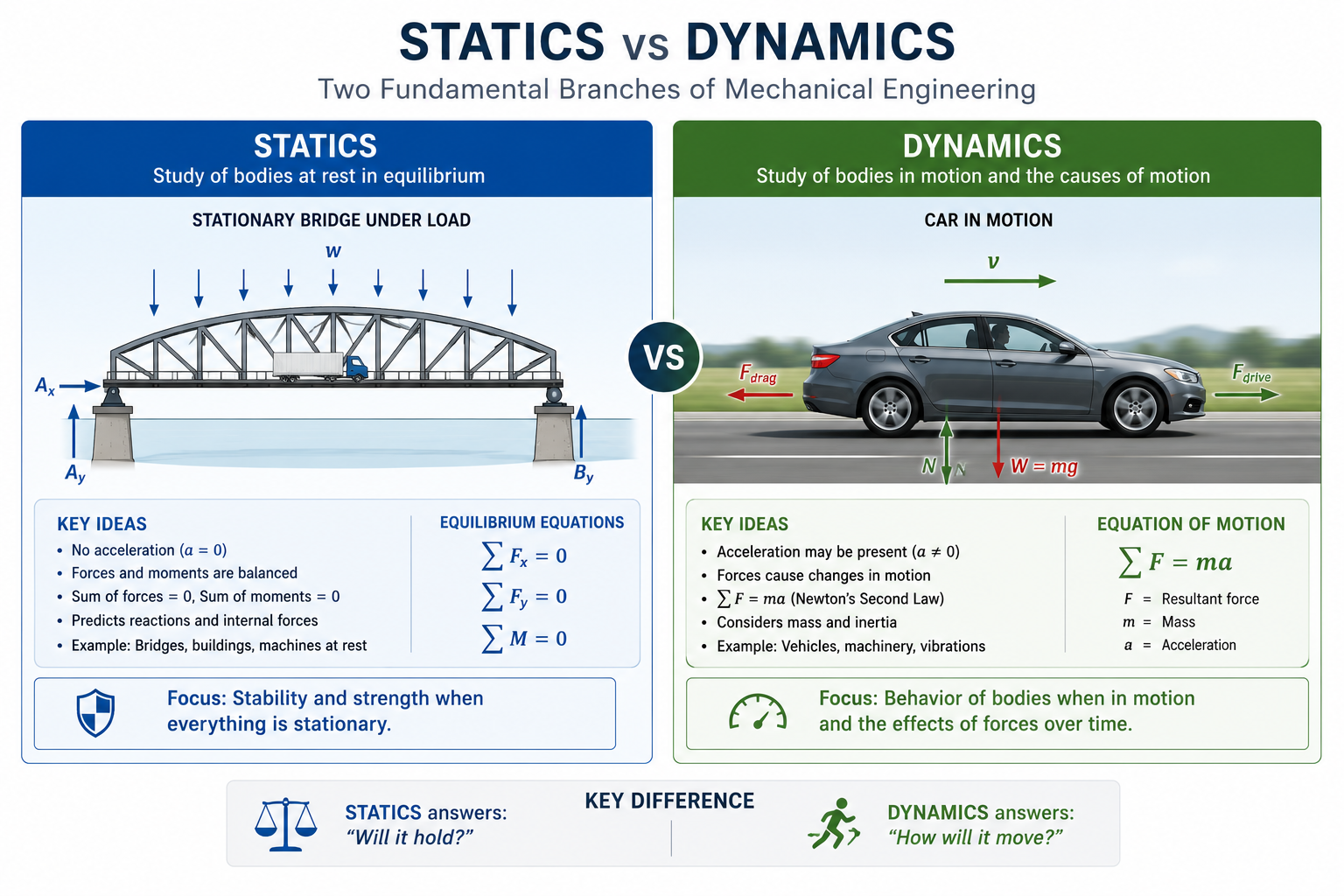
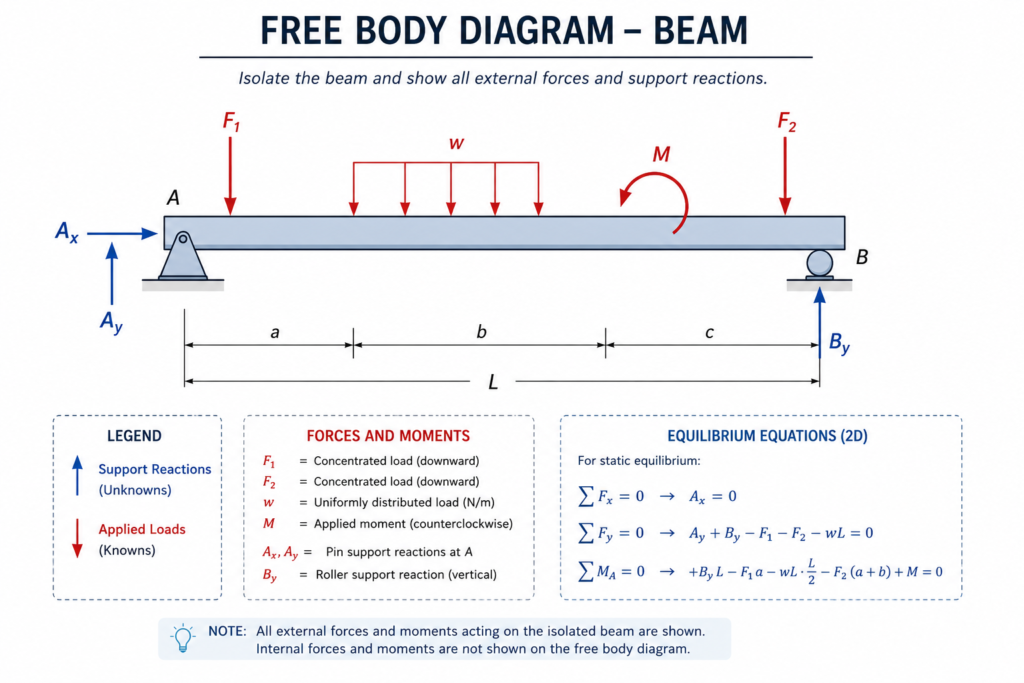
    Every structure that stands, every machine that moves, and every vehicle that travels owes its safe and predictable behaviour to one foundational discipline: engineering mechanics. It is the scientific backbone of engineering, the toolkit that allows engineers to move from “I think this will hold” to “I can prove this will hold, here is the calculation.”

    And yet, for many engineering students encountering it for the first time, engineering mechanics can feel abstract, disconnected from the real world, or simply overwhelming. A subject full of vectors, free body diagrams, Newton’s laws, and equilibrium equations does not always arrive with a clear sense of why it matters or how it connects to the things engineers actually build.

    This guide fixes that. It explains engineering mechanics from the ground up: what it is, how it is structured, what each branch covers, how its principles are applied in practice, which tools engineers use to apply them, and how mastery of the subject translates into a professional engineering career. Whether you are a first-year student facing your first mechanics module, a professional refreshing your foundations, or simply someone who wants to understand the science behind the built world, this is the most complete and readable explanation you will find.

    Free body diagram example showing a simply supported beam with applied loads, pin support reaction, and roller support reaction in engineering mechanics
    Quick Answer:  Engineering mechanics is the branch of applied science that uses the principles of physics and mathematics to predict and analyse how physical bodies respond to forces, motion, and deformation. It is the foundational discipline of virtually all engineering fields and is divided into three primary branches: statics (bodies in equilibrium), dynamics (bodies in motion), and mechanics of materials (how materials deform and fail under load).

    What Is Engineering Mechanics? A Clear Definition

    Engineering mechanics is the application of the principles of classical mechanics, a branch of physics, to solve practical engineering problems. It deals with the behaviour of physical bodies when subjected to forces or displacements, and the subsequent effects those forces and displacements have on the bodies and their surrounding environments.

    The word “engineering” in engineering mechanics is important. Pure or theoretical mechanics asks: “What happens?” Engineering mechanics asks: “What happens, and how do we use that knowledge to design something safe, efficient, and reliable?” The distinction is the difference between scientific knowledge and the professional application of that knowledge.

    At its core, engineering mechanics is concerned with three fundamental physical quantities: force, motion, and deformation. Every problem in engineering mechanics ultimately reduces to understanding how these three quantities interact in a specific physical situation.

    Simple Everyday Example:  When you sit on a chair, engineering mechanics explains why the legs do not buckle (statics), why the chair does not vibrate excessively when you move (dynamics), and why the material of the chair deforms slightly but springs back when you stand up (mechanics of materials). All three branches of engineering mechanics are at work simultaneously in that single, unremarkable act.

    The Full Map of Engineering Mechanics: How It Is Structured

    Most introductory resources present engineering mechanics as simply “statics and dynamics”. That is a significant oversimplification. The full discipline is structured as a hierarchy of sub-fields, each building on the one before it.

    Infographic comparing statics (bridge under static load) and dynamics (vehicle in accelerating motion) as the two primary branches of engineering mechanics.
    LevelSub-FieldWhat It StudiesPrerequisite
    FoundationClassical MechanicsThe general science of motion, force, and matter: Newton’s Laws, conservation of momentum, energyMathematics (vectors, calculus, differential equations)
    Primary Branch 1Rigid Body MechanicsBodies that do not deform under load: all statics and most dynamics problemsClassical mechanics
    Sub-branch 1aStaticsForces on bodies in equilibrium (at rest or constant velocity)Rigid body mechanics
    Sub-branch 1bDynamics: KinematicsDescription of motion (displacement, velocity, acceleration) without reference to forceStatics
    Sub-branch 1cDynamics: KineticsForces that cause or result from motion; Newton’s 2nd Law applied to moving bodiesKinematics
    Sub-branch 1dVibrationsOscillatory motion in mechanical systems; forced and free vibrations, resonanceKinetics
    Primary Branch 2Deformable Body Mechanics (Mechanics of Materials)How real materials stretch, compress, bend, and fail under loadStatics
    Sub-branch 2aStress and Strain AnalysisInternal force distribution and deformation in loaded bodiesMechanics of materials
    Sub-branch 2bFracture and Fatigue MechanicsCrack propagation, fatigue life prediction, failure analysisStress and strain analysis
    Sub-branch 2cContinuum MechanicsGeneralised treatment of both solid and fluid deformation under loadAdvanced mathematics
    Primary Branch 3Fluid MechanicsHow liquids and gases respond to forces; pressure, flow, viscosity, turbulenceClassical mechanics
    Sub-branch 3aHydrostaticsFluids at rest: pressure distribution, buoyancy, forces on submerged surfacesFluid mechanics
    Sub-branch 3bHydrodynamics / CFDFluids in motion: Bernoulli’s equation, pipe flow, aerodynamics, turbulenceHydrostatics

    This hierarchy matters because it explains the logical order in which engineering mechanics is taught. You cannot understand dynamics without statics. You cannot understand mechanics of materials without statics. You cannot understand vibrations without dynamics. The subject is hierarchical by nature, which is why first-year engineering students universally encounter statics before any other engineering mechanics topic.

    Why Engineering Mechanics Is Taught First

    Almost every accredited engineering degree in the world, regardless of whether it is mechanical, civil, aerospace, structural, chemical, or industrial, includes engineering mechanics in its first or second semester. This is not a coincidence or an academic tradition preserved from habit. There are precise and compelling reasons why engineering mechanics occupies this foundational position.

    It Is the Language of Engineering Analysis

    Engineering mechanics provides the conceptual vocabulary and analytical framework that every other engineering subject uses. Structural analysis uses statics. Machine design uses dynamics and mechanics of materials. Thermodynamics uses concepts of force and energy from mechanics. Fluid mechanics is itself a branch of engineering mechanics. Without a solid foundation in engineering mechanics principles, none of the more advanced engineering subjects can be properly understood.

    It Develops the Problem-Solving Mindset Engineering Requires

    Engineering mechanics is one of the most rigorous training grounds for the analytical problem-solving approach that all engineering practice demands. The discipline requires students to extract the physically relevant information from a real-world situation, draw a free body diagram, write the governing equations, solve for unknowns, check the result for physical plausibility, and present a clear, defensible answer. This disciplined problem-solving loop is the method all engineers use, regardless of their specialism.

    It Instils the Habit of Quantification

    A core engineering habit is that gut feelings and intuitions must always be tested against numbers. Engineering mechanics is where engineers first learn to be quantitative about the physical world: to ask not just “will this beam bend?” but “by how much will it deflect under this load, and is that deflection within the allowable limit?” This habit of quantification is what distinguishes professional engineering from guesswork.

    Historical Context:  The formalisation of engineering mechanics as a taught discipline dates to the 18th century and the work of mathematicians and physicists including Leonhard Euler, Joseph-Louis Lagrange, and later Augustin-Louis Cauchy. Euler’s equations of motion for rigid bodies, Lagrange’s analytical mechanics, and Cauchy’s stress tensor are all contributions that still appear, in simplified form, in first-year engineering mechanics textbooks today.

    Newton’s Laws of Motion: The Engine of Engineering Mechanics

    The entire edifice of engineering mechanics rests on three laws formulated by Sir Isaac Newton in 1687. Understanding these laws at the level of a working engineer, not just a physics student, is the single most important conceptual foundation in the discipline.

    Newton’s First Law: The Law of Inertia

    A body remains at rest, or continues to move in a straight line at constant velocity, unless acted upon by a net external force.

    Engineering application: This law is the conceptual foundation of statics. If a structure is at rest, the net force and net moment acting on it must both equal zero. That is the condition of static equilibrium, and it is the governing principle for every static analysis in structural and mechanical engineering. It is also why a satellite in orbit does not need continuous thrust to stay in motion: there is no net force opposing it in the vacuum of space.

    Newton’s Second Law: The Law of Acceleration

    The net force acting on a body is equal to the product of its mass and its acceleration: F = ma.

    Engineering application: This is the governing equation of kinetics, the branch of dynamics that deals with forces and motion. It is used to calculate the braking distance of a vehicle, the thrust required to accelerate a rocket, the force on a connecting rod in a reciprocating engine, and the loads transmitted through a vehicle suspension system during a pothole impact. It is perhaps the single most applied equation in all of mechanical engineering.

    Newton’s Third Law: The Law of Action and Reaction

    For every action there is an equal and opposite reaction.

    Engineering application: This law explains why a rocket accelerates in one direction by expelling mass in the other. It explains why a beam exerts an upward reaction force on a support equal to the downward load the beam carries. It is why the analysis of forces in any connected system must account for reaction forces at every joint, support, and contact point. In structural analysis, identifying and correctly calculating reaction forces is one of the most fundamental skills a student of engineering mechanics must develop.

    Newton’s LawStatementPrimary Mechanics BranchKey Engineering Applications
    First Law (Inertia)A body at rest or constant velocity has zero net forceStaticsStructural support design, bridge analysis, building load calculations, static equilibrium of machines
    Second Law (F = ma)Net force equals mass times accelerationDynamics (Kinetics)Vehicle braking, engine load analysis, rocket propulsion, crash mechanics, earthquake response
    Third Law (Action-Reaction)Every force has an equal and opposite reaction forceStatics and DynamicsReaction forces at supports, joint loads in trusses, thrust and propulsion, ground contact forces

    Branch 1: Statics Explained in Full

    Statics is the branch of engineering mechanics that studies the behaviour of bodies under forces that produce a state of equilibrium: a condition where there is no net force and no net moment (turning effect) acting on the body. In simple terms, statics is the study of things that are not accelerating.

    The name “statics” can be misleading. A body does not need to be literally stationary to be in static equilibrium. A car travelling at constant velocity on a straight road is in dynamic equilibrium: the driving force exactly balances the drag and rolling resistance, producing zero net force and zero acceleration. Statics applies to both these situations.

    The Two Conditions of Static Equilibrium

    For any body to be in static equilibrium, two conditions must be simultaneously satisfied:

    • The sum of all forces acting on the body must equal zero (translational equilibrium: the body does not accelerate in any direction).
    • The sum of all moments (torques) acting on the body must equal zero (rotational equilibrium: the body does not rotate).

    In two-dimensional problems (the vast majority of introductory statics), this produces three scalar equations: the sum of forces in the x-direction equals zero, the sum of forces in the y-direction equals zero, and the sum of moments about any chosen point equals zero. These three equations can be used to solve for up to three unknown forces or reactions.

    Core Concepts in Statics

    Force vectors and resultants: All forces are vectors: they have both magnitude and direction. When multiple forces act on a body, they can be combined into a single resultant force using vector addition.

    Moments and torques: A moment is the turning effect of a force about a point. It is calculated as the product of the force magnitude and the perpendicular distance from the line of action of the force to the point (the moment arm). Moments are responsible for bending in beams and rotation in mechanisms.

    Support reactions: Real structures are supported in ways that prevent certain types of motion. A pin support prevents translation but allows rotation. A fixed support prevents both translation and rotation. Engineering mechanics provides the tools to calculate the reaction forces and moments at these supports.

    Trusses and frames: A truss is a structure made of straight members connected at joints, designed to carry loads efficiently. The method of joints and the method of sections are standard techniques in statics for determining the forces in individual truss members.

    Friction: Coulomb friction is the tangential resistance force between surfaces in contact. Statics includes the analysis of systems where friction plays a role, such as wedges, screws, belt drives, and braking systems.

    Real-World Applications of Statics

    ApplicationHow Statics Is Used
    Bridge designCalculating support reactions, member forces in trusses, and stability under traffic loads
    Building structural analysisEnsuring floors, beams, and columns can safely carry occupancy and wind loads without collapsing
    Crane and lifting equipmentDetermining the stability of lifting arms and calculating loads on cables and pulleys
    Bolt and fastener designCalculating the shear and tensile loads on fasteners in mechanical assemblies
    Ergonomic tool designAnalysing the forces and moments at the hand and wrist to minimise repetitive strain risk
    Dam wall designCalculating the hydrostatic pressure distribution and overturning moment from retained water

    Branch 2: Dynamics Explained in Full

    Dynamics is the branch of engineering mechanics that deals with bodies in motion, and specifically with cases where the motion involves acceleration. While statics describes equilibrium, dynamics describes change: changing velocity, changing direction, and the forces responsible for those changes.

    Dynamics is divided into two distinct sub-areas that are often studied sequentially: kinematics and kinetics. Understanding the distinction between these two is one of the first conceptual milestones in any dynamics course.

    Kinematics: Describing Motion Without Forces

    Kinematics is the purely geometric description of motion. It deals with how position, velocity, and acceleration relate to each other and to time, without asking what forces caused the motion. A kinematic analysis of a car journey calculates displacement, speed, and acceleration purely from the geometry of the motion.

    Key kinematic quantities include: displacement (change in position), velocity (rate of change of displacement), acceleration (rate of change of velocity), and angular equivalents of each for rotating bodies. Kinematics is particularly important in the design of mechanisms: gear trains, cam-follower systems, linkages, and robotic arms, where the designer needs to understand the motion geometry before analysing the forces.

    Kinetics: Relating Forces to Motion

    Kinetics applies Newton’s Second Law (F = ma) to relate the forces acting on a body to its resulting acceleration. Where kinematics asks “how does the body move?”, kinetics asks “why does the body move that way, and what force is required to produce that motion?”

    Kinetics methods include Newton-Euler direct application (summing forces and moments), work-energy methods (relating force and displacement to changes in kinetic energy), and impulse-momentum methods (relating force and time to changes in momentum). Each method has situations where it is particularly efficient, and a skilled engineer chooses the most appropriate method for each problem.

    Vibrations: The Dynamic Behaviour of Elastic Systems

    Vibrations is a sub-discipline of dynamics that studies oscillatory motion. Almost every mechanical system vibrates to some degree when disturbed, and understanding and controlling those vibrations is critically important in engineering. Excessive vibration causes fatigue failure, noise, discomfort, and loss of precision.

    Key concepts in vibration analysis include natural frequency (the frequency at which a system naturally oscillates when disturbed), resonance (the catastrophic amplification of vibration that occurs when an excitation frequency matches the natural frequency), damping (energy dissipation that reduces vibration amplitude), and forced vibration (oscillation driven by a sustained external force).

    Famous Engineering Failure: Resonance in Action:  The Tacoma Narrows Bridge collapsed in 1940 because wind-induced oscillations matched the bridge’s natural frequency, causing resonance. The amplitude of vibration grew until the structure tore itself apart. This disaster fundamentally changed how engineers account for dynamic loads and aerodynamic effects in bridge design, and it remains the most cited example of resonance failure in engineering education worldwide.

    Real-World Applications of Dynamics

    ApplicationHow Dynamics Is Used
    Automotive engineeringCrash analysis, suspension dynamics, engine vibration, drivetrain load calculation, ABS braking system design
    Aerospace engineeringFlight dynamics, landing gear impact loads, aeroelastic analysis, satellite orbit mechanics, launch vehicle trajectory
    RoboticsJoint torque calculations, trajectory planning, dynamic stability of walking robots, end-effector force control
    Rotating machineryBalancing of rotating components, shaft critical speeds, bearing load analysis in turbines and motors
    Earthquake engineeringDynamic response of structures to ground motion; resonance avoidance in building and bridge design
    Sports engineeringBiomechanical analysis of athletic motion; equipment dynamics in golf clubs, tennis rackets, bicycle frames

    Branch 3: Mechanics of Materials (Strength of Materials) Explained

    Statics and dynamics treat bodies as rigid: they analyse forces and motion without considering how the material of a body deforms under those forces. Mechanics of materials (also called strength of materials) removes that simplification and asks: given the forces a component must carry, how does the material actually deform, and will it survive?

    This branch of engineering mechanics bridges the gap between theoretical statics and practical design. Knowing the forces on a beam from a statics analysis is only the first step. The second step, which mechanics of materials provides, is determining whether a given material and cross-sectional shape can carry those forces without yielding, fracturing, or deflecting beyond acceptable limits.

    Stress and Strain: The Language of Material Behaviour

    Stress is the internal force per unit area within a material, measured in Pascals (Pa) or pounds per square inch (psi). It represents how intensely a material is being loaded at any given point. Strain is the ratio of deformation to original dimension: a dimensionless measure of how much the material has changed shape relative to its unloaded state.

    The relationship between stress and strain is described by a material’s stress-strain curve. In the elastic region (below the yield strength), stress and strain are proportional, described by Hooke’s Law: stress = E x strain, where E is the Young’s modulus of elasticity, a material property describing stiffness. Beyond the yield point, permanent (plastic) deformation occurs.

    Stress-strain curve diagram for a typical engineering material showing elastic region, yield strength, plastic deformation, and ultimate tensile strength

    Types of Stress in Engineering Components

    • Axial (normal) stress: Stress acting perpendicular to a cross-section, caused by tensile or compressive forces along a member’s axis. Applicable to columns, tie rods, and fasteners.
    • Shear stress: Stress acting parallel to a cross-section, caused by forces that tend to cause sliding failure. Critical in bolts, welds, and shaft keyways.
    • Bending stress: Stress distribution across the cross-section of a beam due to a bending moment. Maximum at the outer fibres, zero at the neutral axis. Governs the design of most structural beams and shafts.
    • Torsional stress: Stress caused by twisting moments (torques) applied to shafts. Critical in drive shafts, bolts, and any rotating component.
    • Combined loading: Most real components experience several stress types simultaneously. Combined loading analysis and failure criteria such as Von Mises and Tresca determine whether a component will survive the combined stress state.

    Buckling: The Failure Mode Unique to Compression

    Buckling is a sudden failure mode that can occur in slender compression members (columns) well below the material’s yield stress. It is a stability failure, not a strength failure: the column becomes geometrically unstable and bends sideways catastrophically. Euler’s buckling formula gives the critical compressive load above which a column will buckle, and it is one of the most important results in structural engineering.

    Branch 4: Fluid Mechanics as Part of Engineering Mechanics

    Fluid mechanics is the branch of engineering mechanics that studies the behaviour of fluids (liquids and gases) under the action of forces. It is sometimes treated as a standalone discipline, but it is deeply rooted in the same physical principles (Newton’s laws, conservation of energy, conservation of mass) that govern solid mechanics.

    Engineers encounter fluid mechanics problems in an enormous range of contexts: the flow of water through pipes in a building, the aerodynamics of a vehicle body, the lubrication of a bearing, the cooling of a computer chip, the thrust generated by a jet engine, and the pressure distribution on a dam wall. Without a working understanding of fluid mechanics principles, mechanical and civil engineers could not design any of these systems.

    Hydrostatics vs. Hydrodynamics

    Hydrostatics deals with fluids at rest. Its primary concerns are pressure distribution in stationary fluids, buoyancy forces on submerged objects (described by Archimedes’ principle), and forces on submerged surfaces such as dam walls and tank floors.

    Hydrodynamics (fluid dynamics) deals with fluids in motion. It analyses how velocity, pressure, and density change through a flowing fluid system. Bernoulli’s equation is the most famous result of fluid dynamics, relating fluid speed, pressure, and elevation in an ideal (frictionless, incompressible) flow. Real flows involve viscosity and turbulence, requiring the full Navier-Stokes equations, which can generally only be solved numerically using Computational Fluid Dynamics (CFD) software.

    Branch 5: Continuum Mechanics and Advanced Applications

    Continuum mechanics is the generalised mathematical framework that treats both solid and fluid mechanics within a single unified theory. It assumes that matter is continuously distributed throughout a body (as opposed to treating materials as collections of discrete atoms), and it uses tensor mathematics to describe stress, strain, and deformation in three dimensions.

    Continuum mechanics provides the theoretical foundation for advanced finite element analysis, computational fluid dynamics, and the analysis of complex materials such as polymers, biological tissues, and composite materials that do not behave in the simple linear-elastic manner assumed by introductory mechanics of materials.

    While continuum mechanics is an advanced topic typically encountered at postgraduate level, its practical consequences appear in everyday engineering tools. When a mechanical engineer uses ANSYS or Abaqus to run a finite element analysis on a complex 3D part, the mathematical engine underneath that simulation is built on continuum mechanics principles.

    Free Body Diagrams: The Most Important Tool in Engineering Mechanics

    If there is one practical skill that is absolutely central to engineering mechanics, it is the ability to draw an accurate free body diagram (FBD). An FBD is a simplified sketch of a body or system, isolated from its surroundings, showing all the external forces and moments acting on it. It is the engineer’s method of translating a complex physical situation into a tractable mathematical problem.

    How to Draw a Free Body Diagram: Step by Step

    1. Identify the body of interest: Decide clearly which object or system you are analysing. Draw it in isolation, separated from everything it contacts.
    2. Identify all external forces: Include applied loads (weights, pressures, applied forces), support reactions (from pins, rollers, fixed supports), and contact forces (friction, normal contact forces at surfaces).
    3. Represent each force as a vector: Show the direction, line of action, and point of application of each force. Label each force with a symbol (F1, W, R_A, etc.).
    4. Establish a coordinate system: Choose x and y axes (and z for 3D problems) to resolve forces into components.
    5. Write the equilibrium equations: For statics, set sum of forces and sum of moments equal to zero. For dynamics, set sum of forces equal to ma (Newton’s Second Law).
    6. Solve for unknowns: Use the equations to calculate unknown forces, reactions, or accelerations.
    Pro Tip:  The quality of a free body diagram determines the quality of the subsequent analysis. An incomplete or incorrectly drawn FBD will produce wrong answers even with perfect mathematics. Experienced engineers draw FBDs carefully, checking that every contact surface, every support, and every applied load is accounted for before writing a single equation. This habit, developed in engineering mechanics courses, is one of the most transferable analytical skills in the entire engineering curriculum.

    Engineering Mechanics vs. Theoretical Mechanics: What Is the Difference?

    A question that occasionally arises is: how does engineering mechanics differ from theoretical or classical mechanics as studied by physicists?

    AspectEngineering MechanicsTheoretical / Classical Mechanics
    Primary GoalProvide tools to design and analyse safe, functional engineering systemsUnderstand the fundamental laws governing physical reality
    Mathematical DepthApplied mathematics: vectors, basic calculus, differential equationsAdvanced mathematics: Hamiltonian mechanics, Lagrangian mechanics, tensor calculus
    Approach to ProblemsIdealised models designed to be tractable and practically usefulGeneralised, abstract formulations applicable to all physical systems
    Treatment of ConstraintsPractical support conditions, friction, and contact modelled pragmaticallyHolonomic and non-holonomic constraints treated with full generality
    OutputForces, stresses, deflections, accelerations: numbers that inform design decisionsEquations of motion, conservation laws, symmetry principles: fundamental understanding
    Who Studies ItAll engineering students; foundation of engineering practicePhysics students, applied mathematicians, research engineers at advanced level

    Engineering Mechanics vs. Mechanical Engineering: Understanding the Distinction

    These two terms are frequently confused, even by people within the engineering profession. The distinction is clear and important.

    Engineering mechanics is a subject or scientific discipline: a specific body of knowledge about forces, motion, and deformation. It is a foundational subject studied across many engineering programs.

    Mechanical engineering is a professional field and degree program: a comprehensive engineering discipline that uses engineering mechanics as one of its foundational tools, alongside thermodynamics, fluid mechanics, manufacturing, materials science, design, and control systems.

    The analogy: engineering mechanics is to mechanical engineering what grammar is to literature. You cannot write well without knowing grammar, but knowing grammar does not make you a novelist. Engineering mechanics is the grammatical foundation; mechanical engineering is the full creative and professional practice built on that foundation.

    AspectEngineering MechanicsMechanical Engineering
    What it isA foundational scientific discipline: the study of forces, motion, and deformationA professional engineering field: broad application of science to design, build, and maintain mechanical systems
    ScopeFocused: mechanics of rigid bodies, deformable bodies, and fluidsBroad: encompasses EM plus thermodynamics, design, manufacturing, controls, materials science
    Studied byStudents across all engineering disciplines in first/second yearMechanical engineering students specifically, plus relevant electives in related programs
    OutputAnalytical results: forces, stresses, deflections, motionsEngineering products: machines, systems, devices, processes
    RelationshipEngineering mechanics is a foundational component of mechanical engineeringMechanical engineering is the broader discipline that applies EM and many other tools

    How Engineering Mechanics Is Applied Across Industries

    The principles of engineering mechanics are applied in some form in virtually every industry that involves physical systems. The following examples illustrate how specific concepts from the discipline translate into real engineering work.

    IndustryEngineering Mechanics Concepts AppliedSpecific Example
    AutomotiveStatics (load paths), dynamics (crash analysis, NVH), mechanics of materials (fatigue), fluid mechanics (aerodynamics)FEA crash simulation to meet Euro NCAP safety ratings; suspension kinematics design for handling performance
    AerospaceStructural statics, flight dynamics, aeroelasticity, fracture mechanics, fluid mechanics (CFD)Wing spar stress analysis; flutter analysis to prevent resonance-induced structural failure in flight
    Civil / StructuralStatics (truss and frame analysis), dynamics (seismic response), mechanics of materials (beam design)Design of a reinforced concrete floor slab to carry specified occupancy loads with controlled deflection
    Energy (Oil, Gas, Renewables)Statics (pipe stress), dynamics (vibration of pipelines and turbines), fluid mechanics (pipe flow)Wind turbine blade structural optimisation; offshore pipeline fatigue life assessment
    Robotics and AutomationKinematics (path planning), kinetics (joint torque), statics (payload capacity)Calculation of motor torques required at each joint of a robotic arm to lift a specified load
    Biomedical / Medical DevicesStatics and mechanics of materials (implant load bearing), biomechanics (human joint forces)Hip replacement implant design: ensuring the prosthesis can survive 30 years of walking loads without fatigue fracture
    ManufacturingStatics (fixture design), dynamics (machine tool vibration), mechanics of materials (forming operations)Press tool design: calculating die forces and spring-back in sheet metal forming; avoiding chatter in CNC machining
    Consumer ProductsStatics and mechanics of materials (structural adequacy), dynamics (drop test simulation)Laptop chassis design: ensuring structural integrity under drop impact and sustained keyboard typing loads

    Modern Tools Used to Apply Engineering Mechanics

    While the principles of engineering mechanics are centuries old, the tools that engineers use to apply those principles have been transformed by computing. Modern engineering practice relies on a combination of hand analysis (for checking, scoping, and understanding) and powerful software tools (for high-fidelity analysis of complex systems).

    Finite Element Analysis (FEA) Software

    FEA software such as ANSYS, Abaqus, and SolidWorks Simulation numerically solves the governing equations of solid mechanics across complex 3D geometries by dividing them into thousands of small elements. FEA allows engineers to determine stress distributions, deflections, natural frequencies, and buckling loads in components too geometrically complex for analytical hand calculation. Proficiency in at least one FEA package is an expected skill for most structural, mechanical, and aerospace engineering roles.

    Computational Fluid Dynamics (CFD) Software

    CFD tools such as ANSYS Fluent, OpenFOAM, and STAR-CCM+ solve the Navier-Stokes equations numerically across complex fluid domains. They enable engineers to analyse airflow around vehicle bodies, thermal management in electronics, combustion in engines, and pressure drops in pipe networks, without physical wind tunnels or flow experiments in many cases.

    Multi-Body Dynamics (MBD) Software

    Multi-body dynamics tools such as Adams (MSC Software) and SIMPACK simulate the kinematic and dynamic behaviour of mechanical systems with multiple interconnected rigid or flexible bodies. They are used extensively in automotive suspension analysis, robotic mechanism design, and machinery simulation.

    Mathematical and Programming Tools

    MATLAB remains the dominant tool for engineering calculation, data analysis, and numerical simulation in academic and industrial settings. Python is increasingly used for engineering calculation scripting, particularly in research and simulation automation. Both are tools that any modern engineer working in analysis and simulation should be proficient with.

    Industry Trend:  The integration of AI and machine learning into engineering simulation workflows is accelerating. Physics-informed neural networks (PINNs), for example, use machine learning to solve partial differential equations at speeds that traditional FEA cannot match. Mechanical engineers who understand both the classical mechanics principles and the emerging AI-assisted simulation tools will be significantly better positioned in the engineering job market over the next decade.

    Career Paths Built on Engineering Mechanics

    Mastery of engineering mechanics is the entry qualification for a range of highly specialised and well-compensated engineering career paths. The following roles are directly and explicitly built on engineering mechanics expertise.

    Career RoleIndustryMechanics Knowledge Central To the RoleTypical Tools
    Structural Analyst / Stress EngineerAerospace, automotive, defence, energyStatics, mechanics of materials, FEA, fracture mechanics, fatigue analysisANSYS, Nastran, Abaqus, hand calculation
    Dynamics / NVH EngineerAutomotive, aerospace, rotating machineryDynamics, vibrations, modal analysis, transfer function analysisMATLAB, Adams, ANSYS, experimental modal testing equipment
    CFD EngineerAerospace, automotive, energy, HVACFluid mechanics, heat transfer, boundary layer theoryANSYS Fluent, OpenFOAM, STAR-CCM+, Python
    Robotics / Mechanisms EngineerRobotics, automation, medical devicesKinematics, kinetics, rigid body dynamics, mechanism synthesisAdams, SolidWorks, MATLAB/Simulink, ROS
    Geotechnical / Civil Structural EngineerCivil, infrastructure, constructionStatics, soil mechanics, structural analysis, mechanics of materialsAutoCAD Structural, SAP2000, ETABS
    Biomechanics EngineerMedical devices, sports science, rehabilitationStatics, dynamics, mechanics of materials, continuum mechanicsANSYS, Mimics, custom FEA code, motion capture systems
    Research / Academic EngineerUniversities, government labs, R&D centresAll branches of engineering mechanics at advanced levelCustom simulation codes, MATLAB, Python, FEA/CFD suites

    MIT OpenCourseWare provides free access to engineering mechanics course materials

    Frequently Asked Questions (FAQ)

    What is engineering mechanics in simple terms?

    Engineering mechanics is the science of how forces affect physical objects: whether they make things move, deform, or stay still. It uses the principles of physics and mathematics to predict how structures, machines, and materials will behave under loads, allowing engineers to design things that are safe, reliable, and efficient. It is taught to all engineering students because its principles underpin virtually every other engineering discipline.

    What are the main branches of engineering mechanics?

    The main branches of engineering mechanics are: statics (forces on bodies in equilibrium), dynamics (forces on bodies in motion, subdivided into kinematics and kinetics), mechanics of materials (how materials deform and fail under load), and fluid mechanics (how liquids and gases respond to forces). Advanced topics include vibrations, fracture mechanics, and continuum mechanics.

    What is the difference between statics and dynamics?

    Statics studies bodies that are in equilibrium: bodies at rest or moving at constant velocity, where the net force and net moment are both zero. Dynamics studies bodies that are accelerating: bodies whose velocity is changing in magnitude or direction, driven by a net unbalanced force. Statics is generally taught before dynamics because static equilibrium analysis is a prerequisite for most dynamic analysis methods.

    What is a free body diagram in engineering mechanics?

    A free body diagram (FBD) is a simplified sketch of a body or system, drawn in isolation from its surroundings, that shows all the external forces and moments acting on it. FBDs are the primary analytical tool in engineering mechanics: they translate a complex physical situation into a set of forces and moments that can be expressed as mathematical equations and solved. Drawing accurate free body diagrams is one of the most important practical skills in all of engineering analysis.

    What is the difference between kinematics and kinetics?

    Kinematics describes motion (position, velocity, acceleration) without reference to the forces that cause it. It answers the question: how does the body move? Kinetics relates forces to motion through Newton’s Second Law (F = ma). It answers the question: what forces are required to produce this motion, or what motion results from these forces? Kinematics is studied first because understanding motion geometry is a prerequisite for applying force-motion relationships in kinetics.

    Why is engineering mechanics important?

    Engineering mechanics is important because it provides the mathematical and physical tools that allow engineers to prove a design will work safely before anything is built. Without it, structural collapses, mechanical failures, and unsafe products would be far more common. It is the analytical foundation of civil, mechanical, aerospace, and structural engineering, and its principles are applied in virtually every physical engineering system in the world. Mastery of engineering mechanics is also one of the strongest predictors of success in advanced engineering study and practice.

    What is the difference between engineering mechanics and mechanical engineering?

    Engineering mechanics is a subject: a specific scientific discipline covering forces, motion, and deformation, studied as a foundational course across all engineering programs. Mechanical engineering is a professional field and degree program that is much broader in scope, covering thermodynamics, fluid mechanics, manufacturing, design, materials science, and control systems in addition to engineering mechanics. Engineering mechanics is one foundational component of mechanical engineering, not the entirety of it.

    How is engineering mechanics used in real life?

    Engineering mechanics is used in real life every time an engineer designs or analyses a physical system. It determines whether a bridge can carry traffic loads, how much a gear shaft will deflect under torque, what force an aircraft landing gear must withstand on touchdown, whether a medical implant will last 30 years under cycling body loads, and how quickly a robotic arm can accelerate its end effector without tipping over. Virtually every engineering structure, machine, and device in the modern world has been analysed using the principles of engineering mechanics.

    Conclusion

    Engineering mechanics is not simply an academic subject to be passed and forgotten. It is the analytical foundation on which the entire built world rests. Every bridge, every aircraft, every machine, and every medical implant exists because an engineer understood and correctly applied the principles of forces, motion, and deformation to predict how those objects would behave in the real world.

    From Newton’s three laws that started it all, to the full suite of statics, dynamics, mechanics of materials, and fluid mechanics that make up the modern discipline, engineering mechanics provides engineers with the vocabulary, tools, and intellectual discipline to move from intuition to proof: from “I think this will work” to “I can demonstrate with mathematical certainty that this will work safely.”

    Mastering it takes genuine effort and a willingness to engage with the mathematics carefully and systematically. But the return on that investment, in analytical capability, professional versatility, and career progression, is unmatched by almost any other component of an engineering education.

    Continue building your engineering foundation. Read our guide to the Nature of Mechanical Engineering Explained, explore What Does a Mechanical Engineer Do? in practice, or discover the CAD and simulation tools that modern engineers use to apply these mechanics principles every day.