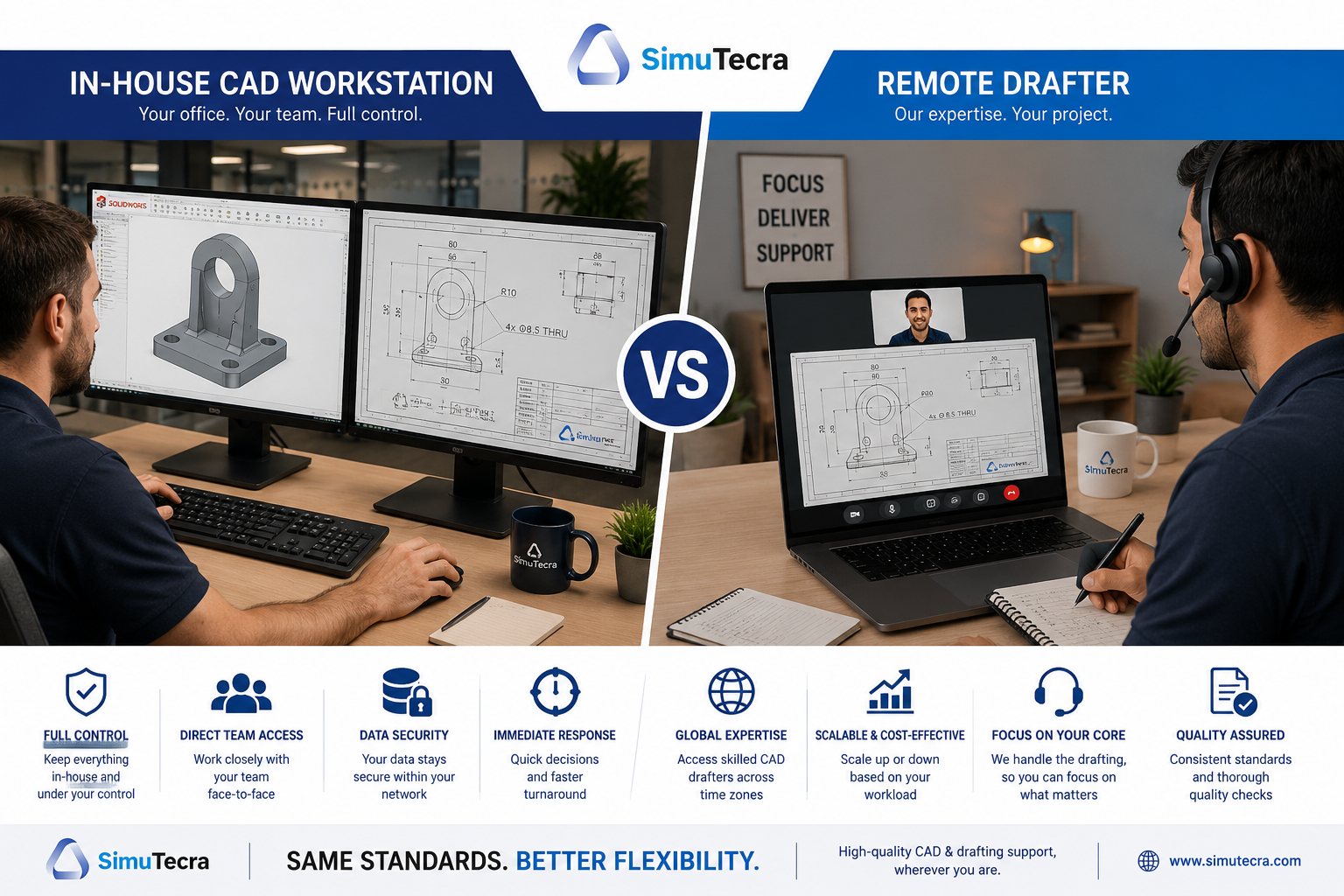
A mid-size mechanical engineering firm in Ohio recently found itself in a familiar bind. Their one full-time CAD drafter was maxed out, a large product redesign project had just landed, and the choice was either hire someone new or send overflow work to an outside firm. The owner asked what most business leaders eventually ask: which model actually makes more sense for us?
It is a question that sounds simple but gets complicated fast. The answer changes depending on how much drafting work you have, how sensitive your designs are, whether your projects are continuous or cyclical, and what your long-term business strategy looks like. Most articles on this topic give you a pros and cons list and leave the decision entirely to you. This guide does something different.
We have researched real salary benchmarks, actual outsourcing cost structures, and the practical operational realities that both models create. By the end, you will have a concrete framework for making the right call for your specific business, including a decision scorecard you can apply immediately.
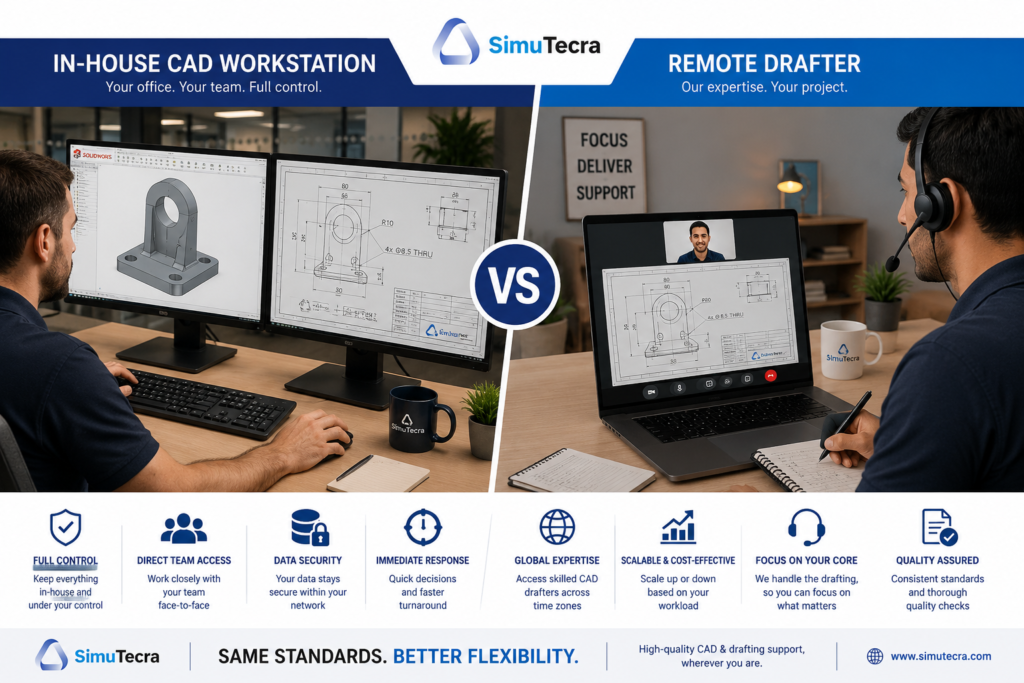
1. What Is CAD Drafting and Why the Sourcing Decision Matters
CAD drafting is the process of creating precise technical drawings and 2D or 3D models using computer-aided design software such as AutoCAD, SolidWorks, Revit, CATIA, or MicroStation. These drawings serve as the authoritative technical language between designers, engineers, fabricators, contractors, and clients. A floor plan, a mechanical assembly drawing, an HVAC layout, a structural detail sheet: all of these are products of CAD drafting.
For most businesses in engineering, architecture, construction, and manufacturing, CAD drafting is not an optional activity. It underpins every project. The question is not whether to do it, but how to staff it.
Getting this decision wrong is expensive. Hire a full-time drafter when your workload does not justify it, and you are paying for idle capacity. Outsource when you should not, and you risk IP exposure, communication failure, and quality inconsistency. The right answer depends on a careful analysis of your workload pattern, budget, project complexity, and strategic direction.
2. What the Top-Ranking Articles on This Topic Miss
Before building this guide, we reviewed the articles currently ranking at the top of search results for this topic. They share a consistent set of weaknesses that leave business owners without the information they actually need to make this decision.
- No real cost data: Most articles say outsourcing ‘saves money’ without citing any salary figures, hourly rates, or total cost calculations. We have included current 2025-2026 market data from salary.com, Glassdoor, and Indeed.
- No hybrid model: Every top-ranking article treats this as a binary either/or choice. The reality is that most growing engineering businesses use a hybrid approach, and we cover exactly how that works.
- No decision framework: Readers get a list of advantages and disadvantages but no structured way to weigh them against their specific situation. This guide includes a scored decision matrix you can actually use.
- No vetting guidance: Articles that recommend outsourcing give no practical advice on how to find, evaluate, and manage an outsourcing partner responsibly.
- No IP protection strategies: Intellectual property risk is mentioned as a concern but never addressed with actionable solutions like NDAs, data handling standards, or contractual protections.
- No transition guidance: None of the top-ranking articles address what happens when your business needs to change models, either adding in-house capacity or transitioning to outsourcing.
This guide fills those gaps directly.
3. The Real Cost of In-House CAD Drafting
The most common mistake businesses make when evaluating in-house CAD staffing is looking only at salary. Salary is the largest line item, but the true cost of an in-house employee runs significantly higher when you account for the full cost stack.
Current CAD Drafter Salary Benchmarks (United States, 2025-2026)
Based on data from Salary.com, Glassdoor, and Indeed as of early 2026:
| Experience Level | Annual Salary Range | Median | Hourly Rate |
|---|---|---|---|
| Entry Level (0-2 years) | $51,675 – $75,848 | $66,200 | ~$32/hr |
| Mid-Level (3-6 years) | $65,000 – $90,000 | $75,335 | ~$36/hr |
| Senior / Experienced | $75,433 – $105,809 | $91,290 | ~$44/hr |
| Specialist / Expert | $100,000 – $138,000+ | $117,900 | ~$57/hr |
Source: Salary.com, Glassdoor (May 2026). Rates vary by geography. California and Massachusetts average 10-15% above national median.
The Full Cost of an In-House Employee: Beyond Salary
When businesses calculate ‘what it costs to hire a drafter,’ they almost always undercount. A commonly accepted rule of thumb in HR is that the fully loaded cost of an employee runs 1.25 to 1.4 times their base salary, accounting for:
- Benefits (health, dental, vision): Typically 15-30% of base salary for employer contributions.
- Payroll taxes (FICA, FUTA, SUTA): Approximately 7.65% federal, plus state unemployment taxes.
- Paid time off: 10-15 days PTO plus holidays represents roughly 5-7% of total work capacity that is paid but non-productive.
- Software licenses: AutoCAD seats run $2,500 to $4,500 per year. SolidWorks with PDM ranges from $4,000 to $10,000+ per year. CATIA and similar enterprise platforms cost considerably more.
- Hardware: A capable CAD workstation costs $2,000 to $5,000 upfront with a typical 3-4 year refresh cycle.
- Training and onboarding: Industry estimates place onboarding costs at one to three months of salary. Ongoing training for software updates, new standards, or skill development adds further cost.
- Recruitment: Recruiting fees (if using an agency) run 15-20% of first-year salary. Internal recruiting time has an opportunity cost even without an agency.
| Real-world example : A business that hires a mid-level CAD drafter at $75,000/year salary is likely incurring a true annual cost of $94,000 to $105,000 when all the above factors are included. A senior drafter at $91,000 salary likely costs $113,000 to $127,000 fully loaded. |
Overhead and Utilization: The Hidden Efficiency Problem
In-house drafters have a fixed cost whether they are fully occupied or not. For businesses with cyclical project loads, this means paying for underutilized capacity during slow periods. If your drafting demand fluctuates significantly across quarters, the periods of low utilization are essentially a cost with no corresponding revenue-generating output.
At the same time, if a key drafter leaves the company, you face recruiting, onboarding, and knowledge transfer costs all over again. Industry data suggests the cost of replacing a technical employee runs between 50% and 200% of annual salary when you factor in lost productivity, recruiting fees, and training time.
4. The Real Cost of Outsourced CAD Drafting
The appeal of outsourcing is straightforward: you pay only for the work you actually need, with no payroll overhead, benefits, or idle capacity. The reality is nuanced. Outsourcing costs vary enormously depending on the provider’s location, specialization level, and engagement model.
Outsourced CAD Drafting Rate Ranges
| Provider Type / Region | Typical Hourly Rate | Strengths | Considerations |
|---|---|---|---|
| Domestic US freelancer | $45 – $95/hr | Time zone alignment, no language barrier | Higher cost, limited scale |
| Domestic US firm | $65 – $150/hr | Accountability, quality standards | Most expensive outsource option |
| India-based firm | $8 – $25/hr | Large talent pool, established industry | Time zone gap, quality varies |
| Philippines-based firm | $10 – $30/hr | English proficiency, cultural alignment | Still requires vetting |
| Eastern Europe (Poland, Romania) | $25 – $55/hr | High technical quality, EU compliance | Higher than Asian rates |
| Latin America (Mexico, Colombia) | $20 – $45/hr | Near-shore, time zone proximity to US | Growing but smaller talent pool |
| Note: Rates as of 2025-2026. Actual pricing depends on project complexity, drawing type, software required, and contract structure (hourly vs. per-sheet vs. dedicated resource). |
Hidden Costs in Outsourcing That Are Rarely Discussed
The advertised hourly rate is only part of the total outsourcing cost. Businesses that do not plan for these additional factors often find that their outsourcing savings are smaller than expected:
- Management overhead: Someone on your internal team must coordinate with the outsourcing partner, review deliverables, and manage revisions. This is real labor time with a real cost.
- Rework and revision cycles: If the outsourcing partner misunderstands your standards or specifications, correction cycles add time and cost. Proper brief writing and QC processes are essential.
- Onboarding new partners: Every time you switch providers or onboard a new firm, there is a learning curve. They need to understand your drawing standards, title block formats, layer conventions, and project context.
- Legal and compliance setup: NDAs, data handling agreements, and IP transfer clauses require legal review upfront.
- Data transfer and file management: Secure file sharing platforms, version control, and format compatibility all have costs in time and sometimes in software.
- Quality assurance: Building or buying a QA process for outsourced drawings adds cost that in-house work often absorbs implicitly.
| Key insight : A project-based outsourced drawing that appears to cost $500 may actually cost $700 or more once management time, revision cycles, and QA are accounted for. This does not make outsourcing a bad choice – it simply means the comparison to in-house cost needs to be honest and complete on both sides. |
5. In-House CAD Drafting: Advantages and Honest Disadvantages
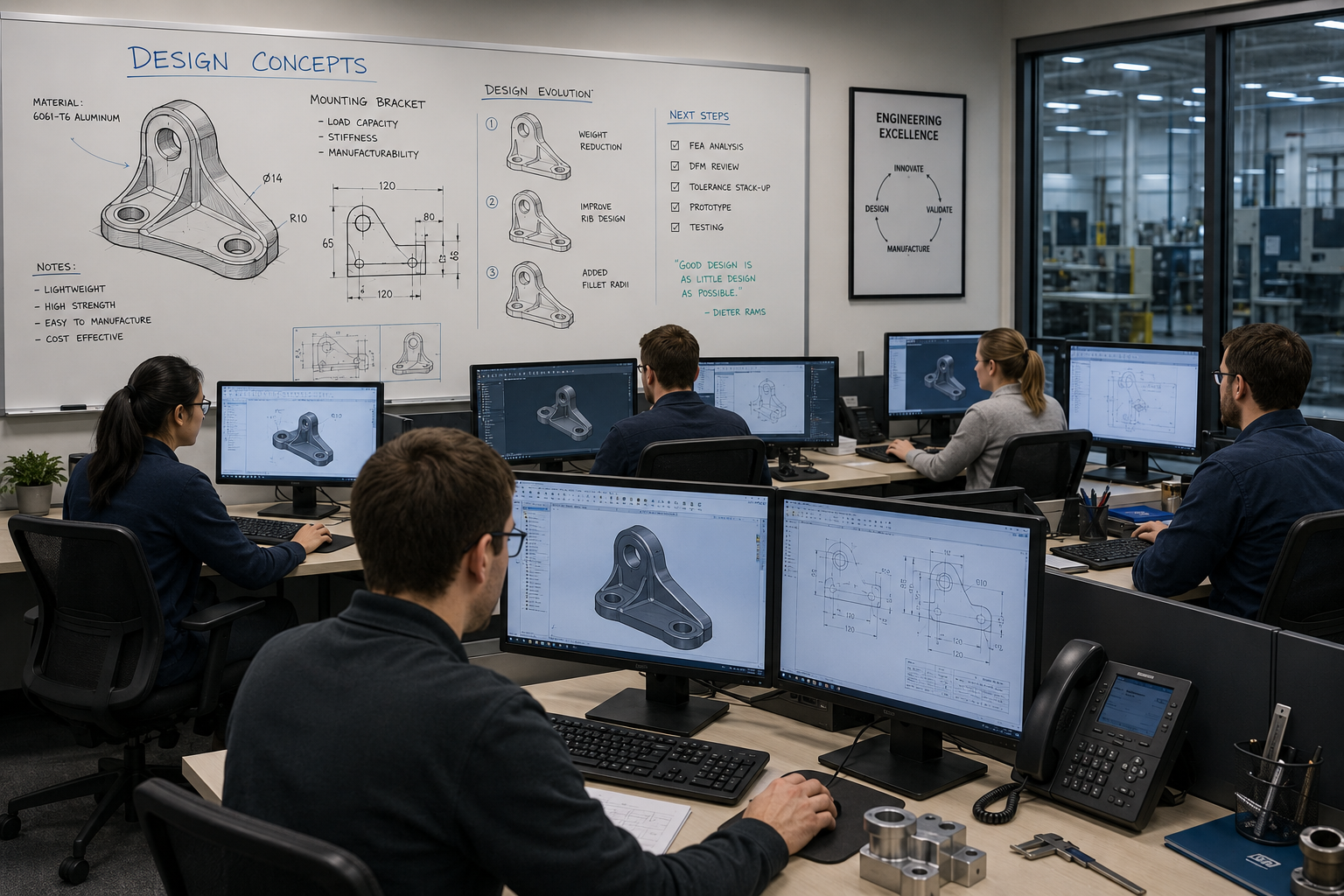
Genuine Advantages of an In-House Team
- Contextual knowledge: An in-house drafter who has worked with your team for two years understands your design standards, preferred tolerances, drawing conventions, and client preferences without being told. This institutional knowledge has real value and is genuinely difficult to replicate with an outside provider.
- Speed on urgent requests: When a last-minute client change comes in at 4 PM, an in-house drafter can respond immediately. Outsourcing introduces a communication and handoff step that adds time, even with the best partners.
- Collaboration and iteration: When engineering design and CAD drafting happen in the same room (or on the same Slack channel), iteration cycles are faster. Engineers can sketch something on a whiteboard and a drafter can model it in real time.
- Quality consistency: In-house teams develop consistent habits and standards over time. Drawing quality tends to be predictable once onboarding is complete.
- IP security: Proprietary designs and sensitive technical data stay within your organization’s own infrastructure, under your own security policies.
- Career investment: Building an in-house team allows you to develop people who grow with the business, take on more responsibility, and become genuine technical assets.
Honest Disadvantages (That Articles Rarely Acknowledge)
- Skills ceiling: A small in-house team’s expertise is bounded by who you hired. If a project requires specialized skills in, say, pressure vessel detailing or complex assembly animation, your team may simply not have that capability.
- Single point of failure: One-person CAD teams are surprisingly common in small and mid-size firms. When that person is sick, on vacation, or resigns, the entire drafting workflow stops. This is a serious operational vulnerability.
- Technology lag: Keeping an in-house team current on the latest CAD software versions, new BIM standards, and emerging tools requires dedicated investment in training. Busy teams often fall behind because there is never a ‘good time’ to upskill.
- Recruiting difficulty: Skilled CAD drafters, particularly those with mechanical or structural specializations, are not always easy to hire. In markets with strong engineering employment, competition for qualified drafters is real.
- Scalability limit: If a large project suddenly doubles your drafting workload for six months, an in-house team has limited ability to absorb the surge without significant overtime or delays.
6. Outsourced CAD Drafting: Advantages and Honest Disadvantages
Genuine Advantages of Outsourcing CAD Drafting
- Cost flexibility: You pay only for the work performed, with no fixed overhead during slow periods. For businesses with irregular drafting workloads, this is a genuine and significant financial benefit.
- Immediate access to specialization: Need BIM coordination drawings for a complex MEP project? Structural steel shop drawings for a one-off job? Outsourcing firms often have specialists in these areas ready to go, without the cost of maintaining those skills in-house year-round.
- Scalability on demand: A reputable outsourcing firm can deploy multiple drafters to a large project simultaneously, compressing timelines in ways that a small in-house team simply cannot.
- Around-the-clock production: Offshore partners in India or Southeast Asia can work while your team sleeps, creating a true follow-the-sun workflow that can significantly reduce project cycle times on deadline-driven engagements.
- Access to current software: Established CAD outsourcing firms maintain current licenses across multiple platforms. You get access to those tools without carrying the license cost yourself.
- Reduced management complexity: With a fixed-scope outsourcing arrangement, the provider manages their own team, quality control, and delivery. You own the brief and the outcome.
Honest Disadvantages (That Deserve Direct Acknowledgment)
- Communication overhead: Every instruction must be clearly documented. Ambiguities that would be resolved in 30 seconds face-to-face can become multi-day email chains with an offshore team. This is a manageable problem with good process, but it is a real one.
- Time zone challenges: A 12-hour time zone difference means that a question asked at the end of your day may not be answered until the next morning. For fast-moving projects, this rhythm can create friction.
- Knowledge transfer loss: Every time you use a new outsourcing partner, you start from scratch on standards and context. Switching partners frequently is inefficient and error-prone.
- Quality control responsibility: With in-house work, quality problems surface naturally through daily interaction. With outsourcing, you need a deliberate QC process for every deliverable, or problems may not be caught until late in the project.
- IP exposure: Proprietary designs are transmitted to external systems and sometimes to individuals in jurisdictions with different IP law frameworks. This is manageable but requires contractual and technical safeguards.
- Dependency risk: If a key outsourcing partner loses staff, changes ownership, or closes, you may face a sudden gap in your drafting capability with no internal fallback.
7. The Hybrid Model: Why the Best Answer Is Often ‘Both’
One of the most significant gaps in the existing literature on this topic is the failure to address the hybrid model seriously. The framing of ‘in-house versus outsourced’ suggests these are mutually exclusive choices. They are not, and treating them as such leads many businesses to a suboptimal decision.
The hybrid model involves maintaining a core in-house CAD capability while using outsourcing partners for specific, well-defined needs. This approach is increasingly common among mid-size engineering and architecture firms, and it often delivers better results than either pure model.
What the Hybrid Model Looks Like in Practice
- Core team for context-sensitive work: The in-house drafter or drafting team handles complex or confidential drawings, works directly with engineers and clients, manages document control, and builds institutional knowledge.
- Outsourcing for volume overflow: During peak periods or large project surges, the outsourcing partner handles defined, standardized drafting tasks with a clear brief. This avoids overtime burn and hiring cycles.
- Outsourcing for specialty disciplines: When a project requires a skill set not maintained in-house (BIM clash detection, 3D rendering, structural steel detailing), the outsourcing partner fills that gap without requiring permanent headcount.
- In-house oversight of outsourced work: The in-house team serves as QC reviewers and project coordinators for the outsourced output, ensuring it meets your standards before it enters your workflow.
| Real-world example : A UK-based architectural firm maintains two in-house CAD technicians who handle all permit drawings and client-facing documentation. During planning submission seasons, they engage an outsourcing partner in the Philippines for as-built drawing production and drawing set formatting, reducing turnaround time by approximately one week without hiring additional permanent staff. |
When the Hybrid Model Makes the Most Sense
- Workload pattern: If your drafting workload peaks predictably (end of quarter, permitting seasons, product launch cycles), hybrid is usually more cost-effective than pure in-house.
- Confidentiality stratification: If some of your work is highly sensitive and some is routine, keeping the sensitive work in-house while outsourcing routine production is a natural and efficient division.
- Growth stage: If your business is growing but not yet large enough to justify a full drafting department, a hybrid approach bridges the gap while you scale.
8. Industry-Specific Guidance
The right model varies by industry. The following guidelines reflect the practical norms and specific pressures of different sectors.
| Industry | Typical Best Fit | Key Reason | Common Outsource Use Case |
|---|---|---|---|
| Architecture / AEC | Hybrid | High project volume with cyclical peaks | As-builts, permit sets, BIM modeling |
| Mechanical / Product Mfg | In-house or Hybrid | IP sensitivity, tolerance precision, iteration speed | Overflow drafting, 3D rendering |
| Structural Engineering | Hybrid | Specialty detailing needs + standard production | Steel shop drawings, rebar detailing |
| Civil Engineering | Hybrid or Outsource | High drawing volume, standardized deliverables | Site plans, survey drawings, grading plans |
| Defense / Aerospace | In-house only | ITAR and security restrictions (see below) | N/A – regulatory prohibition |
| MEP Contracting | Outsource or Hybrid | High drawing volume, tight margins | Fabrication drawings, coordination drawings |
| Medical Device | In-house | FDA design control, quality system requirements | Typically not outsourced for IP and regulatory reasons |
| Construction Management | Outsource or Hybrid | Project-based, no sustained in-house need | Shop drawing review, record drawings |
A Note on ITAR and Export Control
For US companies in defense, aerospace, or any program involving export-controlled technical data under ITAR (International Traffic in Arms Regulations), outsourcing CAD drafting to foreign nationals or overseas firms can constitute a violation of federal law without proper export licenses. ITAR restrictions apply to the sharing of technical drawings, not just physical items. If your projects involve defense hardware, munitions, or space systems, consult your legal counsel before considering any form of offshore outsourcing. The penalties for ITAR violations are severe.
9. The Decision Framework: A Practical Scorecard
Rather than leaving you with a list of considerations, this section gives you a structured scoring approach. Rate your business against each factor below using the scale provided, then total your score to see which model best fits your current situation.
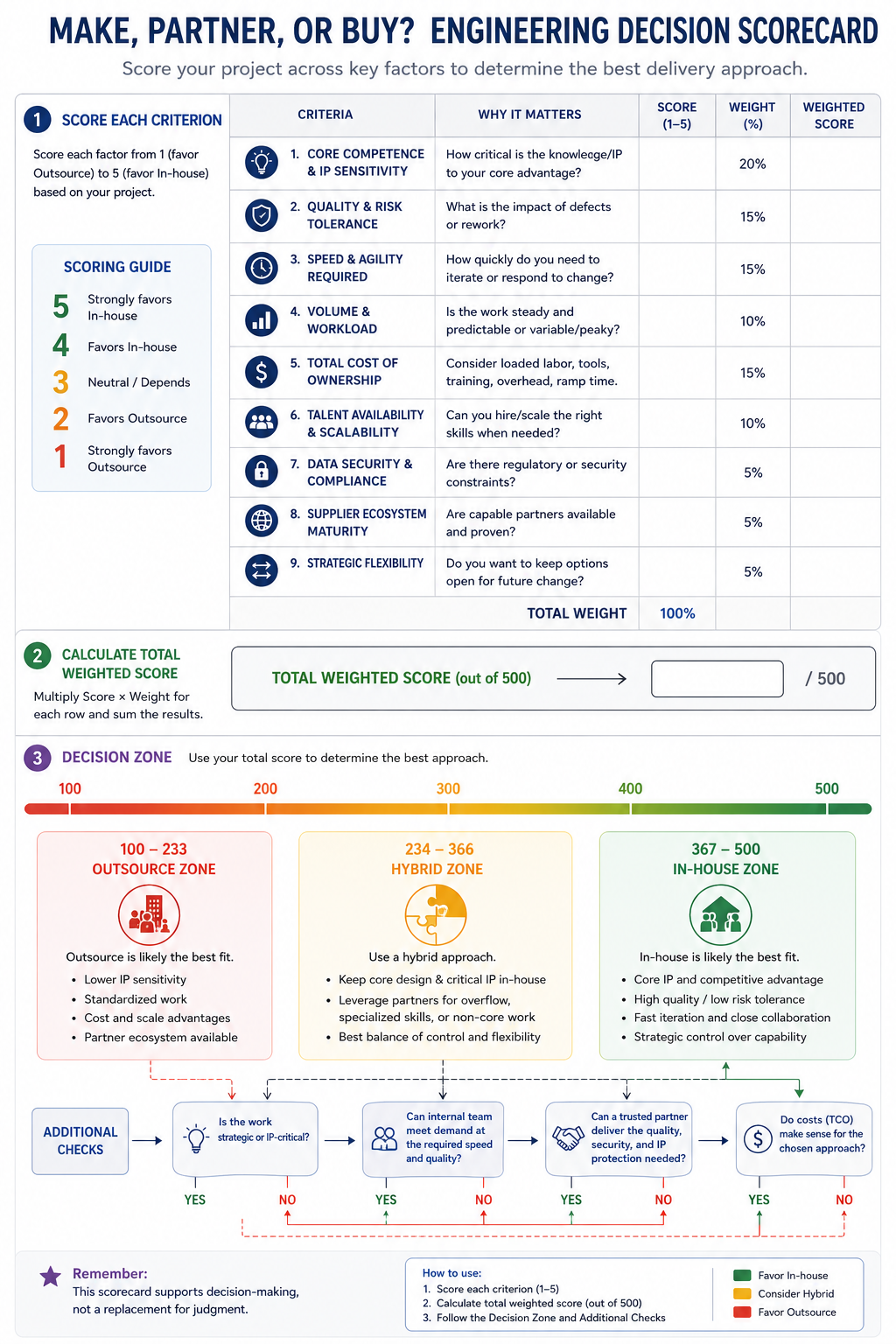
Scoring Guide: Rate Each Factor 1-3
| Factor | Score 1 (Points to Outsource) | Score 2 (Neutral / Hybrid) | Score 3 (Points to In-House) |
|---|---|---|---|
| Monthly drafting volume | Low (less than 40 hrs/month) | Medium (40-120 hrs/month) | High (120+ hrs/month) |
| Workload consistency | Highly variable / project-based | Seasonal peaks and valleys | Consistent year-round |
| IP sensitivity | Low sensitivity, generic drawings | Mixed sensitivity levels | High sensitivity, proprietary designs |
| Drawing complexity | Standardized, repeatable tasks | Mixed complexity | Complex, iterative, specialized |
| Response time needs | Days or weeks acceptable | Same-day to 48 hours | Hours – face-to-face access needed |
| Budget constraint | Minimize fixed overhead | Balance cost and quality | Can justify fixed headcount cost |
| Industry regulation | No special restrictions | Some compliance needs | ITAR / FDA / AS9100 restricted |
| Internal oversight capacity | Limited (no one to manage outsourcing) | Some management bandwidth | Sufficient to manage internal team |
| Interpretation: Total scores of 8-13 suggest outsourcing is likely the better fit. Scores of 14-19 suggest a hybrid model. Scores of 20-24 suggest in-house staffing makes the most business sense. Use this as a starting framework, not an absolute answer. |
The One Question That Clarifies Most Decisions
If you find the scorecard ambiguous, ask yourself this: Is CAD drafting a core competency of our business, or is it a support function?
If drafting is core to your value proposition (a custom fabrication shop that differentiates on drawing quality, a design-build firm that competes on speed-to-drawing), in-house capability is a strategic asset worth the investment. If drafting is a support function that enables your core work but is not the reason clients choose you, it is a strong candidate for outsourcing or hybrid treatment.
10. How to Vet and Manage an Outsourcing Partner
If your decision scorecard points toward outsourcing or a hybrid model, the quality of your outsourcing partner will determine whether the arrangement succeeds or fails. These are the criteria that experienced firms use when evaluating CAD outsourcing providers.
Vetting Criteria
- Portfolio and samplesReview actual deliverables from previous clients in your industry. Look for drawing quality, layering conventions, title block formatting, and annotation standards. Generic portfolio samples that do not reflect your type of work are a warning sign.
- Industry specializationA firm that does mechanical engineering shop drawings every day will outperform a general drafting service on mechanical work. Ask specifically about their experience with your drawing type and industry.
- Software capabilitiesConfirm the firm uses current, licensed versions of the CAD software your workflow requires. Ask about file format delivery (DWG, DXF, STEP, native CAD, PDF). Mismatched file formats create unnecessary friction.
- Communication practicesAsk how they handle questions during a project. What is their typical response time? Do they assign a dedicated project manager or coordinator? Good communication infrastructure is predictive of successful engagements.
- Quality control processAsk specifically: what does your internal QC process look like before drawings are delivered? A firm that cannot describe its QC process does not have one.
- Data security practicesAsk about their data handling protocols. Do they use encrypted file transfer? Do they have NDAs with their own staff? Are drawings stored on isolated servers or on shared infrastructure?
- ReferencesAsk for references from clients with similar project types and follow up with at least one call. A simple 10-minute reference conversation reveals more than any portfolio.
Managing an Outsourcing Partner Effectively
- Create a drawing standards brief: Document your layer conventions, title block requirements, dimension and annotation standards, and file naming rules. Share this at the start of every new engagement and update it when your standards change.
- Start with a paid pilot project: Do not commit to a large engagement without first running a smaller, lower-stakes project to evaluate the partner’s actual output quality. This is worth the extra time investment.
- Establish clear communication rhythms: Agree on communication channels (email, Slack, a project management tool), response time expectations, and who the point of contact is on both sides.
- Build a review and approval step: No outsourced drawing should enter your production workflow without a QC review by someone on your team. Build this step into your project schedule explicitly.
- Define escalation paths: If a drawing is wrong, who gets contacted? What is the correction turnaround commitment? Agree on this upfront, before problems occur.
11. Protecting Your Intellectual Property When You Outsource
IP risk is the most frequently cited concern about CAD outsourcing, and the least frequently addressed in practical terms. Here is what actually needs to happen to protect your designs.
Contractual Protections
- Non-Disclosure Agreement (NDA): Require a signed NDA before sharing any project files. The NDA should explicitly cover technical drawings, design concepts, specifications, and client information. Verify that the NDA is enforceable in the jurisdiction of both parties.
- IP ownership clause: Your contract should explicitly state that all drawings produced by the outsourcing partner are work-for-hire and that IP ownership transfers to your organization upon delivery and payment. Do not assume this by default.
- Data handling and deletion clause: Specify that the outsourcing partner must delete all project files from their systems within a defined period after project completion (typically 30-60 days). Request confirmation of deletion.
- Subcontracting restriction: Some outsourcing firms subcontract work to additional third parties without disclosure. Require written approval for any subcontracting, and ensure that subcontractors are bound by the same IP and confidentiality terms.
Technical Protections
- Use secure file transfer: Avoid emailing design files as attachments. Use encrypted file sharing platforms (ShareFile, Box with enterprise encryption, or a dedicated engineering file exchange portal).
- Watermark preliminary files: For early-stage drawings shared for review or briefing, consider using visible or embedded watermarks that identify the recipient. This does not prevent copying, but it creates a paper trail.
- Limit access to what is needed: Share only the files required for the specific task at hand. Do not provide access to your full project file library, BOM data, or client information unless directly necessary.
- Consider physical data security requirements: For highly sensitive projects, some firms require outsourced drafters to work in isolated virtual desktop environments where files cannot be downloaded locally. This is common among defense-adjacent commercial work.
12. Transition Tips: Changing Models Without Disruption
Businesses change. An outsourcing arrangement that made sense when you were a 12-person firm may need to evolve when you grow to 50 people. An in-house team built during a period of strong growth may become difficult to justify during a contraction. Here is how to manage transitions well.
Transitioning from Outsourcing to In-House
- Capture standards documentation before you hire: Use your outsourcing period to develop and document your drawing standards, approval workflows, and file management processes. This documentation becomes the onboarding foundation for your first in-house hire.
- Overlap the transition: Keep your outsourcing relationship active for 90-120 days after your in-house drafter starts. This provides overflow coverage while your new hire comes up to speed and ensures no projects are disrupted.
- Transfer institutional knowledge: Request that your outsourcing partner provide organized project file archives in a format your new hire can navigate. A clean handover file structure is worth negotiating as part of the contract wind-down.
Transitioning from In-House to Outsourcing
- Document before departure: If an in-house drafter is leaving and you are transitioning to outsourcing, ensure that all drawing standards, template files, project archives, and process documentation are organized and preserved before they leave.
- Run a parallel period: Engage your outsourcing partner while your in-house drafter is still available, even if only for a few weeks. This allows the outgoing drafter to review and provide feedback on the outsourced output quality before you are fully dependent on the new arrangement.
- Rebuild standards documentation for external use: Standards that live in a drafter’s head need to be externalized. Invest time in creating a clear drawing standards package that can be shared with any outsourcing partner.
FAQ: In-House vs Outsourced CAD Drafting
Is outsourced CAD drafting cheaper than hiring in-house?
In most cases, outsourcing is cheaper on a per-drawing or per-hour basis, particularly when comparing offshore rates to fully-loaded domestic employee costs. However, the total cost comparison is more complex than the hourly rate gap suggests. You need to account for management overhead, revision cycles, onboarding, and QA processes on the outsourcing side, and set this against the true all-in cost (not just salary) of an in-house hire. For businesses with consistent, high-volume drafting needs, in-house may reach cost parity with a well-managed outsourcing arrangement, with the added benefit of institutional knowledge and faster turnaround.
What types of CAD work should never be outsourced?
Defense and aerospace work covered by ITAR, medical device design subject to FDA design control requirements, and drawings containing highly sensitive proprietary technology (novel processes, pending patent designs, core product innovations) are strong candidates for in-house-only handling. Beyond regulatory requirements, any work where the feedback iteration cycle is so rapid and context-dependent that external handoffs would be genuinely disruptive is also better suited for in-house treatment.
How do I maintain drawing quality standards with an outsourcing partner?
Quality management with an outsourcing partner requires three things: a clear, documented drawing standards brief that is shared at the start of every engagement; an internal QC review step built into your project schedule before outsourced drawings enter production; and a consistent, respectful feedback loop that helps the partner improve their understanding of your expectations over time. The firms that struggle with outsourcing quality are usually those that provide inadequate briefing, skip the review step, or change partners too frequently to build institutional knowledge.
Can a small business benefit from outsourcing CAD drafting?
Yes, and small businesses are often the best-suited candidates for CAD outsourcing. A 10-person engineering consultancy rarely has enough consistent drafting work to justify a full-time drafter, but needs high-quality drawings regularly. Outsourcing allows small firms to access professional drafting on a project basis, with no fixed overhead, while keeping their limited capital focused on revenue-generating work. The key is finding a reliable partner and investing in the brief and QC process, which takes effort upfront but pays off repeatedly.
What is the typical turnaround time for outsourced CAD drawings?
Turnaround varies significantly by complexity, drawing type, and provider. For straightforward 2D AutoCAD drawings (floor plans, layouts, simple mechanical details), turnaround from a good offshore provider is typically 24 to 72 hours after briefing. Complex assembly drawings, 3D models, or BIM deliverables may take several days. Offshore time zones can work in your favor for turnaround: a brief sent at 5 PM US Eastern Time may be answered with draft drawings by 8 AM the next morning.
How do I handle a situation where my outsourcing partner’s work is consistently below standard?
First, review whether the quality problem is caused by inadequate briefing on your side or poor execution on theirs. Many quality disputes are actually briefing failures. If the brief is clear and comprehensive and the work is still falling short, have a direct conversation with the firm’s project manager citing specific examples. A good outsourcing firm will take quality feedback seriously and make corrections. If the problem persists across multiple projects and conversations, it is time to find a different partner. Do not continue to invest in a relationship that is not delivering consistent results.
Conclusion: The Right Answer for Your Business
There is no universal correct answer to the in-house versus outsourced CAD drafting question. What there is, is a correct answer for your specific business, your workload pattern, your budget structure, your IP sensitivity, and your growth stage.
If your drafting work is consistent, confidential, fast-turnaround, and central to your competitive value, invest in building a strong in-house team. If your workload is variable, your sensitivity levels are mixed, and your need for specialized skills exceeds what a small team can maintain, a hybrid model will likely serve you better than either pure approach.
The businesses that consistently succeed with outsourcing are not those who went looking for the cheapest option. They are those who treated their outsourcing partner as a professional relationship, invested in clear communication and standards, and built a QC process that caught problems early. The businesses that succeed with in-house teams are those who planned for the full cost of employment, built redundancy against the single-point-of-failure risk, and invested in keeping their team’s skills current.
Use the scorecard in Section 9 as your starting point. Re-evaluate your model every one to two years as your business evolves. And if you are considering a change, the transition guidance in Section 12 will help you make the switch without disrupting the projects that depend on you.
Ready to make the right call for your business?
Explore our related guides on CAD document management, version control for engineering drawings, and PLM system selection to build a complete engineering operations framework for your organization.