Tag: cad drafting mistakes

  • How Much Does CAD Drafting Cost? 2026 Pricing Guide

    How Much Does CAD Drafting Cost? 2026 Pricing Guide

    One of the most common questions engineering managers, architects, and small business owners ask when a new project lands on their desk is deceptively simple: what is this going to cost in drafting?

    The honest answer is that CAD drafting costs span a wide range, from under $50 for a basic conversion task to well over $50,000 for a complex commercial construction drawing package. The range is not arbitrary. It reflects real differences in drawing complexity, drafter experience, project discipline, delivery speed, and where in the world the work is being done.

    Most pricing articles on this topic give you a number and move on. This guide goes deeper. We break down costs by drawing type, discipline, pricing model, and provider category. We explain every factor that moves the price up or down. We include a practical budget-planning section and a red flag list for quotes that do not pass the smell test. By the end, you will know not just what CAD drafting costs, but why it costs what it does, and how to get better value from every dollar you spend.

    Quick Answer: CAD Drafting Cost at a Glance
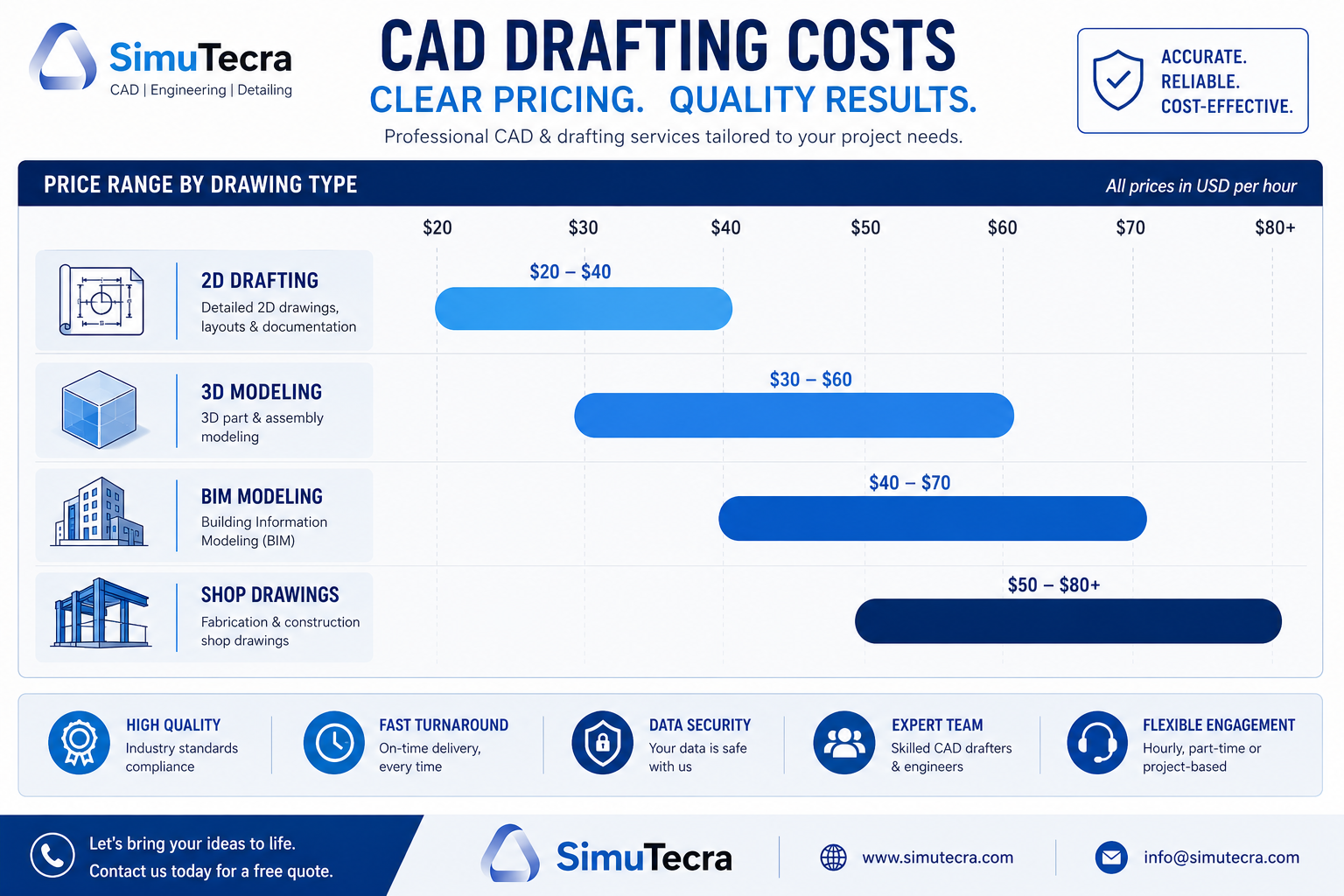
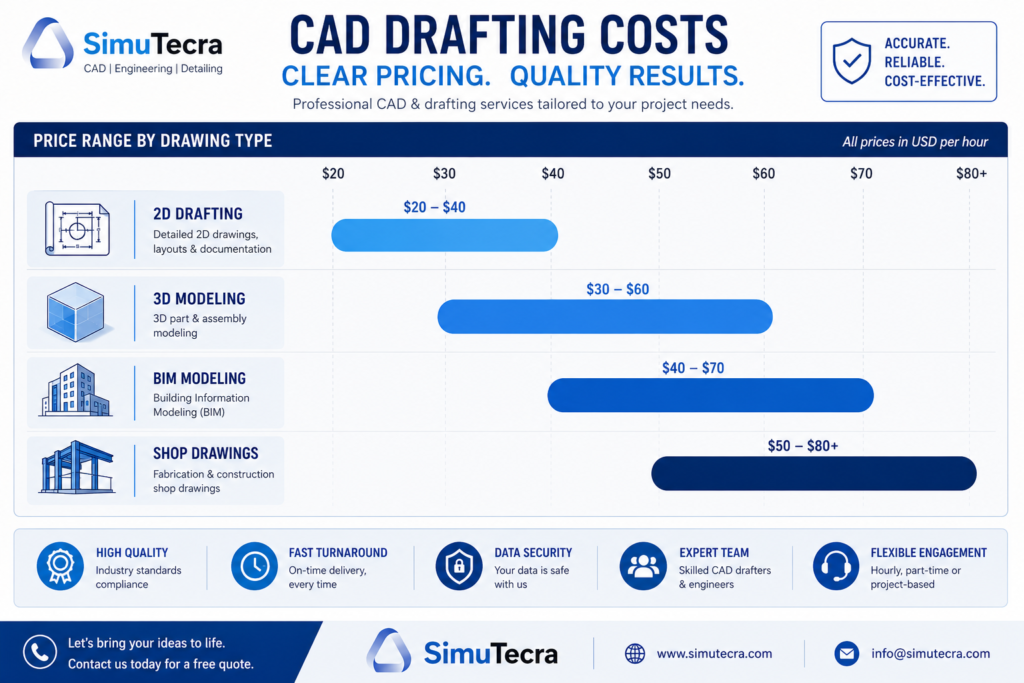
    If you need a number right now, here is where most CAD drafting projects land based on current market data compiled from vendor pricing pages, industry surveys, and published rate data for 2026-2026:
    CAD drafting cost comparison chart showing price ranges for 2D drafting, 3D modeling, BIM services, and shop drawings in 2026
    Pricing MetricTypical RangeNotes
    Hourly rate (domestic freelancer)$45 – $95/hrVaries by discipline and experience
    Hourly rate (domestic firm)$75 – $150/hrIncludes overhead, QA, account management
    Hourly rate (offshore firm)$8 – $35/hrVaries significantly by region and quality tier
    Per-sheet rate (2D CAD conversion)$45 – $250/sheetRush turnaround doubles or triples cost
    Simple 2D drawing package$150 – $800Single-page layouts, basic floor plans
    Standard residential drawing set$800 – $3,500Full permit-ready plans for a home
    Commercial drafting package$5,000 – $30,000+Multi-discipline, multi-sheet sets
    3D CAD model (single component)$300 – $2,500Complexity and tolerance precision drive cost
    BIM model (full building)$8,000 – $50,000+Depends on LOD and number of disciplines
    Monthly retainer (outsourced)$1,200 – $6,000/moDedicated or shared resource block
     Important framing:  These ranges reflect real market data, not optimistic estimates. The bottom of each range represents straightforward work from lower-cost providers. The top reflects complex, high-stakes deliverables from experienced domestic firms. Most real projects land somewhere in the middle.

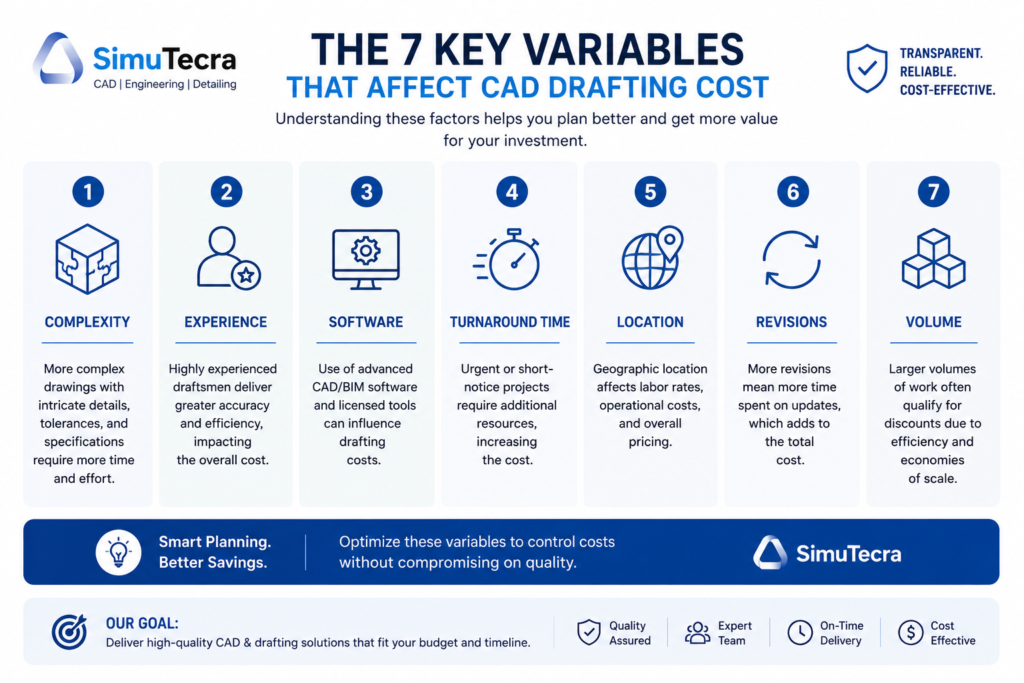
    2. What Determines CAD Drafting Pricing? The 7 Core Variables

    CAD drafting is not a commodity where one price fits all. Every quote you receive reflects a specific combination of the following factors. Understanding each one helps you assess whether a quote is fair, and gives you tools to control your costs.

    Infographic showing seven variables that determine CAD drafting cost complexity, drafter experience, software, turnaround time, provider location, revisions, and project volume

    Variable 1: Drawing Complexity

    Complexity is the single biggest cost driver in CAD drafting. A simple 2D floor plan redraw with clean linework and basic dimensions might take a skilled drafter three to five hours. The same space drawn with structural details, MEP coordination, material specifications, and permit-ready annotation can take fifteen to thirty hours. That difference directly multiplies your cost.

    Complexity factors include the number of distinct components or rooms, the level of annotation and dimensioning required, whether the drawing needs to meet code compliance or permit submission standards, how many layers and disciplines must be coordinated, and whether 3D modeling or BIM data is involved alongside 2D output.

    Variable 2: Drafter Experience and Specialization

    An entry-level drafter working in AutoCAD LT will produce basic 2D layouts accurately and affordably. A senior mechanical engineer who also drafts will charge three to four times more per hour, but may deliver a complete SolidWorks assembly package with GD&T annotations, BOM, and manufacturing notes in a fraction of the time. Specialization commands a premium. Structural steel detailing, medical device drafting, aerospace documentation, and MEP coordination drawings all require expertise that general drafters do not have, and the market rates for specialists reflect that.

    Variable 3: Software and Deliverable Format

    The software platform matters both for capability and cost. An AutoCAD 2D drawing is the most common and typically the least expensive output. SolidWorks or CATIA 3D models involve more complex workflows and higher-cost software licenses, which factor into quoted rates. Revit BIM deliverables require BIM-trained professionals and carry a premium over standard CAD. If you require deliverables in a specific format (native DWG, STEP, IFC, PDF, DXF), or need files structured to a specific standard like ISO or AIA layering, mention this upfront, as non-standard requirements affect time and cost.

    Variable 4: Turnaround Time

    Rush work costs more, often significantly more. Most CAD drafting providers have tiered pricing based on delivery speed. Standard turnaround (5 to 10 business days) is typically the baseline rate. Three-day delivery often carries a 25 to 50 percent premium. Same-day or next-day delivery, when available, can double the base price. If your timeline is flexible, communicate that clearly. Some providers discount work with relaxed deadlines, using it to fill gaps between priority projects.

    Variable 5: Provider Location

    Where the drafting is done dramatically affects what you pay. A domestic US firm in a major metropolitan area will charge two to five times what an equivalent-quality offshore firm in India or the Philippines charges for the same drawing. The cost difference is real, but so are the tradeoffs in communication, time zone overlap, and IP handling. The pricing section on domestic versus offshore providers covers this in detail.

    Variable 6: Number of Revisions

    Revisions are a significant and often underestimated cost driver. Most drawing packages include a defined number of revision rounds in the base quote (commonly one or two rounds of minor changes). Changes beyond that scope are billed at the hourly rate, which can substantially increase total project cost. Poor upfront briefing is the main cause of excessive revision cycles. The clearer and more complete your design intent and specifications are at the start, the fewer revision rounds you will need.

    Variable 7: Project Scale and Volume

    Volume pricing is real. A single drawing sheet costs proportionally more than a batch of fifty similar sheets. If you have an ongoing, high-volume drafting need, most firms will offer a reduced per-sheet or per-hour rate in exchange for a committed volume or retainer arrangement. Conversely, minimum project charges (typically $150 to $250 for most firms) mean that very small one-off requests are often not worth outsourcing individually.

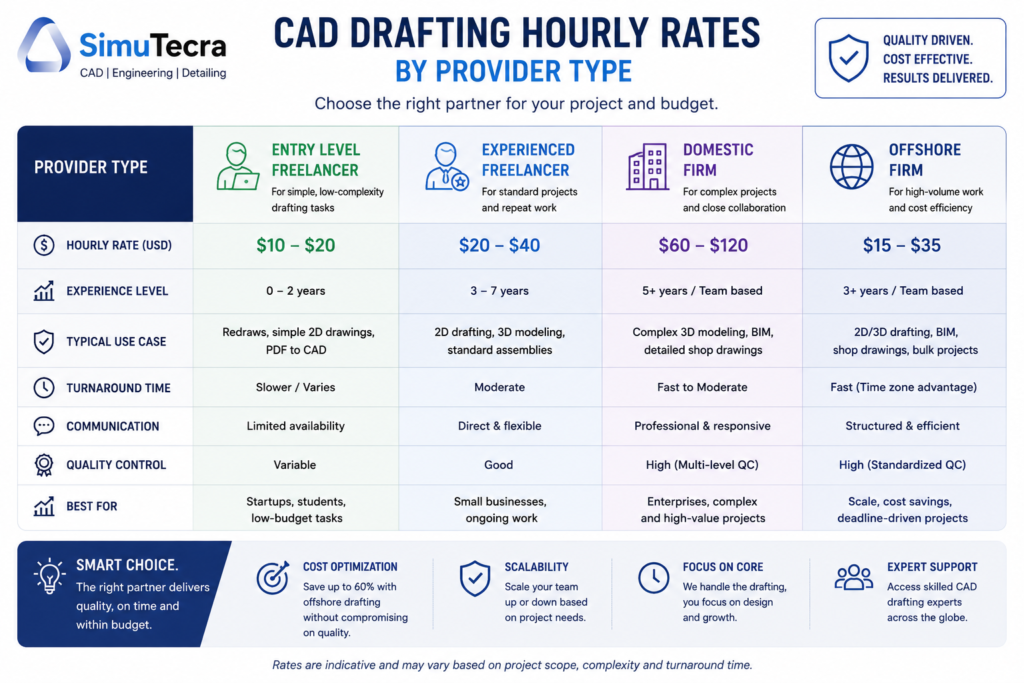
    3. CAD Drafting Hourly Rates: A Realistic Breakdown

    Hourly billing is the most transparent and flexible pricing model for CAD drafting, and it is the dominant model for iterative or undefined-scope work. Here is what the market looks like in 2026-2026 across provider types and experience levels.

    Bar chart comparing CAD drafting hourly rates by provider type from entry-level freelancers to domestic firms in 2026
    Provider TypeEntry LevelMid LevelSenior / SpecialistNotes
    US Domestic Freelancer$30 – $45/hr$45 – $75/hr$75 – $120/hrRates vary by discipline; structural and MEP specialists at the top
    US Domestic Firm$60 – $80/hr$80 – $120/hr$100 – $175/hrIncludes project management, QA, software overhead
    UK / Western Europe Firm£45 – £65/hr£65 – £100/hr£95 – £150/hrComparable to US in GBP; EU regulations familiarity a plus
    Eastern Europe (Poland, Romania)$20 – $35/hr$35 – $55/hr$50 – $80/hrStrong technical quality; growing for BIM and complex drafting
    India-Based Firm$8 – $15/hr$15 – $25/hr$22 – $40/hrLargest offshore talent pool; quality varies significantly
    Philippines-Based Firm$10 – $18/hr$18 – $30/hr$25 – $45/hrStrong English proficiency; good AEC and MEP drafting capability

    What Is Included in an Hourly Rate?

    When you hire a domestic firm at $100 per hour, you are not just paying for the drafter’s hands on a mouse. That rate typically covers:

    • The drafter’s time and expertise
    • Software license costs (AutoCAD at $1,975/year, Revit at $2,310/year, SolidWorks at $4,000+ per year)
    • Internal quality review before delivery
    • File management and delivery infrastructure
    • Project management and communication overhead
    • The firm’s business overhead including insurance, office, and administrative staff

    When you hire a solo freelancer at $55 per hour, most of those costs are lower or absent, which explains the rate difference. Neither is inherently better — the right choice depends on your project’s complexity and what level of process and oversight you need.

    4. Per-Sheet and Per-Project Pricing: When Each Makes Sense

    Per-Sheet Pricing

    Per-sheet pricing is common for CAD conversion work, PDF-to-DWG conversion, permit drawing sets, and other tasks where each sheet is a discrete, standardized deliverable. It is popular with clients because it is predictable: you know how many sheets you need, you multiply by the rate, and you have your budget.

    Drawing Sheet TypeTypical Per-Sheet RateRush MultiplierNotes
    PDF to CAD conversion (basic)$45 – $90/sheet2 – 3xSimple linework, minimal annotation
    PDF to CAD conversion (detailed)$90 – $180/sheet2 – 4xFull annotation, dimensions, notation
    Architectural floor plan (new draw)$150 – $350/sheet1.5 – 2xOriginal drafting from sketches or notes
    Structural detail sheet$200 – $450/sheet1.5 – 2.5xIncludes member sizing, connection details
    MEP (mechanical/electrical/plumbing)$175 – $400/sheet1.5 – 3xCoordination complexity adds cost
    Shop drawing (fabrication)$150 – $350/sheet1.5 – 2xWeld symbols, tolerances, BOM
    Civil site plan$250 – $600/sheet1.5 – 2xSurvey data integration, grading, utilities
    On rush pricing:  One published provider (CAD/CAM Services) lists a flat rate of $185 per D or E size AutoCAD 2D sheet at standard turnaround. The same work at rush turnaround (24 hours) typically runs $370 to $550. Plan your deadlines accordingly.

    Per-Project (Fixed Fee) Pricing

    Fixed-fee pricing works well when the scope is clearly defined and the deliverables are well-understood. The drafter agrees to produce a specific set of outputs for a set price. You get budget certainty; the drafter accepts the risk if the job takes longer than estimated.

    Fixed-fee pricing is common for residential drawing packages, permit submission sets, and defined industrial or manufacturing drawing packages. It is less common for complex commercial or industrial projects where scope evolves during the engagement.

    Project TypeTypical Fixed-Fee RangeWhat Is Usually Included
    Simple 2D drawing (single sheet)$150 – $400Line conversion or basic redraw, one revision round
    Small residential renovation drawings$800 – $2,700Floor plans, elevations, basic sections for permit
    Full custom home drawing set$3,500 – $10,000+Full architectural set: plans, sections, elevations, details
    Small commercial building (permit set)$5,000 – $15,000Multi-discipline permit package, ADA compliance
    Medium commercial / industrial$15,000 – $35,000Full structural, MEP, architectural coordination
    Large commercial or industrial project$35,000 – $100,000+Multiple disciplines, extensive coordination, BIM deliverables
    Product design (simple mechanical part)$300 – $1,5003D model, 2D drawing package, BOM
    Product design (complex assembly)$2,000 – $15,000+Multi-component assembly, GD&T, manufacturing drawings

    5. Cost by Drawing Type and Discipline

    CAD drafting costs vary significantly across disciplines. The differences are not arbitrary: they reflect the level of specialized knowledge required, the complexity of applicable standards and codes, and the typical time investment per drawing.

    Architectural CAD Drafting Costs

    Architectural drafting is one of the most common CAD services and covers a wide range of work from basic floor plans to complex construction document sets. Costs are driven by the number of sheets, the level of detail, and whether permit submission formatting is required.

    • Basic floor plan (single level): $300 – $800
    • Full residential permit set (plans, elevations, sections, details): $1,500 – $5,000
    • Commercial permit-ready drawing package: $8,000 – $30,000+
    • As-built drawings (measured and drawn): $500 – $3,000 depending on size and complexity
    • PDF to AutoCAD conversion (per sheet): $45 – $180

    Architectural drafting rates for domestic freelancers average $75 to $125 per hour. This is substantially less than hiring a licensed architect, whose hourly rates run $200 to $400 per hour. For pure drafting work (translating a design into accurate CAD output), a skilled architectural drafter is the appropriate choice, not an architect.

    Mechanical Engineering CAD Drafting Costs

    Mechanical CAD drafting is where precision is paramount. Drawings must convey exact dimensions, tolerances, material specifications, and surface finish requirements in a format that machinists and fabricators can execute without ambiguity. This level of precision requires experienced drafters and commands higher rates than basic architectural work.

    • Simple machined part (2D drawing): $150 – $600
    • Complex machined part with GD&T: $400 – $1,500
    • 3D solid model (single component): $300 – $2,000
    • Sub-assembly drawing package: $800 – $4,000
    • Full product assembly with BOM and exploded views: $2,000 – $15,000+

    Mechanical CAD specialists in AutoCAD Mechanical, SolidWorks, or CATIA typically bill $65 to $120 per hour domestically. The premium over general drafting rates reflects the knowledge of manufacturing processes, GD&T standards (ASME Y14.5), and the criticality of getting tolerances right.

    Structural Engineering CAD Drafting Costs

    Structural drafting covers foundation plans, framing plans, structural steel details, rebar layouts, and connection details. It sits at the intersection of engineering judgment and drafting skill, meaning the best structural drafters have a solid understanding of structural behavior, not just drafting technique.

    • Foundation plan: $400 – $1,200
    • Structural steel shop drawings (per sheet): $200 – $450
    • Rebar detailing drawings (per sheet): $150 – $350
    • Full structural drawing package for a residential project: $1,500 – $4,000
    • Commercial structural documentation package: $8,000 – $40,000+

    Structural shop drawings are a category where outsourcing to specialized overseas firms is extremely common. Firms in India and the Philippines have built strong capabilities specifically in steel detailing and rebar drawings for US and UK markets, typically charging $15 to $30 per hour for what domestic firms bill at $90 to $150 per hour.

    Civil Engineering CAD Drafting Costs

    Civil CAD drafting covers site plans, grading plans, utility layouts, road designs, and land development drawings. Civil work often involves integration with survey data, GIS systems, and regulatory formatting requirements that vary by municipality.

    • Basic site plan: $500 – $1,500
    • Full land development drawing package: $3,000 – $15,000
    • Road design drawings (per sheet): $300 – $700
    • Utility layout drawings (per sheet): $200 – $500
    • Civil 3D model (grading and drainage): $1,500 – $8,000

    MEP (Mechanical, Electrical, Plumbing) Drafting Costs

    MEP drafting is among the most complex and expensive CAD work because it requires coordination between three distinct systems, all of which must occupy the same physical building space without conflict. MEP drawings are increasingly produced in BIM to enable clash detection.

    • HVAC layout drawing (per floor): $600 – $2,000
    • Electrical layout drawing (per floor): $400 – $1,500
    • Plumbing riser diagram: $300 – $900
    • Full MEP coordination package for a commercial building: $15,000 – $60,000+
    • BIM model with MEP coordination and clash detection: $20,000 – $80,000+

    BIM Modeling Costs

    Building Information Modeling (BIM) represents the highest tier of CAD-related drafting cost. BIM is not just drawing: it is a data-rich 3D model that carries information about every component in a building, including material properties, manufacturer data, maintenance requirements, and spatial relationships. The Level of Development (LOD) spec required significantly determines cost.

    BIM Level of DevelopmentWhat It IncludesTypical Cost Impact
    LOD 100 (Conceptual)Massing and overall form onlyLowest cost; schematic only
    LOD 200 (Approximate Geometry)Generic elements, approximate sizesModerate cost; early design phase
    LOD 300 (Specific Geometry)Accurate dimensions, coordination-readyStandard for permit/construction use
    LOD 350 (Construction)Interfaces with adjacent elements includedHigh cost; needed for fabrication coordination
    LOD 400 (Fabrication)Full fabrication and installation detailVery high cost; used for prefab and shop drawing production
    LOD 500 (As-Built)Verified field conditions, actual installed stateHighest cost; full as-built documentation

    6. Domestic vs Offshore CAD Drafting: The Real Cost Comparison

    The cost gap between domestic and offshore CAD drafting is large, and it is worth examining honestly rather than in generalities.

    Cost FactorDomestic (US/UK)Offshore (India/Philippines)Notes
    Hourly rate$65 – $150/hr$8 – $30/hr4 – 10x difference in base rate
    Time zone overlapFull overlapMinimal (8 – 12 hrs difference)Offshore requires asynchronous workflow
    Communication frictionLowModerate to HighDepends on provider’s English proficiency and process maturity
    Revision cycle timeHours1 – 2 daysTime zone gap extends correction loops
    IP risk levelLowModerateManageable with proper contracts; not eliminated
    Drawing quality ceilingVery highHigh for standardized work, variable for complexBest offshore firms deliver excellent output
    Total effective cost (with mgmt overhead)$75 – $160/hr est.$20 – $55/hr est.Offshore savings real but not as large as rate gap suggests

      💰 The real saving:  If a domestic firm charges $100/hr and an offshore firm charges $18/hr, your raw cost savings are 82%. But management overhead, revision cycles, and QA review typically consume 30 to 50% of those savings. Real net savings for well-managed offshore arrangements typically run 40 to 60% compared to equivalent domestic work. Still significant, but calibrate expectations honestly.

    7. Freelancer vs Firm vs Outsourcing Agency: Pricing Differences

    Beyond geography, the type of provider you hire shapes both cost and experience significantly.

    Provider ModelHourly Range (Domestic)Best ForRisk Factors
    Solo freelancer$30 – $95/hrWell-defined projects, cost-conscious budgetsSingle point of failure; limited capacity; inconsistent availability
    Small specialist firm (2-10 people)$65 – $130/hrMid-complexity projects needing some team depthLimited surge capacity; still owner-dependent
    Established CAD firm$85 – $175/hrComplex, multi-sheet, regulated-industry workHighest cost; best process and accountability
    Offshore outsourcing firm$8 – $35/hrVolume drafting, standardized work, cost reductionCommunication overhead; QA management required
    Freelance platform (Upwork, Freelancer)$15 – $80/hrQuick tasks, price testing, low-stakes projectsHighly variable quality; no accountability structure
    Retainer / dedicated resourceNegotiated monthly rateOngoing high-volume needsRequires volume commitment; not flexible for sporadic work

    8. The Hidden Costs No One Talks About

    The quoted price for a CAD drafting project is often not the final price. These additional costs catch clients off guard repeatedly, and they deserve direct attention.

    Revision Costs Beyond Scope

    Most quotes include one or two rounds of minor revisions. Changes beyond that, whether driven by a design change on your end or a misunderstanding in the brief, are billed at the hourly rate. On a complex drawing package, multiple out-of-scope revision cycles can easily add 20 to 40 percent to the original quote. The solution is a comprehensive brief at the start, not a fight with your provider at the end.

    Format Conversion and File Compatibility

    If your provider works in one software platform and you need files in another, expect conversion fees. DWG to DXF is simple. AutoCAD to CATIA native format is not. File format requirements should be specified clearly in the brief and confirmed as included in the quote. Discovering at delivery that your machine shop needs a STEP file when you were expecting DWG files is a costly surprise.

    Minimum Project Fees

    Most professional CAD drafting providers have minimum fees, typically between $150 and $250. A five-minute correction that takes 30 minutes of a drafter’s time, including file handling and delivery, may still cost you the minimum. For very small, frequent requests, a retainer arrangement or in-house capability is usually more economical than individual project billing.

    Rush Premiums

    Rush fees are real and significant. A drawing that costs $500 at standard turnaround may cost $800 to $1,200 at two-day delivery. For same-day or next-day delivery (when available), premiums of 100 percent or more are not unusual. If you find yourself frequently paying rush rates, the root problem is usually project planning and timeline management, not drafting capacity.

    Back-and-Forth Communication Time

    This cost is invisible but real. Every email thread chasing clarification, every video call to explain a markup, every iteration of a brief that was not clear the first time represents time you are paying for indirectly (in management overhead) or paying for directly (in revision billing). Investing 30 to 60 minutes in a thorough project brief almost always saves more time and money than it costs.

    Software License Fees (When Applicable)

    Some specialized deliverables require proprietary software licenses. If you need a Revit model and your preferred firm works in AutoCAD, either the firm will need to bring in a Revit resource (which costs more) or you will need to engage a different firm. Similarly, if you require CATIA or Creo deliverables, expect a reduced pool of providers and higher rates. Always specify required software in your brief.

     Cost trap:  The single most expensive mistake in CAD drafting procurement is providing an incomplete brief and assuming the drafter will figure out the rest. Ambiguity in scope almost always resolves at your expense.

    9. How to Budget for a CAD Drafting Project

    Accurate budget planning for CAD drafting requires more than looking up a price range. Here is a practical process that experienced project managers use.

    Step 1: Define Your Deliverables Before You Ask for a Quote

    Write down exactly what you need: how many drawing sheets, what views (plan, section, elevation, detail, isometric, 3D model), what software format, what layering standard, what annotation level, and what the final use will be (permit submission, fabrication, client presentation, internal reference). The more specific your scope, the more accurate your quote will be.

    Step 2: Identify Your Drawing Type and Discipline

    Use the cost ranges in Section 5 as your starting benchmark. Are you buying architectural, mechanical, structural, civil, or MEP drawings? Simple 2D or 3D? BIM or CAD? Each discipline and output type has a different cost baseline.

    Step 3: Add a Revision Buffer

    Whatever your base quote is, budget an additional 15 to 25 percent as a revision contingency. This is not pessimism; it is realistic planning. Design changes, client feedback, and engineering review comments are normal, and they generate revision work. If you use the full contingency, you accounted for it. If you do not, it is a pleasant surprise.

    Step 4: Get Multiple Quotes and Compare Apples to Apples

    Price alone does not tell you which quote is the best value. When comparing quotes, confirm that each includes the same deliverables (number of sheets, revision rounds, file formats), the same software, the same turnaround window, and the same QA process. A quote that looks 30 percent cheaper may include fewer revision rounds or exclude file format delivery in your required standard.

    Step 5: Consider the Total Engagement Cost, Not Just the Hourly Rate

    If you are evaluating an offshore option, account for your management time. If a $20/hr offshore provider requires three hours of your team’s coordination time per week that would not be needed with a domestic provider at $90/hr, the real cost difference is smaller than the rates suggest. Factor in communication overhead, QA review time, and revision cycle duration when comparing total engagement costs.

    Budget example:  A small manufacturing firm needs a product redesign: 3D model of a new bracket assembly plus 2D manufacturing drawings for five components. Based on current market data, a domestic mid-level freelancer at $65/hr would likely complete this in 15 to 22 hours, putting total cost at $975 to $1,430. An offshore firm at $18/hr for similar complexity would quote $270 to $396, but factor in 4 to 6 hours of your team’s coordination and review time at your internal cost rate. The real offshore cost is likely $450 to $650, still a significant saving, but not the 80% discount the headline rate implies.

    10. Red Flags in CAD Drafting Quotes

    Not every low quote is a bargain, and not every high quote is unjustified. These warning signs in a quote or provider relationship deserve attention before you commit.

    • Vague scope acceptance: A provider who accepts your project brief without asking any clarifying questions does not fully understand the scope. Good providers ask about software requirements, layering standards, revision expectations, and deliverable formats upfront.
    • Unusually low rates without explanation: If a quote is 50 percent below the market rate, ask why. It may reflect genuinely lower overhead (offshore team, minimal QA), or it may reflect inexperience, substandard software, or a plan to bill extensively for revisions.
    • No portfolio in your discipline: A general CAD firm that has never done structural shop drawings is probably not the right choice for your structural shop drawing project. Ask for samples of work similar to yours before committing.
    • No defined revision terms: If the quote does not specify how many revision rounds are included and what constitutes a billable change, you have no budget protection once the project starts.
    • Resistance to NDA: Any provider that hesitates to sign a non-disclosure agreement for a project involving proprietary designs is a serious IP risk. A reputable firm will have a standard NDA ready.
    • No QC process described: Ask directly: who reviews the drawings before they are delivered to you? If the answer is unclear or does not involve a second set of eyes, your QA burden just landed entirely on you.
    • No example of their actual layering standards: A firm that cannot show you a sample drawing in their preferred layering convention before you commit may not have consistent standards, which means more rework aligning their output to your workflow.

    11. How to Reduce Your CAD Drafting Costs Without Cutting Quality

    There are legitimate ways to get better value from your CAD drafting budget. None of them involve choosing the cheapest provider regardless of capability.

    • A thorough brief reduces revision cycles, which is the most controllable cost lever you have. Specify drawing types, view counts, standards, format, software, and final use. Drawings produced to a clear brief require fewer corrections.Write a complete project brief before requesting quotes
    • Disorganized sketches, conflicting markup sets, and unclear source files slow the drafter down, and you pay for that time. Organize your inputs, resolve conflicts internally, and present a clear package.Provide organized input files
    • Rush premiums are avoidable if you plan ahead. Build drafting time into your project schedule rather than treating it as a last-minute activity.Be flexible on turnaround when you can
    • If you have a regular, predictable drafting volume, negotiate a monthly retainer rate. Most providers offer 10 to 20 percent below standard hourly rates for committed volume.Use retainer pricing for ongoing needs
    • Keep complex, IP-sensitive, or fast-turnaround work with a domestic provider. Send standardized, well-defined, lower-risk work offshore. This captures most of the cost savings from offshore pricing while protecting your most sensitive projects.Consider a hybrid sourcing model
    • Volume discounts are real. Instead of requesting five individual drawings one at a time, batch them into a single package. Per-unit cost drops, and provider efficiency increases.Batch similar work together
    • A well-organized title block, layer standard, and annotation template that you provide to your provider eliminates the time they spend inferring or guessing your preferences. This speeds production and reduces errors.Invest in a good drawing standards template

    Frequently Asked Questions

    The following questions represent the most common cost-related queries from engineering managers, project owners, and business leaders evaluating CAD drafting services.

    How much does a CAD drafter charge per hour?

    In the United States, domestic freelance CAD drafters typically charge between $45 and $95 per hour depending on their experience and specialization. Established domestic firms charge $75 to $175 per hour inclusive of overhead, QA, and project management. Offshore firms in India and the Philippines charge $8 to $35 per hour for equivalent skill levels. Hourly rates for specialized disciplines (structural detailing, medical device documentation, aerospace drawings) fall at the upper end of each range.

    How much does a single CAD drawing cost?

    A single CAD drawing can cost anywhere from $45 for a simple PDF-to-DWG conversion to $600 or more for a complex mechanical drawing with full GD&T annotation and 3D model. A standard architectural floor plan sheet typically costs $150 to $350. Structural and MEP sheets generally run $175 to $450 each. The cost per sheet drops meaningfully when you order a full set rather than individual sheets.

    How long does it take to produce a CAD drawing?

    Time varies dramatically with complexity. A simple 2D layout redraw takes 3 to 6 hours. A standard architectural floor plan with annotation and dimensions takes 8 to 15 hours. A complex mechanical assembly model with associated 2D drawings can take 20 to 60 hours. A full construction document set for a residential project typically takes 40 to 120 hours of drafting time. Turnaround time in calendar days depends on how many hours the drafter can dedicate per day and their current workload.

    Is it cheaper to hire a freelancer or a CAD firm?

    A freelancer will almost always be cheaper on an hourly basis. But cheaper per hour does not always mean lower total project cost. Firms bring process discipline, QA review, project management, and the ability to replace a resource if your dedicated drafter is unavailable. For high-stakes, complex, or ongoing work, the overhead of a firm is often worth the premium. For well-defined, contained projects without regulatory requirements, a skilled freelancer can deliver excellent value.

    Why do CAD drafting prices vary so much?

    Because the work itself varies enormously. A simple 2D redraw of a clean sketch and a BIM coordination package for a 10-story commercial building are both called ‘CAD drafting,’ but they involve completely different skill levels, software platforms, time investments, and risk profiles. The price range reflects the reality of the work, not inconsistency in the market. When you understand which of the seven variables in Section 2 apply to your project, the price range for your specific situation narrows considerably.

    What is the cheapest way to get CAD drafting done?

    The cheapest option is typically an offshore firm in India or the Philippines with published hourly rates of $8 to $15 per hour. However, the cheapest option is not always the most cost-effective. Poor quality or misunderstood drawings that require extensive rework can cost more than a higher-priced provider who got it right the first time. The most cost-effective approach combines a well-written project brief (which you control), a provider who has experience with your drawing type, clear revision terms in the contract, and a defined QA review step before the drawings enter production.

    Do CAD drafting services include revision rounds?

    Most professional providers include one or two rounds of minor revisions in their base quote. ‘Minor revisions’ typically means corrections to the existing scope (fixing a dimension that was marked incorrectly, adjusting an annotation). Scope changes (adding a view that was not in the original brief, redesigning a component) are almost always billed additionally at the hourly rate. Clarify exactly what revision terms are included before you sign off on a quote.

    Conclusion:

    CAD drafting costs are not mysterious, but they are not one-size-fits-all either. The wide price range you encounter when researching this topic is real, and it reflects real differences in scope, discipline, complexity, provider type, and geography.

    The most important insight in this guide is this: the cost of your CAD drafting project is more controllable than most clients realize. The biggest cost variable is not the provider’s rate. It is the clarity of your brief. An ambiguous or incomplete brief generates revision cycles, and revision cycles are the primary mechanism by which a well-priced project becomes an expensive one.

    Invest time in defining your scope clearly. Match your provider choice to your project’s actual requirements rather than just choosing the cheapest rate. Build a revision buffer into your budget. And review the drawings before they enter your production workflow, not after they have already been used.

    Do those things consistently, and you will get better results from every CAD drafting dollar you spend.

    Ready to plan your next CAD drafting project?

    Explore our related guides on in-house versus outsourced CAD drafting, version control for engineering drawings, and how to select the right CAD software platform for your team.

  • Common CAD Drafting Mistakes That Cause Manufacturing Delays (and How to Avoid Them)

    Common CAD Drafting Mistakes That Cause Manufacturing Delays (and How to Avoid Them)

    29%  of project reworks in design teams come from simple drafting errors, not complex design failures (CAD Drafter industry report, 2025)
    Top cause  simple drafting errors are among the top causes of rework on-site, per multiple 2026 construction and manufacturing industry sources
    10x  cost multiplier of fixing a design error at production vs at the drawing stage; the same drafting mistake that takes minutes to fix in CAD costs days or weeks to correct in fabricated metal
    Feb 2026  Printform published list of top 10 CAD design mistakes identifies DFM ignorance, incomplete GD&T, and revision control failures as the three most programme-impacting error categories

    Introduction: Why Drawings That Look Right Still Delay Manufacturing

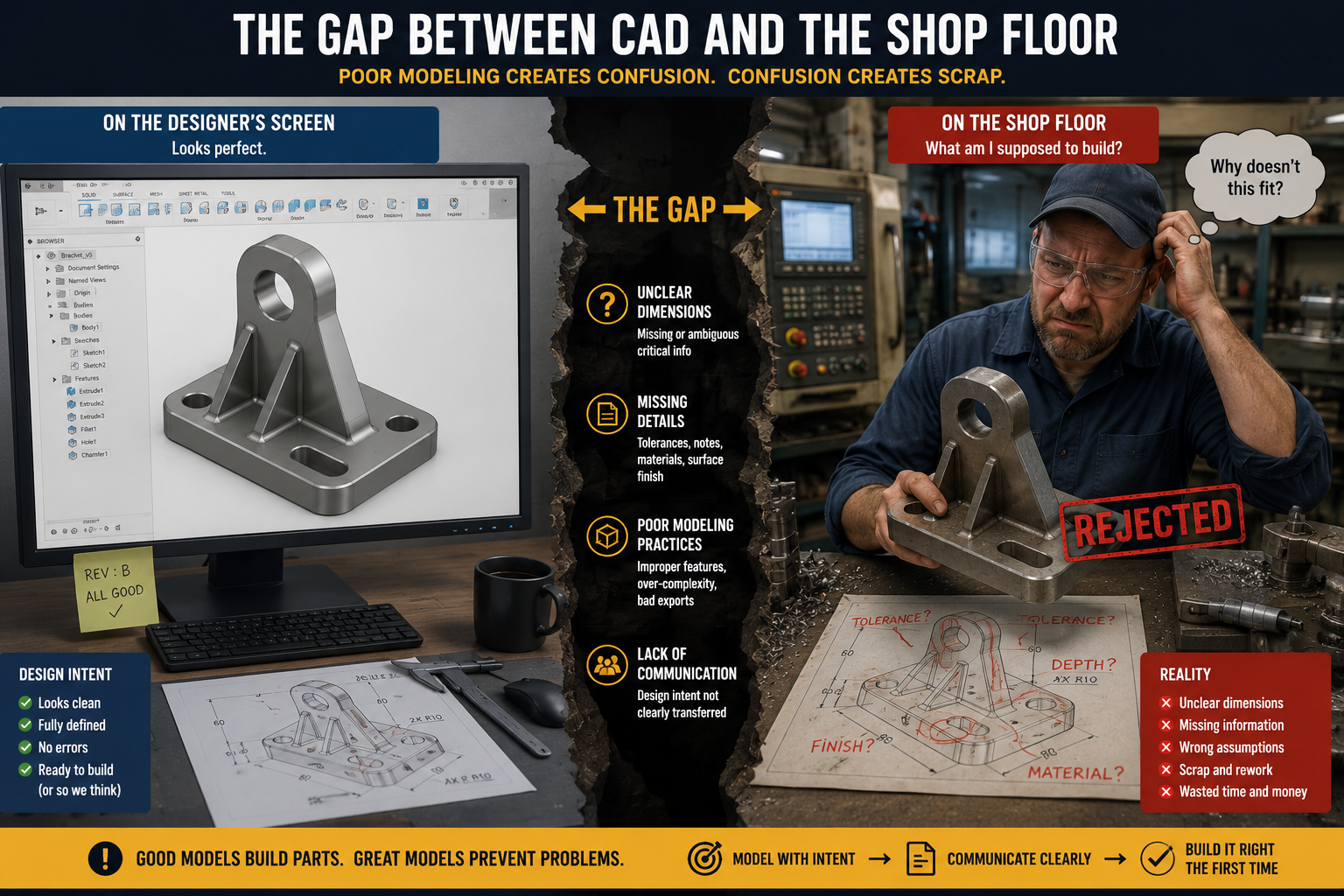
    There is a specific kind of engineering problem that does not get caught by technical design review, does not show up in simulation, and does not appear in a structural calculation. It shows up when a drawing lands on a machinist’s desk and they cannot proceed because a dimension is missing, or when a fabricated batch arrives and the features are on the wrong face because the projection method was never stated.

    These are CAD drafting mistakes. They are not design errors. The design intent is usually correct. The problem is that the drawing, the document that translates that intent into manufactured reality, fails to communicate it accurately, completely, or unambiguously enough for the manufacturer to proceed without stopping, querying, or guessing.

    Industry data published in 2025 and 2026 consistently identifies simple engineering drawing errors as responsible for approximately 29 percent of project reworks. They are not caused by inadequate engineering knowledge. They are caused by habits, by shortcuts taken under time pressure, by the absence of a pre-release checklist, and by the assumption that if the drawing looks complete, it probably is.

    This guide covers fifteen of the most common CAD drawing errors that cause manufacturing delays, what each one costs in time and money, and the specific prevention that eliminates each one before the drawing leaves the engineer’s desk.

    Quick definition:  A CAD drafting mistake is a documentation error in an engineering drawing that prevents or misleads the manufacturer, even when the underlying design intent is correct. It is distinct from a design error. It is fixable at the drawing stage for the cost of engineering time. The same mistake discovered after fabrication costs orders of magnitude more.
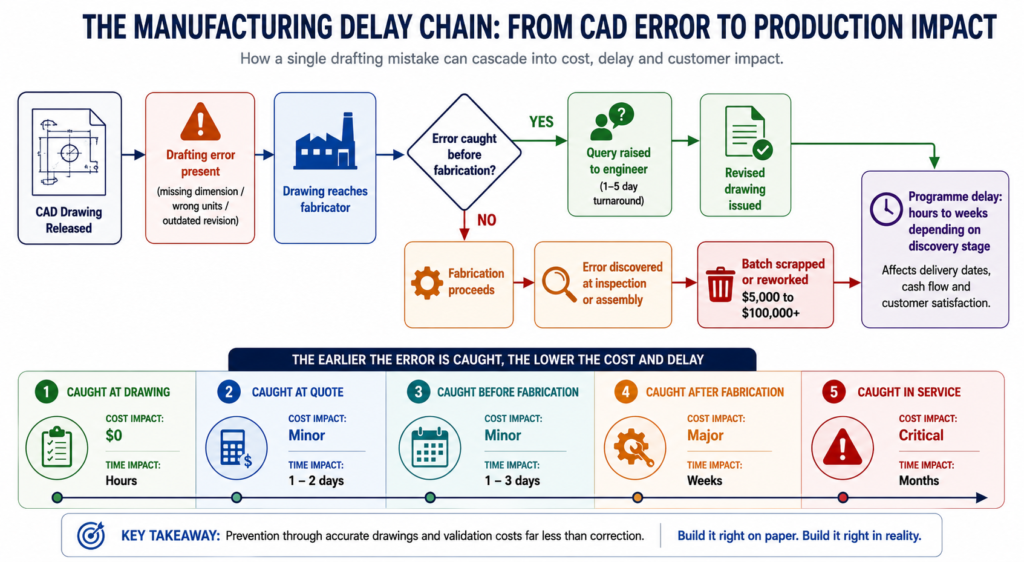
    The Manufacturing Delay Chain From CAD Error to Production Impact which cause CAD Drafting Mistakes
    The same mistake. The cost is entirely determined by when it is caught.

    15 Common CAD Drafting Mistakes That Delay Manufacturing

    The table below covers fifteen of the most consistently occurring CAD drafting mistakes in mechanical, structural, and civil engineering drawing practice. Each is identified by type, manufacturing consequence, and the specific prevention that addresses it. Use this table as a reference during drawing review.

    CAD Drafting MistakeCategoryManufacturing ConsequenceHow to Avoid It
    Missing or incomplete dimensionsDrawing completenessManufacturer stops work to query; delay while engineer respondsEvery feature required for manufacture must be fully dimensioned. Run a dimension audit before release.
    Incorrect or undefined unitsSetup errorSteel plate designed in mm cut in inches; complete scrapping of material and orderSet units in template before modeling. Confirm units on every drawing import with INSUNITS.
    Outdated drawing revision issuedRevision controlTeam builds from superseded design; structural or functional error discovered after fabricationUse a revision control block on every sheet. Archive old versions. Single-source distribution only.
    Ambiguous or missing tolerancesGD&T and tolerancingManufacturer applies own judgment; parts fail assembly or inspectionApply ISO 2768-m as drawing default. Add explicit tolerances only where function requires them.
    Wrong or missing projection symbolDrawing standardViews read as mirrored; features on wrong faceAlways include the first-angle or third-angle projection symbol in the title block. Never omit it.
    Mismatched layer structureDrawing managementReviewer cannot separate structure from annotation; critical notes hidden on wrong layerUse a named layer standard file. Never draft on Layer 0. Assign line weights per layer.
    No general tolerance block in title blockDrawing completenessEvery undimensioned feature is ambiguous; manufacturer queries whole drawingAdd general tolerance reference (ISO 2768-mK or ASME equivalent) to title block on every drawing.
    Scale error in model spaceCAD setupBlocks and XREFs imported at wrong scale; printed dimensions do not match modelAlways draw at 1:1 in model space. Set viewport scale in layout. Mark NTS where applicable.
    Incorrect line weights and typesDrawing clarityHidden lines indistinguishable from visible; centre lines read as object linesAssign line weights through layers not individual entities. Follow ISO 128 or ASME Y14.2 line standards.
    No surface finish callout where requiredDrawing completenessManufacturer applies default finish; sealing or mating surfaces fail in serviceSpecify Ra value by zone: mating faces, sealing surfaces, general. Reference ISO 1302 or ASME B46.1.
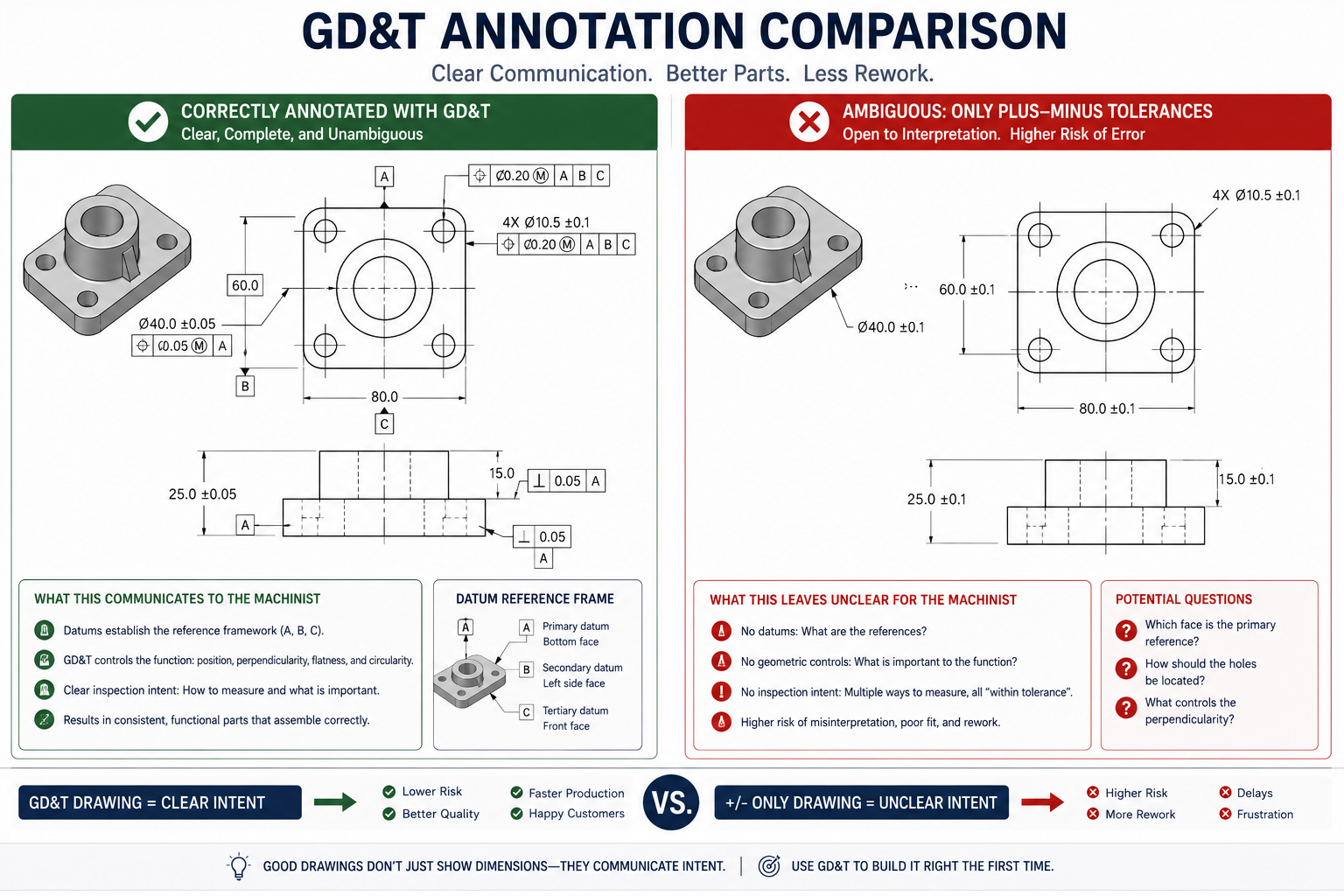
    GD&T datum structure missing or inconsistentGD&T errorsInspection built on wrong reference; all positional measurements meaninglessDefine a three-plane datum reference frame. Apply datums consistently throughout all views.
    Single layer draftingDrawing managementImpossible to isolate discipline layers; collaboration, printing, and review all failMinimum layer set: Object, Hidden, Centre, Dimension, Annotation, Titleblock, Viewport. Never merge.
    No weld specification on welded assembliesFabrication documentationWeld size, type, and process left to fabricator judgment; structural integrity at riskApply AWS or ISO welding symbols to every weld joint. Specify process where it affects quality.
    File format incompatible with downstream toolFile managementFabricator cannot open DWG version; CNC controller cannot read STEP; programme delayedConfirm required format and version before release. Specify format in drawing notes or transmittal.
    No revision cloud on changed areasRevision managementReviewer cannot identify what changed; entire drawing re-checked; review time tripledAdd a revision cloud around every changed region. Log the change description in the revision table.

    What Each Type of Error Actually Costs: Discovery Stage vs Financial Impact

    The cost of a CAD drawing error is not fixed. It is determined almost entirely by the stage at which the error is discovered. The same missing dimension costs minutes to fix at the drawing stage and days of programme delay if it reaches the fabricator. This table puts real numbers on the cost spectrum for the most common error types.

    Error TypeDiscovery StageTypical Direct CostDelay Impact
    Missing dimensionQuoting stageEngineer time only: 0 to $200Hours: query and response turnaround
    Wrong units (mm vs inches)FabricationMaterial scrap plus rework: $500-$10,000Days to weeks: reorder and remake
    Outdated revision issuedPost-fabricationFull part batch scrapped: $5,000-$100,000+Weeks to months: tooling and remanufacture
    Wrong projection (1st vs 3rd angle)FabricationFeatures on wrong face: complete rejectionWeeks: remake of entire batch
    Missing tolerance on critical fitAssemblyReassembly or selective fitting: $1,000-$50,000Days to weeks: 100% inspection and rework
    File format incompatibleBefore fabricationConversion time: $0-$500Hours to days: format conversion or resupply
    Weld not specifiedPost-inspectionWeld rework or full re-fab: $2,000-$30,000Days to weeks: weld repair programme
    Surface finish missing on seal faceIn-service failureWarranty claim or field rework: $10,000+Weeks: field intervention plus investigation

    These ranges are conservative estimates based on published industry case studies and fabrication cost benchmarks. On larger programmes with multiple trades, the cascade effects of a single drawing error can multiply these figures significantly when downstream trades are waiting on the affected component.

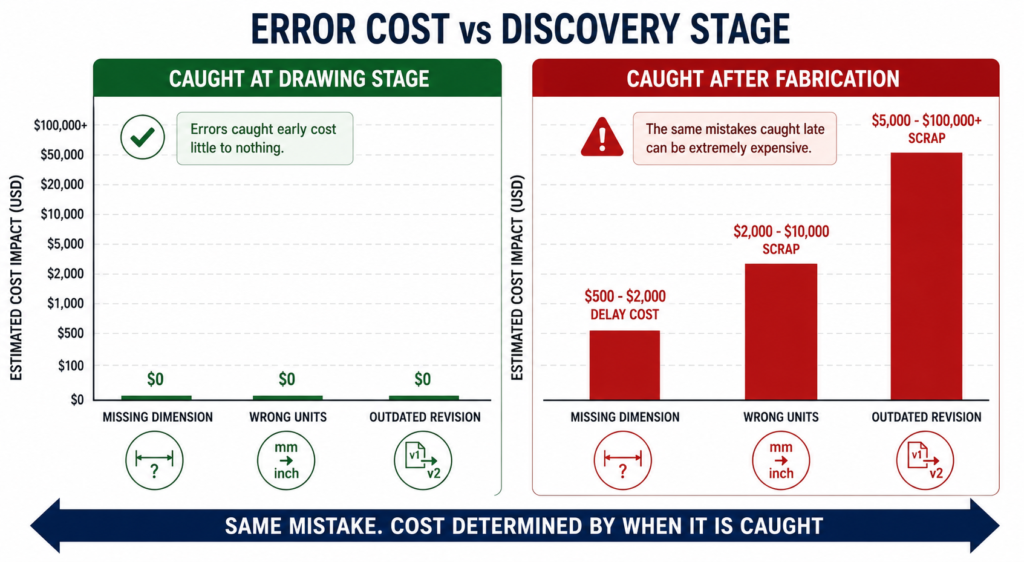
    Error Cost vs Discovery Stage Before and After Bar Chart Common CAD Drafting Mistakes
    The engineering principle is the same at both stages. The economics are not.

    Missing and Incomplete Dimensions: The Most Frequent Delay Trigger

    Missing or incomplete dimensions are the single most reported engineering drawing error category across manufacturing, construction, and infrastructure sectors. They are also the most preventable because their absence is, in principle, detectable by anyone who checks the drawing systematically.

    The practical reason they persist is that engineers check drawings for correctness of what is there, not for completeness of what should be there. A drawing review that confirms every stated dimension is correct can still miss three dimensions that should have been stated but were not. The prevention requires a different type of check: a systematic audit of every feature against what is required for manufacture.

    Dimension Error TypeWhat a Manufacturer Cannot Do Without ItPractical Fix
    Missing linear dimension on a featureCannot set up machine to correct depth, width, or heightDimension audit: every feature must have at least one dimension defining each axis of extent
    Missing hole depth calloutDrills blind hole to default or to judgment; may break throughUse depth symbol with every blind hole callout. Specify depth from which face.
    Missing thread specificationTaps wrong thread standard or pitch; fastener will not engageCallout must include standard, nominal diameter, and pitch (M12x1.75 or 1/2-13 UNC)
    Conflicting dimensions on same featureMust choose one; chooses incorrectly; both can be wrongRemove driven dimensions or reference them explicitly. Check all views show consistent values.
    Reference dimension unmarkedTreated as production dimension; inspected; fails unnecessarilyMark all reference dimensions as REF or in parentheses (50) so manufacturer knows intent.
    Tolerance on non-critical feature too tightManufacturer applies premium process; cost uplift with no benefitAudit every tolerance. Ask: does function change if this is at the wrong end of its tolerance range?
    No GD&T on a feature that requires itSize tolerance controls nothing about form or positionApply GD&T where form, orientation, or position matters for assembly or function.

    The Dimension Audit Method

    A dimension audit is a feature-by-feature check of the drawing against the question: if a machinist builds this feature from this drawing alone, without reference to the 3D model, do they have everything they need? For each feature, identify: what defines its location in X, Y, and Z, what defines its size in every relevant direction, what defines its angular orientation where it is not parallel to a reference plane, and what defines its depth or extent.

    Any feature for which any of these questions cannot be answered from the drawing has a missing dimension. The audit takes five to fifteen minutes on a typical mechanical part drawing. The rework it prevents can save days of programme delay.

    The ‘machinist test’ for dimension completeness:  Before releasing any drawing, ask yourself: if I handed this drawing to a skilled machinist with no access to the 3D model, no access to me, and no ability to ask questions, could they build this part exactly as intended? Every gap in that scenario is a missing dimension or specification that needs to be added before the drawing is released.

    Unit and Scale Errors: Small Oversight, Catastrophic Consequence

    Unit errors are among the most expensive single drafting mistakes in manufacturing. A part designed in millimetres that is cut in inches is 25.4 times larger than intended. A part designed in inches that is cut in millimetres is 25.4 times too small. The material is scrapped entirely. The order is repriced. The lead time restarts from zero.

    The reason these errors happen is structural, not careless. CAD software assumes a unit system and does not always enforce it visibly. When drawing files are shared between teams using different unit conventions, the units embedded in the file may not match the units the recipient expects. An engineer who opens a file, checks the geometry looks right on screen, and proceeds without checking the unit setting is working from an assumption that may be wrong.

    How to Eliminate Unit Errors Permanently

    1. Use a company-standard drawing template (DWT file) with units set correctly for your primary manufacturing context. Every new drawing created from this template inherits the correct units automatically.
    2. Check INSUNITS before inserting any external block or XREF. The INSUNITS variable controls how the CAD software scales inserted content. Mismatched INSUNITS between the source file and the destination file cause scale errors on insertion.
    3. State the unit system explicitly in the title block. Millimetres or inches. Never leave it implicit. The title block statement is the authoritative reference for anyone who reviews or uses the drawing.
    4. Add a dimension of a known element to a new import as a first check. If an imported block shows 25mm where you know it should show 1 inch (25.4mm), the units have mismatch. Catch it immediately, not after the drawing is built around the wrong scale.
    The unit error that keeps happening:  A steel plate designed in AutoCAD in metric units is exported to DWG and opened by a contractor working in an imperial-unit environment. The plate appears at the correct proportional size on screen because AutoCAD scales intelligently, but the file’s internal units are now ambiguous. The fabricator cuts to the dimensions on screen. The plate is 25.4 times too small. This exact sequence is one of the most consistently reported manufacturing disasters from cross-border drawing sharing. The fix is one line in the title block and one INSUNITS check.

    Outdated Revisions on the Shop Floor: The Error That Cannot Be Unseen

    Of all the common drafting errors covered in this guide, issuing an outdated drawing revision to the manufacturing floor is the one with the most consistently catastrophic consequences. When a fabricator builds from a superseded design, the error is invisible until the part either fails to fit, fails inspection, or fails in service. By that point, the material is consumed, the machining time is spent, and the programme impact is measured in weeks, not days.

    Why Outdated Revisions Keep Reaching Manufacturing

    The root cause is almost always a distribution problem rather than a revision control problem. The revision table on the drawing is correctly maintained. The drawing number is correct. But the drawing that reaches the fabricator is a copy from a previous issue, saved to a personal drive, an unmanaged shared folder, or an email attachment that predates the current revision.

    The fabricator has no way of knowing the drawing is outdated because it looks identical to the current drawing in every visible respect. The only difference is the revision letter in the title block, which is easy to overlook if the process for checking revision currency before fabrication is not enforced.

    The Three-Part Revision Control System

    • Revision control block on every sheet: Current revision letter, change description, date, and approver name visible in the title block on every sheet of a multi-sheet drawing set. If sheet 3 carries a different revision from sheet 1, the set is not coherent and must not be issued.
    • Single-source distribution: One controlled location where fabricators and site teams access drawings. Any copy of a drawing outside this controlled source is a liability. Archive superseded revisions with a clear SUPERSEDED watermark or move them to a separated archive folder.
    • Transmittal acknowledgement: When a revised drawing is issued, the transmittal record documents who received it, which revision, and on what date. This creates an auditable chain of custody and eliminates the ‘I did not receive the updated drawing’ dispute at the root cause.

    Tolerance Errors: The Silent Cause of Failed Assemblies

    Tolerance errors in CAD drawings fall into two categories that cost in opposite directions. Over-specified tolerances add cost and lead time without improving function because they require premium machining processes and 100 percent inspection of features that do not need precision control. Under-specified tolerances, or no tolerances at all, allow parts to be made within a range that prevents correct assembly or function, leading to selective fitting, rework, or rejection.

    Both types of tolerance error are extremely common. A 2026 industry analysis by Printform identified incomplete GD&T and inconsistent tolerance application as one of the three most programme-impacting error categories in mechanical CAD design. The consistent pattern is engineers applying tight tolerances by default to all dimensions, or applying no GD&T at all and relying on plus/minus values that do not control form or position.

    The Tolerance Strategy That Prevents Both Problems

    The correct approach is selective tolerancing: apply tight tolerances only to features that genuinely require them for assembly or function, and let all other features default to a general tolerance standard. In practice, this means two steps before any drawing is released.

    First, add a general tolerance block to the title block referencing ISO 2768-m (for ISO drawings) or the equivalent ASME general tolerance note. This covers all undimensioned and unlabelled features with a documented default. Second, go through every dimension that carries an individual tolerance and ask: does the function of this assembly change measurably if this dimension is at the opposite end of its tolerance range? If yes, the tolerance is justified. If no, replace the individual tolerance with a general tolerance reference.

    This approach removes the cost of precision machining from features that do not require it, concentrates quality control effort on the features that genuinely matter, and communicates to the manufacturer which features are critical and which are not.

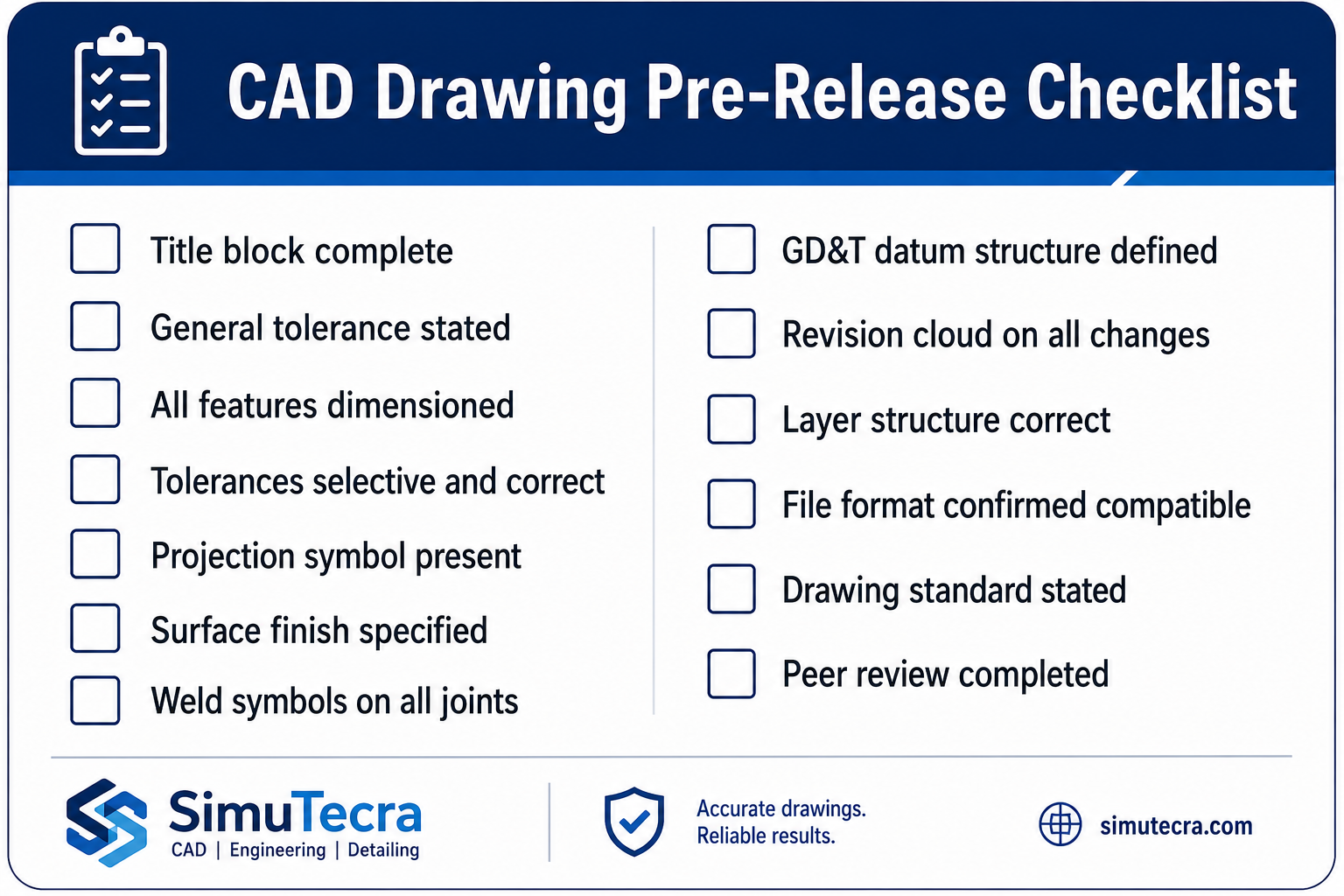
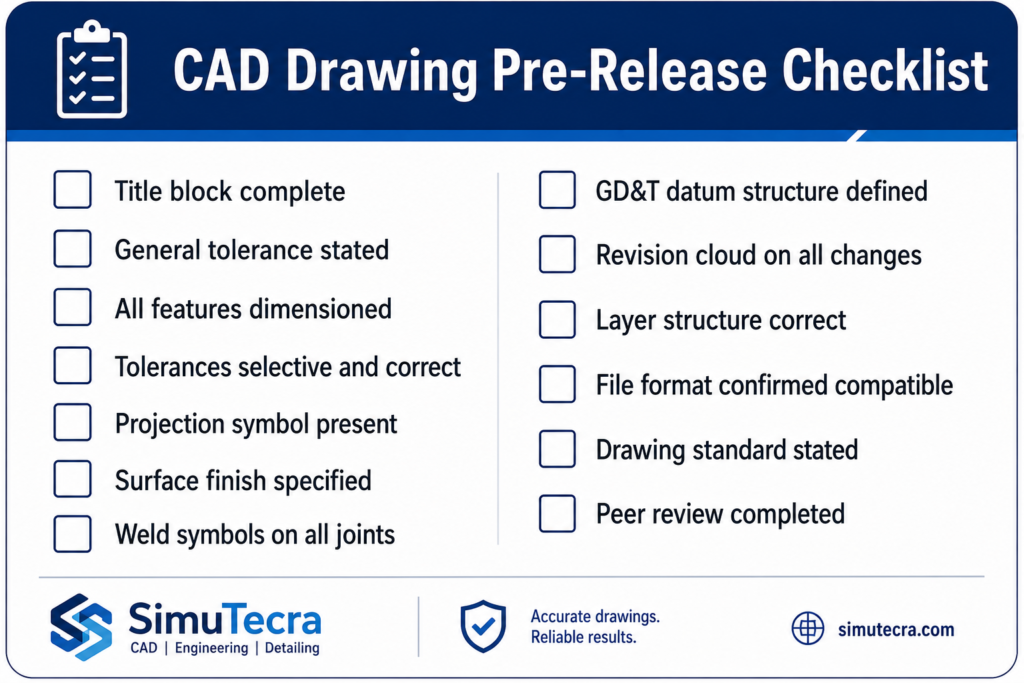
    The Pre-Release Drawing Checklist: 13 Checks Before Every Issue

    The majority of engineering drawing mistakes that cause manufacturing delays are detectable by a structured pre-release check. The following checklist addresses the most common error categories systematically. Build it into your drawing release workflow as a mandatory gate before any drawing is issued to manufacturing, procurement, or a client.

    General tolerance stated | All features dimensioned | Tolerances selective and correct | Projection symbol present | Surface finish specified | Weld symbols on all joints | GD&T datum structure defined | Revision cloud on all changes | Layer structure correct | File format confirmed compatible | Drawing standard stated | Peer review completed.
    This checklist takes three minutes to complete. It prevents rework that takes three weeks to fix.’
    Pre-Release CheckWhat to Verify
    Title block completeDrawing number, revision, date, scale, units, projection symbol, approval signature all populated
    General tolerance statedISO 2768-m or ASME equivalent in title block; no drawing issued without a general tolerance reference
    All features dimensionedEvery feature a manufacturer needs to produce is dimensioned; no feature defined by scale alone
    Tolerances selective and correctTight tolerances on mating and functional interfaces only; general tolerance everywhere else
    Projection symbol presentFirst-angle or third-angle symbol visible in title block; never omitted
    Surface finish specified by zoneRa value on all sealing, mating, and cosmetic surfaces; general finish in notes for remaining surfaces
    Weld symbols on all jointsEvery joint that will be welded carries the correct AWS or ISO symbol with process note where relevant
    GD&T datum structure definedPrimary, secondary, tertiary datums established and consistently referenced throughout all views
    Revision cloud on all changesEvery area changed from the previous revision is circled; revision table updated with description and date
    Layer structure correctAll content on named layers per convention; nothing on Layer 0; line weights assigned through layers
    File format confirmed compatibleFormat and version match the downstream requirement; INSUNITS set correctly before any XREFs inserted
    Drawing standard statedGeneral note referencing ASME Y14.5-2018, ISO 1101, or equivalent; standard clear to any reader
    Peer review completedA second engineer has checked the drawing; checker name and date in title block or review record
    The two-minute check that prevents two-week delays:  Print this checklist or keep it on your second monitor. Before issuing any drawing, run through every item. Cross off each one as you confirm it is present and correct. If any item cannot be crossed off, the drawing is not ready to issue. The checklist takes two minutes. The rework it prevents takes days or weeks.

    GD&T Errors: When Geometry Looks Right but Cannot Be Inspected

    Geometric Dimensioning and Tolerancing errors occupy a specific category of CAD drafting mistake because their consequences are not always visible at fabrication. A part made to a drawing with incorrect GD&T may be dimensionally correct by the manufacturer’s interpretation but fail inspection under the correct interpretation, or pass inspection and then fail to assemble correctly because the GD&T should have controlled a form error that the manufacturer did not realise was significant.

    The Most Common GD&T Drafting Errors

    • No datum reference frame: GD&T callouts for position, orientation, and runout are all meaningless without a defined datum structure. A positional tolerance of 0.2mm means nothing unless it is stated relative to a specific datum. Define primary, secondary, and tertiary datums that correspond to how the part will be fixtured and inspected.
    • Datum letters not consistent across views: Datum A references one face in the front view and appears to reference a different face in the right side view due to unclear label placement. Inspection builds on the wrong surface. All positional measurements are invalid.
    • Mixing ASME and ISO GD&T symbols: Concentricity is deprecated in ASME Y14.5-2018 but valid in ISO 1101. Using it on an ASME drawing creates an undefined callout. The drawing standard must be stated and symbols must be sourced from that standard alone.
    • GD&T applied where plus/minus is sufficient: Adding unnecessary feature control frames to every dimension adds complexity without adding information. GD&T should be applied where form, orientation, or position genuinely needs controlling beyond what a size tolerance provides.
    • Feature control frame referencing non-existent datum: The positional callout references datum D, but datum D is not labelled anywhere on the drawing. The manufacturer cannot inspect the feature to the stated control. The drawing must be re-issued before inspection can proceed.

    Layer Structure and File Management Errors: The Hidden Source of Review Time

    Layer management errors and file management mistakes do not always cause physical manufacturing problems, but they consistently cause review delays, collaboration failures, and the kind of confusion that makes a drawing set difficult to use efficiently. In an outsourcing or multi-discipline environment, a drawing with disorganised layers adds rework time at every stage of review, coordination, and update.

    Single-Layer Drafting: The Most Persistent Bad Habit

    Drawing all content on a single layer (or on Layer 0 in AutoCAD) is one of the most widespread CAD drafting mistakes in practice and one of the most difficult to correct retroactively. When all content is on a single layer, it is impossible to isolate object lines from annotations, to hide dimension layers for presentation, to control line weights by layer, or to extract specific content for coordination or fabrication.

    The minimum layer set for a mechanical drawing is: Object (visible geometry), Hidden (hidden lines), Centre (centre lines and axes), Dimension (dimension lines and text), Annotation (notes, leaders, hatching), Titleblock (title block content), Viewport (viewport borders in layout space). Every element on the drawing belongs to exactly one of these layers. No element should ever be on Layer 0 in a drawing issued for production.

    File Format and Version Incompatibility

    Specifying or delivering the wrong file format or wrong software version is a drafting workflow mistake that is entirely preventable and entirely common. The three most frequent situations: a DWG file saved in a newer format than the recipient’s software can open, a STEP file exported with the wrong geometry kernel for the recipient’s CAD system, and a PDF that is a rasterised image rather than a vector file, making text and dimensions unsearchable and non-scaleable.

    The prevention is a one-line confirmation: ask the recipient what format and version they require before the first file is delivered. State the required format in the drawing transmittal. For recurring partners, include format requirements in your CAD drawing specification document.

    How AI and DFM Tools Are Catching CAD Drafting Errors in 2026

    The category of CAD drawing errors that AI and automated DFM tools are most effective at catching in 2026 is geometric manufacturability violations: internal corners too tight for available tooling, pocket depths exceeding standard tool reach, walls lacking required draft angles, holes too close to bends. These are systematic, rule-based errors that human reviewers consistently miss because they are focused on technical content rather than process compliance.

    ToolWhat it checksCAD integration2026 status
    DFMXpress (SolidWorks)DFM violations: corner radii, draft, hole ratiosNative in SolidWorksBuilt-in, available to all SW users
    Fusion 360 DFM workspaceMachining, 3D printing, and sheet metal rulesNative in Fusion 360Active development, cloud-connected
    CoLab AutoReviewDrawing best practices, standard complianceBrowser-based, no CAD requiredComment on 3D models; emerging tool
    Xometry Instant DFMCNC, moulding, printing manufacturabilitySTEP file upload, cloudReturns feedback with quote instantly
    Autodesk Forma / ACCClash detection, coordination checkingCloud BIM environmentFor architecture and civil, not mechanical
    InfinitFormActive geometry optimisation for DFMFusion 360 and SolidWorksAutomated fix, not just flag
    GD&T AdvisorGD&T completeness and consistencyEmbedded in PTC CreoSpecialist GD&T checking tool

    What AI Tools Cannot Catch

    AI DFM tools in 2026 are strong on geometric rules and process compliance. They are weak on intent. A drawing that is geometrically manufacturable but functionally wrong, where the correct dimension was entered but the feature is in the wrong location relative to the datum, will pass most automated checks and fail only when the part is assembled. This category of error still requires human peer review.

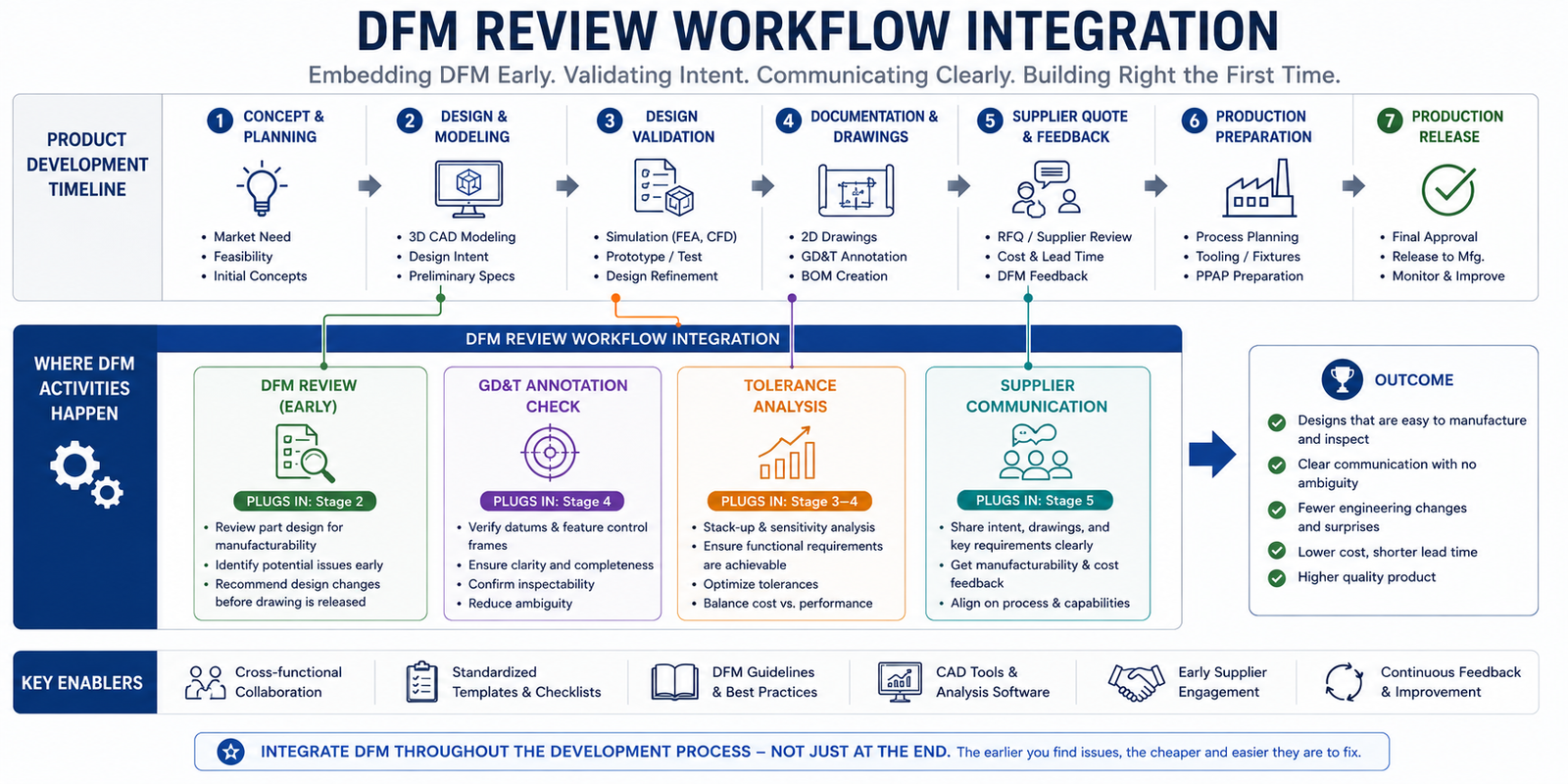
    The most effective quality system in 2026 combines automated first-pass checking for geometric and format compliance (using DFMXpress, Xometry, or similar tools) with mandatory human peer review for technical content, and a structured pre-release checklist as the final gate before issue. Each layer catches what the others miss.

    Building Habits That Prevent CAD Drafting Mistakes

    The majority of common drafting errors are not caused by a lack of knowledge about what is correct. They are caused by habits, by defaults that were set up incorrectly long ago, by time pressure that shortcuts review, and by the absence of a system that makes the correct practice the path of least resistance.

    Use a Drawing Template, Not a Blank File

    Every engineering drawing should be started from a company-standard template that pre-configures units, projection method, title block, layer structure, text styles, dimension styles, and general tolerance reference. A blank file requires the engineer to set all of these correctly each time. A template makes the correct configuration automatic.

    A well-built DWT template file in AutoCAD, or a drawing template in SolidWorks, Revit, or Civil 3D, eliminates the unit setup error, the missing title block, the wrong projection symbol, and the default layer problem in one action. It is the single highest-leverage investment against systematic CAD drafting mistakes.

    Make Peer Review Non-Negotiable

    Industry data is unambiguous on this point: drawings reviewed by a second engineer before issue have significantly fewer drafting errors reaching manufacturing than drawings reviewed only by the drafter. The peer reviewer does not need to check every dimension for technical correctness. They need to run through the pre-release checklist and verify that the drawing is complete and internally consistent.

    In organisations where peer review is consistently applied, the rate of engineering drawing errors reaching manufacturing falls significantly. In organisations where it is treated as an optional step to be skipped under schedule pressure, the same errors recur in every batch of rework.

    Treat the Drawing as a Manufacturing Instruction, Not a Visual Record

    The most powerful mental shift for eliminating CAD drafting mistakes is to change how you think about what a drawing is. It is not a visual record of a 3D model. It is a manufacturing instruction set. Every element on the drawing is there to tell the manufacturer something they need to know. Every element that is missing prevents the manufacturer from knowing something they need to know.

    If an element on the drawing would not help a skilled machinist build the part correctly, it probably does not need to be there. If an element that would help the machinist is not there, it needs to be added. That single question, ‘what does this manufacturer need to know and have I told them?’, is the foundation of every effective drawing review.

    Conclusion:

    The CAD drafting mistakes covered in this guide are not the result of inadequate engineering skill. They are the result of process gaps: no template, no pre-release checklist, no peer review, no revision distribution system. Every one of them is preventable with a structured approach that takes less time to apply than the rework it prevents.

    The statistics are consistent: approximately 29 percent of project reworks start with simple drafting errors. The cost multiplier between fixing a drawing error at the CAD stage versus fixing it after fabrication is measured in orders of magnitude. The prevention investment, a proper template, a 13-item checklist, a peer review gate, and a revision distribution protocol, is measured in engineering hours per project.

    Start with the checklist. Apply it to the next drawing you release. Identify which items you are currently not checking. Those gaps are where your manufacturing delays are coming from.

    The drawing is the instruction. Write it so clearly that the manufacturer can follow it without stopping to ask a single question.

    Frequently Asked Questions

    What are the most common CAD drafting mistakes that cause manufacturing delays?

    The most common CAD drafting mistakes that cause manufacturing delays are: missing or incomplete dimensions that force the manufacturer to stop and query, incorrect or undefined units causing scale errors in fabrication, outdated drawing revisions issued to the shop floor, ambiguous or missing tolerances, missing projection symbols that cause views to be read as mirrored, and file formats incompatible with the downstream tool. Industry data shows approximately 29 percent of project reworks in design teams come from simple drafting errors.

    How do missing dimensions on a CAD drawing cause manufacturing delays?

    Missing dimensions cause manufacturing delays because the fabricator cannot proceed without knowing the exact size of a feature. When a dimension is missing, the standard workflow is to raise a query to the engineer, wait for the response, receive a revised drawing, and then begin fabrication. This cycle typically costs one to five days. On time-critical projects, a single missing dimension can push a part off a machine schedule entirely, adding weeks to the programme if the machinist’s capacity is allocated and cannot be immediately recovered.

    Why do wrong units in a CAD drawing cause such expensive problems?

    Wrong units in a CAD drawing cause expensive problems because the scale error is invisible until the fabricated part is measured or assembled. A part designed in millimetres and cut in inches is 25.4 times the intended size. A part designed in inches and cut in millimetres is 25.4 times too small. The material is scrapped, the order must be repriced, the lead time restarts, and the programme delay can range from days to weeks depending on material availability. Industry case studies consistently cite unit errors as one of the most expensive single-drawing mistakes.

    What is the difference between a drafting error and a design error in CAD?

    A design error is a technical decision that is wrong: the part will not function, the assembly will not fit, or the structure will not carry the load. A drafting error is a documentation error: the design intent is correct but the drawing fails to communicate it accurately to the manufacturer. A missing dimension is a drafting error. A hole in the wrong position is a design error. Both cause manufacturing delays, but drafting errors are generally cheaper to fix at the drawing stage and more expensive to catch after fabrication because they are easy to overlook during design review.

    How do I prevent outdated CAD drawings from reaching the manufacturing floor?

    Preventing outdated drawings from reaching the manufacturing floor requires three practices. First, a drawing distribution system where only the current approved revision is accessible to the manufacturing team, with older revisions archived and clearly marked as superseded. Second, a revision control block on every drawing sheet showing the current revision letter, change description, date, and approver. Third, a document transmittal process where every drawing issue is logged, dated, and acknowledged by the recipient, so there is an auditable record of who received which revision and when.

    Can AI tools catch CAD drafting mistakes before drawings are released?

    Yes. AI and automated DFM tools in 2026 can catch many common CAD drafting mistakes before drawings are released to manufacturing. DFMXpress in SolidWorks checks for geometric manufacturability violations. Xometry’s Instant DFM returns manufacturability feedback at the same time as a quote. CoLab AutoReview checks drawings against best practice standards. InfinitForm actively corrects geometry rather than just flagging it. These tools do not replace peer review, but they catch the systematic and geometric errors that human reviewers tend to miss because they are focused on technical content rather than drawing compliance.


    Printform 2026: the top 10 CAD design mistakes that delay manufacturing’