Tag: Mechanical Engineering degrees

  • Frontiers of Mechanical Engineering Explained (2026)

    Frontiers of Mechanical Engineering Explained (2026)

    Every discipline has a core and a frontier. The core is what is established, taught in textbooks, and applied daily by practitioners. The frontier is where the known ends and the unknown begins: the territory where researchers are actively pushing, where the limits of what is possible are being tested, and where today’s experimental result becomes tomorrow’s engineering standard.

    The frontiers of mechanical engineering in 2026 are simultaneously exciting and demanding. They span scales from the sub-nanometre to the planetary. They reach across disciplinary boundaries into biology, quantum physics, computer science, neuroscience, and environmental science. They address challenges ranging from the decarbonisation of global energy systems to the design of machines that can survive and operate on other planets.
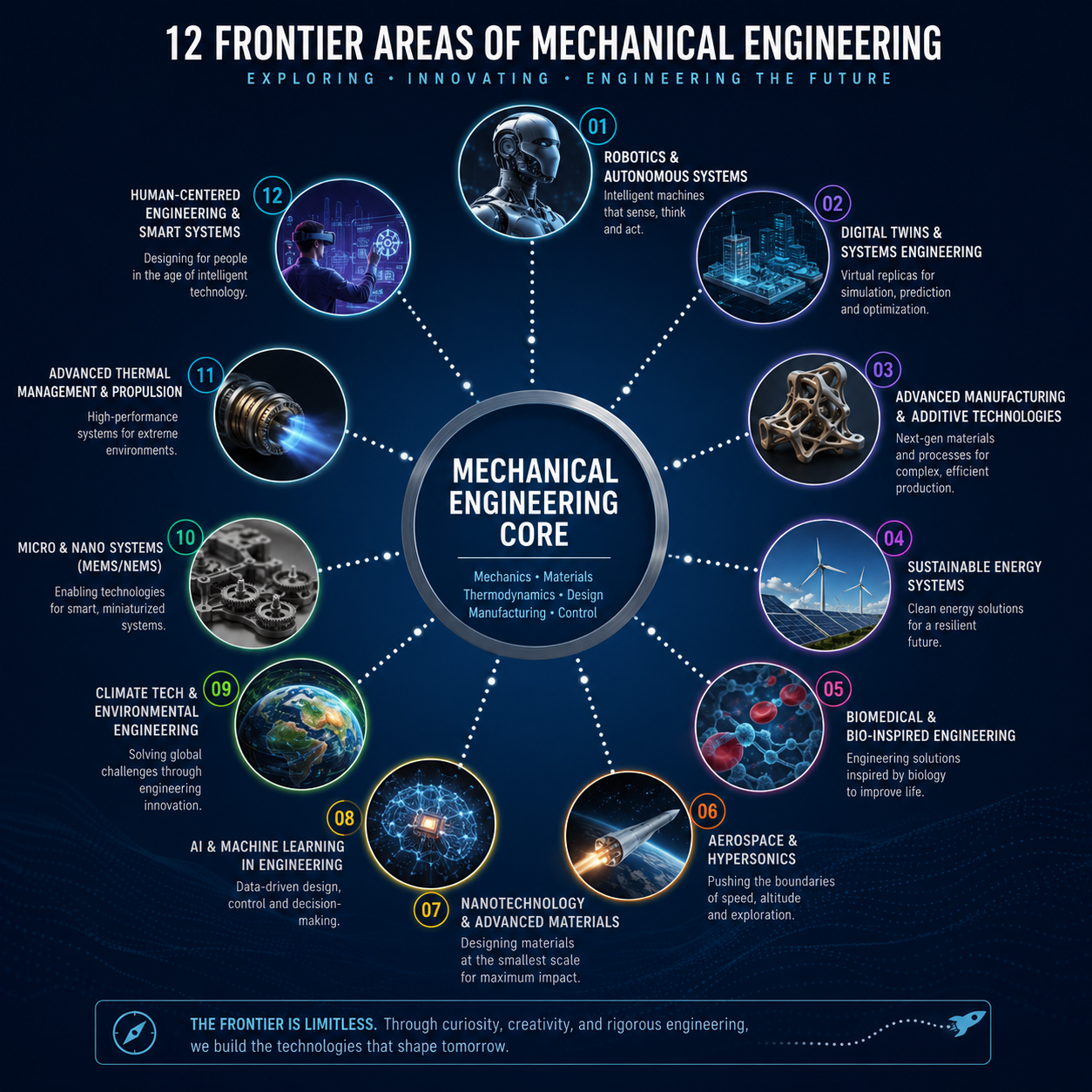
    Conceptual diagram showing 12 frontier areas of mechanical engineering radiating from the classical engineering core including tribology, quantum engineering, soft robotics and bio-inspired design

    This article provides the most comprehensive, readable, and practically relevant guide to the frontiers of mechanical engineering available outside of academic journals. It is written for engineering students who want to understand where the discipline is heading, for practising engineers considering whether to pursue research or advanced specialisation, and for anyone who wants to understand what the brightest engineering minds in the world are currently working on and why it matters.

    What We Mean by ‘Frontiers’:  The frontiers of mechanical engineering are the research-active boundaries of the discipline: areas where current knowledge is being extended, where conventional methods reach their limits, where new tools and theories are being created, and where the results of today’s research will become the engineering standards of the next decade. Understanding the frontiers is how engineers anticipate where the profession is heading before it arrives.

    Understanding the Concept of a Discipline’s Frontier

    The word “frontier” in the context of an engineering or scientific discipline describes the region at the edge of current knowledge, where established methods no longer provide complete answers and where new approaches, tools, materials, and theories are being actively developed. A frontier of mechanical engineering is therefore not simply an advanced topic: it is an area where the profession’s current best knowledge is genuinely insufficient to solve the problem at hand.

    Frontiers matter for several practical reasons beyond intellectual curiosity. They are where the highest-value research positions exist. They are where industry is willing to pay the largest premiums for specialised knowledge. They are where today’s PhD thesis becomes tomorrow’s commercially deployed technology. And they are where mechanical engineering’s identity as a discipline is continuously being renewed and expanded.

    The frontiers of mechanical engineering are also where the discipline is most overtly interdisciplinary. The core of mechanical engineering, statics, dynamics, thermodynamics, and manufacturing, is relatively self-contained. The frontiers almost never are. They require mechanical engineers to engage deeply with biology, chemistry, physics, neuroscience, data science, and materials science simultaneously. Engineers who work at these frontiers are genuinely hybrid practitioners.

    Important Distinction:  The frontiers of mechanical engineering are distinct from the latest advances covered in the previous article in this cluster. Advances are technologies and methods that have crossed from research into deployment: they are being used in factories and products today. Frontiers are the research-active boundary conditions: the places where engineers and scientists are working right now to build knowledge that does not yet exist in a commercially deployable form. Some of today’s frontiers will become tomorrow’s advances; others will remain at the frontier for decades.

    Frontier 1: Nano-Scale Mechanical Engineering and Molecular Machines

    At the deepest frontier of scale, mechanical engineering is grappling with the behaviour of matter at the nanometre and even angstrom level, where classical mechanics gives way to quantum mechanical effects and where the dominant forces are surface interactions rather than gravitational or inertial loads. Nano-scale mechanical engineering is the field that designs, fabricates, and analyses mechanical systems with features measured in billionths of a metre.
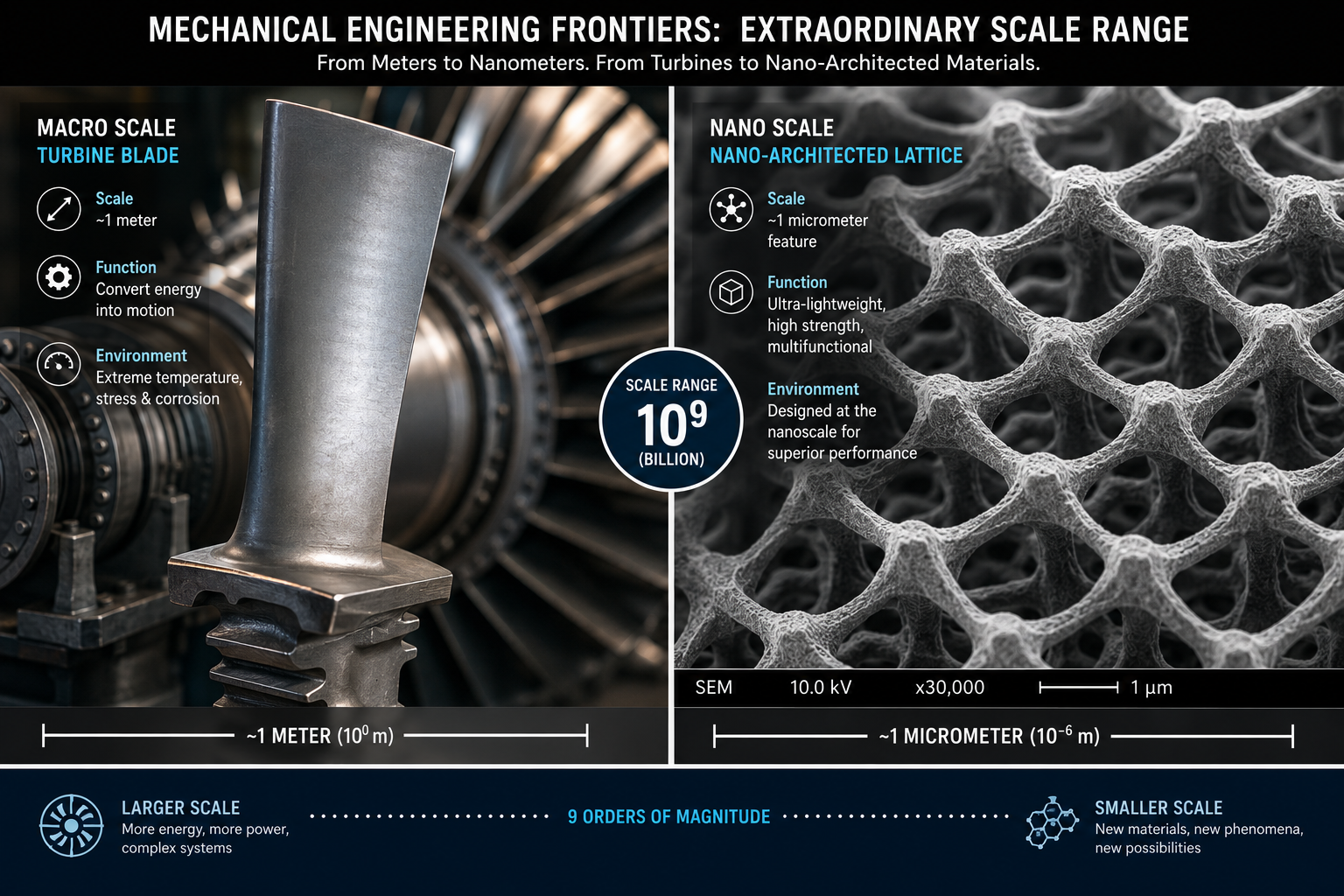
    Mechanical engineering scale range comparison turbine blade at macro scale versus nano-architected lattice material at nanometre scale under electron microscopy

    Nano-Architected Materials: Tuning Mechanics at the Atomic Scale

    MIT graduate research (featured in MIT News, 2024) by Somayajulu Dhulipala with advisor Professor Carlos Portela has focused on developing nano-architected materials with tunable mechanical properties through scalable fabrication methods. Unlike conventional materials whose properties are fixed by composition, nano-architected materials derive their mechanical behaviour from their geometric structure at the nanoscale, enabling engineers to programme stiffness, strength, and energy absorption by design rather than by material selection alone.

    The ability to fine-tune the mechanical properties of specific materials at the nanoscale brings versatility across multiple industries. Applications include ultra-lightweight structural panels for aerospace, impact-absorbing helmets with precisely graduated energy dissipation zones, implantable scaffolds for bone tissue engineering that match the mechanical compliance of natural bone, and nano-scale thermal management structures for next-generation semiconductor devices.

    Molecular Machines: Mechanical Engineering at the Biological Scale

    Biology has been running molecular machines for billions of years. Proteins such as myosin (the motor protein responsible for muscle contraction), ATP synthase (the rotary motor that produces cellular energy), and kinesin (which transports cargo along microtubule tracks inside cells) are all mechanical machines operating at the molecular scale with astounding efficiency and precision.

    Mechanical engineers and biophysicists are studying these biological machines not merely out of curiosity but with the explicit aim of copying their principles in synthetic systems. Artificial molecular motors, molecular switches, and DNA-based mechanical actuators are all active research areas, with potential applications in targeted drug delivery, molecular assembly of materials, and ultra-compact energy conversion devices.

    Frontier 2: Bio-Inspired and Biohybrid Engineering

    Nature is the most sophisticated engineer on Earth, operating over four billion years with the most rigorous possible selection pressure: anything that does not work is eliminated. Bio-inspired mechanical engineering studies biological systems, from spider silk and mantis shrimp claws to bird wing aerodynamics and tree root anchor mechanics, to extract design principles that can be translated into engineered systems.

    Biological Structures as Engineering Inspiration

    The mantis shrimp’s dactyl club, which delivers impact forces of up to 1,500 Newtons while striking hard-shelled prey, has a layered helicoidal composite microstructure that distributes crack propagation energy with extraordinary efficiency. Researchers at UC Riverside and other institutions have used this structure as a template for impact-resistant composite materials for helmets, body armour, and aircraft panels. Spider silk, with its combination of strength, toughness, and extensibility that no synthetic fibre matches, has inspired decades of biomimetic fibre research. Gecko adhesion, achieved through millions of micro-scale hair-like structures that exploit van der Waals forces, is the basis for research into dry, reversible adhesives for robotics, medical devices, and structural repair.
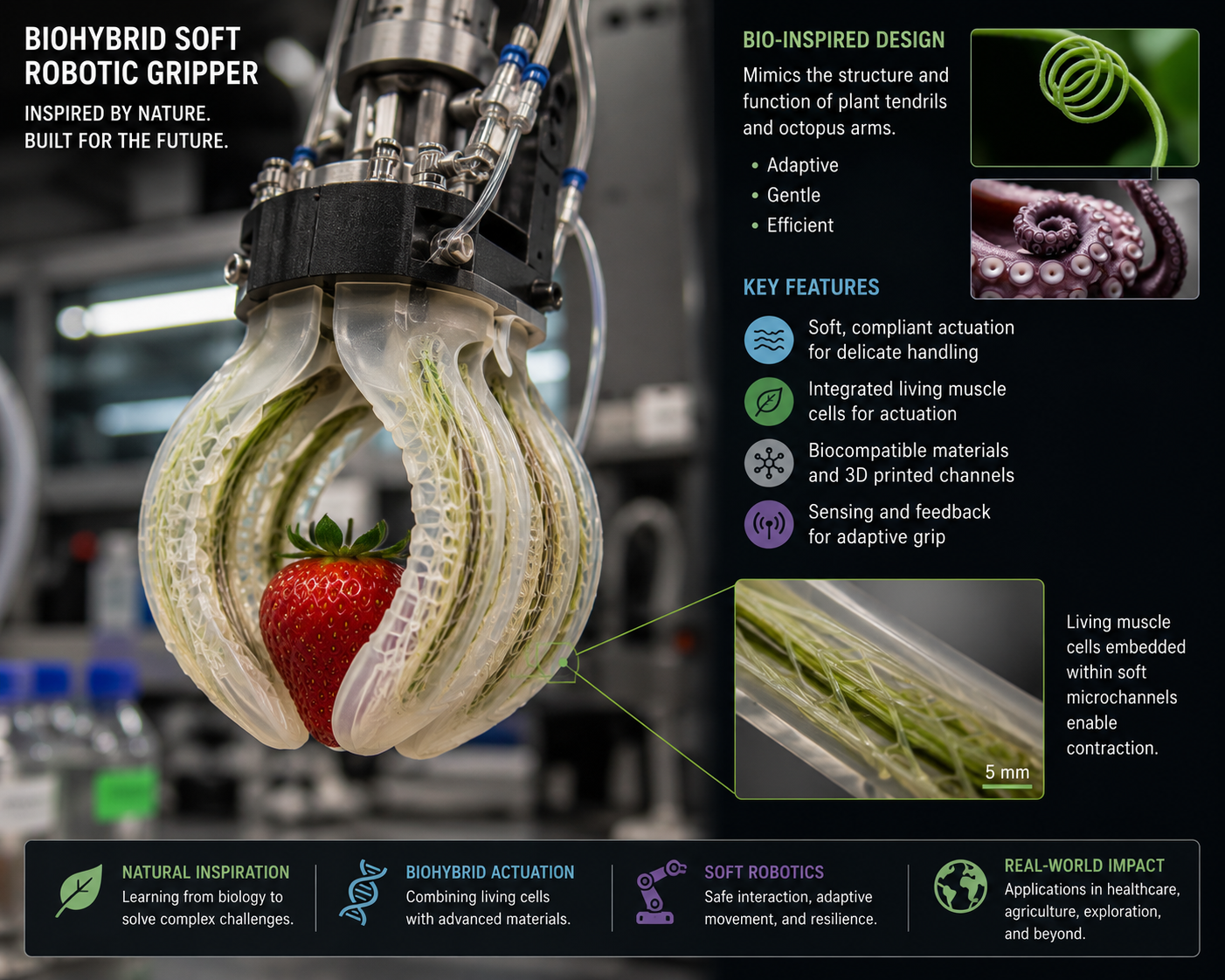
    Bio-inspired soft robotic gripper based on biological design principles in a laboratory setting, representing the frontier of bio-inspired mechanical engineering

    Biohybrid Systems: Merging Living Tissue with Mechanical Structures

    The most radical frontier in this area is biohybrid engineering: the integration of living biological tissue with mechanical structures to create systems that cannot be built from either component alone. Researchers have demonstrated biohybrid robots powered by muscle tissue grown from stem cells, in which the living muscle provides actuation force while a synthetic mechanical scaffold provides structure and constraint. These systems can be actuated by electrical stimulation or by light, and they self-repair, a capability no conventional actuator possesses.

    MIT research highlighted in 2024 includes work by graduate student Loïcka Baille developing remote sensing technologies to study and protect marine life, and by Carlos Díaz-Marín designing salt-polymer materials that capture humidity from air for water generation and thermal energy storage. Both represent mechanical engineers working at the frontier between the physical and biological worlds.

    Frontier 3: Tribology at the Extreme: Zero-Wear and Self-Lubricating Systems

    Tribology, the science of friction, wear, and lubrication between interacting surfaces, is one of the oldest mechanical engineering disciplines and one of the most economically significant. Friction and wear losses account for approximately 23 percent of global energy consumption, according to estimates from the International Energy Agency and tribology research institutions. Eliminating or reducing these losses is one of the most impactful engineering challenges on the planet.

    Superlubricity: Near-Zero Friction Surfaces

    Superlubricity is the phenomenon in which friction between two sliding surfaces approaches zero. First observed at the atomic scale between misaligned graphene layers, superlubricity has now been demonstrated in engineering-relevant conditions using graphene-based coatings, carbon nanotube arrays, and engineered surface topographies. Achieving superlubricity in macroscale engineering components, such as engine bearings, gears, and hydraulic seals, at practical operating temperatures and loads, is an active and commercially compelling research frontier.

    Solid Lubricants and Self-Healing Coatings

    Conventional liquid lubrication is impossible in many extreme environments: the vacuum of space, cryogenic temperatures, and high-radiation nuclear environments all preclude conventional oils and greases. Solid lubricant research is developing coatings based on materials including molybdenum disulfide (MoS2), hexagonal boron nitride, and diamond-like carbon (DLC) that can provide low-friction surfaces in these extreme conditions. The next frontier in tribology is self-healing tribological coatings: surfaces that autonomously repair wear damage through the release of embedded lubricant reservoirs or through surface chemistry triggered by frictional heat.

    Economic Impact:  A 2017 study published in Tribology International estimated that tribological advances already in existence, if fully implemented globally, could reduce energy consumption by up to 40 percent in transport applications alone. The potential economic saving runs to trillions of dollars annually. This is why tribology research, despite its low public profile, is one of the most heavily funded areas at the frontier of mechanical engineering.

    Frontier 4: Turbomachinery for Next-Generation Energy Systems

    Turbomachinery, the design of turbines, compressors, fans, and pumps that exchange energy between a fluid and a rotating shaft, is one of the most mature branches of mechanical engineering. And yet it remains one of the most active research frontiers, driven by the urgent need to make turbomachinery more efficient, more durable, and capable of operating with new working fluids including hydrogen, supercritical carbon dioxide, and ammonia.

    Supercritical CO2 Power Cycles

    Supercritical carbon dioxide (sCO2) power cycles operate with CO2 as the working fluid at conditions above its critical point (31 degrees Celsius and 73.8 bar), where it behaves as a dense fluid with properties between a liquid and a gas. sCO2 turbines can achieve thermal efficiencies significantly higher than conventional steam turbines at the same operating temperature, while being physically much smaller and more compact. They are potentially transformative for concentrated solar power, nuclear power, and waste heat recovery applications, but they operate in conditions of extreme pressure and temperature that push current materials and seal technologies to their limits.

    Hydrogen-Fuelled Turbines and Combustion Engineering

    The transition of gas turbines from natural gas to hydrogen fuel is a frontier research problem of enormous commercial importance. Hydrogen combustion is fundamentally different from methane combustion: it burns at higher temperatures, with a much wider flammability range, higher flame speeds, and greater tendency toward flashback (where the flame propagates back into the fuel supply). Designing combustor geometries that handle these challenges while maintaining low NOx emissions requires new computational tools, new experimental rigs, and deep collaboration between mechanical engineers, combustion chemists, and materials scientists.

    Additive Manufacturing of Turbine Components

    The ability to produce turbine blades with internal cooling channel geometries impossible to achieve by casting or machining is one of the most commercially significant applications of metal additive manufacturing in any industry. Current research is focused on qualifying AM-produced turbine components for service, developing post-processing methods to achieve the surface finish and dimensional accuracy required, and pushing the temperature capability of AM-compatible nickel superalloys to enable higher turbine inlet temperatures and greater thermal efficiency.

    Frontier 5: Quantum Engineering and Mechanical Systems

    The intersection of quantum physics and mechanical engineering is one of the most intellectually fascinating frontiers in contemporary science. Quantum mechanical engineering is not a single coherent field but a collection of research areas in which quantum phenomena are either exploited for engineering purposes or in which mechanical systems are used as platforms to study and control quantum states.

    Optomechanics: Controlling Mechanical Motion with Light

    Optomechanical systems use the radiation pressure of light to cool, drive, and sense the motion of mechanical resonators at the micro and nano scale. Researchers have cooled micro-mechanical oscillators to their quantum ground state, the lowest energy state allowed by quantum mechanics, using laser cooling techniques. This enables precision measurements of mechanical motion with sensitivity far below the standard quantum limit, with applications in ultra-sensitive force and mass sensors, gravitational wave detectors, and fundamental tests of quantum mechanics.

    Quantum Sensing Using Mechanical Systems

    MEMS and NEMS (Nano-ElectroMechanical Systems) devices are being developed as quantum sensors capable of detecting forces, fields, and masses at the single-molecule or single-atom level. These devices are relevant to medical diagnostics (detecting disease biomarkers at vanishingly low concentrations), defence (detecting trace chemical and biological agents), and fundamental physics (searching for dark matter and testing quantum gravity theories). The mechanical engineering challenges of fabricating, characterising, and operating these devices at the required sensitivity are at the very frontier of the discipline.

    Why This Matters for Engineers:  Quantum engineering may seem remote from practical mechanical engineering, but its applications are converging rapidly with mainstream practice. The inertial navigation systems in autonomous vehicles, the gravimeters used in oil and gas exploration, the accelerometers in smartphones, and the force sensors in precision manufacturing equipment are all heading toward quantum-enhanced sensitivity in the next decade. Mechanical engineers who understand the physical principles will be the ones designing and deploying these systems.

    Frontier 6: Autonomous and Self-Adaptive Mechanical Systems

    The frontier of autonomous mechanical systems goes significantly beyond current industrial robotics. The research frontier is concerned with systems that can not only execute pre-programmed tasks autonomously but can perceive their environment, adapt their behaviour in response to unexpected conditions, learn from experience, and make decisions in contexts their designers did not explicitly anticipate.

    Morphing Structures: Machines That Change Their Shape

    Morphing structures are mechanical systems that can change their shape, stiffness, or topology in response to changing conditions, optimising their performance across multiple operating regimes rather than being fixed to a single geometry. Aircraft morphing wings, which can change their profile for optimal efficiency at different flight speeds and altitudes, have been a research frontier for two decades. Recent advances in smart material actuators (shape memory alloys, dielectric elastomers, and piezoelectric actuators) and in lightweight compliant mechanism design are making morphing structures genuinely viable for practical deployment.

    Self-Healing Mechanical Structures

    A frontier that bridges materials science and mechanical engineering, self-healing structural materials can autonomously repair damage such as cracks, delamination, or corrosion without human intervention. Vascular networks embedded in composite materials release healing agents when crack propagation ruptures the vascular channels. Research published in 2024 and 2026 demonstrates self-healing efficiencies of 80 to 95 percent of original fracture toughness in fibre-reinforced composite systems. The engineering frontier is moving from demonstration at coupon scale to application in structural components for aerospace panels, wind turbine blades, and offshore infrastructure.

    Swarm Robotics and Distributed Mechanical Systems

    Swarm robotics applies principles from collective biological behaviour (ant colonies, bird flocking, fish shoaling) to large numbers of simple robots that collectively achieve complex tasks no individual robot could accomplish alone. The mechanical engineering challenges include designing robust, miniaturised robots capable of operating in swarms, developing compliant mechanisms for ground and aerial locomotion at small scales, and creating fault-tolerant mechanical systems that maintain collective functionality even when individual robots fail.

    Read the blog on: Nature of Mechanical Engineering Explained (2026)

    Frontier 7: Sustainable and Circular Manufacturing Engineering

    If there is a single frontier that is reshaping the entire profession rather than a specific technical sub-domain, it is the frontier of sustainable and circular engineering. The pressure to decarbonise manufacturing, eliminate waste, and design products for longevity, repairability, and material recovery is not merely a regulatory requirement: it is a fundamental redesign of the engineering brief itself.

    Net-Zero Carbon Manufacturing

    Achieving net-zero carbon manufacturing requires mechanical engineers to address energy consumption at every stage of the production process: material extraction and processing, forming and machining, assembly, and end-of-life treatment. Research frontiers include electrification of high-temperature industrial processes that currently rely on fossil fuel combustion (cement kilns, steel furnaces, glass melting), the use of green hydrogen as an industrial reductant (replacing coking coal in iron and steel production), and the development of low-energy precision manufacturing processes that reduce material waste.

    Design for Circularity: Engineering Products That Can Be Fully Recovered

    The circular economy requires products designed from the outset for disassembly, component recovery, and material recycling. Design for circularity (DfC) is a mechanical engineering frontier that challenges virtually every conventional design heuristic. Designs that are optimised for manufacturing (minimising fasteners, using permanent joins, co-moulding multiple materials) are often the hardest to disassemble and recycle. Developing design methodologies that optimise simultaneously for manufacturability, performance, and end-of-life material recovery requires new computational design tools, new joining technologies, and new frameworks for quantifying circular value alongside structural and thermal performance.

    Frontier 8: Extreme Environment Engineering: Deep Sea, Polar, and Space

    Mechanical engineering has always operated at environmental extremes, but the frontiers of extreme environment engineering in 2026 are being pushed further than ever by the demands of deep-sea resource exploration, polar scientific infrastructure, and the emerging commercial space economy.

    Deep-Sea Engineering

    The deep ocean, defined as depths below 200 metres, covers more than 60 percent of the Earth’s surface and remains one of the least-explored environments on the planet. Hydrostatic pressures at full ocean depth (11,000 metres, the depth of the Challenger Deep) reach more than 1,100 bar: equivalent to supporting the weight of 50 passenger aircraft on a square centimetre of surface. Deep-sea mechanical engineering faces challenges including the design of pressure housings that maintain structural integrity under these loads, the development of buoyancy materials for full-ocean-depth operation, corrosion management in oxygen-depleted saline environments, and the engineering of low-power, long-endurance unmanned underwater vehicles (UUVs) capable of multi-year autonomous operation.

    Space Mechanical Engineering: From Launch to In-Situ Manufacturing

    The commercial space sector, valued in 2024 at approximately $630 billion and growing at 9 percent annually, is creating new mechanical engineering frontiers across propulsion, structures, thermal control, and manufacturing. The mechanical engineering challenges of space-based manufacturing range from the design of in-space assembly robots for large orbital structures, to the development of ISRU (In-Situ Resource Utilisation) systems for manufacturing structural materials and propellant from lunar or Martian regolith, to the engineering of mechanisms that can reliably operate in the thermal cycling, vacuum, and radiation environment of space over mission durations of a decade or more.

    MIT graduate student Somayajulu Dhulipala’s research on nano-architected materials is explicitly motivated by applications in making space habitable: lightweight, high-performance materials engineered at the nanoscale could provide thermal insulation, radiation shielding, and structural support with mass fractions that conventional materials cannot achieve.

    Frontier 9: Neuro-Mechanical Engineering and Brain-Machine Interfaces

    Neuro-mechanical engineering is one of the newest and most intellectually challenging frontiers in the discipline: the design of mechanical systems that interface directly with the human nervous system, reading neural signals to control external devices and delivering mechanical or electrical actuation to restore or augment physical function.

    Prosthetics at the Frontier: Restoring Sensation and Dexterity

    Advanced prosthetic limbs have moved far beyond passive mechanical replacements. The current frontier involves bidirectional neural interfaces: prosthetic hands that can not only be controlled by motor nerve signals decoded from the residual limb but can also send sensory feedback signals back to the nervous system, giving the user a sense of touch and proprioception. The mechanical engineering challenges include designing actuated fingers with sufficient degrees of freedom and force capacity to replicate natural hand dexterity, embedding sensor arrays to measure contact force, texture, and slip, and packaging all of this into a prosthetic of appropriate weight and form factor.

    Exoskeletons: Augmenting Human Physical Capability

    Powered exoskeletons for rehabilitation, workplace ergonomic assistance, and military load-bearing are an active engineering frontier with several products already in commercial deployment. The mechanical engineering challenges at the frontier include developing lightweight, compliant actuation systems that can match the kinematics of the human musculoskeletal system across its full range of motion, designing control systems that interpret user intent from muscle electromyography (EMG) signals with sufficient speed and accuracy, and creating wearable structures that are comfortable and safe for extended daily use.

    Frontier 10: Multi-Scale and Multi-Physics Simulation as a Design Frontier

    Simulation is not new in mechanical engineering, but the frontier of multi-scale and multi-physics simulation represents a qualitative change in what computational engineering can achieve. Traditional FEA operates at a single scale (the component scale) and typically addresses a single physics domain (structural mechanics). The frontier involves coupling simulations across scales and physics domains in ways that capture emergent behaviours that no single-domain, single-scale analysis can reveal.

    Molecular Dynamics to Continuum Mechanics: Bridging the Scale Gap

    The behaviour of engineering materials at the macroscale is fundamentally determined by phenomena at the atomic and microstructural scale: dislocation motion controls plasticity, grain boundary chemistry controls corrosion, nanoscale defects initiate fatigue cracks. Multi-scale modelling seeks to bridge from molecular dynamics simulations (picosecond timescales, nanometre length scales) through crystal plasticity models (microsecond timescales, micron scales) to continuum FEA (second timescales, component scales). Achieving this bridging reliably for complex loading histories and environments is an unsolved computational engineering challenge of the first order.

    Physics-Informed Machine Learning: AI at the Simulation Frontier

    Physics-Informed Neural Networks (PINNs) represent one of the most exciting developments at the intersection of machine learning and engineering simulation. PINNs encode the governing differential equations of physics (Navier-Stokes, heat equation, elastic wave equation) as constraints in the training of neural networks, enabling them to solve complex physical problems at speeds that conventional numerical methods cannot match. MIT research groups and commercial simulation vendors are actively developing PINN-based solvers for fluid dynamics, structural mechanics, and heat transfer, with the potential to make high-fidelity simulation accessible for real-time design optimisation.

    Frontier 11: In-Body Mechanical Engineering: Ingestible and Implantable Devices

    One of the most remarkable frontiers in mechanical engineering is the design of devices that operate inside the human body, subject to an environment of extraordinary complexity: corrosive fluids, living tissue that can respond immunologically to foreign objects, mechanical loads from breathing, heartbeat, and movement, and spatial constraints measured in millimetres.

    Ingestible Mechatronic Capsules

    MIT graduate student Jimmy McRae’s research focuses on ingestible electronic and mechatronic devices that can perform continuous monitoring and remotely triggerable actuation from within the gastrointestinal tract. These devices range from ingestible electroceutical capsules that modulate hunger-regulating hormones by delivering electrical stimulation to the stomach lining, to devices capable of continuous ultralong monitoring of gut chemistry, pH, temperature, and motility. The mechanical engineering challenges include miniaturisation, biocompatible sealing, power harvesting from body motion or chemical energy, and wireless communication through tissue.

    Next-Generation Implantable Devices

    Beyond conventional pacemakers and orthopaedic implants, the frontier of implantable mechanical engineering includes totally artificial hearts driven by continuous-flow turbopumps, cochlear implants with MEMS-based frequency selective membranes that replicate the basilar membrane of the inner ear, retinal implants that convert light to electrical nerve stimulation to restore partial vision, and drug delivery implants with MEMS-actuated valves that release precise drug doses on demand in response to biosensors monitoring disease markers. Each of these devices is a complete mechanical and electrical engineering system operating in one of the most demanding environments imaginable.

    Frontier 12: The Convergence Frontier: Where Mechanical Engineering Meets Everything

    The most distinctive characteristic of mechanical engineering’s frontier in the 2020s is that the most exciting and impactful work is almost never confined within a single discipline. It happens at convergence points: where mechanical engineering meets biology, quantum physics, neuroscience, data science, environmental engineering, or space science.

    This convergence is not a diffusion of the discipline’s identity. It is an expansion. The core physical principles, mechanics, thermodynamics, fluid mechanics, materials science, remain the analytical foundation. What changes at the frontier is the context in which those principles are applied and the collaborators alongside whom they are developed. A mechanical engineer at the nano-scale frontier is using continuum mechanics and nanofabrication in the same breath. A mechanical engineer at the neuro-mechanical frontier is applying biomechanics and control systems theory to human anatomy.

    The Frontiers in Mechanical Engineering journal (published by Frontiers Media) explicitly recognises this convergence in its scope, covering biomechanical engineering, digital manufacturing, engine and automotive engineering, fluid mechanics, heat transfer, mechatronics, MEMS, solid and structural mechanics, tribology, turbomachinery, and vibration systems simultaneously. The Frontiers of Mechanical Engineering journal (published by Higher Education Press / Springer, formerly sponsored by China’s Ministry of Education) covers machines and mechanisms, mechanical design and bionics, manufacturing automation, precision engineering, mechatronics, micro/nano manufacturing, robotics, and green manufacturing. Both journals reflect the reality that the frontier of mechanical engineering does not exist at a single point: it is a wide, multidimensional boundary.

    How the Frontiers Shape Mechanical Engineering Careers

    Understanding the frontiers of mechanical engineering is not merely intellectually rewarding. It is a practical career advantage. Engineers and researchers who position themselves at a frontier, particularly one with strong commercial pull, are among the most sought-after professionals in the field.

    Frontier AreaCareer PathwaysDegree Level Typically RequiredWhere the Jobs Are
    Nano-scale ME and molecular machinesNanomaterials engineer, MEMS design engineer, nanotechnology R&D scientistMSc or PhDSemiconductor industry, biomedical devices, defence, space technology companies
    Bio-inspired and biohybrid engineeringSoft robotics engineer, biomimetic materials scientist, biohybrid systems researcherMSc or PhDMedical device companies, robotics startups, university research labs, defence R&D
    Tribology: superlubricity and self-healing coatingsTribology engineer, surface technology specialist, lubrication systems engineerBEng + specialisation or MScAutomotive OEMs, aerospace, energy sector, bearing and seal manufacturers
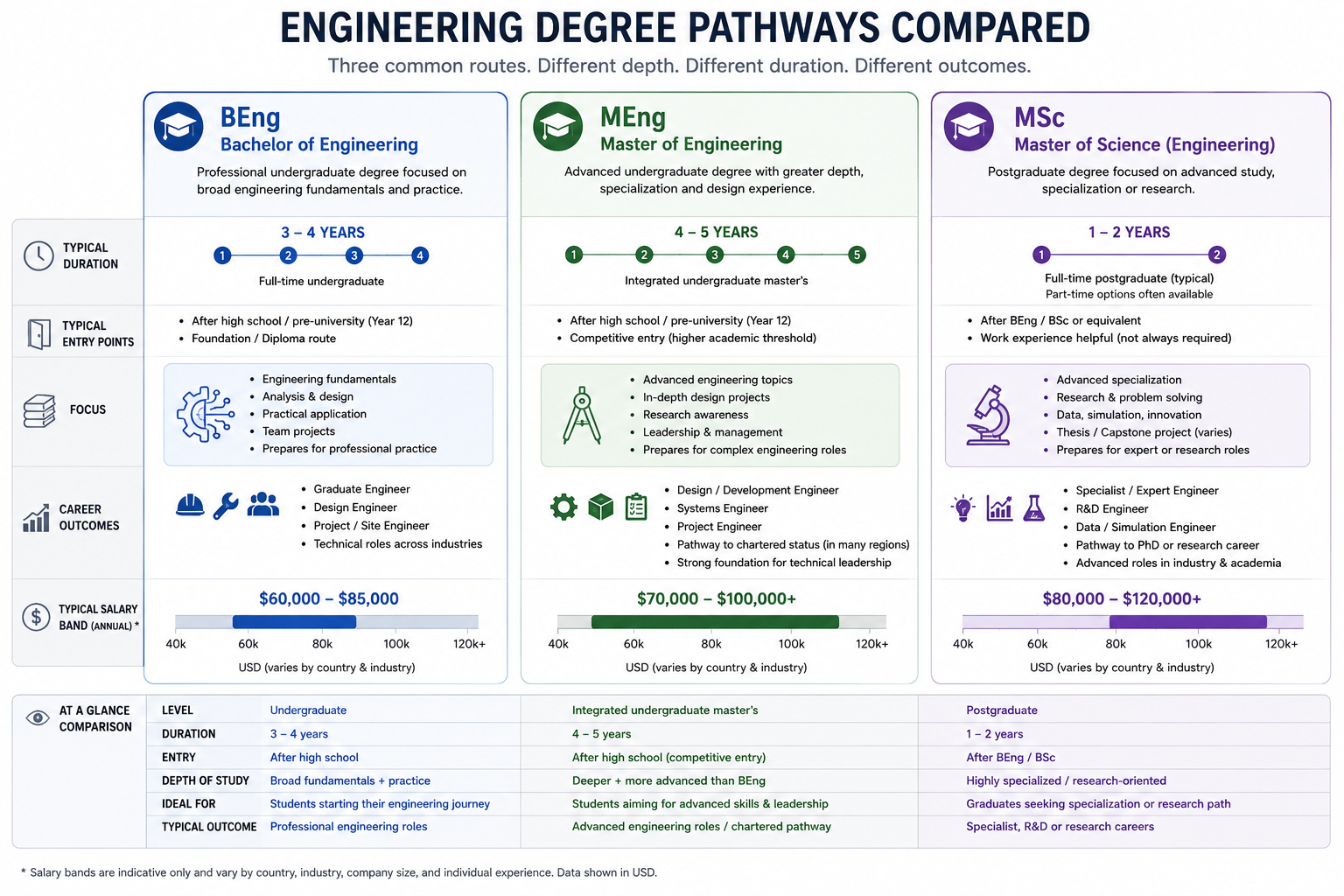
    Advanced turbomachineryTurbomachinery aerodynamicist, combustion engineer, AM turbine component engineerMEng or MSc, PhD for research rolesGas turbine OEMs (GE, Siemens, Rolls-Royce), energy utilities, aerospace propulsion
    Quantum engineering and sensingQuantum sensor engineer, optomechanics researcher, precision instruments engineerPhD almost universally requiredNational laboratories, quantum computing companies, defence, precision instrument manufacturers
    Autonomous and self-adaptive systemsMorphing structures engineer, swarm robotics engineer, smart materials engineerMSc or PhDAerospace R&D, defence, advanced manufacturing, robotics companies
    Sustainable and circular manufacturingCircular design engineer, sustainable manufacturing specialist, LCA engineerBEng + experience or MScAll major manufacturing industries; green technology sector; consulting
    Extreme environment engineeringDeep-sea systems engineer, space mechanisms engineer, nuclear materials engineerMEng or MScEnergy majors, space agencies, nuclear operators, defence
    Neuro-mechanical engineeringProsthetics engineer, exoskeleton designer, neural interface mechanical engineerMSc or PhDMedical device companies, rehabilitation technology, defence, neurotechnology startups
    In-body devicesIngestible device engineer, implantable systems engineer, bioMEMS engineerMSc or PhDMedical device OEMs, hospital technology, biotech companies
    Career Strategy Insight:  The highest-value career positioning at the frontiers of mechanical engineering comes from combining a deep classical mechanical engineering foundation with genuine expertise in one frontier area. The engineer who understands tribology from first principles and can also write Python scripts to analyse surface metrology data is significantly more valuable than one with either skill alone. The frontier engineer is almost always a bridge builder: between classical ME and a partner discipline, between academic research and industrial application, between physical and digital engineering.

    Academic Journals Covering the Frontiers of Mechanical Engineering

    For engineers and students who want to engage with the primary research literature at the frontiers of the discipline, the following journals are the most relevant and widely read.

    JournalPublisherFocus AreaKey Metric (2024/2026)
    Frontiers of Mechanical EngineeringHigher Education Press / SpringerAll major ME branches; machines, mechanisms, tribology, manufacturing, precision engineering, mechatronics, MEMS, green manufacturingImpact Factor: ~4.5-5.1; SJR: Q1; H-index: 48
    Frontiers in Mechanical EngineeringFrontiers Media (open access)Biomechanical engineering, digital manufacturing, fluid mechanics, heat transfer, mechatronics, MEMS, solid mechanics, tribology, turbomachineryOpen access; ESCI indexed; growing citation base
    International Journal of Machine Tools and ManufactureElsevierMachining processes, manufacturing technology, precision engineeringTop-ranked in manufacturing ME; highly cited
    Journal of the Mechanics and Physics of SolidsElsevierTheoretical solid mechanics, fracture, plasticity, metamaterialsPremier journal for solid mechanics frontiers
    Nature Machine IntelligenceSpringer NatureAI and robotics frontiers, machine learning in engineering systemsHigh-impact interdisciplinary; key for AI-ME convergence
    Science RoboticsAAASAdvanced robotics: soft robots, surgical robots, biohybrid systemsAmong the highest-impact robotics journals
    Applied Physics Letters / Physical Review AppliedAIP / APSMEMS, optomechanics, quantum mechanical systems, nanoscale MEEssential for quantum engineering and MEMS frontiers

    Frequently Asked Questions (FAQ)

    What are the frontiers of mechanical engineering?

    The frontiers of mechanical engineering are the research-active boundary areas where current knowledge is being extended, where conventional methods are insufficient, and where new tools, materials, and theories are being created. In 2026, the most active frontiers include nano-scale mechanical engineering and molecular machines, bio-inspired and biohybrid systems, tribology research on superlubricity and self-healing coatings, next-generation turbomachinery for hydrogen and sCO2 cycles, quantum mechanical engineering, autonomous and self-adaptive systems, sustainable and circular manufacturing, extreme environment engineering, neuro-mechanical engineering, and multi-scale simulation. These are the areas where today’s PhD research becomes tomorrow’s engineering standard.

    What is the difference between the frontiers and the latest advances in mechanical engineering?

    The latest advances in mechanical engineering are technologies and methods that have already crossed from research into industrial deployment: they are being used in factories, products, and systems today. The frontiers of mechanical engineering are the research-active boundary conditions where knowledge is still being built: engineers and scientists are working at the frontier right now to create knowledge that does not yet exist in commercially deployable form. Some frontiers become advances in five to ten years; others remain at the frontier much longer. Understanding both is important for strategic career planning in engineering.

    What is bio-inspired mechanical engineering?

    Bio-inspired mechanical engineering is a research frontier that studies biological systems to extract design principles that can be translated into engineered systems. Examples include mantis shrimp-inspired impact-resistant composite materials, gecko adhesion-inspired reversible dry adhesives, spider silk-inspired high-toughness synthetic fibres, and bird wing-inspired morphing aircraft structures. Biohybrid engineering extends this further by integrating living biological tissue directly with mechanical structures, such as robots powered by stem-cell-derived muscle tissue.

    What is tribology and why is it a frontier of mechanical engineering?

    Tribology is the science of friction, wear, and lubrication between interacting surfaces. It is a frontier of mechanical engineering because friction and wear losses account for approximately 23 percent of global energy consumption, making tribological improvement one of the highest-impact engineering opportunities on the planet. Current frontier research includes superlubricity (near-zero friction achieved through graphene coatings and engineered surface architectures), self-healing tribological coatings, and solid lubricants for extreme environments where conventional oils and greases cannot function.

    What is quantum mechanical engineering?

    Quantum mechanical engineering is the emerging frontier where quantum physics phenomena are exploited in engineering applications. It includes optomechanics (using laser light to control and sense mechanical motion at the quantum level), quantum sensing using MEMS and NEMS devices capable of detecting forces at the single-atom level, and the development of mechanical systems that operate as platforms for quantum information processing. While still largely a research discipline, quantum sensors based on mechanical principles are already entering commercial use in precision navigation, geological surveying, and medical imaging.

    How do I build a career at the frontiers of mechanical engineering?

    Building a career at the frontiers of mechanical engineering typically requires a postgraduate qualification (MSc or PhD) in a specific frontier area, built on a solid classical mechanical engineering undergraduate foundation. The most effective approach is to identify one frontier area with strong commercial pull (hydrogen systems, advanced tribology, autonomous systems, biomedical ME) and develop genuine deep expertise in it while maintaining and demonstrating classical ME foundations. Adding cross-disciplinary skills, whether data science, biology, materials science, or control engineering, significantly increases both research and industry employability at the frontier.

    What are the Frontiers in Mechanical Engineering and Frontiers of Mechanical Engineering journals?

    These are two separate academic journals. Frontiers in Mechanical Engineering is published by Frontiers Media (Switzerland) as an open-access journal covering biomechanical engineering, digital manufacturing, fluid mechanics, heat transfer, mechatronics, MEMS, tribology, turbomachinery, and vibration systems. Frontiers of Mechanical Engineering is published by Higher Education Press / Springer and was formerly sponsored by China’s Ministry of Education, covering machines and mechanisms, tribology, manufacturing automation, precision engineering, mechatronics, micro/nano manufacturing, robotics, and green manufacturing (and is now being renamed to ENGINEERING Mechanical Engineering as of 2026). Both are legitimate, indexed, peer-reviewed journals covering cutting-edge research in the field.

    What is the scope of the frontiers of mechanical engineering?

    The scope of the frontiers of mechanical engineering is extraordinarily broad, spanning scales from nanometres to planetary dimensions, disciplines from quantum physics to environmental science, and applications from ingestible medical devices to space-based manufacturing. The frontiers are not a single location on a map of knowledge but a multi-dimensional boundary: wherever established mechanical engineering methods encounter a problem they cannot yet fully solve, a frontier exists. The convergence with biology, quantum physics, neuroscience, data science, and sustainability science is particularly defining the character of the frontier in 2026.

    Conclusion

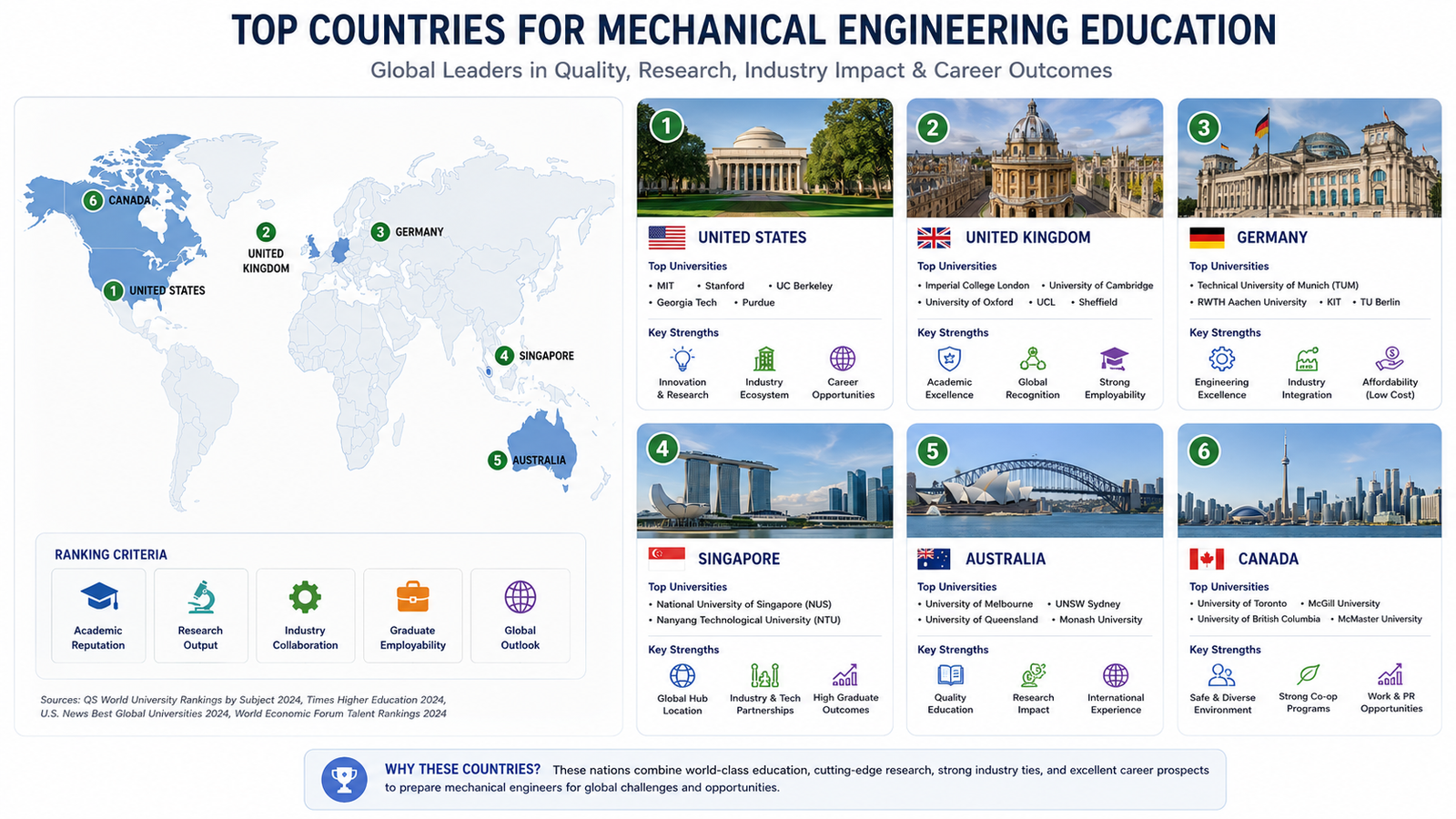
    The frontiers of mechanical engineering are not distant or abstract. They are the active research programmes happening in laboratories at MIT, ETH Zurich, Imperial College, TU Munich, NUS, and hundreds of other institutions globally right now. They are the questions that the best mechanical engineers in the world are spending their careers trying to answer. And they are the source of the technologies that will define engineering practice in the decade ahead.

    From the molecular machines that may one day deliver drugs to individual cancer cells, to the superlubricious coatings that could eliminate 23 percent of global energy losses, to the quantum sensors that will navigate autonomous vehicles more precisely than any GPS, to the in-body mechatronic devices that will transform medicine, the frontiers of mechanical engineering represent the most intellectually rich and practically consequential territory in the discipline’s long history.

    Understanding these frontiers, even at the level of an informed non-specialist, gives any engineer a significant advantage: in research conversations, in strategic career decisions, in identifying where to invest in further learning, and in recognising which industries and technologies are worth paying attention to in the years ahead.

    Continue exploring the discipline. Read our guide to the Latest Advances in Mechanical Engineering for the technologies already crossing from frontier to deployment, understand What Does a Mechanical Engineer Do? to see how these frontiers connect to practice, or explore the Nature of Mechanical Engineering for the philosophical foundations that make all of this possible.
  • Nature of Mechanical Engineering Explained (2026)

    Nature of Mechanical Engineering Explained (2026)

    Most explanations of mechanical engineering start and end with the same sentence: it is the branch of engineering that deals with machines and motion. That definition is accurate as far as it goes, but it barely scratches the surface of what the discipline actually is.

    The nature of mechanical engineering is far richer, far more layered, and far more interesting than any single-sentence definition suggests. It is simultaneously analytical and creative, theoretical and practical, deeply specialised and extraordinarily broad. It is a profession that requires mathematical rigour and human empathy in equal measure, that demands both the precision of a physicist and the imagination of a designer.

    This article goes beyond the standard textbook definition. It examines the true nature of mechanical engineering from multiple dimensions: its philosophical character, its scientific foundations, its creative and iterative process, its interdisciplinary reach, its ethical obligations, its sub-disciplines, and its scope in the modern world. Whether you are a student trying to understand what you are signing up for, a professional reflecting on your field, or simply curious about engineering, this is the most thorough exploration of the subject you will find.

    Quick Answer:  The nature of mechanical engineering is fundamentally problem-solving through the application of physical science and mathematics to design, build, analyse, and improve mechanical and thermal systems. It is analytical by method, creative by necessity, iterative by practice, interdisciplinary by evolution, and ethical by responsibility. It is one of the broadest and oldest engineering disciplines, and its scope continues to expand with every technological generation.
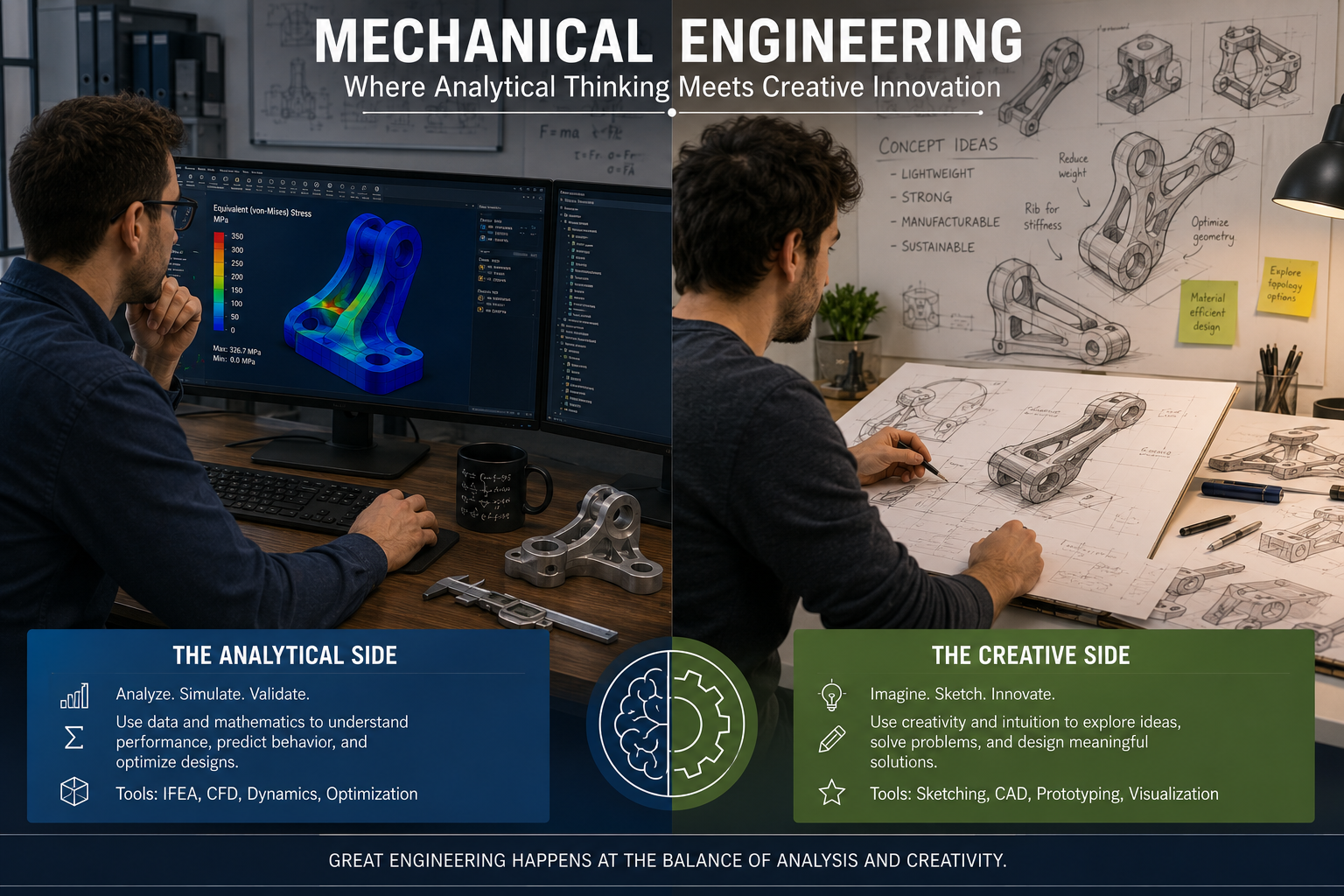
    Mechanical engineer combining analytical simulation review with creative concept sketching, illustrating the dual analytical and creative nature of the discipline

    Defining the Nature of Mechanical Engineering

    At the most fundamental level, mechanical engineering is the application of physics, mathematics, and materials science to conceive, design, manufacture, and maintain systems that involve force, motion, energy, or heat. It is the engineering discipline most directly rooted in classical physics, and yet it is also one of the most practically grounded professions in existence.

    The word “nature” in this context asks us to look beyond the technical definition and understand the character of the discipline: what kind of thinking it requires, what kind of problems it tackles, how it relates to other fields of knowledge, and what it means to practise it at a professional level.

    Understanding the nature of mechanical engineering is valuable for several reasons. It helps prospective students decide whether the discipline suits their way of thinking. It helps practitioners articulate what they do and why it matters. And it helps anyone who interacts with engineers understand the mindset, methods, and responsibilities that come with the title.

    Worth Knowing:  The American Society of Mechanical Engineers (ASME) currently recognises 36 distinct technical divisions within mechanical engineering, from advanced energy systems and aerospace engineering to biomedical devices and textile engineering. The breadth of that list is one of the clearest indicators of the discipline’s true nature: it is almost limitlessly wide in scope.

    The Analytical Nature: Science and Mathematics as the Foundation

    The first and most fundamental dimension of mechanical engineering’s nature is its analytical character. At the core of everything a mechanical engineer does is a commitment to using mathematics and physical science to understand, predict, and verify the behaviour of systems.

    This analytical foundation distinguishes engineering from craft and from intuition-based design. When a mechanical engineer designs a bridge support, a turbine blade, or a prosthetic limb, they do not rely on guesswork or aesthetic judgment alone. They use established physical laws, validated mathematical models, and systematic analytical tools to predict how the system will behave under real conditions.

    The Physical Laws That Underpin Everything

    The analytical nature of mechanical engineering rests on a set of physical laws that are among the most robust and well-verified in all of science:

    • Newton’s Laws of Motion: govern the relationship between forces and the motion of bodies. Every mechanism, vehicle, and structural component is analysed through this lens.
    • Laws of Thermodynamics: set absolute physical limits on energy conversion efficiency. Every engine, refrigerator, and power plant is constrained by these laws.
    • Conservation Laws (energy, mass, momentum): provide the accounting framework for any physical system, ensuring that nothing is created from nothing and nothing disappears without trace.
    • Hooke’s Law and Elastic Theory: describe how materials deform under stress, forming the basis for structural analysis and design.
    • Navier-Stokes Equations: govern fluid flow behaviour, underpinning everything from pipe network design to aerodynamic analysis.

    From Hand Calculations to Finite Element Analysis

    The tools for applying these laws have evolved dramatically. Earlier generations of mechanical engineers performed complex analyses entirely by hand, using tables, slide rules, and enormous patience. Today, engineers use Finite Element Analysis (FEA), Computational Fluid Dynamics (CFD), and multi-body dynamics simulation to analyse systems of extraordinary complexity in hours rather than months.

    But the analytical nature of the discipline has not changed. The tools have simply expanded what is analytically tractable. A mechanical engineer using ANSYS to run a stress analysis is doing exactly what their predecessor was doing with a slide rule: applying the same fundamental physical laws to predict real-world behaviour.

    Key Insight:  The analytical nature of mechanical engineering means that engineering decisions are always grounded in evidence and physical law, not opinion. When two engineers disagree about a design, the disagreement is ultimately resolvable through analysis, testing, and measurement. This gives the discipline a unique kind of intellectual honesty.

    The Creative Nature: Engineering as a Design Discipline

    A common misconception is that mechanical engineering is purely a technical, left-brain profession: full of equations and devoid of creativity. This is fundamentally wrong, and understanding why is central to understanding the true nature of the discipline.

    Engineering is, at its heart, a design discipline. Design is an inherently creative act. Given a set of constraints, requirements, and resources, a mechanical engineer must imagine a solution that does not yet exist and then develop it into a physical reality. That process requires creativity of a high order.

    Creativity Within Constraints

    What makes engineering creativity distinctive is that it operates within hard constraints. A mechanical engineer designing a new product cannot simply imagine anything they like. They are constrained by physics, by manufacturing capabilities, by cost, by safety standards, by the properties of available materials, and by the needs of the end user.

    Working creatively within tight constraints is actually harder than unconstrained creative work. A sculptor can change the shape of their work freely. A mechanical engineer designing a turbine blade that must achieve a specific aerodynamic profile, withstand temperatures above 1,000 degrees Celsius, survive millions of loading cycles, and be manufacturable in large quantities at controlled cost has a much more demanding creative challenge.

    Concept Generation and Divergent Thinking

    The early phases of mechanical engineering design are explicitly creative. Concept generation, the process of imagining multiple possible approaches to a design problem before converging on the best one, requires divergent thinking: the ability to consider unconventional approaches, challenge existing assumptions, and explore the design space broadly before narrowing down.

    Great mechanical engineers are not just technically competent. They are genuinely inventive. The engineers who developed the first jet engine, designed the retractable landing gear, conceived the lithium-ion battery pack for electric vehicles, or created the first implantable cardiac stent were all doing creative work of the highest order, guided by physical knowledge but driven by creative imagination.

    Real-World Example:  The development of the Dyson cyclone vacuum cleaner involved James Dyson creating over 5,000 prototype iterations before arriving at a commercially viable design. This is not unusual in mechanical engineering. The creative and iterative process of moving from concept to working product routinely involves hundreds or thousands of design cycles across subsystems.

    The Iterative Nature: How Engineering Really Works

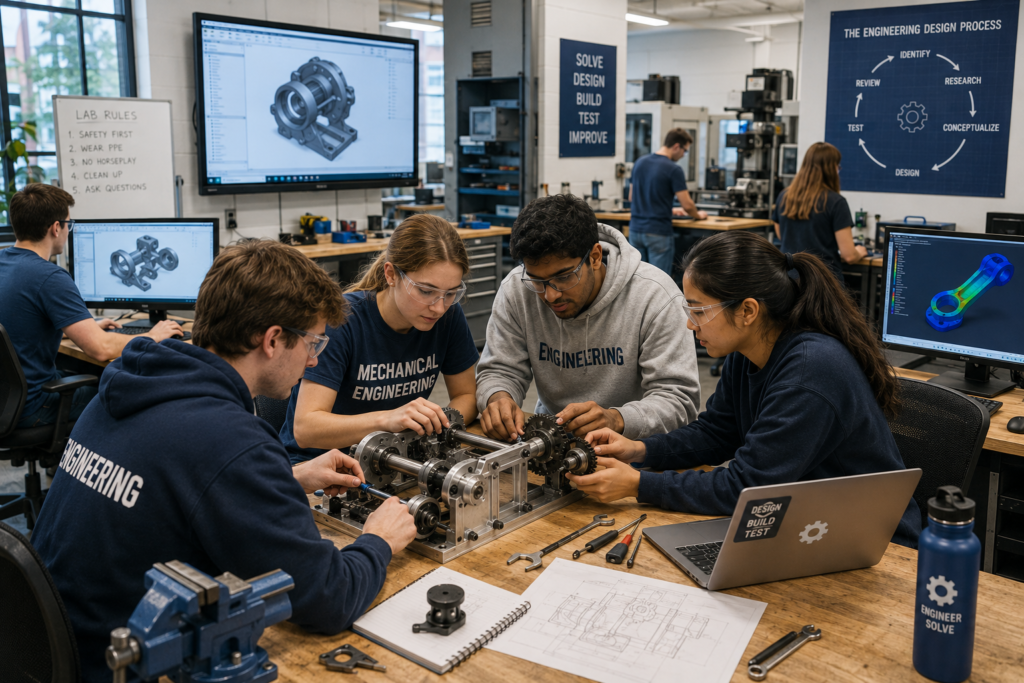
    One of the most important and least discussed aspects of the nature of mechanical engineering is that it is fundamentally iterative. The popular image of an engineer having a flash of genius and producing a perfect design is almost completely false. Real engineering is a cycle of designing, analysing, building, testing, learning from failure, and redesigning.

    The Engineering Design Loop

    The engineering design process follows a recognisable iterative loop regardless of the industry or product involved. Every iteration adds knowledge, tightens the design, and reduces uncertainty. The loop typically proceeds as follows:

    1. Define the problem and establish requirements: what must the design achieve, what constraints must it meet?
    2. Generate concepts: produce multiple potential approaches through creative thinking and research.
    3. Analyse and evaluate: apply analytical tools and judgement to assess which concepts are most promising.
    4. Develop the preferred concept: create detailed designs, drawings, and specifications.
    5. Prototype and test: build physical or virtual models and measure performance against requirements.
    6. Learn and refine: use test data and analysis to identify weaknesses and redesign accordingly.
    7. Repeat: continue iterating until the design meets all requirements or a design freeze decision is made.

    Why Failure Is Not the Opposite of Engineering Success

    A key aspect of the iterative nature of mechanical engineering is that failure is not a setback; it is a tool. A test that reveals a design weakness is not a failure in the pejorative sense. It is the system working as intended: generating the information needed to make the design better.

    This is why experienced engineers are rarely demoralised by test failures. They are demoralised by insufficient testing, by designs that reach the field without adequate validation, and by failures that were predictable but not predicted. A well-structured engineering program assumes failures will occur and builds in the time and resources to learn from them.

    You may like this article: Best Mechanical Engineering Degrees in 2026

    The Interdisciplinary Nature: Where Mechanical Engineering Meets Everything Else

    Perhaps the most defining characteristic of mechanical engineering in the modern era is its extraordinary interdisciplinary reach. Mechanical engineering does not exist in a silo. It intersects with, borrows from, and contributes to virtually every other engineering and scientific discipline.

    DisciplineHow It Intersects with Mechanical EngineeringExample Application
    Electrical EngineeringCombined in mechatronics, electric vehicle systems, and electromechanical actuatorsElectric motor design for EV powertrains; industrial robot servo systems
    Software EngineeringEmbedded software controls modern mechanical systems; simulation requires advanced codingEngine management systems; PLC programming for automated manufacturing lines
    Materials ScienceMaterial selection, failure analysis, and advanced composites designCarbon fibre aerospace structures; high-temperature superalloys in turbine blades
    Civil EngineeringShared structural analysis methods; mechanical systems in buildings and infrastructureHVAC systems in large buildings; bridge bearings and expansion joints
    Chemical EngineeringShared thermodynamics; heat exchanger design; fuel systemsChemical plant piping systems; combustion analysis in engines
    Biomedical EngineeringMechanical principles applied to biological systems and medical devicesProsthetic limb design; surgical robot mechanisms; orthopaedic implants
    Environmental EngineeringEmissions control, waste heat recovery, pollution reduction technologiesCatalytic converters; industrial filtration systems; wind turbine design
    PhysicsFoundation discipline for all ME analytical methodsQuantum effects in MEMS; relativistic corrections in GPS satellite systems
    Computer Science / AIGenerative design, digital twins, machine learning in predictive maintenanceAI-assisted topology optimisation; IoT-connected industrial equipment monitoring

    This interdisciplinary nature means that a mechanical engineer who invests in cross-disciplinary knowledge is significantly more capable and more employable than one who confines themselves to the traditional ME curriculum. The boundaries between mechanical, electrical, software, and data engineering are blurring rapidly, and the most valuable engineers in the modern workforce are those who can work fluently across those boundaries.

    The Ethical Nature: Responsibility Built Into the Discipline

    A dimension of mechanical engineering’s nature that is rarely discussed in introductory resources, but is absolutely central to professional practice, is its ethical character. Mechanical engineers make decisions that directly affect human safety, public health, and the natural environment. That responsibility is not optional or peripheral. It is built into the fundamental nature of the profession.

    Public Safety as a Primary Obligation

    Professional engineering codes of ethics, including those of the American Society of Mechanical Engineers (ASME) and the Institution of Mechanical Engineers (IMechE), consistently place the protection of public safety above all other obligations. An engineer who knowingly approves an unsafe design, conceals a known defect, or fails to raise safety concerns because of commercial pressure is violating the most fundamental ethical obligation of the profession.

    This is not merely theoretical. The history of mechanical engineering includes catastrophic failures caused by ethical lapses as much as technical ones. The Space Shuttle Challenger disaster, the Deepwater Horizon blowout, the Tacoma Narrows Bridge collapse, and numerous industrial accidents have all involved situations where engineers either knew of problems and were not heard, or where professional judgement was overridden by schedule and budget pressures.

    Sustainability and Environmental Responsibility

    The ethical dimension of mechanical engineering has expanded significantly in recent decades to include environmental responsibility. Engineers today are expected to consider the full lifecycle impact of their designs: the energy consumed in manufacturing, the emissions generated in operation, the difficulty or ease of repair and maintenance, and the options for recycling or responsible disposal at end of life.

    Life Cycle Assessment (LCA) and circular economy principles are no longer niche specialisms. They are becoming standard considerations in product development processes across most major industries, driven partly by regulation and partly by the growing recognition within the engineering community that sustainability is an engineering problem, not just a political one.

    Historical Context:  The engineering profession’s explicit commitment to public safety in codes of ethics emerged largely in response to disasters. The widespread adoption of formal safety standards in pressure vessel engineering, for example, followed catastrophic boiler explosions that killed hundreds of workers in 19th-century factories and aboard steamships. The ASME Boiler and Pressure Vessel Code (BPVC), first published in 1914, is a direct product of that ethical reckoning.

    Core Principles That Define the Discipline

    The core principles of mechanical engineering are the technical pillars on which the entire discipline is built. These are the subjects that appear in every accredited mechanical engineering curriculum globally, because without them a practitioner cannot function as an engineer.

    Core PrincipleWhat It CoversWhy It Matters in Practice
    StaticsEquilibrium of stationary bodies and the forces acting on themStructural design: ensuring nothing moves when it should be still; calculating support reactions and internal forces
    DynamicsMotion, acceleration, and the forces that cause or result from themVehicle dynamics, vibration analysis, rotating machinery, mechanism design
    ThermodynamicsEnergy, heat, and how they transform between formsEngine design, refrigeration systems, HVAC, power generation, energy efficiency analysis
    Fluid MechanicsBehaviour of liquids and gases at rest and in motionPipeline design, pump and fan selection, aerodynamics, hydraulic systems, CFD
    Mechanics of MaterialsStress, strain, and failure of solid materials under loadComponent design, structural analysis, fatigue life prediction, FEA input
    Heat TransferConduction, convection, and radiation of thermal energyCooling system design, electronics thermal management, furnace and reactor design
    Manufacturing ProcessesHow materials are shaped, joined, and finished to produce componentsDesign for manufacture (DFM), process selection, cost estimation, quality control
    Control SystemsFeedback, sensors, actuators, and automated regulation of system behaviourAutopilots, robotics, engine management systems, HVAC control, industrial automation
    Machine DesignDesigning mechanical components (gears, bearings, shafts, fasteners) for load, life, and reliabilityAll rotating and reciprocating machinery; power transmission systems

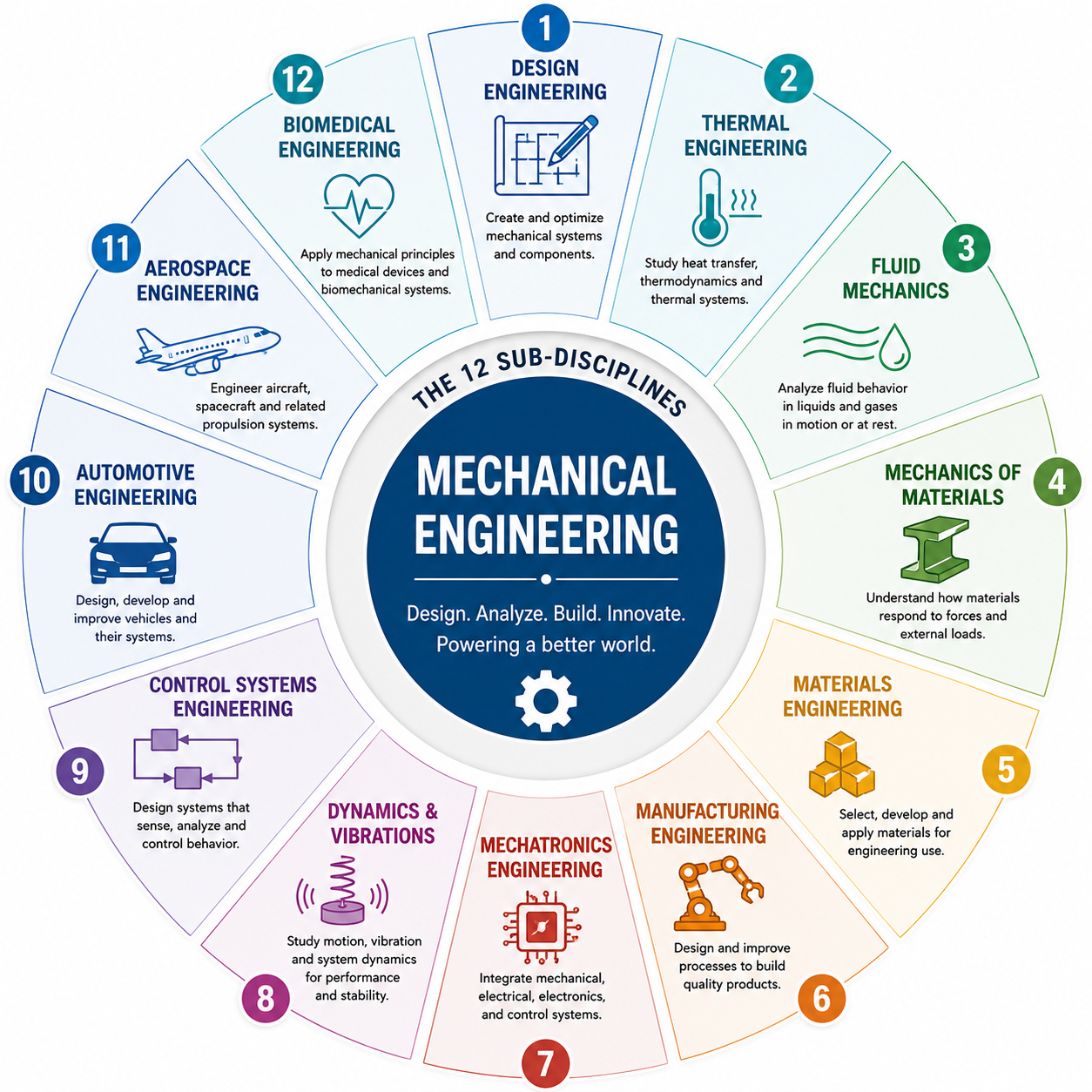
    The Scope of Mechanical Engineering: 12 Sub-Disciplines Explained

    One of the most compelling expressions of the nature and scope of mechanical engineering is the range of sub-disciplines it encompasses. These are not loosely related fields that have been administratively grouped together. Each is a genuine specialisation built on the core ME principles, applied to a specific problem domain.

    Infographic showing the 12 major sub-disciplines of mechanical engineering including automotive, aerospace, robotics, biomedical, and renewable energy

    1. Automotive Engineering

    Automotive engineering applies mechanical engineering principles to the design, development, and manufacture of cars, trucks, and other road vehicles. It encompasses powertrain engineering (engine and transmission), chassis and suspension design, NVH (noise, vibration, and harshness), vehicle safety systems, and increasingly, electrification and autonomous driving technologies. Automotive is one of the largest employers of mechanical engineers worldwide.

    2. Aerospace Engineering

    Aerospace engineering applies ME principles to aircraft, spacecraft, rockets, and drones. It demands the highest levels of structural analysis rigour, given that failures in aerospace systems are typically catastrophic and non-recoverable. Key sub-areas include aerodynamics, propulsion, structural analysis, avionics integration, and thermal management of re-entry vehicles. The discipline is also one of the primary drivers of materials science innovation.

    3. Thermal and Energy Engineering

    Thermal and energy engineering focuses on the generation, conversion, and efficient use of energy. Practitioners in this sub-discipline design power plants, gas turbines, heat exchangers, refrigeration systems, and renewable energy technologies including wind turbines, solar thermal systems, and fuel cells. The global energy transition is creating enormous demand for engineers with deep thermal and energy expertise.

    4. Manufacturing Engineering

    Manufacturing engineering is concerned with how things are made: the processes, equipment, and systems used to transform raw materials into finished products. It encompasses machining, casting, forging, welding, additive manufacturing (3D printing), lean production systems, quality engineering, and Industry 4.0 automation. Manufacturing engineers are the bridge between design intent and physical reality.

    5. Robotics and Automation

    Robotics and automation represent one of the fastest-growing sub-disciplines within mechanical engineering. Mechanical engineers in this space design robot structures, actuators, end effectors, and motion systems. They work alongside electrical and software engineers in mechatronic teams to create systems that can sense, plan, and act in the physical world. Applications range from automotive welding robots and surgical robots to autonomous vehicles and agricultural drones.

    6. Biomechanics and Biomedical Engineering

    Biomechanics applies mechanical engineering principles to biological systems. This sub-discipline produces prosthetic limbs, orthopaedic implants, heart valves, stents, surgical robots, and diagnostic devices. It is one of the most ethically demanding specialisations in mechanical engineering, given the immediate and direct impact of failures on human health. The required knowledge spans ME fundamentals, materials science, human anatomy, and clinical regulatory requirements.

    7. HVAC and Building Services Engineering

    Heating, Ventilation, and Air Conditioning (HVAC) engineering applies thermodynamics and fluid mechanics to control the thermal environment of buildings, data centres, hospitals, and other structures. HVAC engineers design duct systems, select and size mechanical plant, and increasingly integrate smart controls and energy recovery systems. Given that buildings account for approximately 40 percent of global energy consumption, HVAC engineering has a significant role in the sustainability transition.

    8. Marine and Offshore Engineering

    Marine engineering encompasses the design of ships, submarines, offshore oil platforms, and floating renewable energy structures. Mechanical engineers in this domain work on propulsion systems, hull structural integrity, mooring systems, and the challenging corrosion and fatigue environments of the marine sector. With the growth of offshore wind energy, this sub-discipline is experiencing renewed demand.

    9. Mechatronics

    Mechatronics is the synergistic integration of mechanical, electrical, and software engineering to create intelligent automated systems. Modern consumer electronics, domestic appliances, industrial robots, CNC machine tools, and autonomous vehicles are all mechatronic systems. A mechatronics engineer must be genuinely proficient across all three contributing disciplines, making this one of the most intellectually demanding specialisations in engineering.

    10. Nano and Micro Engineering (MEMS)

    Micro-Electromechanical Systems (MEMS) and nano engineering represent mechanical engineering at its smallest scale. MEMS devices are microfabricated mechanical structures, often integrated with electronic circuits, used in accelerometers (smartphones, airbag triggers), pressure sensors, inkjet print heads, and lab-on-a-chip medical diagnostic devices. At this scale, surface forces dominate over volume forces, and engineers must account for phenomena that are irrelevant at conventional scales.

    11. Structural and Stress Engineering

    Structural and stress engineering focuses on ensuring that components and assemblies can safely withstand their operating loads throughout their intended service life. Stress engineers are specialists in FEA, fatigue analysis, fracture mechanics, and pressure vessel design. This sub-discipline is critical in aerospace, nuclear, oil and gas, and any industry where structural failure could have catastrophic consequences.

    12. Renewable Energy and Sustainable Engineering

    Renewable energy and sustainable engineering is a rapidly expanding sub-discipline that applies mechanical engineering principles to wind turbines, solar thermal systems, tidal energy converters, hydrogen production equipment, and energy storage technologies. It is perhaps the fastest-growing area of mechanical engineering employment globally, driven by the need to decarbonise energy systems at unprecedented speed and scale.

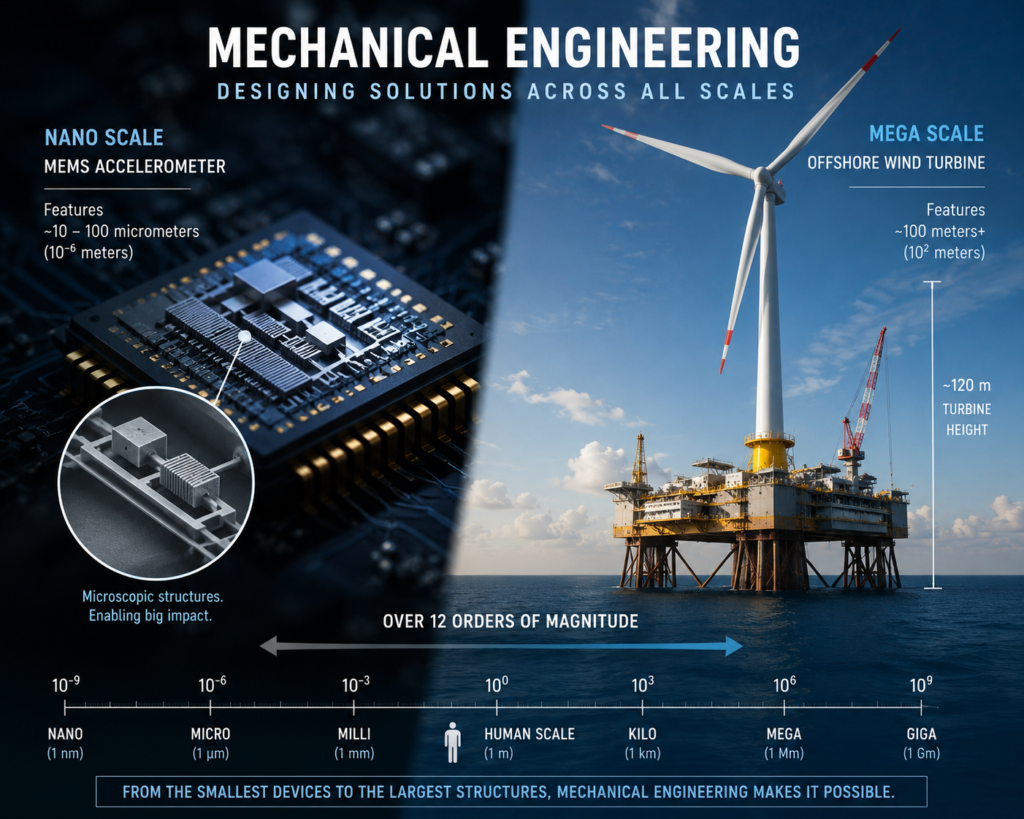
    The Scale of Mechanical Engineering: From Nano to Mega

    Another defining characteristic of the nature of mechanical engineering is the extraordinary range of scales at which it operates. No other engineering discipline spans such a vast range from the microscopic to the monumental.

    Scale comparison illustrating mechanical engineering applications from micro-scale MEMS devices to mega-scale wind turbine structures
    ScaleOrder of MagnitudeMechanical Engineering Application
    Nano scale10^-9 metres (nanometres)Nanomaterial design, molecular machines, drug delivery mechanisms, nano-tribology
    Micro scale10^-6 metres (micrometres)MEMS devices, microfluidic chips, inkjet nozzles, microsensors
    Small component scaleMillimetres to centimetresWatch mechanisms, surgical instruments, fasteners, precision bearings
    Product scaleCentimetres to metresEngines, pumps, consumer products, robots, medical devices
    Vehicle and machine scale1-10 metresAutomobiles, aircraft, ships, construction equipment, industrial machinery
    Plant and facility scale10-100 metresPower stations, chemical plants, offshore platforms, manufacturing facilities
    Infrastructure scaleHundreds of metresSuspension bridges, wind farm structures, dam spillway mechanisms, tunnelling equipment
    Mega scaleKilometresTidal barrages, very large crude carriers, launch vehicle systems, mega-scale solar thermal facilities

    This extraordinary range of operating scales is itself a testament to the depth and generality of the physical principles that underpin mechanical engineering. Newton’s laws of motion apply to a nanometre-scale MEMS accelerometer and to a 300-metre supertanker. The laws of thermodynamics govern a micro-combustion chamber and a utility-scale gas turbine. The universality of the underlying physics is what gives mechanical engineering its remarkable scope.

    Mechanical Engineering vs. Other Engineering Disciplines: Key Differences

    Understanding the nature of mechanical engineering is sharpened by understanding how it differs from adjacent engineering disciplines. The following comparison highlights the key philosophical and practical distinctions.

    FeatureMechanical EngineeringCivil EngineeringElectrical EngineeringChemical Engineering
    Primary Physical DomainMachines, mechanisms, thermal systems, and fluid systemsFixed structures and infrastructureElectromagnetic fields, circuits, and signalsChemical reactions and process systems
    Core Physical LawsNewton’s laws, thermodynamics, fluid mechanics, solid mechanicsStructural mechanics, soil mechanics, hydrologyMaxwell’s equations, Ohm’s law, quantum mechanicsChemical kinetics, thermodynamics, mass transfer
    Primary Design OutputsMoving or energy-converting systems and componentsStationary structures, roads, and water systemsCircuits, power systems, control electronicsProcess plants, reaction vessels, separation systems
    Relationship to MotionCentral: mechanical engineering is fundamentally about motion and forcePeripheral: civil structures are designed to resist motionIndirect: motion appears in electromechanical systemsLargely irrelevant: chemical processes do not primarily involve mechanical motion
    Scale of ObjectsNano to mega across the widest range of any disciplineMetres to kilometres; infrastructure scaleNanometre (chip) to grid-scale power systemsMolecular to plant-scale
    Interdisciplinary OverlapExtensive: overlaps with all major engineering disciplinesSignificant with structural and environmental engineeringExtensive with mechanical in mechatronics and power systemsSignificant with mechanical in thermal and energy systems

    The Human Impact of Mechanical Engineering

    To understand the nature of mechanical engineering fully, it is essential to understand its impact on human life. No other technical discipline has touched as many aspects of daily life as consistently and as profoundly.

    Mechanical Engineering and the Quality of Human Life

    The internal combustion engine, developed by mechanical engineers in the late 19th century, transformed human mobility and commerce. Refrigeration, a purely thermodynamic engineering achievement, eliminated much of the food spoilage that caused hunger and disease for millennia. Clean water infrastructure, which relies heavily on mechanical pump systems, is directly responsible for the eradication of waterborne diseases that once killed millions annually.

    Medical mechanical engineering has given millions of people functional limbs, beating hearts (via pacemakers), clear vision (via precision optics and surgical lasers), and life-extending implants of every description. The ventilators that sustained critically ill patients during the COVID-19 pandemic were mechanical engineering achievements. The MRI machines that detect cancers early enough to treat them effectively are electromechanical engineering achievements.

    Mechanical Engineering and Global Challenges

    Looking forward, mechanical engineering is central to addressing the most urgent challenges facing humanity. Climate change mitigation depends on mechanical engineers designing more efficient wind turbines, lower-emission aircraft engines, better-performing batteries, and more effective carbon capture systems. Food security depends on agricultural machinery, efficient food processing systems, and precision irrigation technology. Global health equity depends on affordable medical devices, low-cost water purification, and robust cold chain infrastructure in developing regions.

    Data Point:  According to the U.S. Bureau of Labor Statistics, employment of mechanical engineers is projected to grow approximately 11 percent from 2023 to 2033, with around 19,800 new job openings expected annually. This growth is driven primarily by demand in renewable energy, robotics, medical devices, and advanced manufacturing, precisely the sectors where mechanical engineering’s problem-solving nature is most urgently needed.

    How the Nature of Mechanical Engineering Is Evolving

    The nature of mechanical engineering is not static. While its foundational physical principles are timeless, the way those principles are applied, the tools engineers use to apply them, and the problems they are called upon to solve are all changing rapidly.

    From Physical Prototypes to Digital-First Design

    The development of digital twin technology and high-fidelity simulation has fundamentally shifted the balance between physical and virtual prototyping. Increasingly, the first “prototype” of a complex mechanical system is a fully validated digital model, with physical prototypes reserved for final validation and regulatory approval. This shift is accelerating the design cycle and enabling engineers to explore far more design options than was previously possible.

    AI and Generative Design: Changing What Engineers Create

    Artificial intelligence and generative design tools are beginning to change the nature of the creative phase of mechanical engineering. AI-assisted design algorithms can explore thousands of potential design geometries based on engineering constraints and objectives, often producing optimised structures that no human designer would intuitively conceive. Engineers who understand how to set up, direct, and critically evaluate AI-generated designs are increasingly valued.

    Sustainability as a Core Engineering Requirement

    The growing urgency of the climate transition is fundamentally changing what it means to be a good mechanical engineer. Sustainable engineering design is no longer optional. Life cycle thinking, material efficiency, repairability, and the minimisation of embodied carbon are becoming standard elements of the engineering design brief across most major industries. Engineers who understand both the technical and environmental dimensions of their decisions will define the next generation of the profession.

    The Convergence of the Physical and Digital Worlds

    The rise of Industry 4.0, the Internet of Things (IoT), and cyber-physical systems is blurring the boundary between mechanical engineering and information technology. Modern mechanical systems are increasingly sensors-rich, software-controlled, and network-connected. Mechanical engineers who can work at this physical-digital interface, understanding both the hardware and the data dimensions of their systems, are emerging as some of the most sought-after professionals in the engineering workforce.

    Frequently Asked Questions (FAQ)

    What is the nature of mechanical engineering?

    The nature of mechanical engineering is multi-dimensional. It is analytical (grounded in physics and mathematics), creative (requiring design thinking and problem-solving imagination), iterative (built on cycles of designing, testing, and refining), interdisciplinary (overlapping extensively with other engineering and scientific fields), and ethical (carrying direct responsibility for public safety and environmental impact). It is one of the broadest, oldest, and most practically impactful engineering disciplines.

    What are the main characteristics of mechanical engineering?

    The main characteristics of mechanical engineering include its grounding in classical physics and mathematics, its focus on machines, mechanisms, and energy systems, its extraordinarily broad scope across industries and scales, its inherently iterative design process, its increasing interdisciplinary character, and its fundamental commitment to public safety and engineering ethics. These characteristics make it one of the most versatile and enduring engineering professions.

    What is the scope of mechanical engineering?

    The scope of mechanical engineering is vast. It encompasses at least 12 major sub-disciplines including automotive, aerospace, thermal and energy, manufacturing, robotics, biomechanics, HVAC, marine, mechatronics, MEMS, structural, and renewable energy engineering. It operates across scales from nanometres to kilometres. The American Society of Mechanical Engineers (ASME) recognises 36 distinct technical divisions within the discipline, indicating just how broad the scope genuinely is.

    Is mechanical engineering more creative or analytical?

    Mechanical engineering is genuinely both. The analytical dimension, which involves applying physics and mathematics to predict and verify system behaviour, is what makes engineering reliable and trustworthy. The creative dimension, which involves imagining novel solutions within tight physical and commercial constraints, is what makes engineering valuable and innovative. The best mechanical engineers are both rigorous analysts and bold creative thinkers, and it is the combination that produces genuinely great engineering.

    What makes mechanical engineering different from other engineering disciplines?

    Mechanical engineering is distinguished from other disciplines by its extraordinary breadth, its direct focus on machines, motion, and energy conversion, and its deep roots in classical physics. Unlike civil engineering (which focuses on stationary structures), electrical engineering (which focuses on electromagnetic phenomena), or chemical engineering (which focuses on molecular-level processes), mechanical engineering deals fundamentally with the physical world at human scales and above, covering everything from precision watch mechanisms to massive power plant turbines. Its interdisciplinary overlap with virtually every other engineering field is also uniquely broad.

    Why is mechanical engineering called the mother of all engineering disciplines?

    Mechanical engineering is often called the ‘mother of all engineering disciplines’ for three main reasons. First, it is one of the oldest formalised engineering disciplines, with roots stretching back to ancient Greece and formalisation during the Industrial Revolution. Second, its foundational principles (mechanics, thermodynamics, fluid mechanics, materials science) underpin almost every other engineering discipline. Third, historically, most other engineering branches evolved by specialising from mechanical engineering: aerospace engineering is specialised ME applied to flight; chemical engineering incorporated ME’s thermodynamics; biomedical engineering grew from ME’s design methods applied to the human body.

    What is the interdisciplinary nature of mechanical engineering?

    The interdisciplinary nature of mechanical engineering refers to the way the discipline intersects with, borrows from, and contributes to other fields of engineering and science. Mechanical engineering overlaps with electrical engineering in mechatronics and electric vehicle systems; with materials science in composite and alloy design; with software engineering in simulation and embedded control systems; with biomedical science in prosthetics and implants; with environmental science in sustainability and emissions engineering; and with computer science in AI-assisted design and digital twins. This interdisciplinary character is one of the reasons mechanical engineering remains relevant and in demand across so many industries.

    What are the core principles of mechanical engineering?

    The core principles of mechanical engineering are statics, dynamics, thermodynamics, fluid mechanics, mechanics of materials (strength of materials), heat transfer, manufacturing processes, control systems, and machine design. These subjects form the foundation of every accredited mechanical engineering curriculum globally. Together, they give practitioners the analytical tools to understand, predict, design, and verify the behaviour of any mechanical or thermal system.

    Conclusion

    The nature of mechanical engineering cannot be captured in a single sentence, and it deserves far better than the definition typically given to it. It is a discipline that is simultaneously one of the most ancient and one of the most rapidly evolving in human knowledge. It is analytical and creative in equal measure. It is deeply specialised and extraordinarily broad. It is grounded in timeless physical laws and continuously reinvented by new technologies and new challenges.

    Understanding this multi-dimensional nature is valuable whether you are a student choosing a career, a practitioner reflecting on your profession, an employer seeking to understand what you are hiring, or simply a curious person trying to make sense of the engineered world around you. Mechanical engineering is not just about machines. It is about the application of human intelligence, creativity, and responsibility to the physical world, in service of human needs and the health of the planet.

    The discipline’s scope is expanding, its interdisciplinary reach is growing, its ethical obligations are deepening, and its role in addressing the world’s most urgent challenges has never been more central. Understanding its true nature is the first step toward understanding why mechanical engineering remains one of the most important and most rewarding professions in the world.

    Want to go deeper? Read our complete pillar guide: What Is Mechanical Engineering?, explore Engineering Mechanics Explained for the mathematical foundations, or discover the Latest Advances in Mechanical Engineering to see where the discipline is heading next.

  • Best Mechanical Engineering Degrees: Complete 2026 Guide

    Best Mechanical Engineering Degrees: Complete 2026 Guide

    Choosing the right mechanical engineering degree is one of the most consequential decisions an aspiring engineer will make. The program you attend shapes the technical skills you build, the professional network you develop, the industry doors that open to you, and ultimately the trajectory of your entire career.

    The challenge is that the options are enormous and often confusing. There are BEng vs. MEng programs, online degrees and on-campus degrees, specialist schools and broad research universities, programs with co-op placements and those without. Accreditation requirements differ by country. Tuition costs vary by a factor of ten or more between institutions. And league tables rank universities by research output, which does not always correlate with what matters most to a working engineer.

    This guide cuts through all of that. We explain what to actually look for in a mechanical engineering program, break down the different degree types and their real value in the job market, compare the top universities globally, address the online degree question honestly, and give you a clear framework for making the right choice for your specific goals and circumstances.

    Quick Answer:  The best mechanical engineering degree is one that is accredited by a recognised engineering body (such as ABET in the US or IMechE in the UK), taught by faculty with real industry experience, includes hands-on design and project work, and aligns with the industry sector you are targeting. Prestige matters, but it is not the only factor that counts.
    Mechanical engineering students collaborating on a hands-on design project in a well-equipped university laboratory

    Why Your Choice of Mechanical Engineering Degree Matters

    A mechanical engineering degree is not just a qualification. It is a multi-year technical education that builds the analytical foundations, problem-solving habits, and professional instincts you will rely on for the rest of your career. The program you choose determines the depth of that foundation.

    There is a meaningful difference between a mechanical engineering program that puts students in design studios and fabrication labs from their first year and one that front-loads three years of lectures before touching anything physical. There is a difference between a program taught by faculty who have spent time working in industry and one staffed entirely by theoreticians. These differences do not always show up in rankings.

    Employers notice. Recruiters at aerospace companies, automotive manufacturers, and medical device firms often have strong preferences about which programs produce graduates who can contribute quickly. The reputation of your program and university carries genuine weight, particularly in your first job search when you have little else on your CV to differentiate yourself.

    At the same time, the best mechanical engineering program for one person is not the best for another. A student targeting automotive racing needs a different program from someone targeting offshore energy. A student who needs to minimise debt has different constraints from one whose family can absorb a top-tier private university’s fees. This guide accounts for all of those dimensions.

    Types of Mechanical Engineering Degrees Explained

    Understanding the different types of mechanical engineering degrees available is the necessary first step before evaluating specific programs or institutions.

    Infographic comparing BEng vs MEng vs MSc mechanical engineering degree pathways including duration and career outcomes

    Bachelor of Engineering (BEng) or Bachelor of Science (BS/BSc) in Mechanical Engineering

    The BEng or BSc in Mechanical Engineering is the standard undergraduate entry-level qualification in most countries. In the UK, a BEng typically takes three years; in the US, a BS typically takes four years. This is the degree most students complete before entering the workforce or pursuing postgraduate study.

    A BEng provides the core technical grounding in mechanics, thermodynamics, fluid mechanics, materials science, and mathematics. Most graduates enter junior engineering roles directly from this level, though some employers, particularly in aerospace and defence, have a preference for candidates with postgraduate qualifications.

    Master of Engineering (MEng): Integrated vs. Standalone

    An integrated MEng program combines undergraduate and master’s level study into a single four or five year course. In the UK and Ireland, the MEng is the standard route to Chartered Engineer (CEng) status. In the US, most students complete a separate standalone master’s after their bachelor’s degree.

    An MEng graduates a more technically rounded engineer than a BEng alone and typically commands a salary premium of 10 to 20 percent at entry level. For students confident about pursuing engineering as a long-term career, the MEng route is generally worth the additional year of study.

    Master of Science (MSc or MS) in Mechanical Engineering

    A standalone postgraduate MSc in Mechanical Engineering is typically completed in one to two years after a bachelor’s degree. It allows engineers to specialise in a specific area such as robotics, thermal engineering, advanced manufacturing, biomechanics, or aerospace systems.

    An MSc is particularly valuable for engineers who want to change specialisation, move into research-adjacent roles, or increase their competitiveness for senior positions. International students frequently use an MSc at a prestigious institution as an entry point into a new country’s engineering job market.

    Doctor of Philosophy (PhD) in Mechanical Engineering

    A PhD in Mechanical Engineering is a research degree that typically takes three to five years and involves producing an original contribution to knowledge through independent research. It is the route into academic positions, government research laboratories, and senior R&D leadership roles in industry.

    A PhD is not necessary for most engineering careers and can actually narrow employability in production-focused roles. It should be pursued only if you have a clear research interest or a specific career goal that genuinely requires it.

    Associate Degree and Higher National Diploma (HND)

    In some countries, particularly the US and UK, associate degrees or Higher National Diplomas (HNDs) in mechanical engineering provide a faster route into technical roles. These are sub-bachelor qualifications that typically produce technician-level graduates rather than professional engineers. Many holders later top up to a full bachelor’s degree through part-time or distance learning.

    Degree LevelDurationCareer Entry PointTypical Salary Impact
    BEng / BSc3-4 yearsJunior engineer, graduate schemeBaseline
    MEng (integrated)4-5 yearsJunior to mid-level, faster progression+10 to 20% vs BEng at entry
    MSc / MS (standalone)1-2 years post-BEngSpecialist, R&D, career pivot+10 to 25% depending on specialisation
    PhD3-5 yearsResearch, academia, senior R&DVariable; premium in niche research roles
    HND / Associate Degree1-2 yearsTechnician, junior drafterBelow BEng; often used as stepping stone

    What to Look for in a Good Mechanical Engineering Program

    Beyond prestige and rankings, the following criteria are the most reliable indicators of a high-quality mechanical engineering program.

    Accreditation by a Recognised Engineering Body

    This is the single most important criterion. An accredited mechanical engineering degree guarantees that the program meets a defined standard of technical content, faculty qualification, and graduate competency. Without accreditation, a degree may not be recognised by professional institutions, government agencies, or international employers.

    Strong Industry Links and Placement Opportunities

    Programs with structured industrial placement years, co-operative education programs (co-ops), or strong industry sponsorship give students exposure to real engineering work before graduation. Graduates who enter the job market with 12 months of relevant work experience are in a fundamentally stronger position than those without it. This is one of the most powerful differentiators a program can offer.

    Hands-On Design and Build Projects

    The best mechanical engineering programs integrate practical design and fabrication work from the first year. This might take the form of design-build competitions, student formula racing teams, engineering project modules, or capstone design projects. Engineers learn differently from physicists or mathematicians: the discipline’s practical nature demands a curriculum that engages both analytical and creative thinking.

    Quality of Laboratory and Workshop Facilities

    Modern teaching laboratories equipped with current CAD software, rapid prototyping equipment, material testing machines, and fluid mechanics rigs matter. A program that teaches SolidWorks or ANSYS on current software versions prepares students more effectively than one using outdated tools.

    Faculty with Industry Experience

    A mix of research-active academics and faculty members with significant industry backgrounds produces better-rounded engineers. Pure research universities sometimes produce graduates with excellent theoretical depth but limited awareness of industrial practice. Check faculty profiles and look for industry advisory boards, which indicate that a department maintains active engagement with the engineering sector.

    Graduate Employment Outcomes

    Where do graduates actually work? Reputable programs publish or can provide graduate employment data. Look for high proportions entering engineering roles, the names of employers who hire regularly from the program, and average starting salaries. This data is a more reliable signal of program quality than any ranking table.

    Accreditation: Why It Is Non-Negotiable

    If there is one absolute rule when choosing a mechanical engineering degree, it is this: the program must be accredited by a recognised professional engineering body. Here is what accreditation means in the major engineering education markets and why it matters so profoundly.

    United States: ABET Accreditation

    In the United States, ABET accreditation (Accreditation Board for Engineering and Technology) is the gold standard for engineering programs. ABET-accredited programs meet rigorous criteria for curriculum coverage, faculty qualifications, student outcomes, and continuous improvement. An ABET-accredited mechanical engineering degree is required to sit the Fundamentals of Engineering (FE) exam, the first step toward becoming a licensed Professional Engineer (PE). Without PE licensure, many engineering roles in infrastructure, government, and consulting are inaccessible.

    United Kingdom: IMechE and Engineering Council Accreditation

    In the UK, mechanical engineering degrees are accredited by the Institution of Mechanical Engineers (IMechE) on behalf of the Engineering Council. An IMechE-accredited BEng provides a partial route to Incorporated Engineer (IEng) status, while an accredited MEng provides the educational requirement for Chartered Engineer (CEng) status. CEng is the benchmark for senior engineering professionals in the UK and is recognised internationally through the International Professional Engineers Agreement (IPEA).

    Europe: EUR-ACE Framework

    Across the EU and beyond, the EUR-ACE label is applied by national accreditation agencies to engineering programs that meet a defined European standard of quality. EUR-ACE accredited degrees are mutually recognised across member countries, simplifying cross-border professional recognition for engineers working in Europe.

    Australia and Asia-Pacific: Engineers Australia and the Washington Accord

    In Australia, Engineers Australia accredits engineering programs, and accreditation is effectively required for professional recognition. Washington Accord signatory countries, which include the US, UK, Australia, Canada, Ireland, Japan, South Korea, and Singapore, mutually recognise each other’s accredited bachelor’s degrees. A Washington Accord accredited degree has genuine international portability.

    Critical Rule:  Always verify that a specific program is accredited, not just the university or department. Accreditation is granted at the program level. A prestigious university can have an engineering department where only certain programs carry current accreditation. Verify on the accrediting body’s official website.

    Best Mechanical Engineering Universities in the World

    The following institutions consistently rank among the best universities for mechanical engineering globally, based on academic reputation, employer surveys, research output, and graduate employment outcomes. Rankings draw on QS World University Rankings by Subject, Times Higher Education, and employer data.

    UniversityCountryRecognised ForIndustry Strengths
    Massachusetts Institute of Technology (MIT)USAResearch excellence, innovation cultureRobotics, aerospace, advanced manufacturing, energy systems
    Stanford UniversityUSAEntrepreneurship, design thinking, Silicon Valley ecosystemMechatronics, design innovation, energy, AI-engineering integration
    ETH ZurichSwitzerlandRigorous fundamentals, European engineering cultureStructural mechanics, materials engineering, robotics, precision systems
    University of CambridgeUKTheoretical depth, long engineering heritageEngineering design, thermodynamics, aerospace structures
    Imperial College LondonUKApplied engineering, central London industry networkBiomedical engineering, aerospace, advanced materials, energy
    National University of Singapore (NUS)SingaporeAsia-Pacific industry integration, research qualityManufacturing systems, robotics, thermal engineering
    Tsinghua UniversityChinaScale, government-backed research programsAutomotive, energy systems, precision manufacturing
    TU Munich (TUM)GermanyIndustrial relevance, BMW and Siemens research partnershipsAutomotive engineering, aerospace, mechatronics
    California Institute of Technology (Caltech)USADeep research focus, aerospace and space systemsFluid dynamics, aerospace structures, propulsion systems
    University of TorontoCanadaStrong co-op model, North American industry linksAerospace, automotive, manufacturing, energy

    Note: Global rankings change year to year and measure different things. The best university in the world is rarely the best choice for a specific individual student. Use this table as a starting point for research, not a definitive verdict on where to apply.

    Best Mechanical Engineering Schools in the United States

    The United States has one of the largest and most diverse ecosystems of mechanical engineering programs in the world, spanning elite research universities, well-funded public institutions, and specialist technical colleges. Here is how the landscape breaks down.

    Elite Private Research Universities

    MIT, Stanford, and Caltech occupy the global top tier. These programs are exceptionally competitive to enter, carry enormous prestige with elite employers, and provide unparalleled research opportunities. They are best suited to students with outstanding academic records and a strong interest in pushing the boundaries of engineering knowledge. Financial aid at these institutions is generous: MIT, for example, meets 100 percent of demonstrated financial need.

    Leading Public Universities: Outstanding Value

    The University of Michigan, Georgia Tech, UC Berkeley, and Purdue University consistently rank among the best public universities for mechanical engineering in the US. These programs offer a powerful combination of rigorous technical education, strong industry partnerships, and significantly more accessible tuition for in-state students. Georgia Tech’s co-op program is one of the largest in the US, placing students in paid engineering roles worth $60,000 to $100,000 in total earnings over the degree.

    Strong Mid-Tier Programs with Excellent ROI

    Schools such as Penn State, Ohio State, Virginia Tech, University of Wisconsin-Madison, and Texas A&M offer excellent accredited mechanical engineering programs with strong regional industry links, healthy graduate employment rates, and significantly lower costs than elite private universities. For many students, these programs represent the best overall value in American mechanical engineering education.

    UniversityTypeABET AccreditedNotable StrengthApprox. Annual In-State Tuition
    MITPrivateYesResearch, robotics, aerospace$57,000+
    StanfordPrivateYesDesign innovation, Silicon Valley links$57,000+
    Georgia TechPublicYesCo-op program, manufacturing, aerospace$12,000-14,000
    University of MichiganPublicYesAutomotive, broad industrial research$15,000-17,000
    UC BerkeleyPublicYesResearch excellence, Bay Area tech links$14,000-16,000
    Purdue UniversityPublicYesAerospace, manufacturing, strong placement$10,000-12,000
    Penn StatePublicYesApplied engineering, defence industry links$18,000-20,000
    Virginia TechPublicYesAerospace, CAE simulation tools$13,000-15,000
    University of Waterloo (Canada)PublicYes (Engineers Canada)Co-op model, North American employer networkCAD $12,000-15,000

    Best Mechanical Engineering Universities in the United Kingdom

    The UK offers some of the world’s most respected mechanical engineering degree programs, and the IMechE-accredited MEng route provides a clear path to Chartered Engineer status that carries genuine international weight.

    Russell Group: The Academic Flagship Programs

    The University of Cambridge, Imperial College London, University of Manchester, University of Bristol, and University of Sheffield consistently lead UK rankings for mechanical engineering. Cambridge’s Engineering Tripos is broadly considered one of the most intellectually demanding engineering undergraduate programs in the world. Imperial’s proximity to London and its strong industry networks make it a particularly attractive choice for students targeting aerospace, energy, or finance-adjacent engineering roles.

    Industry-Linked Programs with Exceptional Placement Records

    Institutions such as Loughborough University, University of Bath, Heriot-Watt University, and Cranfield University offer MEng programs with outstanding industry placement rates. Loughborough is renowned for its sport engineering and automotive research partnerships. The University of Bath runs one of the most competitive automotive engineering programs in Europe, benefiting from proximity to the UK motorsport valley. Cranfield operates as a postgraduate-only institution and is globally respected for its aerospace, defence, and manufacturing engineering programs.

    UniversityDegree OfferedIMechE AccreditedNotable Strength
    University of CambridgeMEng Engineering (with ME pathway)YesTheoretical rigour, broad engineering foundation
    Imperial College LondonMEng Mechanical EngineeringYesAerospace, biomedical, advanced manufacturing
    University of ManchesterBEng / MEng Mechanical EngineeringYesMaterials science, nuclear, advanced manufacturing
    University of BristolBEng / MEng Mechanical EngineeringYesAerospace structures, composites, robotics
    Loughborough UniversityBEng / MEng Mechanical EngineeringYesAutomotive, sport engineering, placement year
    University of BathBEng / MEng Mechanical EngineeringYesAutomotive dynamics, 12-month placement year
    University of SheffieldBEng / MEng Mechanical EngineeringYesAdvanced manufacturing, aerospace, AMRC links
    Cranfield UniversityMSc / EngD (postgraduate only)YesAerospace, defence, manufacturing systems

    Top Mechanical Engineering Programs in Europe, Asia, and Beyond

    World map showing the best countries for mechanical engineering degrees and top engineering universities by region

    Germany: Engineering Education at Its Most Industry-Integrated

    Germany’s engineering education system is world-renowned for combining rigorous technical training with deep industry integration. TU Munich (TUM), RWTH Aachen, and Karlsruhe Institute of Technology (KIT) are the flagship institutions. Germany’s export-led manufacturing economy means graduates from these programs have outstanding access to employers including BMW, Volkswagen, Siemens, Bosch, and Airbus. Tuition fees at German public universities are minimal or zero, even for international students, making them exceptional value on a global scale.

    Singapore and Asia-Pacific

    The National University of Singapore (NUS) and Nanyang Technological University (NTU) are Singapore’s leading engineering schools and rank among the global top 15 for mechanical engineering. Both programs are taught in English, are strongly industry-linked, and provide excellent access to the Asia-Pacific manufacturing and technology sectors. In Australia, the University of Melbourne, UNSW Sydney, and Monash University are the leading options, all carrying Engineers Australia accreditation and strong connections to the local resources, defence, and advanced manufacturing sectors.

    Canada: Co-op Education Done Right

    The University of Toronto, University of Waterloo, and McGill University lead Canadian mechanical engineering education. Waterloo’s co-op program is one of the most respected in North America, producing graduates with up to two years of structured work experience alongside their degree. Canadian engineering degrees are accredited by Engineers Canada and are recognised under the Washington Accord, providing strong international portability.

    Online Mechanical Engineering Degrees: Are They Worth It?

    The question of whether an online mechanical engineering degree is worth pursuing deserves an honest and nuanced answer, because the landscape has changed significantly and not all online programs are created equal.

    When an Online Degree Makes Sense

    An accredited online mechanical engineering degree from a reputable institution can be a legitimate and valuable qualification in specific circumstances: working professionals seeking to formalise their technical knowledge; engineers in regions where access to quality on-campus programs is limited; candidates pursuing an online MSc to specialise or advance after completing an on-campus bachelor’s degree; and students who need to manage work and family commitments alongside study.

    Honest Limitations of Online Programs

    However, online programs have real limitations that anyone considering them should weigh carefully. The hands-on laboratory work, physical prototyping experience, and face-to-face collaboration that are central to a quality on-campus mechanical engineering education are difficult to replicate in an online environment. Employers in hardware-focused industries, particularly aerospace, automotive, and defence, often retain a preference for on-campus graduates, though this varies by employer and role.

    Networking is also harder online. The peer relationships, faculty connections, and industry contacts built during years of on-campus study are a significant and often underestimated part of the value of a mechanical engineering degree.

    Best Online Mechanical Engineering Programs to Consider

    If an online route is appropriate for your circumstances, the following programs are among the most respected. The University of Illinois at Urbana-Champaign (UIUC) online MechSE program, the Georgia Tech online MSE, and Purdue University’s online MSE are from institutions with strong engineering reputations and established graduate outcomes. For bachelor’s level, the Arizona State University online BSE is ABET-accredited and has built a solid industry reputation for an online program.

    Honest Assessment:  An online MSc from a reputable, accredited institution is a legitimate professional credential that adds real value for working engineers. An online bachelor’s degree is more complex: it can work well, but students need to work harder to compensate for reduced hands-on and networking opportunities. Always verify accreditation first.

    Mechanical Engineering Degree Costs and Financial Aid

    The cost of a mechanical engineering degree varies enormously by country, institution type, and residency status. Understanding the full cost picture is essential for making a financially sound decision.

    Country / Institution TypeApproximate Total Degree CostKey Financial Notes
    US Private University (e.g. MIT, Stanford)$220,000 – $250,000 totalNeed-based financial aid widely available; net cost often far lower for eligible students
    US Public University (in-state)$40,000 – $80,000 totalBest value in US system; co-op earnings can offset cost significantly
    US Public University (out-of-state)$100,000 – $160,000 totalConsider co-op programs, scholarships, or establishing in-state residency
    UK University (home student)GBP 27,000 – 45,000 total (tuition)Income-contingent student loans available; repayments only kick in above salary threshold
    UK University (international student)GBP 80,000 – 130,000 totalScholarships available; strong ROI for those entering UK engineering market
    Germany (public university)Near zero tuitionSemester fees EUR 100-500; living costs are the primary expense
    Australia (domestic)AUD 40,000 – 60,000 totalHECS-HELP loans available; repayment is income-contingent via the tax system
    Online programs (US-based)$20,000 – $60,000 totalSignificant cost advantage; verify ABET accreditation with care before enrolling

    One factor that significantly changes the cost calculation for US students is the co-operative education (co-op) program model. At schools like Georgia Tech, Purdue, and Northeastern, students alternate between academic semesters and paid engineering placements. Over a five-year degree, a student can earn $60,000 to $100,000 in paid placements, dramatically reducing net degree cost while graduating with genuine, employer-valued work experience.

    Mechanical Engineering Degree vs. Related Engineering Degrees

    Prospective students often wonder whether a mechanical engineering degree is the right choice compared to adjacent disciplines. Here is an honest, practical comparison.

    DegreeBest Suited ForOverlap with MEKey Practical Difference
    Mechanical EngineeringAnyone interested broadly in machines, energy, motion, thermal systems, and physical productsIt is the reference pointBroadest physical engineering discipline; most career flexibility
    Aerospace EngineeringStudents specifically targeting aircraft, spacecraft, and defence applicationsHigh: shares mechanics, thermodynamics, and materialsDeeper aerodynamics, propulsion, and flight systems focus; narrower scope
    Mechatronics EngineeringStudents interested in robotics, automation, and electromechanical systemsHigh: mechanical foundations sharedMore electrical and software content; slightly narrower career scope
    Civil EngineeringStudents interested in infrastructure, buildings, and environmental systemsModerate: shares structural mechanicsDifferent materials context, scale, and regulatory environment
    Chemical EngineeringStudents interested in process industries, energy, and molecular-level materialsLow to moderate: shared thermodynamicsFocus on chemical reactions and process systems; very different toolset
    Manufacturing EngineeringStudents with a specific interest in production systems and lean operationsVery high: often offered as ME specialisationNarrower scope; primarily operations and production focused

    In most cases, if you are undecided between mechanical engineering and a related discipline, mechanical engineering is the safer, broader choice. Its breadth gives you more options and more flexibility to specialise later, while a more specific degree locks you into a narrower set of career paths from the outset.

    How to Choose the Right Mechanical Engineering Program for You

    With all of the above as context, here is a practical six-step framework for selecting the right mechanical engineering degree program for your specific circumstances.

    Step 1: Define Your Career Direction First

    Do not choose a university and then figure out your career direction. Start with a rough sense of the industry sector and type of role you are targeting. Aerospace? Automotive? Medical devices? Robotics? Renewable energy? Each of these sectors has programs that are particularly well-connected to it. A student targeting Formula 1 engineering should shortlist programs very differently from one targeting offshore wind or medical device design.

    Step 2: Filter Non-Negotiably by Accreditation

    Remove any program from your list that is not accredited by the relevant recognised body in your country. ABET in the US, IMechE in the UK, Engineers Australia in Australia. Verify accreditation on the accrediting body’s official website, not the university’s own marketing materials. This step alone eliminates a surprising number of programs that look legitimate on the surface.

    Step 3: Prioritise Industrial Placement Opportunities

    Programs that include structured industrial placement years, co-ops, or internship coordination give students a measurable advantage in the job market. Weight this heavily in your decision. One year of real engineering experience during your degree is worth more to most employers than the difference between the 5th and 20th ranked university on any league table.

    Step 4: Research Graduate Employment Outcomes Directly

    Contact departments directly if published data is not available. Ask what percentage of graduates are working in engineering roles within six months of graduation and which employers hire most regularly from the program. This is the single most direct measure of a program’s career value.

    Step 5: Calculate the Real Total Cost

    Calculate total cost of attendance including living expenses, not just headline tuition fees. Factor in scholarship opportunities, co-op earnings potential, and post-graduation salary expectations in your target sector. A mechanical engineering degree from a strong public university with a co-op program may deliver a better financial outcome over a ten-year career than a more expensive private university degree in the same field.

    Step 6: Visit, Talk to Students, and Trust Your Instincts

    Open days, virtual campus tours, and honest conversations with current students and recent graduates will tell you things that rankings and brochures never will. The culture of a department, the accessibility of faculty, the condition of laboratories, and the energy of the student community all affect the quality of your learning experience in ways that are hard to quantify but very real.

    Frequently Asked Questions (FAQ)

    What is the best degree for mechanical engineering?

    The best degree for mechanical engineering is an accredited BEng or MEng in Mechanical Engineering from a recognised university. In the US, ABET accreditation is essential. In the UK, IMechE accreditation is the standard. The specific university matters less than the quality of the program’s industry links, placement opportunities, and curriculum depth. For most students who are committed to a long-term engineering career, an MEng is worth the additional study time compared to a BEng alone.

    Is a mechanical engineering degree hard?

    Yes, a mechanical engineering degree is among the more demanding undergraduate programs, particularly in the first two years when the mathematics, mechanics, and thermodynamics content is heaviest. However, the difficulty is also what makes the qualification genuinely valuable to employers. Students who engage seriously with the material and seek support when needed do graduate, and the discipline becomes more rewarding as theoretical knowledge starts connecting to practical engineering challenges.

    Is a mechanical engineering degree worth it?

    For the right person, a mechanical engineering degree is absolutely worth it. It provides access to well-paid, intellectually stimulating careers across a huge range of industries, with strong long-term earnings potential and genuine international employment opportunities. The key is choosing an accredited program, making the most of placement and co-op opportunities, and entering a growth sector such as renewable energy, robotics, or medical devices.

    What GPA or grades do I need to get into a mechanical engineering program?

    Entry requirements vary enormously by institution. Elite programs like MIT, Stanford, and Cambridge are extremely selective and typically admit students from the very top of their academic cohort. Strong public universities and mid-tier programs are more accessible, generally requiring grades in the top 25 to 40 percent of applicants. Many students also enter mechanical engineering via foundation year programs, community colleges, or transfer pathways from HND qualifications.

    Can I become a mechanical engineer with an online degree?

    Yes, provided the online mechanical engineering program is accredited by the relevant recognised engineering body. An accredited online MSc from a reputable institution is a legitimate professional credential that adds real career value. For a bachelor’s level online degree, students need to work harder to compensate for reduced hands-on and networking opportunities, but it is a viable path for the right person in the right circumstances.

    Which country has the best mechanical engineering education?

    The United States, United Kingdom, Germany, Switzerland, and Singapore consistently produce the highest-ranked mechanical engineering programs globally. Germany stands out as exceptional value given near-zero public university tuition combined with outstanding industry ties. The US offers the broadest range of options across all price points. The UK’s MEng route provides a clear, internationally recognised path to Chartered Engineer status. Ultimately, the best country depends on where you intend to work after graduation and your financial circumstances.

    What is the difference between a BEng and MEng in mechanical engineering?

    A BEng (Bachelor of Engineering) is a three to four year undergraduate degree providing the foundational technical qualification for engineering practice. An MEng (Master of Engineering) is either an integrated five-year program combining undergraduate and postgraduate study, or a standalone postgraduate qualification taken after a BEng. The MEng provides greater technical depth and specialisation, is required for Chartered Engineer status in the UK, and typically commands a salary premium of 10 to 20 percent at entry level.

    Conclusion

    Choosing the right mechanical engineering degree is not about finding the most famous name on a ranking table. It is about finding a program that is properly accredited, gives you genuine hands-on engineering experience, connects you with the industries you want to work in, and fits your financial circumstances honestly.

    The world’s best mechanical engineering programs are spread across dozens of countries and institutions. Many of the most successful engineers in the world graduated from solid, well-regarded programs rather than household-name elite universities. What they had in common was the drive to extract maximum value from their program: engaging with placement and co-op opportunities, building industry contacts, developing practical skills alongside theoretical knowledge, and entering the workforce ready to contribute from day one.

    Use the framework in this guide to build your shortlist, verify accreditation rigorously, research graduate outcomes honestly, and make your decision based on evidence and your own specific goals rather than brand recognition alone.

    Ready to go deeper? Explore our complete guide to What Is Mechanical Engineering?, find out exactly What Does a Mechanical Engineer Do?, or discover the CAD and engineering software skills that employers are looking for in new graduates.