Every discipline has a core and a frontier. The core is what is established, taught in textbooks, and applied daily by practitioners. The frontier is where the known ends and the unknown begins: the territory where researchers are actively pushing, where the limits of what is possible are being tested, and where today’s experimental result becomes tomorrow’s engineering standard.
The frontiers of mechanical engineering in 2026 are simultaneously exciting and demanding. They span scales from the sub-nanometre to the planetary. They reach across disciplinary boundaries into biology, quantum physics, computer science, neuroscience, and environmental science. They address challenges ranging from the decarbonisation of global energy systems to the design of machines that can survive and operate on other planets.
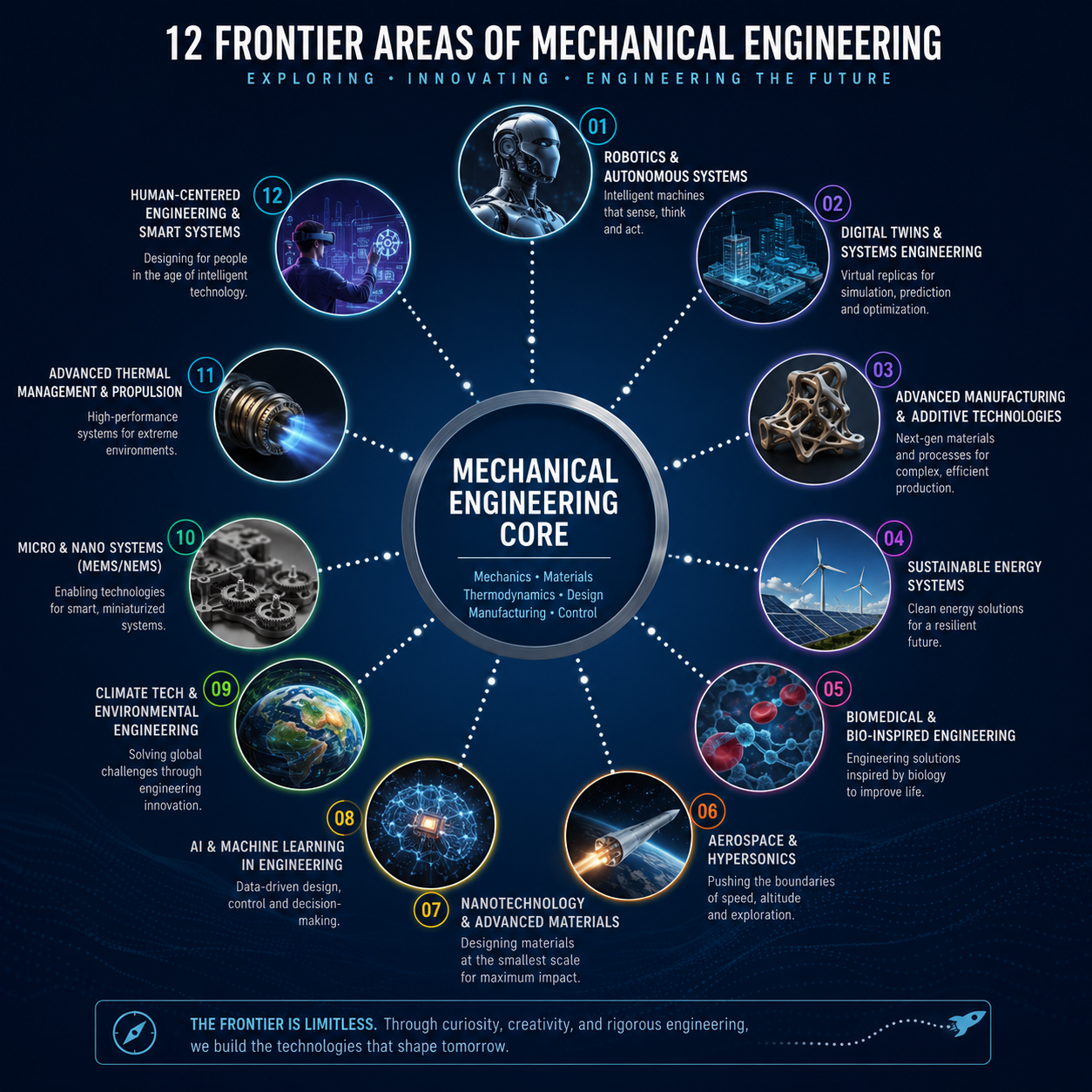
This article provides the most comprehensive, readable, and practically relevant guide to the frontiers of mechanical engineering available outside of academic journals. It is written for engineering students who want to understand where the discipline is heading, for practising engineers considering whether to pursue research or advanced specialisation, and for anyone who wants to understand what the brightest engineering minds in the world are currently working on and why it matters.
| What We Mean by ‘Frontiers’: The frontiers of mechanical engineering are the research-active boundaries of the discipline: areas where current knowledge is being extended, where conventional methods reach their limits, where new tools and theories are being created, and where the results of today’s research will become the engineering standards of the next decade. Understanding the frontiers is how engineers anticipate where the profession is heading before it arrives. |
Understanding the Concept of a Discipline’s Frontier
The word “frontier” in the context of an engineering or scientific discipline describes the region at the edge of current knowledge, where established methods no longer provide complete answers and where new approaches, tools, materials, and theories are being actively developed. A frontier of mechanical engineering is therefore not simply an advanced topic: it is an area where the profession’s current best knowledge is genuinely insufficient to solve the problem at hand.
Frontiers matter for several practical reasons beyond intellectual curiosity. They are where the highest-value research positions exist. They are where industry is willing to pay the largest premiums for specialised knowledge. They are where today’s PhD thesis becomes tomorrow’s commercially deployed technology. And they are where mechanical engineering’s identity as a discipline is continuously being renewed and expanded.
The frontiers of mechanical engineering are also where the discipline is most overtly interdisciplinary. The core of mechanical engineering, statics, dynamics, thermodynamics, and manufacturing, is relatively self-contained. The frontiers almost never are. They require mechanical engineers to engage deeply with biology, chemistry, physics, neuroscience, data science, and materials science simultaneously. Engineers who work at these frontiers are genuinely hybrid practitioners.
| Important Distinction: The frontiers of mechanical engineering are distinct from the latest advances covered in the previous article in this cluster. Advances are technologies and methods that have crossed from research into deployment: they are being used in factories and products today. Frontiers are the research-active boundary conditions: the places where engineers and scientists are working right now to build knowledge that does not yet exist in a commercially deployable form. Some of today’s frontiers will become tomorrow’s advances; others will remain at the frontier for decades. |
Frontier 1: Nano-Scale Mechanical Engineering and Molecular Machines
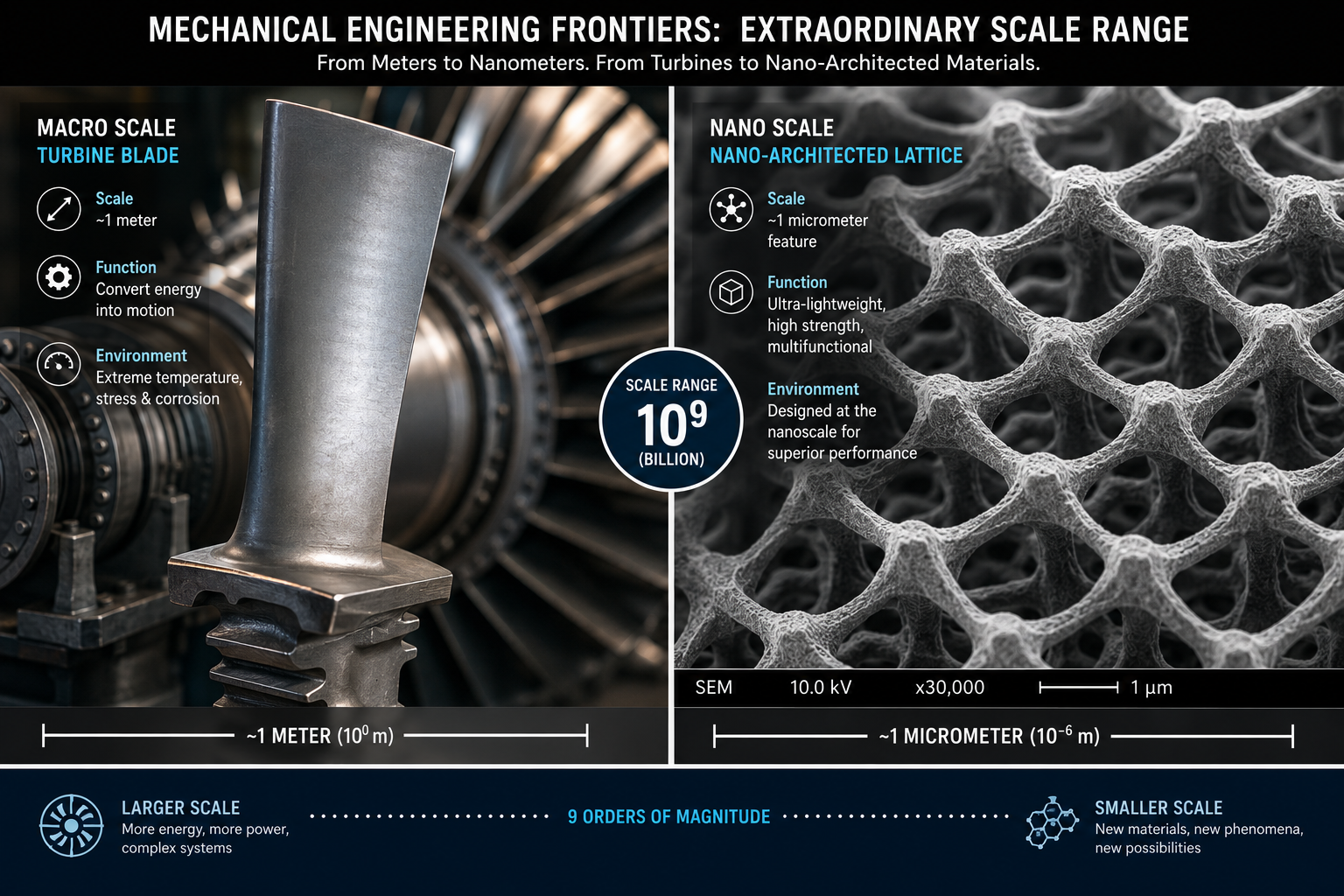
At the deepest frontier of scale, mechanical engineering is grappling with the behaviour of matter at the nanometre and even angstrom level, where classical mechanics gives way to quantum mechanical effects and where the dominant forces are surface interactions rather than gravitational or inertial loads. Nano-scale mechanical engineering is the field that designs, fabricates, and analyses mechanical systems with features measured in billionths of a metre.
Nano-Architected Materials: Tuning Mechanics at the Atomic Scale
MIT graduate research (featured in MIT News, 2024) by Somayajulu Dhulipala with advisor Professor Carlos Portela has focused on developing nano-architected materials with tunable mechanical properties through scalable fabrication methods. Unlike conventional materials whose properties are fixed by composition, nano-architected materials derive their mechanical behaviour from their geometric structure at the nanoscale, enabling engineers to programme stiffness, strength, and energy absorption by design rather than by material selection alone.
The ability to fine-tune the mechanical properties of specific materials at the nanoscale brings versatility across multiple industries. Applications include ultra-lightweight structural panels for aerospace, impact-absorbing helmets with precisely graduated energy dissipation zones, implantable scaffolds for bone tissue engineering that match the mechanical compliance of natural bone, and nano-scale thermal management structures for next-generation semiconductor devices.
Molecular Machines: Mechanical Engineering at the Biological Scale
Biology has been running molecular machines for billions of years. Proteins such as myosin (the motor protein responsible for muscle contraction), ATP synthase (the rotary motor that produces cellular energy), and kinesin (which transports cargo along microtubule tracks inside cells) are all mechanical machines operating at the molecular scale with astounding efficiency and precision.
Mechanical engineers and biophysicists are studying these biological machines not merely out of curiosity but with the explicit aim of copying their principles in synthetic systems. Artificial molecular motors, molecular switches, and DNA-based mechanical actuators are all active research areas, with potential applications in targeted drug delivery, molecular assembly of materials, and ultra-compact energy conversion devices.
Frontier 2: Bio-Inspired and Biohybrid Engineering
Nature is the most sophisticated engineer on Earth, operating over four billion years with the most rigorous possible selection pressure: anything that does not work is eliminated. Bio-inspired mechanical engineering studies biological systems, from spider silk and mantis shrimp claws to bird wing aerodynamics and tree root anchor mechanics, to extract design principles that can be translated into engineered systems.
Biological Structures as Engineering Inspiration
The mantis shrimp’s dactyl club, which delivers impact forces of up to 1,500 Newtons while striking hard-shelled prey, has a layered helicoidal composite microstructure that distributes crack propagation energy with extraordinary efficiency. Researchers at UC Riverside and other institutions have used this structure as a template for impact-resistant composite materials for helmets, body armour, and aircraft panels. Spider silk, with its combination of strength, toughness, and extensibility that no synthetic fibre matches, has inspired decades of biomimetic fibre research. Gecko adhesion, achieved through millions of micro-scale hair-like structures that exploit van der Waals forces, is the basis for research into dry, reversible adhesives for robotics, medical devices, and structural repair.
Biohybrid Systems: Merging Living Tissue with Mechanical Structures
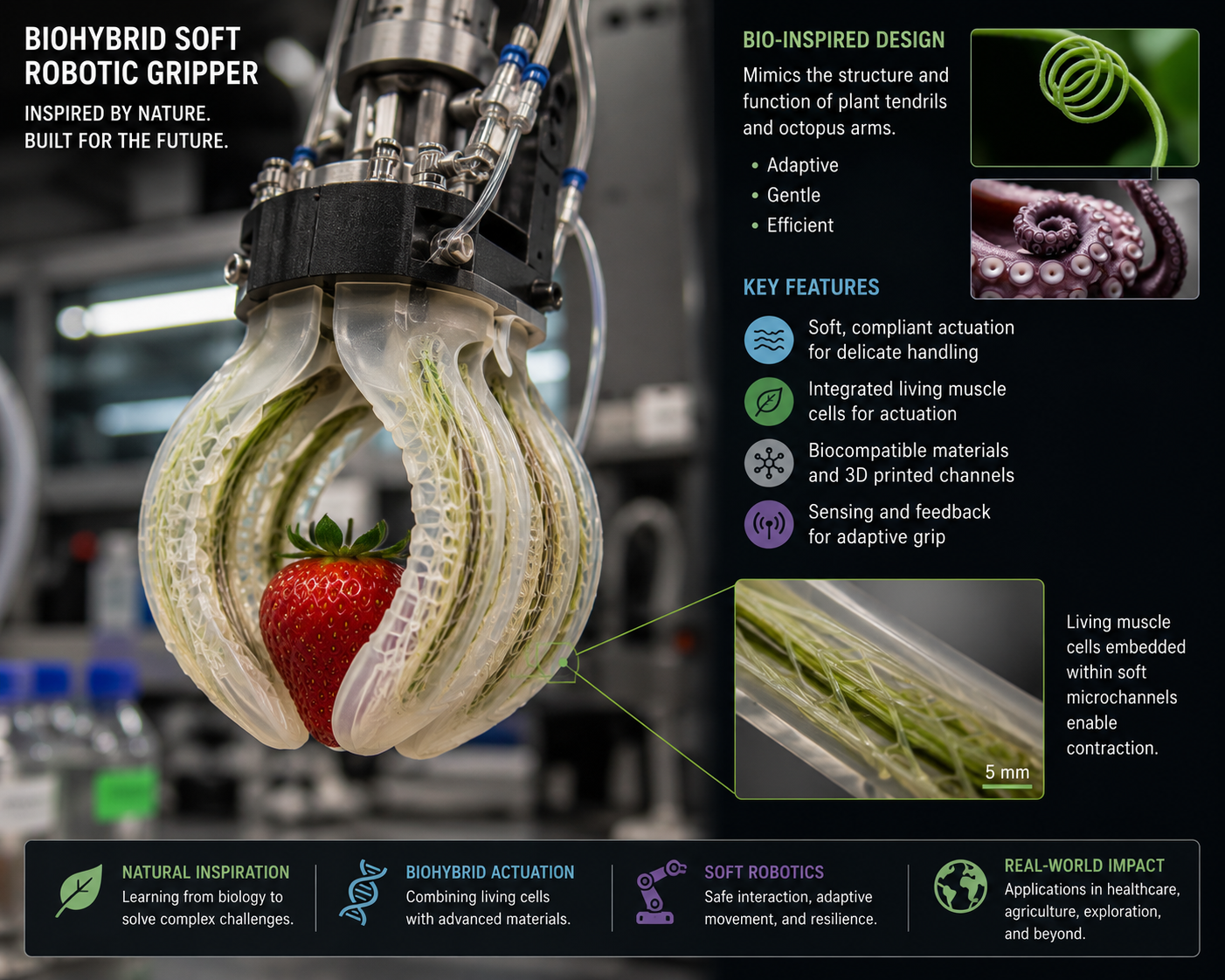
The most radical frontier in this area is biohybrid engineering: the integration of living biological tissue with mechanical structures to create systems that cannot be built from either component alone. Researchers have demonstrated biohybrid robots powered by muscle tissue grown from stem cells, in which the living muscle provides actuation force while a synthetic mechanical scaffold provides structure and constraint. These systems can be actuated by electrical stimulation or by light, and they self-repair, a capability no conventional actuator possesses.
MIT research highlighted in 2024 includes work by graduate student Loïcka Baille developing remote sensing technologies to study and protect marine life, and by Carlos Díaz-Marín designing salt-polymer materials that capture humidity from air for water generation and thermal energy storage. Both represent mechanical engineers working at the frontier between the physical and biological worlds.
Frontier 3: Tribology at the Extreme: Zero-Wear and Self-Lubricating Systems
Tribology, the science of friction, wear, and lubrication between interacting surfaces, is one of the oldest mechanical engineering disciplines and one of the most economically significant. Friction and wear losses account for approximately 23 percent of global energy consumption, according to estimates from the International Energy Agency and tribology research institutions. Eliminating or reducing these losses is one of the most impactful engineering challenges on the planet.
Superlubricity: Near-Zero Friction Surfaces
Superlubricity is the phenomenon in which friction between two sliding surfaces approaches zero. First observed at the atomic scale between misaligned graphene layers, superlubricity has now been demonstrated in engineering-relevant conditions using graphene-based coatings, carbon nanotube arrays, and engineered surface topographies. Achieving superlubricity in macroscale engineering components, such as engine bearings, gears, and hydraulic seals, at practical operating temperatures and loads, is an active and commercially compelling research frontier.
Solid Lubricants and Self-Healing Coatings
Conventional liquid lubrication is impossible in many extreme environments: the vacuum of space, cryogenic temperatures, and high-radiation nuclear environments all preclude conventional oils and greases. Solid lubricant research is developing coatings based on materials including molybdenum disulfide (MoS2), hexagonal boron nitride, and diamond-like carbon (DLC) that can provide low-friction surfaces in these extreme conditions. The next frontier in tribology is self-healing tribological coatings: surfaces that autonomously repair wear damage through the release of embedded lubricant reservoirs or through surface chemistry triggered by frictional heat.
| Economic Impact: A 2017 study published in Tribology International estimated that tribological advances already in existence, if fully implemented globally, could reduce energy consumption by up to 40 percent in transport applications alone. The potential economic saving runs to trillions of dollars annually. This is why tribology research, despite its low public profile, is one of the most heavily funded areas at the frontier of mechanical engineering. |
Frontier 4: Turbomachinery for Next-Generation Energy Systems
Turbomachinery, the design of turbines, compressors, fans, and pumps that exchange energy between a fluid and a rotating shaft, is one of the most mature branches of mechanical engineering. And yet it remains one of the most active research frontiers, driven by the urgent need to make turbomachinery more efficient, more durable, and capable of operating with new working fluids including hydrogen, supercritical carbon dioxide, and ammonia.
Supercritical CO2 Power Cycles
Supercritical carbon dioxide (sCO2) power cycles operate with CO2 as the working fluid at conditions above its critical point (31 degrees Celsius and 73.8 bar), where it behaves as a dense fluid with properties between a liquid and a gas. sCO2 turbines can achieve thermal efficiencies significantly higher than conventional steam turbines at the same operating temperature, while being physically much smaller and more compact. They are potentially transformative for concentrated solar power, nuclear power, and waste heat recovery applications, but they operate in conditions of extreme pressure and temperature that push current materials and seal technologies to their limits.
Hydrogen-Fuelled Turbines and Combustion Engineering
The transition of gas turbines from natural gas to hydrogen fuel is a frontier research problem of enormous commercial importance. Hydrogen combustion is fundamentally different from methane combustion: it burns at higher temperatures, with a much wider flammability range, higher flame speeds, and greater tendency toward flashback (where the flame propagates back into the fuel supply). Designing combustor geometries that handle these challenges while maintaining low NOx emissions requires new computational tools, new experimental rigs, and deep collaboration between mechanical engineers, combustion chemists, and materials scientists.
Additive Manufacturing of Turbine Components
The ability to produce turbine blades with internal cooling channel geometries impossible to achieve by casting or machining is one of the most commercially significant applications of metal additive manufacturing in any industry. Current research is focused on qualifying AM-produced turbine components for service, developing post-processing methods to achieve the surface finish and dimensional accuracy required, and pushing the temperature capability of AM-compatible nickel superalloys to enable higher turbine inlet temperatures and greater thermal efficiency.
Frontier 5: Quantum Engineering and Mechanical Systems
The intersection of quantum physics and mechanical engineering is one of the most intellectually fascinating frontiers in contemporary science. Quantum mechanical engineering is not a single coherent field but a collection of research areas in which quantum phenomena are either exploited for engineering purposes or in which mechanical systems are used as platforms to study and control quantum states.
Optomechanics: Controlling Mechanical Motion with Light
Optomechanical systems use the radiation pressure of light to cool, drive, and sense the motion of mechanical resonators at the micro and nano scale. Researchers have cooled micro-mechanical oscillators to their quantum ground state, the lowest energy state allowed by quantum mechanics, using laser cooling techniques. This enables precision measurements of mechanical motion with sensitivity far below the standard quantum limit, with applications in ultra-sensitive force and mass sensors, gravitational wave detectors, and fundamental tests of quantum mechanics.
Quantum Sensing Using Mechanical Systems
MEMS and NEMS (Nano-ElectroMechanical Systems) devices are being developed as quantum sensors capable of detecting forces, fields, and masses at the single-molecule or single-atom level. These devices are relevant to medical diagnostics (detecting disease biomarkers at vanishingly low concentrations), defence (detecting trace chemical and biological agents), and fundamental physics (searching for dark matter and testing quantum gravity theories). The mechanical engineering challenges of fabricating, characterising, and operating these devices at the required sensitivity are at the very frontier of the discipline.
| Why This Matters for Engineers: Quantum engineering may seem remote from practical mechanical engineering, but its applications are converging rapidly with mainstream practice. The inertial navigation systems in autonomous vehicles, the gravimeters used in oil and gas exploration, the accelerometers in smartphones, and the force sensors in precision manufacturing equipment are all heading toward quantum-enhanced sensitivity in the next decade. Mechanical engineers who understand the physical principles will be the ones designing and deploying these systems. |
Frontier 6: Autonomous and Self-Adaptive Mechanical Systems
The frontier of autonomous mechanical systems goes significantly beyond current industrial robotics. The research frontier is concerned with systems that can not only execute pre-programmed tasks autonomously but can perceive their environment, adapt their behaviour in response to unexpected conditions, learn from experience, and make decisions in contexts their designers did not explicitly anticipate.
Morphing Structures: Machines That Change Their Shape
Morphing structures are mechanical systems that can change their shape, stiffness, or topology in response to changing conditions, optimising their performance across multiple operating regimes rather than being fixed to a single geometry. Aircraft morphing wings, which can change their profile for optimal efficiency at different flight speeds and altitudes, have been a research frontier for two decades. Recent advances in smart material actuators (shape memory alloys, dielectric elastomers, and piezoelectric actuators) and in lightweight compliant mechanism design are making morphing structures genuinely viable for practical deployment.
Self-Healing Mechanical Structures
A frontier that bridges materials science and mechanical engineering, self-healing structural materials can autonomously repair damage such as cracks, delamination, or corrosion without human intervention. Vascular networks embedded in composite materials release healing agents when crack propagation ruptures the vascular channels. Research published in 2024 and 2026 demonstrates self-healing efficiencies of 80 to 95 percent of original fracture toughness in fibre-reinforced composite systems. The engineering frontier is moving from demonstration at coupon scale to application in structural components for aerospace panels, wind turbine blades, and offshore infrastructure.
Swarm Robotics and Distributed Mechanical Systems
Swarm robotics applies principles from collective biological behaviour (ant colonies, bird flocking, fish shoaling) to large numbers of simple robots that collectively achieve complex tasks no individual robot could accomplish alone. The mechanical engineering challenges include designing robust, miniaturised robots capable of operating in swarms, developing compliant mechanisms for ground and aerial locomotion at small scales, and creating fault-tolerant mechanical systems that maintain collective functionality even when individual robots fail.
Read the blog on: Nature of Mechanical Engineering Explained (2026)
Frontier 7: Sustainable and Circular Manufacturing Engineering
If there is a single frontier that is reshaping the entire profession rather than a specific technical sub-domain, it is the frontier of sustainable and circular engineering. The pressure to decarbonise manufacturing, eliminate waste, and design products for longevity, repairability, and material recovery is not merely a regulatory requirement: it is a fundamental redesign of the engineering brief itself.
Net-Zero Carbon Manufacturing
Achieving net-zero carbon manufacturing requires mechanical engineers to address energy consumption at every stage of the production process: material extraction and processing, forming and machining, assembly, and end-of-life treatment. Research frontiers include electrification of high-temperature industrial processes that currently rely on fossil fuel combustion (cement kilns, steel furnaces, glass melting), the use of green hydrogen as an industrial reductant (replacing coking coal in iron and steel production), and the development of low-energy precision manufacturing processes that reduce material waste.
Design for Circularity: Engineering Products That Can Be Fully Recovered
The circular economy requires products designed from the outset for disassembly, component recovery, and material recycling. Design for circularity (DfC) is a mechanical engineering frontier that challenges virtually every conventional design heuristic. Designs that are optimised for manufacturing (minimising fasteners, using permanent joins, co-moulding multiple materials) are often the hardest to disassemble and recycle. Developing design methodologies that optimise simultaneously for manufacturability, performance, and end-of-life material recovery requires new computational design tools, new joining technologies, and new frameworks for quantifying circular value alongside structural and thermal performance.
Frontier 8: Extreme Environment Engineering: Deep Sea, Polar, and Space
Mechanical engineering has always operated at environmental extremes, but the frontiers of extreme environment engineering in 2026 are being pushed further than ever by the demands of deep-sea resource exploration, polar scientific infrastructure, and the emerging commercial space economy.
Deep-Sea Engineering
The deep ocean, defined as depths below 200 metres, covers more than 60 percent of the Earth’s surface and remains one of the least-explored environments on the planet. Hydrostatic pressures at full ocean depth (11,000 metres, the depth of the Challenger Deep) reach more than 1,100 bar: equivalent to supporting the weight of 50 passenger aircraft on a square centimetre of surface. Deep-sea mechanical engineering faces challenges including the design of pressure housings that maintain structural integrity under these loads, the development of buoyancy materials for full-ocean-depth operation, corrosion management in oxygen-depleted saline environments, and the engineering of low-power, long-endurance unmanned underwater vehicles (UUVs) capable of multi-year autonomous operation.
Space Mechanical Engineering: From Launch to In-Situ Manufacturing
The commercial space sector, valued in 2024 at approximately $630 billion and growing at 9 percent annually, is creating new mechanical engineering frontiers across propulsion, structures, thermal control, and manufacturing. The mechanical engineering challenges of space-based manufacturing range from the design of in-space assembly robots for large orbital structures, to the development of ISRU (In-Situ Resource Utilisation) systems for manufacturing structural materials and propellant from lunar or Martian regolith, to the engineering of mechanisms that can reliably operate in the thermal cycling, vacuum, and radiation environment of space over mission durations of a decade or more.
MIT graduate student Somayajulu Dhulipala’s research on nano-architected materials is explicitly motivated by applications in making space habitable: lightweight, high-performance materials engineered at the nanoscale could provide thermal insulation, radiation shielding, and structural support with mass fractions that conventional materials cannot achieve.
Frontier 9: Neuro-Mechanical Engineering and Brain-Machine Interfaces
Neuro-mechanical engineering is one of the newest and most intellectually challenging frontiers in the discipline: the design of mechanical systems that interface directly with the human nervous system, reading neural signals to control external devices and delivering mechanical or electrical actuation to restore or augment physical function.
Prosthetics at the Frontier: Restoring Sensation and Dexterity
Advanced prosthetic limbs have moved far beyond passive mechanical replacements. The current frontier involves bidirectional neural interfaces: prosthetic hands that can not only be controlled by motor nerve signals decoded from the residual limb but can also send sensory feedback signals back to the nervous system, giving the user a sense of touch and proprioception. The mechanical engineering challenges include designing actuated fingers with sufficient degrees of freedom and force capacity to replicate natural hand dexterity, embedding sensor arrays to measure contact force, texture, and slip, and packaging all of this into a prosthetic of appropriate weight and form factor.
Exoskeletons: Augmenting Human Physical Capability
Powered exoskeletons for rehabilitation, workplace ergonomic assistance, and military load-bearing are an active engineering frontier with several products already in commercial deployment. The mechanical engineering challenges at the frontier include developing lightweight, compliant actuation systems that can match the kinematics of the human musculoskeletal system across its full range of motion, designing control systems that interpret user intent from muscle electromyography (EMG) signals with sufficient speed and accuracy, and creating wearable structures that are comfortable and safe for extended daily use.
Frontier 10: Multi-Scale and Multi-Physics Simulation as a Design Frontier
Simulation is not new in mechanical engineering, but the frontier of multi-scale and multi-physics simulation represents a qualitative change in what computational engineering can achieve. Traditional FEA operates at a single scale (the component scale) and typically addresses a single physics domain (structural mechanics). The frontier involves coupling simulations across scales and physics domains in ways that capture emergent behaviours that no single-domain, single-scale analysis can reveal.
Molecular Dynamics to Continuum Mechanics: Bridging the Scale Gap
The behaviour of engineering materials at the macroscale is fundamentally determined by phenomena at the atomic and microstructural scale: dislocation motion controls plasticity, grain boundary chemistry controls corrosion, nanoscale defects initiate fatigue cracks. Multi-scale modelling seeks to bridge from molecular dynamics simulations (picosecond timescales, nanometre length scales) through crystal plasticity models (microsecond timescales, micron scales) to continuum FEA (second timescales, component scales). Achieving this bridging reliably for complex loading histories and environments is an unsolved computational engineering challenge of the first order.
Physics-Informed Machine Learning: AI at the Simulation Frontier
Physics-Informed Neural Networks (PINNs) represent one of the most exciting developments at the intersection of machine learning and engineering simulation. PINNs encode the governing differential equations of physics (Navier-Stokes, heat equation, elastic wave equation) as constraints in the training of neural networks, enabling them to solve complex physical problems at speeds that conventional numerical methods cannot match. MIT research groups and commercial simulation vendors are actively developing PINN-based solvers for fluid dynamics, structural mechanics, and heat transfer, with the potential to make high-fidelity simulation accessible for real-time design optimisation.
Frontier 11: In-Body Mechanical Engineering: Ingestible and Implantable Devices
One of the most remarkable frontiers in mechanical engineering is the design of devices that operate inside the human body, subject to an environment of extraordinary complexity: corrosive fluids, living tissue that can respond immunologically to foreign objects, mechanical loads from breathing, heartbeat, and movement, and spatial constraints measured in millimetres.
Ingestible Mechatronic Capsules
MIT graduate student Jimmy McRae’s research focuses on ingestible electronic and mechatronic devices that can perform continuous monitoring and remotely triggerable actuation from within the gastrointestinal tract. These devices range from ingestible electroceutical capsules that modulate hunger-regulating hormones by delivering electrical stimulation to the stomach lining, to devices capable of continuous ultralong monitoring of gut chemistry, pH, temperature, and motility. The mechanical engineering challenges include miniaturisation, biocompatible sealing, power harvesting from body motion or chemical energy, and wireless communication through tissue.
Next-Generation Implantable Devices
Beyond conventional pacemakers and orthopaedic implants, the frontier of implantable mechanical engineering includes totally artificial hearts driven by continuous-flow turbopumps, cochlear implants with MEMS-based frequency selective membranes that replicate the basilar membrane of the inner ear, retinal implants that convert light to electrical nerve stimulation to restore partial vision, and drug delivery implants with MEMS-actuated valves that release precise drug doses on demand in response to biosensors monitoring disease markers. Each of these devices is a complete mechanical and electrical engineering system operating in one of the most demanding environments imaginable.
Frontier 12: The Convergence Frontier: Where Mechanical Engineering Meets Everything
The most distinctive characteristic of mechanical engineering’s frontier in the 2020s is that the most exciting and impactful work is almost never confined within a single discipline. It happens at convergence points: where mechanical engineering meets biology, quantum physics, neuroscience, data science, environmental engineering, or space science.
This convergence is not a diffusion of the discipline’s identity. It is an expansion. The core physical principles, mechanics, thermodynamics, fluid mechanics, materials science, remain the analytical foundation. What changes at the frontier is the context in which those principles are applied and the collaborators alongside whom they are developed. A mechanical engineer at the nano-scale frontier is using continuum mechanics and nanofabrication in the same breath. A mechanical engineer at the neuro-mechanical frontier is applying biomechanics and control systems theory to human anatomy.
The Frontiers in Mechanical Engineering journal (published by Frontiers Media) explicitly recognises this convergence in its scope, covering biomechanical engineering, digital manufacturing, engine and automotive engineering, fluid mechanics, heat transfer, mechatronics, MEMS, solid and structural mechanics, tribology, turbomachinery, and vibration systems simultaneously. The Frontiers of Mechanical Engineering journal (published by Higher Education Press / Springer, formerly sponsored by China’s Ministry of Education) covers machines and mechanisms, mechanical design and bionics, manufacturing automation, precision engineering, mechatronics, micro/nano manufacturing, robotics, and green manufacturing. Both journals reflect the reality that the frontier of mechanical engineering does not exist at a single point: it is a wide, multidimensional boundary.
How the Frontiers Shape Mechanical Engineering Careers
Understanding the frontiers of mechanical engineering is not merely intellectually rewarding. It is a practical career advantage. Engineers and researchers who position themselves at a frontier, particularly one with strong commercial pull, are among the most sought-after professionals in the field.
| Frontier Area | Career Pathways | Degree Level Typically Required | Where the Jobs Are |
| Nano-scale ME and molecular machines | Nanomaterials engineer, MEMS design engineer, nanotechnology R&D scientist | MSc or PhD | Semiconductor industry, biomedical devices, defence, space technology companies |
| Bio-inspired and biohybrid engineering | Soft robotics engineer, biomimetic materials scientist, biohybrid systems researcher | MSc or PhD | Medical device companies, robotics startups, university research labs, defence R&D |
| Tribology: superlubricity and self-healing coatings | Tribology engineer, surface technology specialist, lubrication systems engineer | BEng + specialisation or MSc | Automotive OEMs, aerospace, energy sector, bearing and seal manufacturers |
| Advanced turbomachinery | Turbomachinery aerodynamicist, combustion engineer, AM turbine component engineer | MEng or MSc, PhD for research roles | Gas turbine OEMs (GE, Siemens, Rolls-Royce), energy utilities, aerospace propulsion |
| Quantum engineering and sensing | Quantum sensor engineer, optomechanics researcher, precision instruments engineer | PhD almost universally required | National laboratories, quantum computing companies, defence, precision instrument manufacturers |
| Autonomous and self-adaptive systems | Morphing structures engineer, swarm robotics engineer, smart materials engineer | MSc or PhD | Aerospace R&D, defence, advanced manufacturing, robotics companies |
| Sustainable and circular manufacturing | Circular design engineer, sustainable manufacturing specialist, LCA engineer | BEng + experience or MSc | All major manufacturing industries; green technology sector; consulting |
| Extreme environment engineering | Deep-sea systems engineer, space mechanisms engineer, nuclear materials engineer | MEng or MSc | Energy majors, space agencies, nuclear operators, defence |
| Neuro-mechanical engineering | Prosthetics engineer, exoskeleton designer, neural interface mechanical engineer | MSc or PhD | Medical device companies, rehabilitation technology, defence, neurotechnology startups |
| In-body devices | Ingestible device engineer, implantable systems engineer, bioMEMS engineer | MSc or PhD | Medical device OEMs, hospital technology, biotech companies |
| Career Strategy Insight: The highest-value career positioning at the frontiers of mechanical engineering comes from combining a deep classical mechanical engineering foundation with genuine expertise in one frontier area. The engineer who understands tribology from first principles and can also write Python scripts to analyse surface metrology data is significantly more valuable than one with either skill alone. The frontier engineer is almost always a bridge builder: between classical ME and a partner discipline, between academic research and industrial application, between physical and digital engineering. |
Academic Journals Covering the Frontiers of Mechanical Engineering
For engineers and students who want to engage with the primary research literature at the frontiers of the discipline, the following journals are the most relevant and widely read.
| Journal | Publisher | Focus Area | Key Metric (2024/2026) |
| Frontiers of Mechanical Engineering | Higher Education Press / Springer | All major ME branches; machines, mechanisms, tribology, manufacturing, precision engineering, mechatronics, MEMS, green manufacturing | Impact Factor: ~4.5-5.1; SJR: Q1; H-index: 48 |
| Frontiers in Mechanical Engineering | Frontiers Media (open access) | Biomechanical engineering, digital manufacturing, fluid mechanics, heat transfer, mechatronics, MEMS, solid mechanics, tribology, turbomachinery | Open access; ESCI indexed; growing citation base |
| International Journal of Machine Tools and Manufacture | Elsevier | Machining processes, manufacturing technology, precision engineering | Top-ranked in manufacturing ME; highly cited |
| Journal of the Mechanics and Physics of Solids | Elsevier | Theoretical solid mechanics, fracture, plasticity, metamaterials | Premier journal for solid mechanics frontiers |
| Nature Machine Intelligence | Springer Nature | AI and robotics frontiers, machine learning in engineering systems | High-impact interdisciplinary; key for AI-ME convergence |
| Science Robotics | AAAS | Advanced robotics: soft robots, surgical robots, biohybrid systems | Among the highest-impact robotics journals |
| Applied Physics Letters / Physical Review Applied | AIP / APS | MEMS, optomechanics, quantum mechanical systems, nanoscale ME | Essential for quantum engineering and MEMS frontiers |
Frequently Asked Questions (FAQ)
What are the frontiers of mechanical engineering?
The frontiers of mechanical engineering are the research-active boundary areas where current knowledge is being extended, where conventional methods are insufficient, and where new tools, materials, and theories are being created. In 2026, the most active frontiers include nano-scale mechanical engineering and molecular machines, bio-inspired and biohybrid systems, tribology research on superlubricity and self-healing coatings, next-generation turbomachinery for hydrogen and sCO2 cycles, quantum mechanical engineering, autonomous and self-adaptive systems, sustainable and circular manufacturing, extreme environment engineering, neuro-mechanical engineering, and multi-scale simulation. These are the areas where today’s PhD research becomes tomorrow’s engineering standard.
What is the difference between the frontiers and the latest advances in mechanical engineering?
The latest advances in mechanical engineering are technologies and methods that have already crossed from research into industrial deployment: they are being used in factories, products, and systems today. The frontiers of mechanical engineering are the research-active boundary conditions where knowledge is still being built: engineers and scientists are working at the frontier right now to create knowledge that does not yet exist in commercially deployable form. Some frontiers become advances in five to ten years; others remain at the frontier much longer. Understanding both is important for strategic career planning in engineering.
What is bio-inspired mechanical engineering?
Bio-inspired mechanical engineering is a research frontier that studies biological systems to extract design principles that can be translated into engineered systems. Examples include mantis shrimp-inspired impact-resistant composite materials, gecko adhesion-inspired reversible dry adhesives, spider silk-inspired high-toughness synthetic fibres, and bird wing-inspired morphing aircraft structures. Biohybrid engineering extends this further by integrating living biological tissue directly with mechanical structures, such as robots powered by stem-cell-derived muscle tissue.
What is tribology and why is it a frontier of mechanical engineering?
Tribology is the science of friction, wear, and lubrication between interacting surfaces. It is a frontier of mechanical engineering because friction and wear losses account for approximately 23 percent of global energy consumption, making tribological improvement one of the highest-impact engineering opportunities on the planet. Current frontier research includes superlubricity (near-zero friction achieved through graphene coatings and engineered surface architectures), self-healing tribological coatings, and solid lubricants for extreme environments where conventional oils and greases cannot function.
What is quantum mechanical engineering?
Quantum mechanical engineering is the emerging frontier where quantum physics phenomena are exploited in engineering applications. It includes optomechanics (using laser light to control and sense mechanical motion at the quantum level), quantum sensing using MEMS and NEMS devices capable of detecting forces at the single-atom level, and the development of mechanical systems that operate as platforms for quantum information processing. While still largely a research discipline, quantum sensors based on mechanical principles are already entering commercial use in precision navigation, geological surveying, and medical imaging.
How do I build a career at the frontiers of mechanical engineering?
Building a career at the frontiers of mechanical engineering typically requires a postgraduate qualification (MSc or PhD) in a specific frontier area, built on a solid classical mechanical engineering undergraduate foundation. The most effective approach is to identify one frontier area with strong commercial pull (hydrogen systems, advanced tribology, autonomous systems, biomedical ME) and develop genuine deep expertise in it while maintaining and demonstrating classical ME foundations. Adding cross-disciplinary skills, whether data science, biology, materials science, or control engineering, significantly increases both research and industry employability at the frontier.
What are the Frontiers in Mechanical Engineering and Frontiers of Mechanical Engineering journals?
These are two separate academic journals. Frontiers in Mechanical Engineering is published by Frontiers Media (Switzerland) as an open-access journal covering biomechanical engineering, digital manufacturing, fluid mechanics, heat transfer, mechatronics, MEMS, tribology, turbomachinery, and vibration systems. Frontiers of Mechanical Engineering is published by Higher Education Press / Springer and was formerly sponsored by China’s Ministry of Education, covering machines and mechanisms, tribology, manufacturing automation, precision engineering, mechatronics, micro/nano manufacturing, robotics, and green manufacturing (and is now being renamed to ENGINEERING Mechanical Engineering as of 2026). Both are legitimate, indexed, peer-reviewed journals covering cutting-edge research in the field.
What is the scope of the frontiers of mechanical engineering?
The scope of the frontiers of mechanical engineering is extraordinarily broad, spanning scales from nanometres to planetary dimensions, disciplines from quantum physics to environmental science, and applications from ingestible medical devices to space-based manufacturing. The frontiers are not a single location on a map of knowledge but a multi-dimensional boundary: wherever established mechanical engineering methods encounter a problem they cannot yet fully solve, a frontier exists. The convergence with biology, quantum physics, neuroscience, data science, and sustainability science is particularly defining the character of the frontier in 2026.
Conclusion
The frontiers of mechanical engineering are not distant or abstract. They are the active research programmes happening in laboratories at MIT, ETH Zurich, Imperial College, TU Munich, NUS, and hundreds of other institutions globally right now. They are the questions that the best mechanical engineers in the world are spending their careers trying to answer. And they are the source of the technologies that will define engineering practice in the decade ahead.
From the molecular machines that may one day deliver drugs to individual cancer cells, to the superlubricious coatings that could eliminate 23 percent of global energy losses, to the quantum sensors that will navigate autonomous vehicles more precisely than any GPS, to the in-body mechatronic devices that will transform medicine, the frontiers of mechanical engineering represent the most intellectually rich and practically consequential territory in the discipline’s long history.
Understanding these frontiers, even at the level of an informed non-specialist, gives any engineer a significant advantage: in research conversations, in strategic career decisions, in identifying where to invest in further learning, and in recognising which industries and technologies are worth paying attention to in the years ahead.
Continue exploring the discipline. Read our guide to the Latest Advances in Mechanical Engineering for the technologies already crossing from frontier to deployment, understand What Does a Mechanical Engineer Do? to see how these frontiers connect to practice, or explore the Nature of Mechanical Engineering for the philosophical foundations that make all of this possible.
Leave a Reply