Blog

  • GD&T Explained: How Geometric Dimensioning and Tolerancing Works in CAD

    GD&T Explained: How Geometric Dimensioning and Tolerancing Works in CAD

    Two machined parts are designed to fit together. The drawing shows a diameter of 25.00 mm with a plus/minus tolerance of 0.10 mm — but it says nothing about whether that bore is allowed to be oval, tapered, or tilted relative to the mating face. The parts are made to the numbers on the drawing. They still do not fit.

    This is the problem that Geometric Dimensioning and Tolerancing (GD&T) was developed to solve. Traditional plus/minus tolerancing defines size. GD&T defines shape, orientation, location, and form. It is the difference between telling a machinist how big to make a feature and telling them exactly how precise its geometry needs to be, in every dimension that matters functionally.

    This guide covers what GD&T is, how it works, the 14 core symbols, how to read a feature control frame, and the most common mistakes that drive up manufacturing cost unnecessarily.

    What Is GD&T and Why Does It Exist?

    GD&T stands for Geometric Dimensioning and Tolerancing. It is a standardised symbolic language applied to engineering drawings to define the allowable variation in the shape, size, orientation, and location of part features. In the United States, it is governed by ASME Y14.5-2018 (the most recent revision of the standard). Internationally, the equivalent is ISO 1101.

    The system exists because coordinate tolerancing — the older method of simply assigning plus/minus values to X, Y, and Z dimensions — is inherently limited. Consider a bolt hole pattern on a flange. A coordinate tolerance defines a square tolerance zone around each hole’s nominal position. GD&T’s True Position control defines a cylindrical tolerance zone centred on the exact theoretically perfect location. The cylindrical zone is 57% larger in area than the equivalent square zone for the same stated tolerance value — meaning more parts pass inspection without any compromise to the functional requirement. That directly reduces scrap and rework cost.

    GD&T does not make tolerances tighter. Used correctly, it makes tolerances more precisely matched to functional requirements — which often means they can be looser in areas that do not affect fit or function.

    Beyond the efficiency argument, GD&T eliminates ambiguity. A drawing annotated with GD&T controls is interpreted the same way by any engineer, machinist, or quality inspector who knows the standard — whether they are in your facility or a supplier facility on the other side of the world. That universality is essential when manufacturing is distributed across multiple suppliers or geographies.

    The 5 Categories of GD&T Controls

    5 Categories of GD&T Controls | ASME Y14.5 | ISO 1101 | MMC

    GD&T controls are grouped into five categories, each addressing a different aspect of geometric variation. Understanding these categories is the foundation for knowing which symbol to apply and when.

    CategoryControlsSymbols IncludedTypical Use Case
    FormShape of a surface or feature in isolation — no datum neededFlatness, Straightness, Circularity, CylindricitySealing faces, bearing bores, precision guide rails
    OrientationAngle of a feature relative to a datumParallelism, Perpendicularity, AngularityMating flanges, gearbox housings, mounting faces
    LocationPosition of a feature relative to a datum reference frameTrue Position, Concentricity, SymmetryBolt hole patterns, shaft centrelines, symmetric slots
    RunoutVariation of a surface as a part rotates about a datum axisCircular Runout, Total RunoutRotating shafts, pulleys, brake rotors
    ProfileShape and location of any surface or lineProfile of a Line, Profile of a SurfaceAerofoil sections, complex curves, cast/moulded surfaces

    The critical distinction between Form controls and all other categories is that Form controls — flatness, straightness, circularity, and cylindricity — do not reference a datum. They describe the shape of a feature in isolation. Every other control references at least one datum because it describes the relationship of a feature to something else.

    The 14 GD&T Symbols: A Complete Reference

    ASME Y14.5 defines 14 geometric characteristic symbols, one for each type of control. The table below provides the name, category, and a plain-English description of what each symbol controls. Keep this as a reference when annotating drawings or reviewing a drawing package from a supplier or design partner.

    14 GD&T Symbols | ASME Y14.5 | Simutecra
    Symbol NameCategorySymbol / Abbr.What It Controls
    FlatnessFormFlat symbolHow flat a surface is — all points must lie within two parallel planes
    StraightnessFormStraight symbolHow straight a line or axis is — applies to surface lines or feature axes
    CircularityFormCircle symbolHow round a circular cross-section is at any given point along its length
    CylindricityFormCylinder symbolCombines roundness and straightness — controls the full cylinder surface
    ParallelismOrientation// symbolControls a surface or axis to be parallel within a tolerance to a datum
    PerpendicularityOrientation90 deg symbolControls a surface or axis to be perpendicular within a tolerance to a datum
    AngularityOrientationAngle symbolControls a surface or axis to be at a specified angle to a datum
    True PositionLocationTarget symbolDefines the exact (theoretically perfect) location of a feature from datums
    ConcentricityLocationCircle-dotControls the axis of a feature to coincide with a datum axis (rarely used now)
    SymmetryLocation= symbolControls the median points of a feature to lie in a datum plane (rarely used)
    Circular RunoutRunoutSingle arrowControls surface variation at any single cross-section when part rotates
    Total RunoutRunoutDouble arrowControls cumulative variation across the entire surface as the part rotates
    Profile of a LineProfileArc open symbolControls the shape of a cross-sectional curve relative to a true profile
    Profile of a SurfaceProfileArc filled sym.Controls the shape of an entire surface relative to its true theoretic form

    Note on Concentricity and Symmetry: Both symbols are retained in ASME Y14.5-2018 but their use is now actively discouraged for most applications. They require median-point measurement, which is expensive and difficult to inspect reliably. In most cases, True Position with an appropriate material condition modifier achieves the same functional result and is far easier to measure. When you see these symbols on a drawing, it is worth questioning whether they are the right choice.

    How to Read a Feature Control Frame

    The feature control frame is the rectangular annotation box on a drawing that specifies a GD&T requirement. Every GD&T callout uses one. Reading it correctly is a fundamental skill for anyone working with engineering drawings.

    A feature control frame is divided into compartments read from left to right:

    Box 1Box 2Box 3Box 4 (optional)
    True Position symbolDiameter symbol + 0.5A  (primary datum)B  (secondary datum)
    Which geometric characteristic is being controlledThe tolerance value (and shape of the tolerance zone — diameter symbol = cylindrical zone)The primary datum this control referencesAdditional datums if needed (up to three)

    Worked example: A True Position callout reads as follows — the leftmost compartment shows the True Position symbol (a circle with crosshairs). The second compartment shows the diameter symbol followed by 0.5. The third compartment shows ‘A’. This means: the axis of this feature must fall within a cylindrical tolerance zone of diameter 0.5 mm, centred on the theoretically exact position defined relative to datum A. If a second datum ‘B’ appears in a fourth compartment, the position is also constrained relative to that secondary reference.

    Geometric Dimensioning and Tolerancing (GD&T) is governed by internationally recognized standards such as the ASME Y14.5 standard, which provides rules, symbols, and guidelines for interpreting engineering drawings accurately.

    Geometric Dimensioning and Tolerancing (GD&T)

    Understanding Datums

    A datum is a theoretically exact point, axis, or plane from which measurements on a drawing are taken. In practice, datums are established by physical contact with datum features — the real surfaces, bores, or faces on the actual part that approximate the theoretical datum.

    Datums are hierarchical. The primary datum (A) constrains the most degrees of freedom — typically established by the largest flat surface, which removes three degrees of freedom in a Cartesian system. The secondary datum (B) constrains two more. The tertiary datum (C) constrains the final degree of freedom. Together, the three-datum reference frame fully defines where the part sits in space, making every measurement repeatable and unambiguous.

    The selection of datums is one of the most important decisions in applying GD&T. Datums should reflect the functional interface of the part — how it is located, constrained, and mated when it is in service. A datum chosen for manufacturing convenience rather than functional interface will produce parts that are easy to make but difficult to assemble correctly.

    Real-World Example: A Precision Pump Housing

    A pump housing has a central bore that must align accurately with the motor shaft axis. The mating face (the flat surface that bolts to the motor) is established as Datum A. The central bore of the housing is Datum B. The bolt hole pattern is controlled with True Position relative to Datums A and B.

    Without GD&T: the bolt holes are dimensioned from an edge with plus/minus tolerances. The machinist makes the holes to the numbers. But if the mating face is not perfectly square to the bore, the holes end up in the right coordinate positions but the housing does not align when assembled. The parts are technically within tolerance and still fail functionally.

    With GD&T: the perpendicularity of the bore axis to the mating face is controlled explicitly. The bolt hole positions are defined relative to the bore centreline. The machinist and the inspector both have unambiguous requirements. Parts made to the drawing will assemble correctly — not because they happened to be made well, but because the drawing required it.

    Common GD&T Mistakes That Drive Up Manufacturing Cost

    GD&T applied well reduces manufacturing cost by ensuring tolerances match functional requirements — no tighter, no looser. Applied poorly, it can make drawings unnecessarily expensive to manufacture and inspect. These are the most frequent errors seen in GD&T annotations:

    MistakeWhat Goes WrongHow to Avoid It
    Over-tolerancingEvery feature is given a very tight tolerance ‘just to be safe’. Machining costs skyrocket because tight tolerances require slower speeds, more passes, and inspection at every stage.Apply tight tolerances only where fit or function genuinely requires them. Most features can tolerate far more variation than designers assume.
    Missing datum referencesA positional or orientation tolerance is called out with no datum specified. The machinist has no reference frame — the control is unenforceable.Every location and orientation control requires at least one datum. Form controls (flatness, circularity) are the exception — they do not need datums.
    Redundant dimensionsDimensions are duplicated across views, creating a closed loop. When tolerances stack up, it becomes mathematically impossible to satisfy all of them simultaneously.Use reference dimensions (marked REF) for informational dimensions that already appear elsewhere. Never create a fully closed dimension chain.
    Ignoring material condition modifiersMMC (Maximum Material Condition) and LMC (Least Material Condition) modifiers allow tolerances to vary with feature size. Ignoring them means leaving allowable tolerance on the table, which raises manufacturing cost unnecessarily.Understand MMC and LMC for hole-shaft fits and bolt patterns. Apply the appropriate modifier when the function of the part allows it.
    Applying GD&T to the wrong featuresA surface finish control is applied to a non-functional surface that has no mating or sealing requirement. This adds inspection cost for no functional benefit.Apply controls only where they serve a functional purpose. Ask: ‘What breaks if this is out of specification?’ If nothing breaks, the control is unnecessary.

    GD&T in CAD Software

    Most professional 3D CAD platforms include GD&T annotation tools that apply feature control frames, datum labels, and tolerances directly to the model or to drawings generated from it. In SolidWorks, GD&T is added through the Annotations toolbar using the Geometric Tolerance dialog. CATIA uses its FT&A (Functional Tolerancing and Annotation) workbench. AutoCAD Mechanical includes a dedicated GD&T toolbar.

    Increasingly, manufacturers and OEMs are moving towards Model-Based Definition (MBD) — embedding all GD&T and drawing information directly in the 3D model rather than generating 2D drawings. Under MBD, the 3D model itself is the authoritative manufacturing document. While MBD is not yet universal, its adoption is accelerating in aerospace, automotive, and precision manufacturing sectors.

    Regardless of whether GD&T is applied to 2D drawings or 3D models, the underlying standard — and the functional thinking behind it — remains the same.

    Frequently Asked Questions

    1. Is GD&T required on all engineering drawings?

    No, Geometric Dimensioning and Tolerancing (GD&T) is not required on all drawings. It is only used when form, orientation, or location of a feature is functionally critical.
    For simple parts, coordinate tolerancing is usually sufficient. The key is to apply GD&T based on functional requirements, not habit.

    2. What is the difference between ASME Y14.5 vs ISO 1101?

    ASME Y14.5 and ISO 1101 are both GD&T standards, but they differ in rules and usage:

    • ASME Y14.5 → Common in the U.S., uses third-angle projection and specific rules for MMC, RFS
    • ISO 1101 → Used in Europe & Asia, has different symbols and interpretations

    👉 Always confirm the standard used in drawings to avoid misinterpretation.

    3. How does GD&T affect machining cost?

    GD&T directly impacts manufacturing cost:

    • Tighter tolerances = more machining time, tooling, and inspection
    • Proper GD&T reduces scrap, rework, and errors

    A well-defined GD&T drawing ensures precision only where needed, optimizing both cost and performance

    4. Can GD&T be applied in 3D CAD models?

    Yes. This is called Model-Based Definition (MBD).
    GD&T is embedded directly into 3D CAD models using tools like:

    • SolidWorks MBD
    • CATIA FT&A
    • NX PMI

    Benefits include a single source of truth, reduced errors, and improved engineering communication.

    5. What does MMC (Maximum Material Condition) mean?

    MMC (Maximum Material Condition) refers to the state where a feature contains the maximum amount of material:

    • Shaft → Largest diameter
    • Hole → Smallest diameter

    Using the MMC modifier allows bonus tolerance, increasing flexibility and reducing manufacturing rejection rates without affecting function.

    The Bottom Line

    GD&T is not an optional extra for complex parts — it is a precision tool for communicating exactly what a part needs to do geometrically, and exactly how much variation is acceptable before it stops doing it. Used correctly, it reduces manufacturing cost, eliminates inspection ambiguity, and prevents the most common class of fit-and-function failures: parts made to the right dimensions that still do not work when assembled.

    The investment in understanding GD&T — whether you are an engineer annotating drawings, a buyer reviewing a supplier’s documentation, or a quality manager setting up inspection criteria — pays back directly in fewer scrapped parts, fewer assembly problems, and fewer drawing revisions after the fact.

    If you are reviewing an existing drawing set and want a second opinion on whether the tolerances are appropriate, or if you need GD&T applied correctly to a new design, that is exactly the kind of review SimuTecra’s drafting team provides.

    Getting GD&T Right the First Time Saves Significant Cost

    SimuTecra’s drafters apply GD&T to ASME Y14.5-2018 and ISO 1101 standards. We review every tolerance callout against the functional requirements of your part — not just the geometry. That means your drawings are manufacturable, inspectable, and cost-appropriate.

    Share your part requirements and we will review your current drawing or produce a new one — correctly toleranced from the start.

  • How to Use Claude to Understand Engineering Drawings (A Guide for Non-Engineers)

    How to Use Claude to Understand Engineering Drawings (A Guide for Non-Engineers)

    You are in a project meeting. The engineer slides a drawing across the table — or emails you a PDF — and asks if you are happy with it. It is full of lines, numbers, symbols, and notations that mean nothing to you. You nod along, take a copy, and plan to figure it out later. This happens constantly in product development, procurement, and construction management, and it creates real risk: decisions made without understanding what is actually being decided.

    Claude AI gives non-engineers a practical way out of this situation. You do not need to learn to read engineering drawings from scratch. You need to be able to ask the right questions about a specific drawing in front of you — and get answers in plain language that let you make informed decisions. This guide shows you exactly how to do that.

    Why Engineering Drawings Are Hard to Read Without Training

    Engineering drawings use a standardised visual language developed over more than a century. Views that show the same object from multiple angles simultaneously. Dimension lines with tolerances expressed in notation most people never encounter outside an engineering context. Symbols for surface finish, geometric tolerancing, and material treatment that have precise technical meanings invisible to the untrained eye.

    Engineering drawings are the standardized,2D technical representations of 3D objects, essential for manufacturing and engineering communication. They are governed by international standards (ISO, ASME) and are critical, with roughly 70% of modern industrial product quality problems originating from drawing errors. 

    Source: Wikipedia — Engineering Drawing

    This language exists for good reason. It communicates information precisely and unambiguously between trained engineers and machinists around the world — without that precision, manufactured parts would not fit together reliably. But that same precision makes drawings opaque to anyone who did not spend years learning the notation.

    The gap this creates is significant. Project managers approve designs they cannot fully evaluate. Procurement teams sign off on drawing packages without knowing whether a tolerance is achievable or a specification is realistic. Founders receive deliverables from CAD partners without being able to verify they got what they paid for. Claude does not replace engineering knowledge — but it closes this gap meaningfully for the people who need it most.

    You do not need to become an engineer to have a useful conversation about an engineering drawing. You need to know what to ask and how to ask it. Claude handles the translation.
    engineering drawing explained for beginners | how to read technical drawing | engineering blueprint parts labelled

    What Claude Can Actually Help You Decode

    Before walking through the prompts, it helps to know what kinds of information are on a typical engineering drawing — and which of those Claude can explain in plain language when you describe or paste them in.

    The Title Block

    Every engineering drawing has a title block — usually in the bottom-right corner — that contains the part name, drawing number, revision level, material specification, scale, drawing standard (ASME or ISO), and the name of the engineer who created and approved it. This block tells you what you are looking at and whether the drawing is current. Claude can explain any field in the title block if you describe what you see.

    Views and Projections

    Engineering drawings typically show the same object from multiple angles — front, top, and side views — arranged in a standard layout. There may also be section views (which cut through the part to show internal features) and detail views (which zoom in on complex areas). Claude can explain why each view exists and what it is showing you.

    Dimensions and Tolerances

    Numbers on a drawing tell the manufacturer how big each feature is. The tolerance — shown as a plus/minus value or as a range — tells them how much variation is acceptable. When you see a dimension like ‘25.0 ±0.1’, Claude can explain what that means in practice: how precise the machinist needs to be, and what happens functionally if that tolerance is not met.

    GD&T Symbols

    Geometric Dimensioning and Tolerancing symbols are the most opaque part of a drawing for non-engineers. Small boxes containing geometric symbols and numbers define requirements for flatness, perpendicularity, position, and other geometric properties of features. Claude can translate these into plain language and explain why each control matters.

    Notes and Specifications

    Most drawings include a general notes section that specifies things like surface finish requirements, heat treatment, cleaning specifications, and drawing standards that apply across the whole part. Claude can explain any note you copy and paste in.

    The Prompts to Use — and When to Use Them

    These prompts are designed for the specific situations a non-engineer typically faces when dealing with engineering drawings. Use them directly in Claude — describe what you are seeing, paste text from the drawing where possible, and ask follow-up questions until you have clarity.

    When You Need to Understand the Drawing Overall

    PROMPT 1 — General Understanding
    I have received an engineering drawing and I am not an engineer. I will describe what I can see on it. Please explain each element in plain language — what it means, why it is there, and what a manufacturer needs to do with it.[Describe the drawing: how many views there are, what the part appears to be, what numbers and symbols you can see, what the title block says, any notes sections, anything else that stands out]

    This is your starting point when you are looking at an unfamiliar drawing for the first time. Claude will give you a structured explanation of what each part of the drawing communicates. Take notes on the things you want to follow up on.

    When You Need to Verify a Specific Dimension or Tolerance

    PROMPT 2 — Tolerance Check
    On this engineering drawing, there is a dimension that reads [describe the dimension exactly — e.g. ‘18.5 +0.0/-0.2 mm on a shaft diameter’]. Can you explain:1. What this means in plain language2. How precise the machinist needs to be3. Whether this is a tight tolerance or a loose one for this type of feature4. What would happen functionally if this tolerance was not met

    Use this when a specific dimension is being discussed in a meeting or when you want to understand whether a quoted tolerance is reasonable for the application. Claude’s answer gives you informed questions to ask your engineering team rather than having to take their answer on faith.

    Read more on Prompt Engineering for CAD Drafting and Engineering Design

    When You See a GD&T Symbol You Do Not Recognise

    PROMPT 3 — GD&T Symbol Explanation
    On this engineering drawing, there is a rectangular box with symbols in it. From left to right it shows: [describe what you see — e.g. ‘a circle with a cross inside it, then the diameter symbol and 0.5, then the letter A’].Please explain:1. What type of geometric control this is2. What it is requiring the manufacturer to achieve3. Why this control might be on this particular feature4. What would go wrong if this requirement was ignored

    GD&T symbols are the most intimidating part of a drawing for non-engineers. This prompt turns any symbol combination into a plain-language explanation. You do not need to know what the symbol is called — just describe what you see.

    When You Are Reviewing a Drawing Before Approving It

    PROMPT 4 — Pre-Approval Review
    I need to review and approve an engineering drawing before it goes to a manufacturer. I am not an engineer but I am responsible for sign-off.I will describe the drawing to you. Please help me:1. Identify the most important things to check before approving2. Flag any information that appears to be missing or incomplete3. Suggest questions I should ask the engineer before I sign off4. Highlight anything that seems unusual or worth querying[Describe the drawing in as much detail as you can]

    This prompt is for procurement leads, project managers, and technical directors who need to sign off on drawing packages without having the engineering background to evaluate them independently. Claude acts as a structured second pair of eyes — not verifying the engineering, but identifying gaps and generating informed questions.

    When You Want to Understand How the Part Is Made

    PROMPT 5 — Manufacturing Context
    Based on this engineering drawing, I want to understand how this part would typically be manufactured. The drawing shows [describe: the part shape, material noted, any surface finish callouts, any notes about manufacturing process].Please explain:1. What manufacturing process would most likely be used to make this part2. Which features are the most difficult or expensive to machine3. Whether the tolerances specified look typical or unusually tight for this type of part4. What I should understand about the manufacturing process when reviewing the timeline and cost estimate

    This is particularly useful when you are evaluating a quote from a manufacturer. Understanding which features drive cost and lead time means you can have a much more productive conversation about schedule and price — and spot if something in the quote does not add up.

    Claude AI explaining GD&T symbol | AI for engineering drawings | Claude technical drawing help

    What to Do With Claude’s Answers

    Claude gives you information and language. What you do with it determines the value. A few habits that make the most of Claude’s explanations in a real engineering context:

    • Write down the questions Claude’s answers generate. The goal is not to become an engineer overnight — it is to have better conversations with the engineers you work with. Use Claude to develop specific, informed questions and then take those questions to your engineering team or CAD partner.
    • Do not use Claude’s output as a substitute for engineering sign-off. Claude explains and interprets — it does not verify that a design is correct, that tolerances are achievable, or that a material is appropriate for the application. Those judgments require a qualified engineer.
    • Use the vocabulary Claude gives you. When Claude explains that the symbol on the drawing is a True Position control with a cylindrical tolerance zone referenced to Datum A, you now have the right terminology to ask your engineer a specific, targeted question. That changes the conversation.
    • Keep a running note of terms you have looked up. Engineering drawing vocabulary is consistent — once you have learned what a feature control frame is, that knowledge applies to every drawing you encounter. Build your own glossary as you go.

    Check our blog to get free 20 prompts every engineer should know

    The Limits of What Claude Can Do

    Claude works from descriptions. It cannot see images or PDFs directly — you need to describe what you are looking at in text. This means some nuance is inevitably lost: the exact geometry of a complex surface, the precise arrangement of views, the specific layout of a drawing that a trained engineer would read at a glance. For complex drawings, describing everything accurately enough to get a fully useful response takes effort.

    Claude also cannot tell you whether the engineering itself is correct. It can explain what a tolerance means but not whether that tolerance is achievable with the manufacturing process specified. It can explain what a material designation refers to but not whether that material is appropriate for the operating environment. It can tell you what questions to ask — not whether the answers are right.

    For high-stakes approvals — drawings that will go directly to manufacturing, structural components, pressure-containing parts — there is no substitute for a qualified engineering review. What Claude offers is the ability to participate meaningfully in that review process rather than being a passive spectator.

    Claude is the most useful engineering drawing tool you have access to if you are not an engineer. It is most valuable not as an answer machine, but as a question generator — giving you the language and confidence to have better conversations with the people who are.

    The Bottom Line

    Engineering drawings communicate with precision in a language most people never learn. That language barrier creates real risk in product development and procurement — decisions made by people who do not fully understand what they are deciding on. Claude does not eliminate that risk, but it reduces it meaningfully by giving non-engineers a way to engage with technical drawings in plain language.

    The five prompts in this guide cover the situations non-engineers encounter most often: understanding a drawing from scratch, checking a specific dimension, decoding a GD&T symbol, preparing for a sign-off review, and understanding the manufacturing implications of what is specified. Start there, follow up on anything that is not clear, and use what you learn to have better conversations with the engineers and CAD partners you work with.

    Working With Engineers But Not One Yourself?SimuTecra works with clients at every level of technical experience. Whether you are an engineer reviewing a complex drawing package or a project manager trying to understand what you are signing off on, our team communicates clearly and ensures you have the context you need at every stage of the project.Send us your drawings or your brief — we’ll take it from there.

  • Stop Wasting Claude AI: Prompt Guide for Engineers | Simutecra

    Stop Wasting Claude AI: Prompt Guide for Engineers | Simutecra

    Most people use Claude AI the same way they use a search engine — type a vague question, read the answer, move on. They get average results, conclude that AI is overrated, and miss the point entirely.

    Claude AI is not a search engine. It is a reasoning engine. And like any precision tool, the quality of output depends almost entirely on the quality of input. The engineers, drafters, and technical teams getting genuinely useful results from Claude AI for engineers are not smarter — they are writing better prompts.

    This is where prompt engineering Claude AI becomes critical.

    Specifically, they are writing Claude prompts for engineering that match how Claude processes information — which is fundamentally different from other tools. If you are learning how to use Claude AI effectively, understanding this difference is the starting point.

    This guide covers what makes Claude different, the techniques that unlock its real capability, and exactly how to apply prompt engineering Claude AI engineering design in real workflows.

    Claude AI chat interface by Anthropic showing a structured prompt input and response
    Claude AI by Anthropic is built differently from other AI models — and prompting it the same way you prompt ChatGPT leaves most of its capability unused.

    Why Claude Responds Differently — and Why It Matters for How You Prompt

    Understanding how Anthropic Claude works directly impacts how to write better prompts for Claude AI.

    Claude was built by Anthropic using Constitutional AI, a training approach that prioritises careful instruction-following, structured reasoning, and nuanced context understanding. The practical result: Claude treats your prompt like a contract. What you specify, it delivers. What you leave vague, it fills with reasonable assumptions — and those assumptions may not match what you actually need.

    That’s why structured prompts are essential.

    Two specific architectural features set Claude AI apart for technical and professional work:

    1. XML-native processing:

      Claude is designed to understand XML tags Claude structure natively.

      Using tags like:

      • <role>
      • <context>
      • <task>
      • <example>

      …helps create clear boundaries in your prompt. This is the foundation of any Claude AI XML tags tutorial and one of the biggest differences in Claude vs ChatGPT prompt engineering.

      This approach improves:

      • Accuracy
      • Consistency
      • Output formatting

      2. Massive context window:

      Claude models like Claude Sonnet and Claude Opus support extremely large context window sizes (up to ~200K tokens).

      This makes Claude ideal for:

      • Full engineering documents
      • Drawing notes
      • Large specifications

      This is where Claude AI for engineers clearly stands out in real workflows.

      Claude 4.x models also follow instructions more literally than previous versions. If you do not ask for something, you will not get it. This is a feature, not a bug — it means you get predictable, controllable outputs. But it requires you to be explicit. Vague prompts now produce vague results more reliably than ever.

      Anthropic publishes its own prompting best practices at docs.anthropic.com/en/docs/build-with-claude/prompt-engineering. It is worth reading directly — the official guidance is more useful than most third-party articles.

      The Claude-Specific Techniques That Actually Make a Difference

      These are not generic AI tips. These are techniques specific to how Claude processes prompts — techniques that do not work as well, or work differently, with ChatGPT or Gemini.

      1. Use XML Tags to Structure Complex Prompts

      This is the single highest-impact change most engineers can make to their Claude prompts. When your prompt has multiple distinct components — instructions, context, examples, variable inputs — wrap each in clearly labelled XML tags.

      <role>

      You are a structural engineer producing fabrication notes to AISC standards.

      </role>

      <context>

      The client is a steel fabricator in the US. They need material and weld notes

      for a 310UB46.2 floor beam, Grade 350 steel, connected via bolted end plates.

      </context>

      <task>

      Write 5 general notes for inclusion on the fabrication shop drawing.

      Cover: steel grade, weld standard, bolt specification, surface prep, inspection.

      </task>

      <format>

      Numbered list. Maximum 15 words per note. Plain language. No abbreviations.

      </format>

      Without XML tags, Claude treats the entire prompt as one undifferentiated block and has to guess how much weight to give each section. With tags, it processes each section independently — role informs tone, context informs accuracy, task defines the output goal, format controls structure. The result is more focused, more consistent, and far less likely to blend irrelevant information into the output.

      Pro tip: Use consistent tag names across all your prompts and save them as reusable templates. Once Claude has learned your tag structure from context, outputs become even more predictable across sessions.

      Structured XML-tagged prompt example showing role, context, task, and format sections for Claude AI
      XML tagging is Claude’s native structuring language — it creates clear semantic boundaries that produce dramatically more consistent outputs on complex, multi-part engineering tasks.

      2. Write Role Prompts with Specific Depth

      Role assignment works in all major AI models, but Claude responds to deeper specificity more reliably than most. The difference between ‘you are a structural engineer’ and ‘you are a structural engineer with 15 years of experience in industrial steel fabrication, familiar with AISC 360 and AWS D1.1, currently reviewing a drawing package before issue to a US fabricator’ is not cosmetic — it meaningfully shifts the accuracy and depth of the output.

      This improves accuracy in Claude prompts for engineering and ensures outputs match real-world standards.

      3. Activate Extended Thinking for Complex Problems

      Claude’s Extended Thinking mode allows the model to reason through a problem step by step before producing its final answer. For engineering tasks — load calculations, design decisions, drawing review, specification writing — this produces substantially better outputs than a single-pass response.

      To activate it in a prompt, you do not need special commands. Simply ask Claude to think through the problem before answering:

      Before writing the specification, work through the following:

      1. What are the key functional requirements for this part?

      2. Which tolerances are safety-critical vs non-critical?

      3. Which notes are mandatory vs informational?

      Then write the final specification based on your reasoning.

      This is particularly powerful for drawing reviews, where asking Claude to ‘check for completeness before summarising findings’ catches issues that a direct question would miss. It’s a core part of advanced prompt engineering workflows.

      4. Give Claude Positive Instructions, Not Just Prohibitions

      Claude 4.x models respond significantly better to positive framing than to prohibitions. ‘Only use data provided in the context below’ consistently outperforms ‘Do not make up information.’ ‘Use bullet points with one sentence each’ outperforms ‘Don’t write long paragraphs.’

      This is not a minor stylistic point — it is a documented pattern in how the model processes instructions. Every time you write ‘don’t do X’ in a prompt, reframe it as ‘do Y instead.’

      Avoid: Using aggressive capitalisation like ‘CRITICAL!’ or ‘YOU MUST NEVER’ in Claude prompts. According to practitioners and Anthropic’s own documentation, this overtriggers the model and produces worse outputs than calm, direct instructions. Just say what you want. Claude follows instructions precisely when they are clearly stated.

      5. Use Few-Shot Examples Inside <example> Tags

      When you need Claude to match a very specific format — a particular house style for drawing notes, a specific BOM layout, a client-specified specification format — provide one or two examples directly in the prompt wrapped in <example> tags.

      Example tags of prompt code in claude ai

      This technique eliminates most of the editing you would otherwise do after the fact. Claude matches the length, tone, structure, and technical register of your examples with high fidelity — because the tags signal clearly what is an instruction and what is a model to follow.

      Claude vs ChatGPT for Engineering Work: What’s Actually Different

      Both models are capable. Choosing the right one for the task saves time and produces better results than defaulting to one tool for everything. When comparing Claude vs ChatGPT for engineering tasks, the difference comes down to workflow needs.

      Task TypeClaude AdvantageChatGPT Advantage
      Long document analysis200K token context handles entire specification packages, full drawing sets, or long project histories in one sessionShorter documents where conversational back-and-forth refines the output
      Structured outputs (specs, notes, BOMs)XML tag structuring produces highly consistent, format-controlled outputs across multiple runsMore flexible when format requirements are loose or undefined
      Complex multi-step reasoningExtended Thinking mode excels at design reviews, multi-condition checks, and reasoned engineering decisionsChain-of-thought prompting works well but is less systematically consistent
      Following detailed instructionsLiteral instruction-following — what you specify is what you get, highly predictableMore forgiving of vague prompts, fills gaps with reasonable defaults
      Real-time web researchNo native web search in standard use — all context must be in the promptWeb search integration available — better for tasks requiring current data
      Creative, open-ended tasksStrong but benefits from explicit style/tone instructionsSlightly more natural for freeform creative output without heavy structuring

      The most productive professionals in 2026 do not pick one model and stick to it. They use Claude for structured, long-context, precision-critical tasks and ChatGPT when they need web access or conversational iteration. The right tool for the task — not loyalty to a brand.

      Claude prompts for engineers | AI engineering workflow | Claude AI CAD design

      Ready-to-Use Claude Prompt Templates for Engineering Tasks

      Copy, adapt, and save these. Each uses the XML structure and technique principles covered above — they are not hypothetical examples, they are the starting point for real engineering workflow tasks.

      TaskClaude Prompt Template (adapt for your project)
      Drawing general notes<role>Structural drafter, AISC standards, US projects.</role><task>Write 5 general notes for a steel fabrication drawing. Cover: steel grade (A992/A36), weld standard (AWS D1.1), bolt grade (ASTM A325), surface prep (SSPC-SP6), and inspection requirements.</task><format>Numbered list. Max 12 words per note. No abbreviations.</format>
      Design brief summary<role>Senior mechanical engineer.</role><task>Convert the requirements below into a one-paragraph engineering brief for a CAD outsource partner. Include: part function, key dimensions, material, tolerance class, and required file format.</task><context>[Paste your raw requirements here]</context><format>Max 120 words. Plain English. No jargon.</format>
      Drawing review checklist<role>Senior structural engineer reviewing a drawing package before issue to fabrication.</role><task>Review the following drawing notes and flag any issues. Check for: missing tolerances, unspecified materials, ambiguous weld callouts, missing revision references, conflicting dimensions.</task><context>[Paste drawing notes here]</context><format>Bullet list. Each issue: flag as HIGH/MED/LOW. One sentence per item.</format>
      Specification writing<role>Mechanical engineer, pressure vessel experience, ASME BPVC knowledge.</role><task>Write a material and fabrication specification for the component described in <context>. Think through key functional requirements first, then write the spec.</task><context>[Paste component description]</context><format>Numbered paragraphs. Max 200 words total. Reference ASME standards where relevant.</format>
      RFI response<role>Project structural engineer responding to a steel fabricator RFI.</role><task>Write a formal RFI response to the query in <context>. Be precise and conclusive. Reference the drawing number provided.</task><context>[Paste RFI text and drawing number]</context><format>Max 150 words. Professional tone. Conclude with a clear decision or instruction.</format>

      Save these as Projects in Claude: Claude’s Projects feature lets you save a system prompt that applies to every conversation in that project. Set your role, standards, and output format preferences once — and every task you bring to that project inherits them automatically. This is the single fastest way to eliminate repetitive prompt setup.

      Frequently Asked Questions

      1. What is prompt engineering for Claude AI?

      Prompt engineering Claude AI is the process of structuring instructions using techniques like XML tags Claude, role prompting, and constraints to get accurate outputs.

      2. What are XML tags in Claude AI?
      XML tags Claude
      are structured labels that separate instructions, context, and examples — improving clarity and output quality.

      3. What makes Claude different from ChatGPT?
      The key difference in Claude vs ChatGPT prompt engineering is:

      ChatGPT → flexible, conversational tasks

      Claude → structured, precise, long-context tasks

      4. How do I activate extended thinking in Claude?

      Ask Claude to reason through the problem step by step before giving its final answer. For Claude API users, there is also an extended_thinking parameter. In the chat interface, explicitly asking Claude to ‘think through’ a problem activates deeper reasoning.

      5. Can Claude read full engineering drawing packages?

      Yes — Claude supports up to 200,000 tokens of context (approximately 500 pages of text). You can paste full specification documents, drawing notes, or project histories and ask Claude to analyse, summarise, or cross-reference across all of it.

      6. What is the Claude Projects feature?

      Claude Projects lets you set a persistent system prompt that applies to every conversation in that project — your role, standards preferences, output format rules, and context. It eliminates repetitive setup and makes outputs more consistent across sessions.

      7. Do I need coding skills to use Claude for engineering tasks?

      No. XML tags look like code but require no programming knowledge — they are just labelled brackets around sections of your prompt. All the techniques in this guide work in plain text in the Claude.ai chat interface.

      8. How do I write better prompts for Claude AI?
      Learn how to write better prompts for Claude AI by using:

      • Structured inputs
      • Role definitions
      • Clear format instructions
      • Context-based prompting

      The Bottom Line

      Claude AI is genuinely one of the most capable tools available for professional engineering work in 2026 — for writing specifications, reviewing drawings, structuring technical documents, and reasoning through design decisions. But it rewards structured input. Vague prompts produce vague outputs.

      The techniques in this guide — XML tagging, specific role prompts, extended thinking, positive framing, and few-shot examples — are not advanced developer tricks. They are practical communication habits that take about a week to build and pay back every time you use Claude for a real task.

      Start with one change: the next prompt you write for Claude, add a <role>, a <task>, and a <format> tag. Compare that output to what you were getting before. The difference is usually immediate and obvious.

      Put Claude to Work on Your Engineering Projects — Without the Learning Curve

      SimuTecra uses Claude AI and other AI tools inside our drafting and design workflows — so the speed and accuracy benefits pass directly to you. Every drawing still goes through expert human review before delivery. You get faster turnaround without trading quality for it.

      Tell us about your project and we will come back with a clear scope and quote.

    1. Prompt Engineering for CAD Drafting and Engineering Design: A Practical Guide | SimuTecra

      Prompt Engineering for CAD Drafting and Engineering Design: A Practical Guide | SimuTecra

      The engineers getting the most out of AI tools right now are not the ones with the best software — they are the ones mastering prompt engineering for engineering design. In CAD drafting and design workflows, the difference between a useful AI output and a useless one often comes down to a single sentence.

      Prompt engineering for engineering design — the skill of writing precise, structured instructions that guide AI models — is rapidly becoming one of the most valuable technical skills. Whether you are using ChatGPT for engineers, working with AI prompts for CAD drafting, or experimenting with text-to-CAD tools, the quality of your prompt determines the quality of your result.

      This guide is written for engineers, CAD drafters, and technical managers who want to understand prompt engineering CAD workflows, improve efficiency, and use AI engineering tools 2026 effectively.

      This guide is written specifically for engineers, CAD drafters, and technical managers. It covers what prompt engineering is, why it matters for engineering workflows, how to write prompts that actually work for design and drafting tasks, and the common mistakes that waste time.

      What Is Prompt Engineering — and Why Should Engineers Care?

      Prompt engineering is the practice of designing structured inputs to generate accurate and useful outputs from AI systems. In the context of AI for CAD, this means giving detailed, technical instructions that align with real engineering requirements.

      For engineers, this matters because AI-assisted drafting and generative CAD tools are becoming part of daily workflows. Platforms like Autodesk AI, SolidWorks AI, and other CAD AI tools are enabling faster design iterations, automation, and even generative design prompts for complex parts.

      But these tools depend heavily on how well you communicate with them.

      None of these tools work well with vague instructions. Tell an AI to ‘design a bracket’ and you will get something generic that requires significant rework. Tell it to ‘design a steel mounting bracket for a 15 kg HVAC unit, bolted to a 150×150 RHS column, with four M12 bolt holes on a 100 mm bolt circle, material grade 350’ and you get something you can actually evaluate.

      Prompt engineering is not a skill reserved for software developers. Any engineer or drafter who uses AI tools is already doing it — the question is whether they are doing it well.

      According to the Prompt Engineering Guide — one of the most widely cited references in the field — the key principles are specificity, context, format instructions, and iterative refinement. All four apply directly to engineering AI tasks.

      This is where prompt engineering CAD becomes critical.

      The Anatomy of a Good Engineering Prompt

      Most engineers who are disappointed with AI outputs are writing prompts that are too short, too vague, or missing critical context. A well-structured engineering prompt has five components — and most poorly written prompts are missing at least three of them.

      ComponentWhat It DoesEngineering Example
      Role / contextTells the AI who it is and what domain it is working in“You are a structural engineer producing fabrication drawings to AISC standards.”
      TaskStates clearly what you want the AI to produce“Write a material specification note for a hot-dip galvanised steel handrail.”
      ConstraintsDefines the boundaries — standards, dimensions, format, word count“Use ASTM A123 for galvanising. Maximum 80 words. Use bullet points.”
      Context / inputsProvides the specific data, dimensions, or design parameters the AI needs“The handrail is 1100 mm high, 48.3 mm OD tube, Grade 350 steel, outdoor exposed environment.”
      Output formatTells the AI how to structure or present the result“Present as a numbered list suitable for inclusion in a drawing general notes section.”

      Weak Prompt vs Strong Prompt: Side-by-Side

      Weak PromptStrong Prompt
      Write a specification for a steel beam.You are a structural engineer. Write a material and fabrication specification note for a 310UB46.2 Grade 350 steel floor beam. Include: steel standard (AS/NZS 3678), surface preparation (Sa 2.5), primer coat (75 micron epoxy zinc phosphate), and web stiffener requirements at point load locations. Maximum 100 words. Format as numbered notes for inclusion on a shop drawing.
      Create a 3D model of a bracket.Generate a parametric 3D model of a flat plate mounting bracket. Plate dimensions: 150 mm x 100 mm x 8 mm thick. Four M10 clearance holes (11 mm diameter) at 20 mm from each corner. Material: mild steel, Grade 250. Two 10 mm radius fillets at the base. Output as a STEP file compatible with SolidWorks.
      Summarise this drawing.You are reviewing an engineering drawing for a pressure vessel flange. Summarise the following drawing notes in plain English for a non-technical project manager. Include: material grade, pressure rating, surface finish requirement, and any special inspection notes. Maximum 150 words.

      Key insight: The strong prompt takes about 30 seconds longer to write. The output it produces takes minutes less to rework. In a workflow where you run dozens of AI tasks per day, that ratio compounds quickly.

      You may also like 20 Best Claude Prompt Every Engineer Should Used

      Text-to-CAD AI software interface showing a natural language prompt input field and the resulting 3D CAD model geometry
      Text-to-CAD tools like Zoo Design Studio and Leo AI generate editable 3D models directly from structured text prompts — the quality of the prompt directly determines the usability of the output.

      Prompt Engineering Techniques That Work in Engineering Contexts

      Several well-established prompting techniques from the AI field translate directly into engineering and CAD workflows. These are not theoretical — they produce measurably better outputs on the kinds of tasks engineers do every day.

      1. Few-Shot Prompting

      Few-shot prompting means showing the AI one or two examples of exactly what you want before making your actual request. This is one of the most reliable techniques for enforcing a specific format or terminology standard.

      Engineering application: If you want drawing notes written in a specific house style, provide one or two examples of your existing notes before asking the AI to write the new one. The AI will match the format, tone, and structure precisely — saving significant editing time.

      2. Chain-of-Thought Prompting

      Chain-of-thought prompting asks the AI to reason through a problem step by step before giving a final answer. For engineering design decisions, this is particularly useful because it forces the AI to surface its assumptions — which you can then verify or correct.

      Engineering application: When using AI to evaluate whether a connection detail is appropriate, ask it to ‘first list the load conditions, then check the bolt capacity, then check the plate thickness, then give a pass/fail verdict.’ The step-by-step reasoning is far easier to audit than a single-sentence answer.

      3. Role Assignment

      Assigning the AI a specific expert role at the start of the prompt significantly improves output quality for technical tasks. ‘You are a mechanical engineer specialising in pressure vessels’ produces more technically accurate output than no role assignment at all — because it activates the relevant domain knowledge the model has been trained on.

      Engineering application: Use role assignment every time you need domain-specific accuracy — ‘You are a structural drafter working to AISC standards,’ ‘You are a civil engineer reviewing a drainage calculation,’ ‘You are a CAD technician producing a BOM from an assembly list.’

      4. Constraint Setting

      One of the most common prompt failures in engineering contexts is not setting explicit constraints on format, length, or standards compliance. Without constraints, the AI defaults to verbose, generic output. With them, you get precise, usable content.

      Engineering application: Always specify: the applicable standard (ASME, ISO, AISC, AS/NZS), the output format (bullet list, table, numbered notes, paragraph), the length limit (maximum 100 words, one sentence per item), and the audience (fabricator, project manager, inspecting engineer).

      5. Iterative Refinement

      Iterative prompting treats AI output as a draft, not a final answer. After the first output, follow up with specific correction instructions — ‘Change the bolt grade from 8.8 to 10.9,’ ‘Remove the reference to ISO and replace with ASME Y14.5,’ ‘Shorten the second note to one sentence.’ This is far faster than rewriting from scratch and gives you full control over the final result.

      Common mistake: Treating AI output as final without review. AI tools do not know your project-specific constraints, your client’s preferences, or your jurisdiction’s code requirements. Prompt engineering improves the starting point — human engineering judgment remains non-negotiable for review and sign-off.

      Real-World Prompt Engineering Use Cases in CAD and Engineering Design

      Here’s how engineers are applying prompt engineering for engineering design in real workflows:

      TaskAI Tool TypeExample Prompt Skeleton
      Generating drawing general notesChatGPT / Claude“You are a mechanical drafter. Write 5 general notes for a machined aluminium part drawing to ASME Y14.5. Include: material spec, surface finish default, deburring requirement, heat treatment, and inspection standard. Maximum 15 words per note.”
      Writing a design brief summaryChatGPT / Claude“Summarise the following design requirements into a one-paragraph engineering brief suitable for issuing to a CAD outsource partner. Include: part function, key dimensions, material, tolerance class, and delivery format. [Paste requirements below]”
      Generating 3D geometry from descriptionZoo / Leo AI / Fusion 360 AI“Generate a parametric 3D model of a [part name]. Dimensions: [list]. Material: [grade]. Key features: [holes, threads, fillets]. Output format: STEP AP214. Optimise for CNC machining.”
      Automating BOM descriptionsChatGPT / Claude“You are a structural drafter. Convert the following list of steel members into a formatted Bill of Materials table with columns: Mark, Description, Section Size, Grade, Length (mm), Qty, Finish. Apply consistent naming to AISC conventions. [Paste member list]”
      Reviewing a drawing for completenessChatGPT / Claude“You are a senior mechanical engineer reviewing a drawing for issue to fabrication. Check the following drawing notes for: missing tolerances, unspecified material, ambiguous surface finish callouts, and missing revision references. Flag each issue as HIGH / MEDIUM / LOW priority. [Paste drawing notes]”
      Drafting an RFI responseChatGPT / Claude“You are a structural engineer. Write a formal RFI response addressing the following query from a steel fabricator. Tone: professional and concise. Maximum 150 words. Reference the relevant drawing number. [Paste RFI query]”
      Engineer using AI-assisted CAD tools at a workstation, with design software and AI interface visible on screen
      Prompt engineering is now a practical daily skill for engineers who want to get faster, more accurate results from AI tools — without sacrificing technical quality.

      The Most Common Prompt Engineering Mistakes Engineers Make

      • Being too vague on dimensions and standards: ‘Design a structural connection’ gives the AI nothing to work with. Always specify member sizes, loads, applicable standard, and material grade.
      • Skipping the role assignment: Without a defined role, AI defaults to a generalist voice. Set the role in every prompt that requires domain-specific accuracy.
      • Asking multiple unrelated questions in one prompt: Break complex tasks into sequential prompts. Each prompt should have one clear output goal.
      • Not specifying the output format: If you need bullet points, say so. If you need a table, say so. If you need the output in 80 words for a drawing note, state the limit.
      • Accepting the first output: The first output is a draft. Use follow-up prompts to refine, correct, and shorten until the result meets your standard.
      • Assuming AI knows your project context: AI has no memory of your project unless you include it in the prompt. Paste the relevant context — drawing notes, specifications, design parameters — into every prompt that needs it.

      Frequently Asked Questions

      1. What is prompt engineering in simple terms?

      It’s the process of writing structured inputs for AI tools to improve outputs in engineering design, CAD drafting, and modeling.

      2. Can prompt engineering be used for CAD drafting?

      Yes — it’s widely used in AI prompts for CAD drafting, documentation, and text-to-CAD modeling.

      3. What AI tools do engineers use for CAD and design?

      The most widely used are ChatGPT and Claude for text tasks, Zoo Design Studio and Leo AI for text-to-CAD generation, DraftAid for automated drawing annotation, and Autodesk Fusion 360 AI and SolidWorks 2026 for AI-assisted modeling and drawing creation.

      4. Do I need coding skills for prompt engineering?

      No. Prompt engineering for most engineering tasks requires no coding — just clear, structured writing. Advanced applications like prompt chaining or API integration do benefit from coding knowledge, but everyday use does not.

      5. What is text-to-CAD?

      Text-to-CAD is a category of AI tools that generate 3D CAD models or 2D drawings from natural language text prompts. You describe the part, the AI generates the geometry as an editable CAD file.

      6. How do I write a good prompt for engineering drawings?

      Include: a role assignment (‘You are a structural drafter’), the specific task, the applicable standard, key dimensions and material, and the required output format. Be explicit — vague prompts produce generic outputs.

      7. Is AI replacing CAD engineers and drafters?

      No. AI tools handle repetitive, formulaic tasks faster — but engineering judgment, design problem-solving, and drawing review still require human expertise. AI makes skilled drafters faster, not redundant.

      The Bottom Line

      Prompt engineering is not a passing trend for engineers — it is a practical, learnable skill that directly improves the speed and quality of AI-assisted design and drafting work. The engineers who invest 20 minutes learning how to write a well-structured prompt are consistently getting better outputs from the same tools their colleagues are frustrated with.

      The five components of a good engineering prompt — role, task, constraints, context, and output format — apply whether you are writing drawing notes, generating 3D geometry, drafting specifications, or reviewing documentation. Build the habit of including all five, and the quality of your AI outputs will improve immediately.

      At SimuTecra, we have built AI-assisted workflows into our CAD drafting and engineering design services — which means clients get the speed benefits of AI tools without the learning curve or the quality risk of unreviewed outputs.

      Want AI-Ready Engineering Drawings Without the Learning Curve?

      SimuTecra’s engineering team combines deep CAD expertise with AI-assisted workflows to deliver faster, more accurate 2D drafting packages and 3D models. You get the output — without needing to master any prompting tools yourself.

      Share your project brief and get a clear quote — no obligation.

    2. What Is Engineering Drafting? A Beginner’s Guide to Technical Drawing

      What Is Engineering Drafting? A Beginner’s Guide to Technical Drawing

      Every physical object that has ever been manufactured — from a bolt to a skyscraper — started as a drawing. Engineering drafting is the discipline that turns design intent into the precise, standardised documents that make manufacturing possible.

      If you have ever received a set of technical drawings from an engineering firm, worked alongside a design team, or commissioned fabrication work, you have already interacted with engineering drafting — even if you did not know what to call it. This guide explains what engineering drafting actually is, what it produces, how it works, and why it still matters in an era of 3D modeling and digital manufacturing.

      What Is Engineering Drafting?

      Engineering drafting is the process of creating precise, standardised technical drawings that communicate the design of a part, structure, or system to the people responsible for building it. These drawings — sometimes called technical drawings, engineering drawings, or blueprints — define geometry, dimensions, tolerances, materials, and surface specifications in a format that leaves no room for interpretation.

      Unlike a sketch or a concept illustration, an engineering drawing carries legal and contractual weight. It is the document a manufacturer refers to when setting up a machine, a fabricator refers to when cutting and welding steel, and a contractor refers to when installing mechanical systems. If something is built incorrectly, the drawing is the reference against which the dispute is resolved.

      Engineering drafting sits at the intersection of engineering and communication. Its job is not to be beautiful — it is to be unambiguous.

      The shift from hand-drawn drafting to Computer-Aided Design (CAD) transformed the speed and accuracy of the process, but it did not change its fundamental purpose. Today, the vast majority of engineering drawings are produced using CAD software such as AutoCAD, SolidWorks, or CATIA — but the standards, conventions, and principles that govern what a drawing must contain have remained largely consistent for decades.

      Get the difference between 2D vs 3D CAD Drafting and when to used each

      Engineering Drafting vs Engineering Design: An Important Distinction

      These two terms are often used interchangeably, but they describe distinct activities. Engineering design is the process of solving an engineering problem — deciding how something should work, what it should be made of, and what form it should take. Engineering drafting is the process of documenting that solution in a precise, communicable format.

      In practice, the same person often does both. But understanding the distinction matters when you are commissioning work: if you have a resolved design and simply need it documented for manufacturing, you need drafting. If you need someone to help figure out the design itself, you need design engineering. SimuTecra provides both, which is why understanding where your project sits on that spectrum is the starting point of any engagement.

      What Does an Engineering Drawing Actually Contain?

      A well-produced engineering drawing is structured — not a freeform document. Every element has a defined purpose and a defined location. Here is what you will find on a standard engineering drawing and why each element exists:

      Drawing ElementWhat It ContainsWhy It Matters
      Title BlockPart name, drawing number, scale, revision, drafter, date, company nameIdentifies the drawing and confirms you have the correct, latest revision
      Revision TableHistory of changes: revision letter, description, date, approverTracks every change made to the drawing over its lifetime
      Orthographic ViewsFront, top, side, and section views of the partCommunicates shape and geometry from multiple angles without ambiguity
      DimensionsLinear, angular, radius, and diameter measurements with unitsTells the manufacturer exactly how large every feature needs to be
      TolerancesAllowable variation on each dimension (plus/minus, limits, or GD&T)Defines how precisely each feature must be made — controls fit and function
      Material CalloutMaterial specification, grade, and sometimes heat treatment or finishTells the manufacturer what to make the part from
      Surface FinishRa values, finish symbols, or text notes on specific surfacesControls how smooth or rough a surface needs to be for its function
      Notes SectionGeneral and specific notes: standards, treatments, inspection requirementsCaptures any requirement that cannot be expressed graphically
      BOM (assemblies)List of all components: part number, description, quantity, materialProvides a complete parts list for assembly drawings

      The level of detail included on any given drawing depends on its purpose. A detail drawing for a machined part will be heavily dimensioned with tight tolerances. A general arrangement drawing for a process plant might show only positional relationships and overall sizes, with the detail left to subordinate drawings. Both are equally valid — the question is always whether the drawing contains everything the reader needs to do their job.

      A Real-World Example: The Humble Pressure Vessel Flange

      Consider a standard pressure vessel flange — a circular steel fitting used to connect pipes in industrial systems. A complete drawing package for that flange includes a detail drawing specifying the exact outer diameter, bore, flange thickness, bolt hole circle diameter, number and size of bolt holes, and surface finish on the sealing face. It will call out the material grade (say, ASTM A105), specify any heat treatment, and reference the applicable standard (ASME B16.5).

      Without that drawing, the machinist is guessing. With it, the flange can be produced to the same specification anywhere in the world — by any competent machinist, in any country — and it will fit correctly when it arrives on-site. That universality is the entire point of engineering drafting.

      The Main Types of Engineering Drawings

      Engineering drawings are not one-size-fits-all. Different types of drawings serve different purposes at different stages of a project. The table below covers the most common types you are likely to encounter:

      Drawing TypeWhat It ShowsCommon Use
      Detail DrawingA single component in full — all dimensions, tolerances, materialMachined parts, fabricated components
      Assembly DrawingHow multiple parts fit together; includes BOMGearboxes, structural frames, product assemblies
      GA DrawingOverall layout and spatial arrangement of a systemPlant design, facilities, building services
      Fabrication DrawingWeld symbols, bend lines, cut profiles, material for fabricated itemsSteel structures, sheet metal, pressure vessels
      Schematic DrawingSystem logic using symbols — not physical layoutElectrical, hydraulic, pneumatic systems
      As-Built DrawingWhat was actually constructed, updated after installationFacilities management, renovation, maintenance
      Shop DrawingContractor-produced drawing showing how they intend to build or fabricateConstruction, steelwork, glazing, joinery

      Most projects require more than one drawing type. A new industrial facility, for example, might require general arrangement drawings for overall layout, fabrication drawings for structural steelwork, schematics for electrical and hydraulic systems, and as-built drawings once construction is complete. Each drawing type feeds into the next stage of the project.

      Drawing Standards: Why ASME, ISO, and DIN Exist

      Engineering drawings only work as a universal communication tool if everyone reading them interprets them the same way. That is the job of drawing standards — they define exactly how dimensions should be presented, what symbols mean, how tolerances are expressed, and how views should be arranged.

      Drawing Standards: Why ASME, ISO, and DIN Simutecra

      The three major standards frameworks you will encounter are:

      • ASME Y14.5 (American Society of Mechanical Engineers): The dominant standard in the United States and widely used in North America. Governs dimensioning, tolerancing, and GD&T notation. Most manufacturing and engineering firms in the US work to ASME standards unless a client specifies otherwise.
      • ISO 128 / ISO 1101 (International Organization for Standardization): The international standard used across Europe, Asia, and most of the rest of the world. Similar in intent to ASME but with some differences in projection method, GD&T notation, and symbology. When working with international suppliers or clients, knowing which standard applies is critical.
      • DIN (Deutsches Institut fur Normung): The German standard, now largely harmonised with ISO. Still referenced on drawings produced in Germany and sometimes seen in Central European manufacturing supply chains.

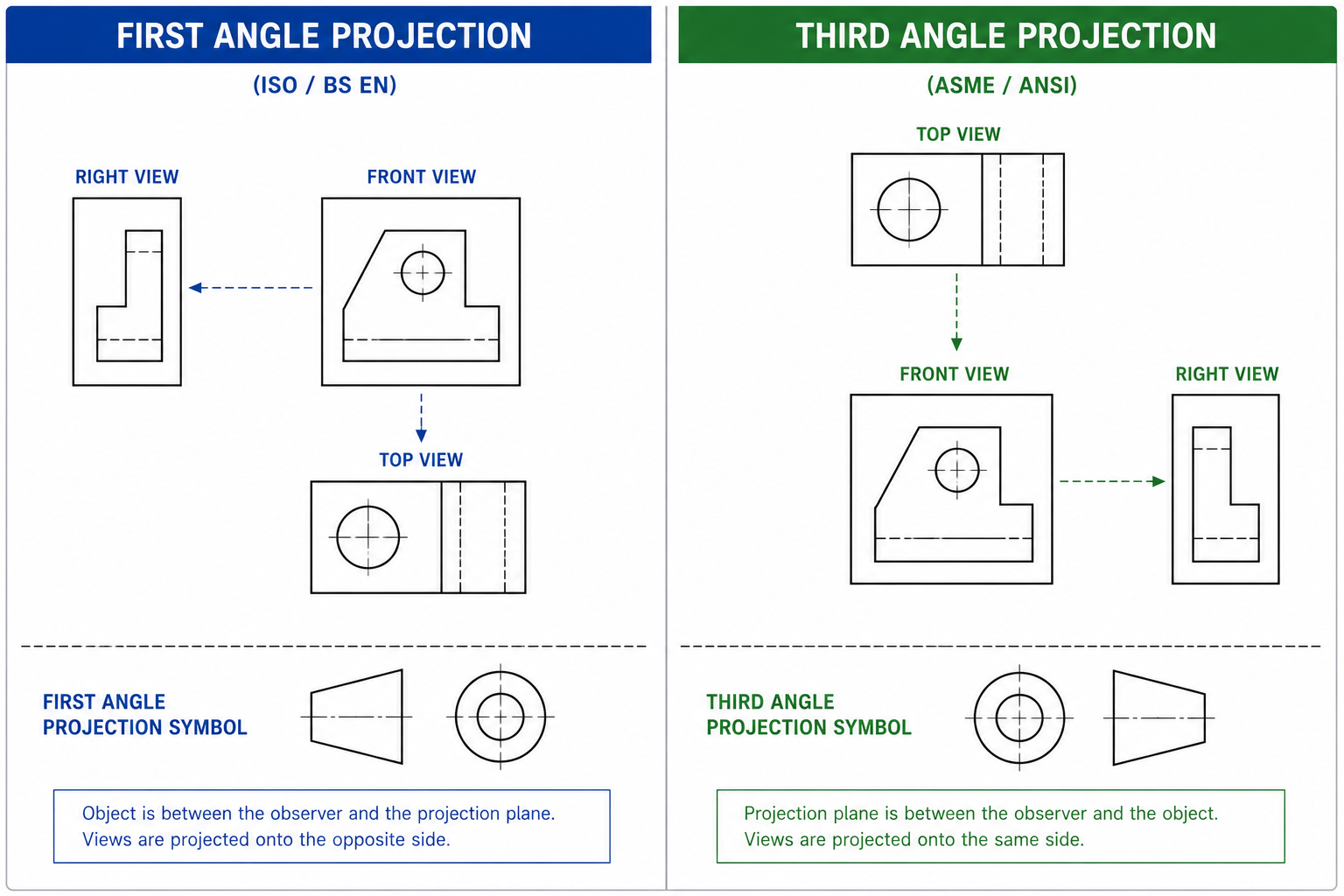
      When commissioning engineering drawings, always specify which standard you require. A drawing produced to ISO first-angle projection cannot be read correctly by someone trained only on ASME third-angle projection — the views appear mirrored.

      SimuTecra produces drawings to ASME, ISO, or client-specified standards. If you are not sure which applies to your project, the answer is usually determined by where the parts will be manufactured or which country the client is based in.

      What Does an Engineering Drafter Actually Do?

      The role of an engineering drafter is more than operating CAD software. A competent drafter interprets design intent from sketches, specifications, or engineer markups and translates it into precise drawings. They apply the correct dimensioning scheme, select appropriate tolerances based on fit and function requirements, add surface finish callouts, reference applicable material standards, and structure the drawing package so it can be read and used without ambiguity by the manufacturing team.

      They also manage revisions — when a design changes, the drafter updates affected drawings, increments the revision level, records the change in the revision table, and reissues the affected sheets. In a production environment, drawing control is as important as drawing quality. An outdated drawing in the hands of a machinist is a manufacturing defect waiting to happen.

      At SimuTecra, drafters work closely with engineers and clients through each revision cycle, maintaining a clear audit trail from concept through to final issued-for-construction drawings.

      Frequently Asked Questions

      QuestionAnswer
      Is engineering drafting still relevant with 3D modeling?Absolutely. 3D modeling is a powerful design tool, but a 2D drawing package remains the standard deliverable for manufacturing. Fabricators, machinists, and contractors work from 2D drawings because they define the legal specification of what is to be made. In most projects, 3D modeling and 2D drafting are used together — the model is the design environment, the drawing is the manufacturing document.
      What software do engineering drafters use?The most widely used tools are AutoCAD (2D drafting, all industries), SolidWorks (mechanical and product design), CATIA (aerospace and automotive), Autodesk Inventor (mechanical), and Revit (building and infrastructure, used alongside AutoCAD for MEP and structural work). The right tool depends on the industry and the complexity of the work.
      How long does it take to produce an engineering drawing?It depends entirely on complexity. A simple machined part detail drawing might take two to four hours. A complex assembly drawing with a full BOM could take two days. A full drawing package for a structural steel frame or a process plant module could take several weeks. The most reliable way to estimate is to share your scope with a drafting partner and request a breakdown.
      What industries use engineering drafting?Engineering drafting is used in virtually every industry that involves physical construction or manufacturing: mechanical and product engineering, civil and structural engineering, architecture, oil and gas, mining, aerospace, automotive, marine, HVAC and building services, electronics manufacturing, and more. The specific drawing types and standards vary by industry, but the underlying discipline is the same.
      What is the difference between a blueprint and an engineering drawing?Technically, ‘blueprint’ refers to an older reproduction process that produced white lines on a blue background. The term has stuck as a colloquial term for any engineering drawing, even though modern drawings are produced digitally and printed on white paper. In professional practice, ‘engineering drawing’ or ‘technical drawing’ is the correct term.

      The Bottom Line

      Engineering drafting is one of the oldest and most essential disciplines in engineering — and despite decades of technological change, its core purpose has not shifted: to communicate design intent precisely enough that anyone with the relevant skill can build the thing correctly, first time.

      Whether you are a project manager reviewing a drawing package, a business owner commissioning fabrication work, or an engineer looking to understand what your drafting team actually produces, the fundamentals covered in this guide give you the foundation to engage with technical drawings with confidence.

      The next step is learning how to read what is on them — which is exactly what the next article in this series covers.

      Need Engineering Drawings You Can Actually Build From?

      SimuTecra produces 2D drafting packages and 3D CAD models for manufacturing, fabrication, and construction clients worldwide. Every drawing is produced to your specified standard — ASME, ISO, or client-specific — and reviewed for accuracy before delivery.

      Send us your project details and get a clear scope and quote — no obligation.

    3. Claude Prompts for Engineers: 20 Ready-to-Use Prompts for CAD, Design, and Manufacturing

      Claude Prompts for Engineers: 20 Ready-to-Use Prompts for CAD, Design, and Manufacturing

      Engineers are not short of things to do. Documentation, drawing reviews, specification writing, supplier communication, tolerance analysis, DFM checks — the work that surrounds the actual engineering is substantial, and most of it follows repeatable patterns. Claude prompts for engineers handles repeatable patterns well.

      This is a working reference guide: 20 prompts across five categories, each one built for a specific engineering task. They are written to be used directly — copy, adapt to your context, and go. The goal is to save you time on the surrounding work so you can spend it on the engineering that actually requires your expertise.

      How to Get the Most Out of These Claude Prompts for Engineers

      Claude’s output quality scales directly with the context you give it. Every prompt below includes placeholder brackets — fill these with your actual project details before sending. A prompt with specifics gets a specific, usable answer. A vague prompt gets a generic one.

      A few principles that apply across all of these:

      • Tell Claude your role and context upfront. ‘I am a mechanical engineer reviewing a supplier’s drawing package for a precision machined housing’ gives Claude a framework it uses throughout the conversation.
      • Iterate. The first response is a starting point, not a final output. Push back, ask for more depth on a specific section, ask it to rewrite something in a different format.
      • Use Claude’s output as a first draft. Everything it produces — specifications, checklists, documentation — should be reviewed by a qualified engineer before it is used in production. Claude accelerates the writing; the engineering judgment is still yours.
      Claude engineering prompt categories | AI prompts CAD manufacturing | engineering AI use cases

      Category 1: Drawing Review and Documentation

      Drawing review and documentation are among the highest-value areas for Claude in an engineering context. The work is structured, the requirements are well-defined, and the output — checklists, review notes, revision summaries — is exactly the kind of writing Claude does well.

      Prompt 1 — Drawing Review Checklist

      DRAWING & DOCUMENTATION
      Generate a drawing review checklist
      I am reviewing a [2D detail drawing / assembly drawing / general arrangement drawing] for a [describe the part or assembly — e.g. ‘precision machined aluminium housing for an industrial pump’]. The drawing was produced to [ASME Y14.5 / ISO 128] standards.Generate a structured review checklist covering:1. Title block completeness2. View and projection correctness3. Dimensioning completeness and correctness4. Tolerance specification (GD&T and general)5. Material and surface finish callouts6. Notes and special requirements7. Drawing standard complianceFormat as a checklist I can work through during the review.

      Prompt 2 — Revision Description

      DRAWING & DOCUMENTATION
      Write a drawing revision description
      I need to write a revision description for an engineering drawing. The revision number is [e.g. Rev C]. The changes made from the previous revision are:[List the changes — e.g. ‘Added 2x M6 tapped holes on the top face, increased wall thickness from 4mm to 6mm on the side flanges, updated surface finish callout from Ra 3.2 to Ra 1.6 on the bore’]Write a concise, professional revision description suitable for the drawing title block revision history table. Maximum 3 sentences.

      Prompt 3 — Drawing Notes Section

      DRAWING & DOCUMENTATION
      Draft a general notes section
      I need to write the general notes section for a manufacturing drawing for a [describe the part — material, manufacturing method, any special requirements].Draft a complete general notes section covering:- Applicable drawing standard- Default tolerances for dimensions without explicit callouts- Surface finish unless otherwise specified- Material and heat treatment- Any special manufacturing or inspection requirements- Deburring and edge break requirementsUse professional engineering drawing language.

      Prompt 4 — Bill of Materials

      DRAWING & DOCUMENTATION
      Structure a Bill of Materials
      I need to create a Bill of Materials for an assembly. The assembly consists of:[List each component: description, quantity, material or part number if known — e.g. ‘1x aluminium housing (custom machined), 4x M8x25 cap head screws (ISO 4762), 2x lip seals (NBR, 25mm bore)’]Format this as a structured BOM table with columns for: Item No., Description, Quantity, Part Number / Standard Reference, Material, Notes. Flag any items where I have not provided enough information.

      Category 2: Design Review and DFM

      Design for Manufacturability (DFM) reviews and design checks are time-consuming when done from scratch. Claude helps you structure the review, generate the right questions, and document findings consistently.

      Prompt 5 — DFM Review

      DESIGN REVIEW & DFM
      Run a Design for Manufacturability check
      I need to conduct a DFM review on a [describe the part: geometry, material, manufacturing method — e.g. ‘injection moulded ABS housing with snap-fit clips and external ribbing’]. The part will be manufactured by [describe the process and any constraints — e.g. ‘a Tier 2 injection moulding supplier, target unit cost under £3 at 10,000 units per year’].Review the following DFM considerations and flag any potential issues:1. Wall thickness uniformity2. Draft angles3. Undercuts and mould release4. Gate location and sink mark risk5. Tolerance achievability for the process6. Feature accessibility for tooling7. Part consolidation opportunitiesI will provide additional geometry details as needed.

      Prompt 6 — Tolerance Stack-Up Explanation

      DESIGN REVIEW & DFM
      Explain a tolerance stack-up scenario
      I have a tolerance stack-up question. In my assembly:[Describe the assembly and the dimensional chain — e.g. ‘Part A has a length of 50mm ±0.1mm. Part B has a bore depth of 52mm ±0.15mm. These parts must interface so that Part A sits 2mm below the face of Part B with a tolerance of ±0.05mm’]Please:1. Explain whether the stated tolerances are compatible with the assembly requirement2. Show the worst-case tolerance calculation3. Identify which tolerances are driving the stack and which have the most room to relax4. Suggest options if the stack does not close

      Prompt 7 — Material Selection Comparison

      DESIGN REVIEW & DFM
      Compare material options for a specific application
      I am selecting a material for a [describe the part and its application — e.g. ‘bracket that will be exposed to outdoor weather, moderate mechanical load from vibration, needs to be painted, manufactured by laser cutting and bending’].Please compare the following materials for this application: [list your candidate materials — e.g. ‘mild steel (S275), 316 stainless steel, 6082-T6 aluminium’]Compare on: strength-to-weight, corrosion resistance, machinability/formability, relative material cost, weldability, and suitability for the manufacturing method. Recommend the best option and explain the tradeoffs.

      Prompt 8 — Design Change Impact Assessment

      DESIGN REVIEW & DFM
      Assess the impact of a proposed design change
      I am considering a design change on an existing part. The current design is [describe briefly]. The proposed change is [describe the change — e.g. ‘increasing the wall thickness from 3mm to 5mm on one face to improve stiffness under bending load’].Please assess the likely impact of this change on:1. Part mass2. Manufacturing cost (machining time, material use)3. Lead time4. Any adjacent features or assembly interfaces that may be affected5. Whether the change is likely to require a drawing revision or a full re-qualificationFlag any downstream effects I may not have considered.

      Category 3: Specification and Technical Writing

      Engineering specifications, inspection plans, test procedures, and technical reports follow consistent structures. Claude drafts these faster than starting from a blank page — and with the right prompt, the structure it produces is close to what you would write yourself.

      Prompt 9 — Incoming Inspection Plan

      SPECIFICATION WRITING
      Draft an incoming inspection plan
      I need to create an incoming inspection plan for a purchased component. The component is: [describe — material, dimensions, manufacturing method, critical features].The key quality requirements are: [list — e.g. ‘bolt hole position within 0.3mm, surface finish Ra 1.6 on sealing face, hardness 200-240 HB, no visible porosity on machined surfaces’].Draft an inspection plan with:- Inspection scope (100% or sample-based, with rationale)- Measurement method for each characteristic- Acceptance criteria- Non-conformance disposition instructionsFormat as a table I can use directly.

      Prompt 10 — Technical Specification Document

      SPECIFICATION WRITING
      Write a part or assembly specification
      I need to write a technical specification document for [describe the part or assembly]. This specification will be used by [describe the audience — supplier, internal manufacturing team, QA department].The specification must cover:[List the key requirements — dimensions, material, surface treatment, functional performance requirements, applicable standards, test requirements]Structure the document with: Scope, References, Material Requirements, Dimensional Requirements, Surface and Finish Requirements, Functional Requirements, Inspection and Test Requirements, Packaging and Marking.Write in formal technical language appropriate for a supplier-facing document.

      Prompt 11 — Engineering Change Notice

      SPECIFICATION WRITING
      Draft an Engineering Change Notice (ECN)
      I need to draft an Engineering Change Notice for the following change:- Part / Assembly affected: [name and number]- Drawing revision: from [Rev X] to [Rev Y]- Description of change: [describe what changed and why]- Reason for change: [technical issue, cost reduction, supplier change, customer requirement, etc.]- Effectivity: [when the change takes effect — e.g. ‘from serial number 1247’, ‘from batch date 01/06/2025’, ‘immediate’]- Impact on existing stock / WIP: [describe]Draft a complete ECN document in a format suitable for internal engineering records and supplier notification.
      Claude AI engineering documentation | AI specification writing engineer | Claude prompts technical writing

      Category 4: Supplier and Procurement Communication

      Supplier communication eats engineering time. RFQ preparation, technical queries, non-conformance documentation, and supplier evaluation all involve structured writing that follows established patterns. These prompts handle the structure so you can focus on the content.

      Prompt 12 — RFQ Technical Package

      SUPPLIER & PROCUREMENT
      Draft the technical section of an RFQ
      I am preparing a Request for Quotation for the manufacture of [describe the part — quantity, material, manufacturing method, key specifications].Draft the technical requirements section of the RFQ, covering:1. Part description and function2. Material specification and certification requirements3. Manufacturing process requirements4. Quality and inspection requirements5. Drawing and document requirements (what the supplier must confirm they have reviewed)6. Packaging and delivery requirements7. Supplier qualification requirementsWrite in formal, supplier-facing language.

      Prompt 13 — Non-Conformance Report

      SUPPLIER & PROCUREMENT
      Draft a supplier non-conformance report
      I need to raise a non-conformance report against a supplier. The details are:- Supplier name: [name]- Part: [part name and number]- Batch / delivery reference: [reference]- Nature of non-conformance: [describe what is wrong — e.g. ‘bore diameter measured at 24.85mm against a drawing requirement of 25.00 +0.00/-0.05mm on 6 of 20 parts inspected’]- Discovery point: [incoming inspection / during assembly / in field]- Disposition of affected parts: [return to supplier / scrap / use as-is with deviation / rework]Draft a formal NCR document requesting a corrective action response within [timeframe].

      Prompt 14 — Supplier Technical Query Response

      SUPPLIER & PROCUREMENT
      Draft a response to a supplier technical query
      A supplier has raised the following technical query on our drawing: [paste or describe the supplier’s query exactly].The correct technical answer is: [describe what the answer is — even if you are not sure how to phrase it formally].Draft a formal written response to the supplier that:1. Acknowledges their query clearly2. Provides the technical clarification3. Confirms whether a drawing revision is required or whether this is a clarification only4. States any action required from the supplier before proceeding

      Category 5: Technical Communication and Reporting

      Engineering findings, project updates, and technical reports are often written under time pressure and read by audiences with varying levels of technical background. These prompts help you communicate findings clearly without spending hours on the writing.

      Prompt 15 — Engineering Summary for a Non-Technical Audience

      TECHNICAL COMMUNICATION
      Translate engineering findings for a non-technical audience
      I need to explain the following engineering finding to a non-technical audience [e.g. senior management, a client, a procurement team]:[Describe the finding in technical terms — e.g. ‘FEA results show that the current bracket design experiences peak von Mises stress of 287 MPa at the fillet radius under the specified 5kN load, exceeding the yield strength of 6082-T6 aluminium at 260 MPa by 10%’]Rewrite this finding in plain language that:1. Explains what was found2. Explains why it matters (what will happen if unaddressed)3. States what the recommended action is4. Avoids engineering jargon without losing technical accuracy

      Prompt 16 — Lessons Learned Document

      TECHNICAL COMMUNICATION
      Document project lessons learned
      I need to document lessons learned from a recently completed engineering project. The project was [brief description]. Key issues that arose were:[List the issues — e.g. ‘tolerance stack-up not identified until assembly stage, causing rework on 30% of first-article parts; supplier changed material grade without notification; drawing revision control not enforced, resulting in manufacturer working from an outdated revision’]For each lesson, structure the entry as:- What happened- Root cause- Impact- Corrective action taken- Process change for future projectsWrite in a format suitable for an internal engineering knowledge base.

      Prompt 17 — Design Review Meeting Agenda

      TECHNICAL COMMUNICATION
      Draft a design review meeting agenda
      I am running a [Preliminary Design Review / Critical Design Review / Drawing Review] for [describe the project or product]. The review will be attended by [list attendees and their roles — e.g. ‘lead mechanical engineer, manufacturing engineer, QA manager, project manager, supplier representative’].Key topics to cover include: [list the main items — e.g. ‘design concept confirmation, material selection rationale, tolerance review, supplier capability assessment, outstanding design actions, timeline to first article’]Draft a structured agenda with time allocations, objectives for each agenda item, and a list of pre-read documents attendees should review before the meeting.

      Prompt 18 — Root Cause Analysis Framework

      TECHNICAL COMMUNICATION
      Structure a root cause analysis
      I need to conduct a root cause analysis for the following problem: [describe the problem clearly — what happened, when, on what product or process, and what the impact was].Please structure a 5-Why analysis for this problem, starting from the observable symptom and working back to the root cause. For each ‘Why’, provide the most likely answer based on the information I have given you, and flag where I need to gather additional data before the analysis can proceed with confidence.At the end, suggest a corrective action targeted at the root cause rather than the symptom.

      Prompt 19 — Progress Report to Client

      TECHNICAL COMMUNICATION
      Write a project progress report
      I need to write a progress report for a client on an engineering project. The project is [brief description]. This report covers [time period].Progress this period:[List what has been completed]Current status:[Describe where the project stands — on schedule / delayed / ahead]Issues and risks:[List any issues or risks and what is being done about them]Next steps:[List what will be completed in the next period]Write a concise, professional progress report suitable for sending directly to the client. Positive but honest in tone. No jargon.

      Prompt 20 — Technical Handover Document

      TECHNICAL COMMUNICATION
      Draft a design handover document
      I need to document a design handover for [describe the project — part, assembly, or system being handed over]. The handover is from [design team / CAD engineer / project engineer] to [manufacturing team / new engineer / client / supplier].The document should cover:1. Design overview and intent2. Key design decisions and their rationale3. Known constraints and limitations4. Critical features and why they are critical5. Outstanding actions or unresolved issues6. Document register (drawings, specifications, analysis reports)7. Contact information for technical queriesWrite in a format that a new team member with engineering background but no prior knowledge of this project can follow.

      The Bottom Line

      These 20 prompts cover the recurring writing and documentation tasks that surround engineering work — the ones that take time without requiring the engineering judgment that is actually your competitive advantage. Claude handles the structure; you supply the context and the technical calls.

      The best way to use this guide is not to work through it sequentially, but to bookmark it and come back to the relevant section when the task arises. The prompts will save you time most consistently when you use them as starting points for an ongoing conversation rather than one-shot generators — iterate, push back, and ask Claude to refine until the output is exactly what you need.

      When Claude Helps You Think — SimuTecra Handles the Execution

      Claude helps you think through problems, structure requirements, and make better decisions. SimuTecra’s engineering team handles the CAD drafting, 3D modeling, and structural analysis that turns those decisions into production-ready deliverables. Use the prompts in this guide to develop your brief — then send it to us.Tell us what you are building and we will take it from there.

    4. 2D vs 3D CAD Drafting: What’s the Difference and When to Use Each

      2D vs 3D CAD Drafting: What’s the Difference and When to Use Each

      2D vs 3D CAD drafting! A supplier just asked you to send over ‘the CAD files’ — and you’re not sure whether to hand them a 2D drawing package or a full 3D model. Get it wrong and you’re looking at delays, rework, and a bill for work you didn’t need.

      This is one of the most common points of confusion in engineering projects, especially for teams that work with outsourced design partners or are newer to commissioning technical drawings. The truth is that 2D and 3D CAD are not competing approaches — they solve different problems at different stages of a project. Knowing which one you need, and when, saves time and money.

      This guide breaks down the practical differences between 2D CAD drafting and 3D CAD modeling, explains the strengths of each, and gives you a clear framework for choosing the right approach on your next project.

      What Is 2D CAD Drafting?

      2D CAD drafting is the process of creating flat, precise technical drawings that communicate the geometry, dimensions, tolerances, and specifications of a part, structure, or system. Rather than showing an object as it looks in the real world, a 2D drawing presents multiple standardised views — typically a front view, a top view, and one or more side views — using a technique called orthographic projection.

      Think of it as a highly structured set of instructions. A machinist reading a 2D drawing knows the exact diameter of every hole, the tolerance on every dimension, the surface finish required on a mating face, and the material the part should be made from. Everything is defined — nothing is left to interpretation.

      2D CAD Drafting by Simutecra

      The dominant tool for 2D drafting is AutoCAD, developed by Autodesk and widely used across architecture, civil engineering, and manufacturing. Other commonly used platforms include DraftSight and BricsCAD. Drawings are typically delivered as DWG or DXF files, or as locked PDFs for review and approval.

      What a 2D Drawing Includes

      • Multiple orthographic views of the part (front, top, side, section views)
      • Fully annotated dimensions and tolerances
      • Material specification and surface finish callouts
      • GD&T symbols where geometric controls are required
      • A title block with part number, revision level, scale, and drafter information
      • A bill of materials (BOM) for assembly drawings

      2D drawings remain the universal language of manufacturing. Even when a 3D model is used during the design phase, a 2D drawing package is almost always required before a part goes into production — because it defines the legal and contractual specification of what is to be made.

      What Is 3D CAD Modeling?

      3D CAD modeling creates a digital solid or surface representation of a part or assembly in three dimensions. Rather than describing a shape through projected views, a 3D model IS the shape — a virtual object that can be rotated, measured, assembled with other parts, and analysed for stress, heat, or fluid flow.

      Most professional 3D CAD tools are parametric, which means every feature of the model is driven by dimensions and relationships rather than fixed geometry. Change the diameter of a shaft in SolidWorks, and every downstream feature — the shoulder, the thread, the associated drawings — updates automatically. This makes 3D modeling particularly powerful during the design and development phase, where changes are frequent.

      3D CAD Modeling by Simutecra

      The most widely used 3D CAD platforms include SolidWorks and Autodesk Inventor for mechanical and product design, CATIA for aerospace and automotive applications, and Fusion 360 for smaller teams and startups. Files are typically shared in STEP or IGES format for interoperability, or in native formats such as .sldprt (SolidWorks) and .ipt (Inventor) when working within the same software environment.

      What a 3D Model Enables

      • Full visualisation and rotation before anything is physically made
      • Automatic generation of 2D drawings from the 3D geometry
      • Assembly modeling — checking how parts fit together and detecting clashes
      • Finite Element Analysis (FEA) for structural stress and deflection testing
      • Computational Fluid Dynamics (CFD) for airflow and thermal analysis
      • Integration with BIM platforms for coordination on construction projects
      • Direct export to 3D printing (STL format) or CNC toolpath generation

      3D modeling shifts a significant amount of problem-solving earlier in the process. Issues that would previously surface on the shop floor — two pipes clashing inside a wall, a bracket that doesn’t have enough clearance for a fastener — are caught on-screen instead. That upstream investment typically pays for itself.

      2D vs 3D CAD Drafting: Key Differences at a Glance

      The table below summarises the most practically relevant differences between the two approaches. Keep this as a reference when briefing your design team or outsourcing partner on what deliverables you need.

      Feature2D CAD Drafting3D CAD Modeling
      OutputFlat technical drawings (orthographic views)Digital solid/surface model + auto-generated drawings
      DimensionalityLength and width (X, Y axes)Length, width, and depth (X, Y, Z axes)
      Primary toolsAutoCAD, DraftSight, BricsCADSolidWorks, Fusion 360, CATIA, Inventor
      File outputsDWG, DXF, PDFSTEP, IGES, native formats (.sldprt, .ipt)
      Best forShop drawings, permits, simple part fabricationNew product development, assemblies, FEA, visualisation
      ComplexityFaster for straightforward geometryBetter for complex, interdependent parts
      Cost to produceLower — fewer hours for standard partsHigher upfront; saves time in revisions and prototyping
      EditabilityManual updates to each viewChange one parameter; all views update automatically

      Important: these two approaches are not mutually exclusive. In most professional engineering workflows, a project begins in 3D and ends with 2D. The 3D model is the design tool; the 2D drawing package is the manufacturing deliverable.

      A Real-World Example: Designing a Custom Mounting Bracket

      A structural fabrication company needs to design a custom steel bracket for mounting industrial HVAC units to a rooftop frame. Here is how both approaches play out on the same project:

      Using 2D drafting only: The drafter produces a set of orthographic drawings showing the bracket geometry, hole positions, weld locations, and material callout (e.g. 50x50x5 RHS, Grade 350 steel). The fabricator quotes and builds directly from those drawings. This works perfectly well — the bracket is straightforward, the geometry is easy to convey in flat views, and the drawings take half a day to produce.

      Using 3D modeling first: For a complex variant of the same job — say, a bespoke bracket that interfaces with three different beam profiles and needs to accommodate variable HVAC unit sizes — the engineer builds a parametric 3D model first. The model allows the team to test fit across all configurations before committing, check that nothing clashes with the rooftop drainage, and automatically generate the 2D drawings for each bracket variant. What would have taken multiple drawing revisions is resolved in the model.

      The simple bracket warrants 2D. The complex multi-variant bracket warrants 3D. Same industry, same client, different choice — made based on geometry complexity and the cost of getting it wrong.

      When to Use 2D Drafting vs 3D Modeling: A Practical Decision Guide

      Choose 2D CAD Drafting When:

      • The geometry is straightforward. Parts with simple, well-understood shapes — flat plates, standard brackets, sheet metal panels — are faster and cheaper to document in 2D.
      • You are producing fabrication or shop drawings. The end deliverable for a fabricator, welder, or machinist is almost always a 2D drawing package. Even if you modelled in 3D, you will produce 2D drawings for manufacturing.
      • You need construction or permit drawings. Architectural and civil permit submissions, site plans, structural general arrangement drawings, and MEP coordination drawings are typically 2D.
      • You are updating legacy documentation. Existing drawing sets from older projects are in 2D. If you are revising rather than redesigning, maintaining the existing format is more efficient.
      • Speed and cost are the priority. For a single, clearly defined part with no complex interfaces, 2D is quicker to produce and cheaper to commission.

      Choose 3D CAD Modeling When:

      • You are developing a new product or assembly. When the design intent is not yet fully resolved, 3D lets you explore, test, and iterate far more efficiently than redrawing views manually.
      • Multiple parts need to fit together. 3D assembly modeling allows you to check every interface before anything is made. Clash detection on-screen is dramatically cheaper than discovering a fit problem after fabrication.
      • You need to run simulation or analysis. FEA for structural loads, CFD for airflow, thermal analysis — all of these require a 3D model. You cannot run meaningful simulation on a 2D drawing.
      • Your client needs to visualise the design. 3D renders and walkthroughs are far more effective communication tools than orthographic views for non-technical stakeholders, clients, and approval bodies.
      • The design will change. Parametric 3D models update automatically when dimensions change. If you anticipate multiple iterations, the upfront investment in a 3D model pays back quickly in time saved on revisions.

      Can You Use Both on the Same Project?

      Absolutely — and in most professional engineering environments, that is exactly what happens. The 3D model is produced first as the design tool. Once the design is locked, 2D drawings are generated directly from the model, complete with dimensions, tolerances, and annotations. The 2D drawing becomes the manufacturing and contractual document; the 3D model is the source of truth for geometry.

      This workflow eliminates a significant source of error: the mismatch between a manually drawn 2D document and the actual intended 3D geometry. When drawings are derived from a 3D model, they are always geometrically consistent.

      Frequently Asked Questions

      QuestionAnswer
      Is 3D CAD always better than 2D?Not at all. 3D is more powerful for complex design work, but 2D is faster and more cost-effective for simple parts, standard fabrication drawings, and permit submissions. The right choice depends entirely on the project requirements.
      Can a 3D model replace a 2D drawing for manufacturing?In some advanced manufacturing environments using Model-Based Definition (MBD), yes — all specifications are embedded directly in the 3D model. But the vast majority of fabricators, machinists, and contractors still work from 2D drawings. Until MBD is universally adopted, a 2D drawing package remains the standard manufacturing deliverable.
      What software produces both 2D drawings and 3D models?Most professional CAD platforms do both. SolidWorks, Inventor, CATIA, and Fusion 360 all allow you to create a 3D model and then generate fully annotated 2D drawings from it within the same environment. AutoCAD has 3D capabilities but is primarily used for 2D drafting.
      How do I know which format to request from my CAD provider?For manufacturing: request a 2D drawing package (PDF + DWG/DXF). For design review or simulation: request a 3D model in STEP format, which is readable by all major CAD platforms. For 3D printing: request an STL file. When in doubt, ask your provider — a good engineering partner will recommend the right format for your workflow.

      The Bottom Line

      2D and 3D CAD are not rivals — they are tools designed for different jobs. 2D drafting is the language of manufacturing: precise, standardised, and universally understood on the shop floor. 3D modeling is the language of design: powerful for exploring complex geometry, catching fit issues early, and communicating ideas to stakeholders.

      Most engineering projects benefit from both. The key is knowing at which stage to use each — and working with a drafting partner who can deliver the right format for where your project actually is.

    5. From Concept to Reality: The Complete Product Design Workflow

      From Concept to Reality: The Complete Product Design Workflow

      Introduction: The Journey from Idea to Market

      Product design is a complex journey that requires careful planning, iterative refinement, and seamless collaboration between multiple disciplines. Our comprehensive workflow ensures that every project moves efficiently from initial concept to market-ready product while maintaining the highest standards of quality, functionality, and manufacturability.

      In this detailed guide, we’ll walk you through our proven seven-phase methodology that has helped hundreds of clients successfully bring innovative products to market. Whether you’re developing a simple consumer product or a complex industrial system, this framework provides the structure and discipline needed for successful product development.

      Phase 1: Discovery and Requirements Definition

      Every successful product begins with a thorough understanding of the problem it’s designed to solve and the context in which it will operate. The discovery phase establishes the foundation for all subsequent design decisions.

      Market Research and User Analysis

      Understanding your target market and users is crucial for developing products that will succeed in the marketplace.

      Key Research Activities:

      • User Interviews: Direct conversations with potential users to understand needs, frustrations, and workflows
      • Competitive Analysis: Evaluation of existing solutions, their strengths, weaknesses, and market positioning
      • Market Sizing: Assessment of market opportunity and potential customer segments
      • Technology Trends: Understanding of relevant technological developments and future directions
      • Regulatory Landscape: Identification of applicable standards, certifications, and compliance requirements

      Requirements Gathering and Prioritization

      Clear, well-prioritized requirements are essential for focused design efforts and successful project outcomes.

      Requirement Categories:

      • Functional Requirements: What the product must do
      • Performance Requirements: How well it must perform
      • Design Constraints: Limitations on size, weight, cost, materials, etc.
      • User Experience Requirements: Ease of use, accessibility, and aesthetic considerations
      • Manufacturing Requirements: Production volume, cost targets, and manufacturing constraints
      • Compliance Requirements: Safety, environmental, and regulatory standards

      Stakeholder Alignment

      Ensuring all stakeholders share a common understanding of project goals and constraints prevents costly misalignments later in the process.

      Stakeholder Alignment Activities:

      • Requirements review and sign-off
      • Success criteria definition
      • Risk assessment and mitigation planning
      • Resource and timeline planning
      • Communication protocols establishment

      Phase 2: Concept Development and Ideation

      With a solid understanding of requirements and constraints, the concept development phase focuses on generating and evaluating potential solutions.

      Ideation Techniques

      Effective ideation requires structured approaches that encourage creative thinking while maintaining focus on user needs and technical feasibility.

      Proven Ideation Methods:

      • Brainstorming Sessions: Structured group creativity sessions with diverse perspectives
      • Mind Mapping: Visual exploration of concept relationships and dependencies
      • SCAMPER Technique: Systematic approach to modifying and improving existing solutions
      • Biomimicry: Learning from natural systems and processes
      • Cross-Industry Analysis: Adapting solutions from other industries and applications

      Concept Evaluation and Selection

      Systematic evaluation ensures that the most promising concepts advance to detailed development.

      Evaluation Criteria:

      • Technical Feasibility: Can it be built with available technology and resources?
      • Market Viability: Will customers want it and pay for it?
      • Manufacturing Feasibility: Can it be produced at target cost and volume?
      • Competitive Advantage: Does it offer meaningful differentiation?
      • Risk Assessment: What are the technical, market, and business risks?
      • Resource Requirements: Development time, cost, and expertise needed

      Concept Visualization

      Clear visualization helps stakeholders understand and evaluate concepts effectively.

      Visualization Tools:

      • Sketches and renderings
      • Concept models and mockups
      • Storyboards and use case scenarios
      • Technical architecture diagrams
      • Functional block diagrams

      Phase 3: Detailed Design and Engineering

      The detailed design phase transforms selected concepts into fully specified products ready for manufacturing.

      Design for Manufacturing (DFM)

      Incorporating manufacturing considerations early in the design process prevents costly redesigns and ensures producibility.

      DFM Principles:

      • Material Selection: Choosing materials that balance performance, cost, and manufacturability
      • Process Optimization: Designing parts for efficient manufacturing processes
      • Tolerance Analysis: Ensuring parts fit and function properly when manufactured
      • Assembly Design: Simplifying assembly processes and reducing labor costs
      • Quality Considerations: Designing features that facilitate inspection and quality control

      3D Modeling and Documentation

      Precise 3D models and comprehensive documentation ensure accurate communication of design intent.

      Modeling Best Practices:

      • Parametric modeling for design flexibility
      • Feature-based modeling for design intent capture
      • Assembly modeling for fit and function verification
      • Configuration management for design variants
      • Standard modeling practices for team consistency

      Documentation Requirements:

      • Detailed drawings with dimensions and tolerances
      • Material specifications and finish requirements
      • Assembly instructions and procedures
      • Quality requirements and inspection criteria
      • Packaging and shipping specifications

      Engineering Analysis and Validation

      Comprehensive analysis ensures that designs meet all performance requirements before physical testing.

      Analysis Types:

      • Structural Analysis: Stress, deflection, and failure prediction
      • Thermal Analysis: Heat transfer and temperature distribution
      • Fluid Analysis: Flow patterns and pressure distributions
      • Modal Analysis: Vibration characteristics and resonance avoidance
      • Fatigue Analysis: Long-term durability under cyclic loading

      Phase 4: Prototyping and Testing

      Prototyping validates design concepts, verifies performance, and identifies issues that require resolution before production.

      Prototyping Strategy

      Effective prototyping requires a strategic approach that balances cost, time, and validation objectives.

      Prototype Types:

      • Concept Prototypes: Early models to verify basic functionality and user interaction
      • Form Prototypes: Appearance models for aesthetic evaluation and user feedback
      • Functional Prototypes: Working models that demonstrate key features and performance
      • Production Prototypes: Parts made using production processes and materials
      • Pilot Production: Small-scale production runs to validate manufacturing processes

      Rapid Prototyping Technologies

      Modern prototyping technologies enable faster iteration and more comprehensive testing.

      Prototyping Methods:

      • 3D Printing: Fast, flexible prototyping for complex geometries
      • CNC Machining: High-precision prototypes in production materials
      • Injection Molding: Low-volume tooling for production-like parts
      • Sheet Metal Fabrication: Rapid prototyping of metal components
      • Electronic Prototyping: Breadboarding and PCB prototyping for electronic systems

      Testing and Validation

      Comprehensive testing ensures that products meet all requirements and perform reliably in real-world conditions.

      Testing Categories:

      • Functional Testing: Verification that all features work as intended
      • Performance Testing: Measurement of key performance parameters
      • Environmental Testing: Performance under various environmental conditions
      • Durability Testing: Long-term reliability and wear characteristics
      • Safety Testing: Compliance with relevant safety standards
      • User Testing: Real-world usability and user experience validation

      Phase 5: Design Optimization and Refinement

      Based on testing results and stakeholder feedback, designs are refined and optimized for final production.

      Performance Optimization

      Systematic optimization ensures that products achieve the best possible performance within cost and manufacturing constraints.

      Optimization Approaches:

      • Parametric Optimization: Fine-tuning design parameters for optimal performance
      • Material Optimization: Selecting the best materials for each application
      • Geometric Optimization: Refining shapes and features for improved function
      • Weight Optimization: Minimizing weight while maintaining performance
      • Cost Optimization: Reducing costs through design and process improvements

      Design for Assembly (DFA)

      Optimizing assembly processes reduces manufacturing costs and improves product quality.

      DFA Principles:

      • Minimize the number of parts and fasteners
      • Design for single-direction assembly
      • Eliminate or simplify adjustments
      • Use self-aligning and self-locating features
      • Design for automated assembly when appropriate

      Quality and Reliability Engineering

      Building quality and reliability into the design prevents field failures and reduces warranty costs.

      Quality Engineering Techniques:

      • Failure Mode and Effects Analysis (FMEA): Systematic identification of potential failures
      • Design of Experiments (DOE): Optimization of multiple design variables simultaneously
      • Statistical Tolerance Analysis: Ensuring robust performance despite manufacturing variations
      • Reliability Prediction: Estimating product life and maintenance requirements
      • Design Reviews: Cross-functional evaluation of design quality and completeness

      Phase 6: Production Planning and Implementation

      Successful product launch requires careful planning and coordination of manufacturing, supply chain, and quality systems.

      Manufacturing Process Development

      Developing robust manufacturing processes ensures consistent quality and efficient production.

      Process Development Activities:

      • Process Selection: Choosing optimal manufacturing processes for each component
      • Tooling Design: Developing jigs, fixtures, and production tooling
      • Process Optimization: Fine-tuning processes for quality and efficiency
      • Quality Planning: Developing inspection and quality control procedures
      • Operator Training: Ensuring production teams understand processes and requirements

      Supply Chain Development

      Reliable supply chains are essential for successful product launches and ongoing production.

      Supply Chain Considerations:

      • Supplier Selection: Evaluating and qualifying component suppliers
      • Supply Chain Risk Management: Identifying and mitigating supply chain risks
      • Inventory Management: Balancing inventory costs with production flexibility
      • Logistics Planning: Optimizing transportation and distribution
      • Supplier Relationships: Building long-term partnerships for continuous improvement

      Quality Systems Implementation

      Robust quality systems ensure that products consistently meet specifications and customer expectations.

      Quality System Elements:

      • Quality planning and control procedures
      • Inspection and testing protocols
      • Statistical process control systems
      • Nonconforming material procedures
      • Continuous improvement processes

      Phase 7: Launch and Post-Launch Support

      Product launch is just the beginning of the product lifecycle. Ongoing support ensures customer satisfaction and provides insights for future improvements.

      Product Launch Planning

      Successful launches require coordination across multiple functions and careful attention to customer needs.

      Launch Activities:

      • Production Ramp-up: Gradually increasing production to full capacity
      • Quality Monitoring: Intensive quality oversight during early production
      • Customer Training: Ensuring customers can use products effectively
      • Technical Support: Providing responsive support for customer questions and issues
      • Marketing Support: Developing technical marketing materials and support

      Post-Launch Monitoring and Improvement

      Continuous monitoring and improvement ensure long-term product success and customer satisfaction.

      Post-Launch Activities:

      • Performance Monitoring: Tracking key performance indicators and customer feedback
      • Quality Tracking: Monitoring field performance and warranty claims
      • Cost Optimization: Ongoing efforts to reduce costs and improve margins
      • Product Updates: Implementing improvements and addressing issues
      • Next Generation Planning: Using insights to inform future product development

      Knowledge Capture and Transfer

      Capturing and sharing lessons learned improves future projects and builds organizational capabilities.

      Knowledge Management:

      • Project retrospectives and lessons learned documentation
      • Best practices capture and sharing
      • Design guideline development and updates
      • Team knowledge transfer and training
      • Organizational capability building

      Best Practices for Successful Product Development

      Cross-Functional Collaboration

      Successful product development requires seamless collaboration between engineering, manufacturing, marketing, and other functions.

      Collaboration Strategies:

      • Regular cross-functional design reviews
      • Co-located teams when possible
      • Shared project management tools and systems
      • Clear communication protocols and expectations
      • Conflict resolution procedures

      Risk Management

      Proactive risk management prevents surprises and keeps projects on track.

      Risk Management Approach:

      • Early risk identification and assessment
      • Risk mitigation planning and implementation
      • Regular risk review and updates
      • Contingency planning for critical risks
      • Risk communication and escalation procedures

      Customer Focus

      Maintaining focus on customer needs throughout the development process ensures market success.

      Customer Focus Techniques:

      • Regular customer feedback collection and analysis
      • User testing at multiple development stages
      • Customer advisory panels and beta programs
      • Voice of customer integration in design decisions
      • Customer satisfaction tracking and improvement

      Conclusion

      Successful product development requires a systematic approach that balances creativity with discipline, innovation with practicality, and speed with quality. Our seven-phase methodology provides the structure and best practices needed to navigate the complex journey from concept to market-ready product.

      The key to success lies in adapting this framework to your specific needs while maintaining focus on the fundamental principles: clear requirements, systematic design, thorough testing, and continuous improvement. By following these principles and leveraging the right expertise and tools, organizations can consistently deliver products that delight customers and succeed in the marketplace.

      At SimuTecra, we’ve refined this methodology through hundreds of successful projects across diverse industries. Our experienced team can guide you through every phase of product development, from initial concept through successful market launch. Whether you need support for a specific phase or comprehensive product development services, we’re here to help you turn your ideas into reality. Contact us today to discuss how we can accelerate your product development and ensure your success in the marketplace.

    6. Finite Element Analysis: When and Why Your Project Needs FEA

      Finite Element Analysis: When and Why Your Project Needs FEA

      Introduction: The Power of Virtual Testing

      Finite Element Analysis (FEA) has become an indispensable tool in modern engineering, allowing designers to predict how products will behave under real-world conditions before they’re manufactured. This powerful simulation technique can identify potential failures, optimize designs, and reduce development costs by minimizing the need for physical prototypes and testing.

      However, many engineers and project managers struggle with understanding when FEA is necessary, what types of analysis are available, and how to implement FEA effectively in their development process. This comprehensive guide will help you make informed decisions about incorporating FEA into your engineering projects.

      What is Finite Element Analysis?

      Finite Element Analysis is a computational method that breaks down complex structures into smaller, simpler elements to analyze their behavior under various conditions. By solving mathematical equations for each element and combining the results, FEA provides detailed insights into how structures respond to forces, heat, vibrations, and other physical phenomena.

      The FEA Process:

      1. Preprocessing: Creating the model, defining materials, and setting up boundary conditions
      2. Solving: The computer calculates the response of each element
      3. Post-processing: Visualizing and interpreting the results

      Types of FEA Analysis:

      • Structural Analysis: Stress, strain, and displacement under mechanical loads
      • Thermal Analysis: Heat transfer and temperature distribution
      • Modal Analysis: Natural frequencies and vibration modes
      • Fluid Dynamics: Fluid flow and pressure distribution
      • Fatigue Analysis: Prediction of failure under cyclic loading
      • Buckling Analysis: Stability under compressive loads

      When Your Project Needs FEA

      Critical Safety Applications

      FEA is essential when failure could result in injury, property damage, or loss of life. Industries such as aerospace, automotive, medical devices, and structural engineering rely heavily on FEA to ensure safety margins are adequate.

      Examples of Critical Applications:

      • Aircraft components subjected to extreme loads and temperatures
      • Automotive crash structures and safety systems
      • Medical implants that must withstand cyclic loading
      • Pressure vessels operating under high pressure and temperature
      • Structural elements in buildings and bridges

      High-Value Projects

      When development costs are high or failure would be extremely expensive, FEA provides valuable risk mitigation. The cost of simulation is typically a small fraction of the cost of physical testing or product failure in the field.

      Cost-Benefit Considerations:

      • Projects with expensive prototyping and testing requirements
      • Products with long development cycles where late-stage changes are costly
      • High-volume production where small improvements yield significant savings
      • Custom or one-off designs where testing isn’t practical

      Performance Optimization Requirements

      FEA excels at identifying optimization opportunities that aren’t obvious through traditional design methods. This is particularly valuable in competitive industries where performance advantages translate to market success.

      Optimization Scenarios:

      • Weight reduction while maintaining strength requirements
      • Improving thermal management in electronic devices
      • Minimizing vibration and noise in mechanical systems
      • Optimizing flow characteristics in fluid systems
      • Maximizing efficiency in rotating machinery

      Complex Loading Conditions

      When parts experience complex combinations of loads, temperatures, or environmental conditions, FEA provides insights that simple hand calculations cannot achieve.

      Complex Loading Examples:

      • Components subjected to multiple load paths simultaneously
      • Parts experiencing thermal cycling and mechanical stress
      • Structures under dynamic or impact loading
      • Systems with significant geometric nonlinearities
      • Assemblies with complex contact interactions

      Types of FEA and Their Applications

      Structural Analysis

      The most common type of FEA, structural analysis determines how parts deform and what stresses develop under mechanical loads.

      Linear Static Analysis:

      • When to Use: Small deformations, linear material behavior, steady loads
      • Applications: Basic strength verification, deflection calculations
      • Benefits: Fast computation, straightforward interpretation
      • Limitations: Cannot handle large deformations or nonlinear effects

      Nonlinear Analysis:

      • When to Use: Large deformations, material plasticity, contact problems
      • Applications: Crash analysis, forming simulations, rubber components
      • Benefits: Accurate representation of real-world behavior
      • Limitations: More complex setup, longer computation times

      Thermal Analysis

      Thermal FEA predicts temperature distributions and heat flow through structures, critical for managing thermal stresses and ensuring proper operation.

      Steady-State Thermal Analysis:

      • Applications: Electronics cooling, heat sink design, insulation effectiveness
      • Key Outputs: Temperature distribution, heat flux, thermal gradients
      • Design Insights: Hot spot identification, cooling optimization

      Transient Thermal Analysis:

      • Applications: Startup/shutdown cycles, thermal shock analysis
      • Key Outputs: Temperature vs. time, thermal cycling effects
      • Design Insights: Thermal stress development, cool-down strategies

      Modal Analysis

      Modal analysis identifies natural frequencies and mode shapes, essential for avoiding resonance problems and designing for dynamic stability.

      When Modal Analysis is Critical:

      • Rotating machinery operating near critical speeds
      • Structures subjected to dynamic loading
      • Systems requiring vibration isolation
      • Parts that must avoid specific frequency ranges

      Key Design Insights:

      • Natural frequency identification
      • Mode shape visualization
      • Damping requirements
      • Stiffness optimization strategies

      Fatigue Analysis

      Fatigue analysis predicts how long parts will last under cyclic loading, crucial for components that experience repeated stress cycles.

      Fatigue Analysis Applications:

      • Automotive suspension components
      • Aircraft structural elements
      • Rotating machinery shafts
      • Pressure vessel nozzles
      • Electronic component solder joints

      Fatigue Analysis Benefits:

      • Life prediction for maintenance scheduling
      • Identification of crack initiation sites
      • Optimization of stress concentrations
      • Material selection guidance

      Implementing FEA in Your Development Process

      Early-Stage Design Validation

      Incorporating FEA early in the design process provides maximum value by identifying issues when changes are still inexpensive to implement.

      Early-Stage FEA Benefits:

      • Concept feasibility verification
      • Material selection guidance
      • Preliminary sizing and optimization
      • Risk identification and mitigation

      Design Optimization

      FEA enables systematic design optimization that would be impractical with physical testing alone.

      Optimization Strategies:

      • Parametric Studies: Varying design parameters to understand sensitivities
      • Topology Optimization: Finding optimal material distribution
      • Shape Optimization: Refining geometry for improved performance
      • Multi-objective Optimization: Balancing competing requirements

      Virtual Testing and Validation

      FEA can supplement or replace physical testing in many scenarios, reducing development time and cost.

      Virtual Testing Advantages:

      • Test conditions that are difficult or dangerous to replicate physically
      • Evaluate multiple design variants quickly
      • Investigate failure mechanisms in detail
      • Reduce the number of physical prototypes required

      Common FEA Mistakes and How to Avoid Them

      Inadequate Model Validation

      One of the most serious mistakes is using FEA results without proper validation against known solutions or experimental data.

      Validation Best Practices:

      • Compare results to analytical solutions when available
      • Perform mesh convergence studies
      • Validate against experimental data or previous designs
      • Check results for physical reasonableness

      Poor Mesh Quality

      The finite element mesh is the foundation of any FEA simulation. Poor mesh quality leads to inaccurate results and convergence problems.

      Mesh Quality Guidelines:

      • Use appropriate element types for the physics being analyzed
      • Refine mesh in high-stress regions
      • Maintain good aspect ratios and avoid highly distorted elements
      • Perform mesh convergence studies to ensure adequate refinement

      Inappropriate Boundary Conditions

      Boundary conditions must accurately represent the real-world constraints and loading conditions.

      Boundary Condition Best Practices:

      • Carefully consider how parts are actually supported and loaded
      • Avoid over-constraining the model
      • Use appropriate load distribution methods
      • Consider thermal expansion effects in constrained systems

      Ignoring Material Nonlinearities

      Many materials exhibit nonlinear behavior, especially at high stress levels or temperatures.

      Material Modeling Considerations:

      • Use appropriate material models for the loading conditions
      • Consider temperature effects on material properties
      • Account for strain rate sensitivity when applicable
      • Validate material models against test data

      Building FEA Capabilities

      In-House vs. Outsourced FEA

      Organizations must decide whether to develop internal FEA capabilities or outsource analysis work.

      In-House FEA Advantages:

      • Greater control over analysis timing and priorities
      • Better integration with design process
      • Accumulated knowledge and experience
      • Ability to perform iterative optimization

      Outsourced FEA Advantages:

      • Access to specialized expertise
      • No capital investment in software and hardware
      • Scalable capacity for project peaks
      • Independent validation of critical analyses

      Training and Skill Development

      Successful FEA implementation requires ongoing investment in training and skill development.

      Essential FEA Skills:

      • Understanding of fundamental mechanics and physics
      • Software-specific training and certification
      • Post-processing and results interpretation
      • Experimental validation techniques

      Software Selection Criteria

      Choosing the right FEA software depends on your specific needs, budget, and organizational capabilities.

      Key Selection Factors:

      • Types of analysis required
      • Integration with CAD systems
      • Ease of use and learning curve
      • Technical support and training availability
      • Total cost of ownership

      Future Trends in FEA

      Cloud-Based Simulation

      Cloud computing is making high-performance FEA more accessible to smaller organizations and enabling new collaborative workflows.

      AI and Machine Learning Integration

      Artificial intelligence is beginning to automate mesh generation, optimize solver settings, and interpret results, making FEA more accessible to non-experts.

      Real-Time Simulation

      Advances in computing power and algorithms are enabling real-time FEA for interactive design optimization and virtual reality applications.

      Multiphysics Integration

      Modern products often involve complex interactions between structural, thermal, electromagnetic, and fluid phenomena, driving demand for integrated multiphysics simulation.

      Conclusion

      Finite Element Analysis is a powerful tool that can significantly improve product quality, reduce development costs, and accelerate time to market when properly implemented. The key to success lies in understanding when FEA adds value, choosing appropriate analysis types, and following best practices for model development and validation.

      Whether your project involves ensuring safety-critical performance, optimizing designs for competitive advantage, or reducing development risk, FEA can provide the insights needed to make informed engineering decisions. The investment in FEA capabilities—whether in-house or through partnerships—often pays for itself many times over through improved products and reduced development cycles.

      At SimuTecra, we specialize in providing comprehensive FEA services across all major analysis types and industries. Our experienced team can help you determine when FEA is beneficial for your projects and provide the analysis and insights needed to optimize your designs. Contact us today to discuss how FEA can accelerate your product development and improve your competitive position.

    7. 5 Essential Tips for Optimizing Your 3D Models for Manufacturing

      5 Essential Tips for Optimizing Your 3D Models for Manufacturing

      Introduction: From Digital Design to Physical Reality

      Creating a 3D model is just the first step in the product development process. To ensure your designs translate seamlessly from digital concept to physical product, you need to consider manufacturability from the very beginning. This approach, known as Design for Manufacturing (DFM), can save significant time, money, and headaches during production.

      In this comprehensive guide, we’ll explore five essential strategies that will help you optimize your 3D models for manufacturing, regardless of whether you’re working with injection molding, CNC machining, 3D printing, or other manufacturing processes.

      1. Design with Material Properties in Mind

      Understanding the properties and limitations of your chosen material is fundamental to creating manufacturable designs. Different materials have unique characteristics that directly impact how your part should be designed.

      Key Material Considerations:

      • Tensile Strength: Determines how much pulling force the material can withstand
      • Flexibility: Affects how the part will behave under stress and what minimum bend radii are possible
      • Thermal Properties: Important for parts that will experience temperature variations
      • Chemical Resistance: Critical for parts exposed to solvents, acids, or other chemicals
      • Surface Finish Requirements: Some materials naturally provide better surface finishes than others

      Practical Application:

      When designing a plastic housing for electronics, consider the thermal expansion of your chosen material. If the housing will be exposed to temperature variations, design appropriate clearances to prevent stress cracking. For metal parts, consider the material’s work hardening characteristics during forming operations.

      Material Selection Best Practices:

      1. Research material datasheets thoroughly before beginning design
      2. Consider the entire product lifecycle, not just initial performance requirements
      3. Consult with material suppliers about specific applications
      4. Factor in material availability and lead times
      5. Consider secondary operations that may be affected by material choice

      2. Optimize Wall Thickness and Feature Sizing

      Proper wall thickness is crucial for both manufacturability and part performance. Too thin, and you risk weak points or manufacturing difficulties. Too thick, and you may encounter issues like sink marks, long cycle times, or excessive material costs.

      General Guidelines by Manufacturing Process:

      Injection Molding:

      • Maintain uniform wall thickness when possible (typically 1-4mm for most plastics)
      • Use gradual transitions between different thicknesses
      • Add ribs for structural support rather than increasing overall wall thickness
      • Consider gate placement and flow patterns

      CNC Machining:

      • Ensure minimum wall thickness can be achieved with available tooling
      • Consider tool access and clearance requirements
      • Design features that can be machined in minimal setups
      • Avoid deep, narrow pockets that require specialized tooling

      3D Printing:

      • Follow printer-specific minimum feature size guidelines
      • Consider support structure requirements for overhangs
      • Design self-supporting features when possible
      • Account for layer adhesion direction in structural elements

      Advanced Wall Thickness Strategies:

      Use simulation tools to analyze flow patterns in injection molding or stress distributions in mechanical parts. This data-driven approach helps optimize wall thickness for both manufacturability and performance.

      3. Incorporate Proper Draft Angles and Undercuts

      Draft angles are essential for parts that need to be removed from molds or machined cavities. Proper draft not only facilitates part removal but also improves surface finish and extends tool life.

      Draft Angle Guidelines:

      • Injection Molding: Minimum 0.5° per side, with 1-3° being typical
      • Die Casting: 1-3° minimum, depending on part depth
      • Sand Casting: 3-5° or more, depending on pattern complexity
      • Machining: Consider tool taper and spindle deflection

      Managing Undercuts:

      Undercuts can significantly increase manufacturing complexity and cost. When undercuts are necessary:

      1. Evaluate if the undercut can be eliminated through design changes
      2. Consider secondary operations like machining or assembly
      3. Design for side actions or slides in molding applications
      4. Use collapsible cores for internal undercuts when possible

      Alternative Design Strategies:

      • Split parts to eliminate undercuts
      • Use snap-fit assemblies instead of integral features
      • Design removable components for complex geometries
      • Consider post-processing operations like ultrasonic welding

      4. Plan for Tolerances and Fit Requirements

      Tolerance planning is often overlooked in early design phases but is critical for manufacturable designs. Understanding the capabilities and limitations of your chosen manufacturing process helps you specify realistic tolerances that balance functionality with cost.

      Manufacturing Process Capabilities:

      CNC Machining:

      • General tolerance: ±0.005″ (±0.13mm)
      • Precision tolerance: ±0.001″ (±0.025mm) with additional cost
      • Surface finish: 32-125 μin Ra typically achievable

      Injection Molding:

      • General tolerance: ±0.002-0.005″ per inch
      • Precision molding: ±0.001″ possible with premium tooling
      • Consider shrinkage variations across part geometry

      3D Printing:

      • FDM: ±0.005″ (±0.13mm) typically achievable
      • SLA/SLS: ±0.002″ (±0.05mm) for small features
      • Consider layer height and orientation effects

      Tolerance Optimization Strategies:

      1. Apply the loosest tolerances that still meet functional requirements
      2. Use geometric dimensioning and tolerancing (GD&T) for complex relationships
      3. Consider assembly sequence and cumulative tolerances
      4. Plan for secondary operations if tight tolerances are required
      5. Document critical dimensions clearly for manufacturing teams

      Fit and Assembly Considerations:

      Design clearances appropriate for your manufacturing process and assembly requirements. Consider thermal expansion, wear, and lubrication requirements when specifying fits between mating parts.

      5. Consider Assembly and Post-Processing Requirements

      Designing individual components is only part of the challenge—successful products require careful consideration of how parts will be assembled and what post-processing operations may be necessary.

      Assembly-Friendly Design Features:

      • Alignment Features: Include pins, slots, or chamfers to guide assembly
      • Access Clearances: Ensure tools and hands can reach fasteners and connection points
      • Visual Indicators: Design features that make correct assembly obvious
      • Mistake-Proofing: Use asymmetric features to prevent incorrect assembly

      Fastener and Connection Strategy:

      Choose fasteners and connection methods that balance assembly time, disassembly requirements, and manufacturing cost:

      • Minimize the number of fastener types and sizes
      • Consider snap-fit connections for permanent assemblies
      • Design for standard tools and equipment
      • Plan for serviceability if maintenance is required

      Post-Processing Planning:

      Many parts require post-processing operations to meet final specifications:

      Surface Finishing:

      • Design surfaces that can be efficiently finished
      • Consider masking requirements for selective finishing
      • Plan for fixturing during finishing operations
      • Specify appropriate surface textures for functionality

      Secondary Machining:

      • Design reference surfaces for consistent setup
      • Minimize the number of setups required
      • Consider how clamping forces will affect part geometry
      • Plan for material removal and chip evacuation

      Quality Control Considerations:

      Design features that facilitate inspection and quality control:

      • Include accessible datums for measurement
      • Design test features for functional verification
      • Consider non-destructive testing requirements
      • Plan for statistical process control measurements

      Implementation Strategies

      Early Collaboration:

      Involve manufacturing engineers and suppliers early in the design process. Their expertise can help identify potential issues before they become costly problems.

      Prototyping and Validation:

      Use rapid prototyping to validate manufacturability assumptions and test assembly procedures before committing to production tooling.

      Design Reviews:

      Conduct formal design reviews with cross-functional teams including manufacturing, quality, and assembly personnel.

      Continuous Improvement:

      Collect feedback from production and incorporate lessons learned into future designs.

      Conclusion

      Optimizing 3D models for manufacturing requires a holistic approach that considers material properties, manufacturing processes, assembly requirements, and quality specifications from the earliest design stages. By following these five essential strategies, you can significantly reduce development time, manufacturing costs, and production risks.

      Remember that manufacturability is not just about making parts that can be produced—it’s about designing parts that can be produced efficiently, consistently, and cost-effectively while meeting all performance requirements.

      At SimuTecra, we specialize in design for manufacturing services that help our clients bring products to market faster and more efficiently. Our experienced team can review your designs and provide recommendations for improved manufacturability across a wide range of production processes. Contact us today to learn how we can help optimize your next product for successful manufacturing.