Choosing the right mechanical engineering degree is one of the most consequential decisions an aspiring engineer will make. The program you attend shapes the technical skills you build, the professional network you develop, the industry doors that open to you, and ultimately the trajectory of your entire career.
The challenge is that the options are enormous and often confusing. There are BEng vs. MEng programs, online degrees and on-campus degrees, specialist schools and broad research universities, programs with co-op placements and those without. Accreditation requirements differ by country. Tuition costs vary by a factor of ten or more between institutions. And league tables rank universities by research output, which does not always correlate with what matters most to a working engineer.
This guide cuts through all of that. We explain what to actually look for in a mechanical engineering program, break down the different degree types and their real value in the job market, compare the top universities globally, address the online degree question honestly, and give you a clear framework for making the right choice for your specific goals and circumstances.
| Quick Answer: The best mechanical engineering degree is one that is accredited by a recognised engineering body (such as ABET in the US or IMechE in the UK), taught by faculty with real industry experience, includes hands-on design and project work, and aligns with the industry sector you are targeting. Prestige matters, but it is not the only factor that counts. |
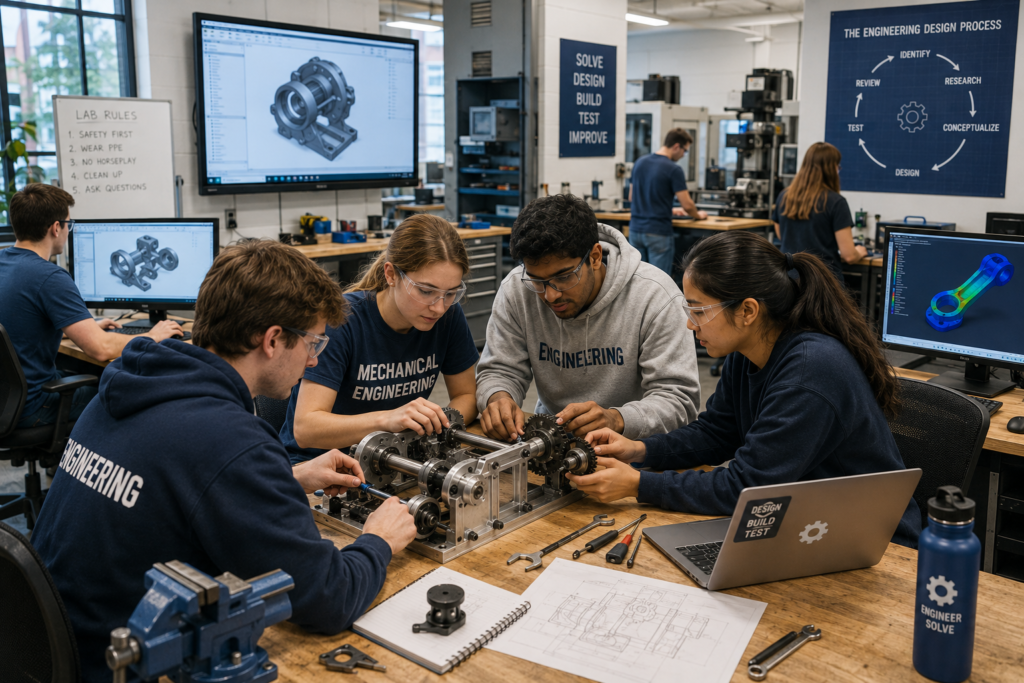
Why Your Choice of Mechanical Engineering Degree Matters
A mechanical engineering degree is not just a qualification. It is a multi-year technical education that builds the analytical foundations, problem-solving habits, and professional instincts you will rely on for the rest of your career. The program you choose determines the depth of that foundation.
There is a meaningful difference between a mechanical engineering program that puts students in design studios and fabrication labs from their first year and one that front-loads three years of lectures before touching anything physical. There is a difference between a program taught by faculty who have spent time working in industry and one staffed entirely by theoreticians. These differences do not always show up in rankings.
Employers notice. Recruiters at aerospace companies, automotive manufacturers, and medical device firms often have strong preferences about which programs produce graduates who can contribute quickly. The reputation of your program and university carries genuine weight, particularly in your first job search when you have little else on your CV to differentiate yourself.
At the same time, the best mechanical engineering program for one person is not the best for another. A student targeting automotive racing needs a different program from someone targeting offshore energy. A student who needs to minimise debt has different constraints from one whose family can absorb a top-tier private university’s fees. This guide accounts for all of those dimensions.
Types of Mechanical Engineering Degrees Explained
Understanding the different types of mechanical engineering degrees available is the necessary first step before evaluating specific programs or institutions.
Bachelor of Engineering (BEng) or Bachelor of Science (BS/BSc) in Mechanical Engineering
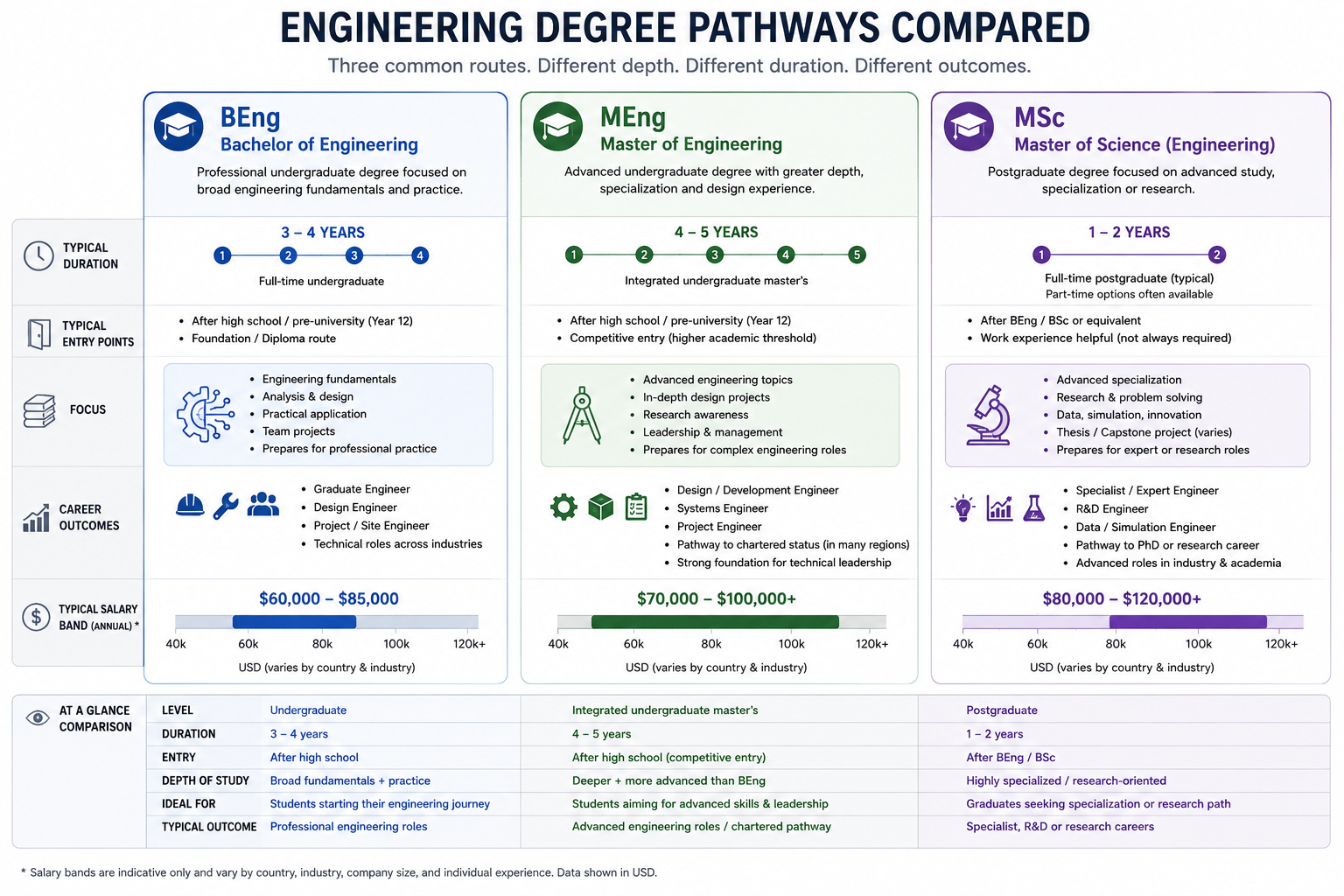
The BEng or BSc in Mechanical Engineering is the standard undergraduate entry-level qualification in most countries. In the UK, a BEng typically takes three years; in the US, a BS typically takes four years. This is the degree most students complete before entering the workforce or pursuing postgraduate study.
A BEng provides the core technical grounding in mechanics, thermodynamics, fluid mechanics, materials science, and mathematics. Most graduates enter junior engineering roles directly from this level, though some employers, particularly in aerospace and defence, have a preference for candidates with postgraduate qualifications.
Master of Engineering (MEng): Integrated vs. Standalone
An integrated MEng program combines undergraduate and master’s level study into a single four or five year course. In the UK and Ireland, the MEng is the standard route to Chartered Engineer (CEng) status. In the US, most students complete a separate standalone master’s after their bachelor’s degree.
An MEng graduates a more technically rounded engineer than a BEng alone and typically commands a salary premium of 10 to 20 percent at entry level. For students confident about pursuing engineering as a long-term career, the MEng route is generally worth the additional year of study.
Master of Science (MSc or MS) in Mechanical Engineering
A standalone postgraduate MSc in Mechanical Engineering is typically completed in one to two years after a bachelor’s degree. It allows engineers to specialise in a specific area such as robotics, thermal engineering, advanced manufacturing, biomechanics, or aerospace systems.
An MSc is particularly valuable for engineers who want to change specialisation, move into research-adjacent roles, or increase their competitiveness for senior positions. International students frequently use an MSc at a prestigious institution as an entry point into a new country’s engineering job market.
Doctor of Philosophy (PhD) in Mechanical Engineering
A PhD in Mechanical Engineering is a research degree that typically takes three to five years and involves producing an original contribution to knowledge through independent research. It is the route into academic positions, government research laboratories, and senior R&D leadership roles in industry.
A PhD is not necessary for most engineering careers and can actually narrow employability in production-focused roles. It should be pursued only if you have a clear research interest or a specific career goal that genuinely requires it.
Associate Degree and Higher National Diploma (HND)
In some countries, particularly the US and UK, associate degrees or Higher National Diplomas (HNDs) in mechanical engineering provide a faster route into technical roles. These are sub-bachelor qualifications that typically produce technician-level graduates rather than professional engineers. Many holders later top up to a full bachelor’s degree through part-time or distance learning.
| Degree Level | Duration | Career Entry Point | Typical Salary Impact |
| BEng / BSc | 3-4 years | Junior engineer, graduate scheme | Baseline |
| MEng (integrated) | 4-5 years | Junior to mid-level, faster progression | +10 to 20% vs BEng at entry |
| MSc / MS (standalone) | 1-2 years post-BEng | Specialist, R&D, career pivot | +10 to 25% depending on specialisation |
| PhD | 3-5 years | Research, academia, senior R&D | Variable; premium in niche research roles |
| HND / Associate Degree | 1-2 years | Technician, junior drafter | Below BEng; often used as stepping stone |
What to Look for in a Good Mechanical Engineering Program
Beyond prestige and rankings, the following criteria are the most reliable indicators of a high-quality mechanical engineering program.
Accreditation by a Recognised Engineering Body
This is the single most important criterion. An accredited mechanical engineering degree guarantees that the program meets a defined standard of technical content, faculty qualification, and graduate competency. Without accreditation, a degree may not be recognised by professional institutions, government agencies, or international employers.
Strong Industry Links and Placement Opportunities
Programs with structured industrial placement years, co-operative education programs (co-ops), or strong industry sponsorship give students exposure to real engineering work before graduation. Graduates who enter the job market with 12 months of relevant work experience are in a fundamentally stronger position than those without it. This is one of the most powerful differentiators a program can offer.
Hands-On Design and Build Projects
The best mechanical engineering programs integrate practical design and fabrication work from the first year. This might take the form of design-build competitions, student formula racing teams, engineering project modules, or capstone design projects. Engineers learn differently from physicists or mathematicians: the discipline’s practical nature demands a curriculum that engages both analytical and creative thinking.
Quality of Laboratory and Workshop Facilities
Modern teaching laboratories equipped with current CAD software, rapid prototyping equipment, material testing machines, and fluid mechanics rigs matter. A program that teaches SolidWorks or ANSYS on current software versions prepares students more effectively than one using outdated tools.
Faculty with Industry Experience
A mix of research-active academics and faculty members with significant industry backgrounds produces better-rounded engineers. Pure research universities sometimes produce graduates with excellent theoretical depth but limited awareness of industrial practice. Check faculty profiles and look for industry advisory boards, which indicate that a department maintains active engagement with the engineering sector.
Graduate Employment Outcomes
Where do graduates actually work? Reputable programs publish or can provide graduate employment data. Look for high proportions entering engineering roles, the names of employers who hire regularly from the program, and average starting salaries. This data is a more reliable signal of program quality than any ranking table.
Accreditation: Why It Is Non-Negotiable
If there is one absolute rule when choosing a mechanical engineering degree, it is this: the program must be accredited by a recognised professional engineering body. Here is what accreditation means in the major engineering education markets and why it matters so profoundly.
United States: ABET Accreditation
In the United States, ABET accreditation (Accreditation Board for Engineering and Technology) is the gold standard for engineering programs. ABET-accredited programs meet rigorous criteria for curriculum coverage, faculty qualifications, student outcomes, and continuous improvement. An ABET-accredited mechanical engineering degree is required to sit the Fundamentals of Engineering (FE) exam, the first step toward becoming a licensed Professional Engineer (PE). Without PE licensure, many engineering roles in infrastructure, government, and consulting are inaccessible.
United Kingdom: IMechE and Engineering Council Accreditation
In the UK, mechanical engineering degrees are accredited by the Institution of Mechanical Engineers (IMechE) on behalf of the Engineering Council. An IMechE-accredited BEng provides a partial route to Incorporated Engineer (IEng) status, while an accredited MEng provides the educational requirement for Chartered Engineer (CEng) status. CEng is the benchmark for senior engineering professionals in the UK and is recognised internationally through the International Professional Engineers Agreement (IPEA).
Europe: EUR-ACE Framework
Across the EU and beyond, the EUR-ACE label is applied by national accreditation agencies to engineering programs that meet a defined European standard of quality. EUR-ACE accredited degrees are mutually recognised across member countries, simplifying cross-border professional recognition for engineers working in Europe.
Australia and Asia-Pacific: Engineers Australia and the Washington Accord
In Australia, Engineers Australia accredits engineering programs, and accreditation is effectively required for professional recognition. Washington Accord signatory countries, which include the US, UK, Australia, Canada, Ireland, Japan, South Korea, and Singapore, mutually recognise each other’s accredited bachelor’s degrees. A Washington Accord accredited degree has genuine international portability.
Critical Rule: Always verify that a specific program is accredited, not just the university or department. Accreditation is granted at the program level. A prestigious university can have an engineering department where only certain programs carry current accreditation. Verify on the accrediting body’s official website.
Best Mechanical Engineering Universities in the World
The following institutions consistently rank among the best universities for mechanical engineering globally, based on academic reputation, employer surveys, research output, and graduate employment outcomes. Rankings draw on QS World University Rankings by Subject, Times Higher Education, and employer data.
| University | Country | Recognised For | Industry Strengths |
| Massachusetts Institute of Technology (MIT) | USA | Research excellence, innovation culture | Robotics, aerospace, advanced manufacturing, energy systems |
| Stanford University | USA | Entrepreneurship, design thinking, Silicon Valley ecosystem | Mechatronics, design innovation, energy, AI-engineering integration |
| ETH Zurich | Switzerland | Rigorous fundamentals, European engineering culture | Structural mechanics, materials engineering, robotics, precision systems |
| University of Cambridge | UK | Theoretical depth, long engineering heritage | Engineering design, thermodynamics, aerospace structures |
| Imperial College London | UK | Applied engineering, central London industry network | Biomedical engineering, aerospace, advanced materials, energy |
| National University of Singapore (NUS) | Singapore | Asia-Pacific industry integration, research quality | Manufacturing systems, robotics, thermal engineering |
| Tsinghua University | China | Scale, government-backed research programs | Automotive, energy systems, precision manufacturing |
| TU Munich (TUM) | Germany | Industrial relevance, BMW and Siemens research partnerships | Automotive engineering, aerospace, mechatronics |
| California Institute of Technology (Caltech) | USA | Deep research focus, aerospace and space systems | Fluid dynamics, aerospace structures, propulsion systems |
| University of Toronto | Canada | Strong co-op model, North American industry links | Aerospace, automotive, manufacturing, energy |
Note: Global rankings change year to year and measure different things. The best university in the world is rarely the best choice for a specific individual student. Use this table as a starting point for research, not a definitive verdict on where to apply.
Best Mechanical Engineering Schools in the United States
The United States has one of the largest and most diverse ecosystems of mechanical engineering programs in the world, spanning elite research universities, well-funded public institutions, and specialist technical colleges. Here is how the landscape breaks down.
Elite Private Research Universities
MIT, Stanford, and Caltech occupy the global top tier. These programs are exceptionally competitive to enter, carry enormous prestige with elite employers, and provide unparalleled research opportunities. They are best suited to students with outstanding academic records and a strong interest in pushing the boundaries of engineering knowledge. Financial aid at these institutions is generous: MIT, for example, meets 100 percent of demonstrated financial need.
Leading Public Universities: Outstanding Value
The University of Michigan, Georgia Tech, UC Berkeley, and Purdue University consistently rank among the best public universities for mechanical engineering in the US. These programs offer a powerful combination of rigorous technical education, strong industry partnerships, and significantly more accessible tuition for in-state students. Georgia Tech’s co-op program is one of the largest in the US, placing students in paid engineering roles worth $60,000 to $100,000 in total earnings over the degree.
Strong Mid-Tier Programs with Excellent ROI
Schools such as Penn State, Ohio State, Virginia Tech, University of Wisconsin-Madison, and Texas A&M offer excellent accredited mechanical engineering programs with strong regional industry links, healthy graduate employment rates, and significantly lower costs than elite private universities. For many students, these programs represent the best overall value in American mechanical engineering education.
| University | Type | ABET Accredited | Notable Strength | Approx. Annual In-State Tuition |
| MIT | Private | Yes | Research, robotics, aerospace | $57,000+ |
| Stanford | Private | Yes | Design innovation, Silicon Valley links | $57,000+ |
| Georgia Tech | Public | Yes | Co-op program, manufacturing, aerospace | $12,000-14,000 |
| University of Michigan | Public | Yes | Automotive, broad industrial research | $15,000-17,000 |
| UC Berkeley | Public | Yes | Research excellence, Bay Area tech links | $14,000-16,000 |
| Purdue University | Public | Yes | Aerospace, manufacturing, strong placement | $10,000-12,000 |
| Penn State | Public | Yes | Applied engineering, defence industry links | $18,000-20,000 |
| Virginia Tech | Public | Yes | Aerospace, CAE simulation tools | $13,000-15,000 |
| University of Waterloo (Canada) | Public | Yes (Engineers Canada) | Co-op model, North American employer network | CAD $12,000-15,000 |
Best Mechanical Engineering Universities in the United Kingdom
The UK offers some of the world’s most respected mechanical engineering degree programs, and the IMechE-accredited MEng route provides a clear path to Chartered Engineer status that carries genuine international weight.
Russell Group: The Academic Flagship Programs
The University of Cambridge, Imperial College London, University of Manchester, University of Bristol, and University of Sheffield consistently lead UK rankings for mechanical engineering. Cambridge’s Engineering Tripos is broadly considered one of the most intellectually demanding engineering undergraduate programs in the world. Imperial’s proximity to London and its strong industry networks make it a particularly attractive choice for students targeting aerospace, energy, or finance-adjacent engineering roles.
Industry-Linked Programs with Exceptional Placement Records
Institutions such as Loughborough University, University of Bath, Heriot-Watt University, and Cranfield University offer MEng programs with outstanding industry placement rates. Loughborough is renowned for its sport engineering and automotive research partnerships. The University of Bath runs one of the most competitive automotive engineering programs in Europe, benefiting from proximity to the UK motorsport valley. Cranfield operates as a postgraduate-only institution and is globally respected for its aerospace, defence, and manufacturing engineering programs.
| University | Degree Offered | IMechE Accredited | Notable Strength |
| University of Cambridge | MEng Engineering (with ME pathway) | Yes | Theoretical rigour, broad engineering foundation |
| Imperial College London | MEng Mechanical Engineering | Yes | Aerospace, biomedical, advanced manufacturing |
| University of Manchester | BEng / MEng Mechanical Engineering | Yes | Materials science, nuclear, advanced manufacturing |
| University of Bristol | BEng / MEng Mechanical Engineering | Yes | Aerospace structures, composites, robotics |
| Loughborough University | BEng / MEng Mechanical Engineering | Yes | Automotive, sport engineering, placement year |
| University of Bath | BEng / MEng Mechanical Engineering | Yes | Automotive dynamics, 12-month placement year |
| University of Sheffield | BEng / MEng Mechanical Engineering | Yes | Advanced manufacturing, aerospace, AMRC links |
| Cranfield University | MSc / EngD (postgraduate only) | Yes | Aerospace, defence, manufacturing systems |
Top Mechanical Engineering Programs in Europe, Asia, and Beyond
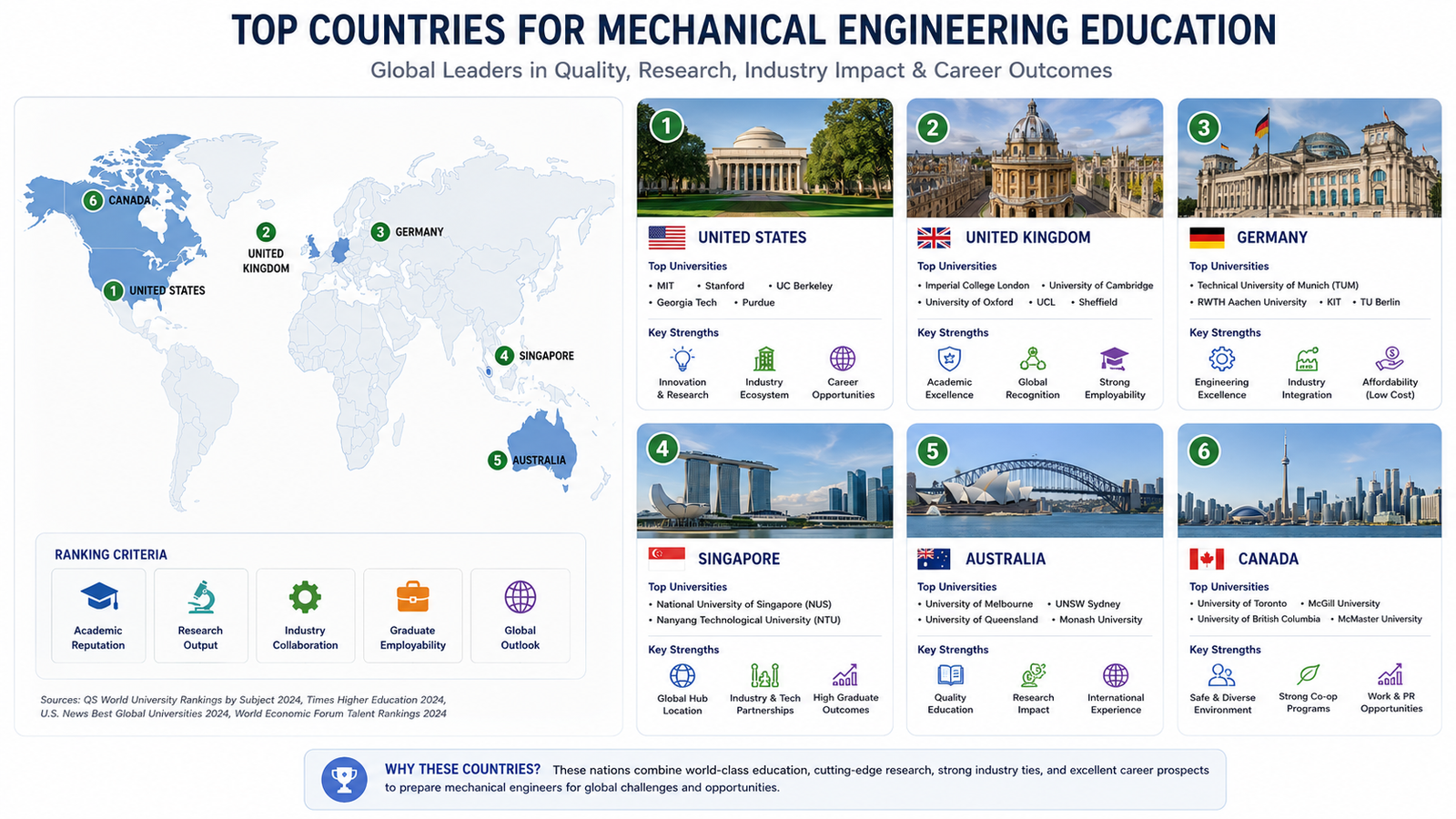
Germany: Engineering Education at Its Most Industry-Integrated
Germany’s engineering education system is world-renowned for combining rigorous technical training with deep industry integration. TU Munich (TUM), RWTH Aachen, and Karlsruhe Institute of Technology (KIT) are the flagship institutions. Germany’s export-led manufacturing economy means graduates from these programs have outstanding access to employers including BMW, Volkswagen, Siemens, Bosch, and Airbus. Tuition fees at German public universities are minimal or zero, even for international students, making them exceptional value on a global scale.
Singapore and Asia-Pacific
The National University of Singapore (NUS) and Nanyang Technological University (NTU) are Singapore’s leading engineering schools and rank among the global top 15 for mechanical engineering. Both programs are taught in English, are strongly industry-linked, and provide excellent access to the Asia-Pacific manufacturing and technology sectors. In Australia, the University of Melbourne, UNSW Sydney, and Monash University are the leading options, all carrying Engineers Australia accreditation and strong connections to the local resources, defence, and advanced manufacturing sectors.
Canada: Co-op Education Done Right
The University of Toronto, University of Waterloo, and McGill University lead Canadian mechanical engineering education. Waterloo’s co-op program is one of the most respected in North America, producing graduates with up to two years of structured work experience alongside their degree. Canadian engineering degrees are accredited by Engineers Canada and are recognised under the Washington Accord, providing strong international portability.
Online Mechanical Engineering Degrees: Are They Worth It?
The question of whether an online mechanical engineering degree is worth pursuing deserves an honest and nuanced answer, because the landscape has changed significantly and not all online programs are created equal.
When an Online Degree Makes Sense
An accredited online mechanical engineering degree from a reputable institution can be a legitimate and valuable qualification in specific circumstances: working professionals seeking to formalise their technical knowledge; engineers in regions where access to quality on-campus programs is limited; candidates pursuing an online MSc to specialise or advance after completing an on-campus bachelor’s degree; and students who need to manage work and family commitments alongside study.
Honest Limitations of Online Programs
However, online programs have real limitations that anyone considering them should weigh carefully. The hands-on laboratory work, physical prototyping experience, and face-to-face collaboration that are central to a quality on-campus mechanical engineering education are difficult to replicate in an online environment. Employers in hardware-focused industries, particularly aerospace, automotive, and defence, often retain a preference for on-campus graduates, though this varies by employer and role.
Networking is also harder online. The peer relationships, faculty connections, and industry contacts built during years of on-campus study are a significant and often underestimated part of the value of a mechanical engineering degree.
Best Online Mechanical Engineering Programs to Consider
If an online route is appropriate for your circumstances, the following programs are among the most respected. The University of Illinois at Urbana-Champaign (UIUC) online MechSE program, the Georgia Tech online MSE, and Purdue University’s online MSE are from institutions with strong engineering reputations and established graduate outcomes. For bachelor’s level, the Arizona State University online BSE is ABET-accredited and has built a solid industry reputation for an online program.
Honest Assessment: An online MSc from a reputable, accredited institution is a legitimate professional credential that adds real value for working engineers. An online bachelor’s degree is more complex: it can work well, but students need to work harder to compensate for reduced hands-on and networking opportunities. Always verify accreditation first.
Mechanical Engineering Degree Costs and Financial Aid
The cost of a mechanical engineering degree varies enormously by country, institution type, and residency status. Understanding the full cost picture is essential for making a financially sound decision.
| Country / Institution Type | Approximate Total Degree Cost | Key Financial Notes |
| US Private University (e.g. MIT, Stanford) | $220,000 – $250,000 total | Need-based financial aid widely available; net cost often far lower for eligible students |
| US Public University (in-state) | $40,000 – $80,000 total | Best value in US system; co-op earnings can offset cost significantly |
| US Public University (out-of-state) | $100,000 – $160,000 total | Consider co-op programs, scholarships, or establishing in-state residency |
| UK University (home student) | GBP 27,000 – 45,000 total (tuition) | Income-contingent student loans available; repayments only kick in above salary threshold |
| UK University (international student) | GBP 80,000 – 130,000 total | Scholarships available; strong ROI for those entering UK engineering market |
| Germany (public university) | Near zero tuition | Semester fees EUR 100-500; living costs are the primary expense |
| Australia (domestic) | AUD 40,000 – 60,000 total | HECS-HELP loans available; repayment is income-contingent via the tax system |
| Online programs (US-based) | $20,000 – $60,000 total | Significant cost advantage; verify ABET accreditation with care before enrolling |
One factor that significantly changes the cost calculation for US students is the co-operative education (co-op) program model. At schools like Georgia Tech, Purdue, and Northeastern, students alternate between academic semesters and paid engineering placements. Over a five-year degree, a student can earn $60,000 to $100,000 in paid placements, dramatically reducing net degree cost while graduating with genuine, employer-valued work experience.
Mechanical Engineering Degree vs. Related Engineering Degrees
Prospective students often wonder whether a mechanical engineering degree is the right choice compared to adjacent disciplines. Here is an honest, practical comparison.
| Degree | Best Suited For | Overlap with ME | Key Practical Difference |
| Mechanical Engineering | Anyone interested broadly in machines, energy, motion, thermal systems, and physical products | It is the reference point | Broadest physical engineering discipline; most career flexibility |
| Aerospace Engineering | Students specifically targeting aircraft, spacecraft, and defence applications | High: shares mechanics, thermodynamics, and materials | Deeper aerodynamics, propulsion, and flight systems focus; narrower scope |
| Mechatronics Engineering | Students interested in robotics, automation, and electromechanical systems | High: mechanical foundations shared | More electrical and software content; slightly narrower career scope |
| Civil Engineering | Students interested in infrastructure, buildings, and environmental systems | Moderate: shares structural mechanics | Different materials context, scale, and regulatory environment |
| Chemical Engineering | Students interested in process industries, energy, and molecular-level materials | Low to moderate: shared thermodynamics | Focus on chemical reactions and process systems; very different toolset |
| Manufacturing Engineering | Students with a specific interest in production systems and lean operations | Very high: often offered as ME specialisation | Narrower scope; primarily operations and production focused |
In most cases, if you are undecided between mechanical engineering and a related discipline, mechanical engineering is the safer, broader choice. Its breadth gives you more options and more flexibility to specialise later, while a more specific degree locks you into a narrower set of career paths from the outset.
How to Choose the Right Mechanical Engineering Program for You
With all of the above as context, here is a practical six-step framework for selecting the right mechanical engineering degree program for your specific circumstances.
Step 1: Define Your Career Direction First
Do not choose a university and then figure out your career direction. Start with a rough sense of the industry sector and type of role you are targeting. Aerospace? Automotive? Medical devices? Robotics? Renewable energy? Each of these sectors has programs that are particularly well-connected to it. A student targeting Formula 1 engineering should shortlist programs very differently from one targeting offshore wind or medical device design.
Step 2: Filter Non-Negotiably by Accreditation
Remove any program from your list that is not accredited by the relevant recognised body in your country. ABET in the US, IMechE in the UK, Engineers Australia in Australia. Verify accreditation on the accrediting body’s official website, not the university’s own marketing materials. This step alone eliminates a surprising number of programs that look legitimate on the surface.
Step 3: Prioritise Industrial Placement Opportunities
Programs that include structured industrial placement years, co-ops, or internship coordination give students a measurable advantage in the job market. Weight this heavily in your decision. One year of real engineering experience during your degree is worth more to most employers than the difference between the 5th and 20th ranked university on any league table.
Step 4: Research Graduate Employment Outcomes Directly
Contact departments directly if published data is not available. Ask what percentage of graduates are working in engineering roles within six months of graduation and which employers hire most regularly from the program. This is the single most direct measure of a program’s career value.
Step 5: Calculate the Real Total Cost
Calculate total cost of attendance including living expenses, not just headline tuition fees. Factor in scholarship opportunities, co-op earnings potential, and post-graduation salary expectations in your target sector. A mechanical engineering degree from a strong public university with a co-op program may deliver a better financial outcome over a ten-year career than a more expensive private university degree in the same field.
Step 6: Visit, Talk to Students, and Trust Your Instincts
Open days, virtual campus tours, and honest conversations with current students and recent graduates will tell you things that rankings and brochures never will. The culture of a department, the accessibility of faculty, the condition of laboratories, and the energy of the student community all affect the quality of your learning experience in ways that are hard to quantify but very real.
Frequently Asked Questions (FAQ)
What is the best degree for mechanical engineering?
The best degree for mechanical engineering is an accredited BEng or MEng in Mechanical Engineering from a recognised university. In the US, ABET accreditation is essential. In the UK, IMechE accreditation is the standard. The specific university matters less than the quality of the program’s industry links, placement opportunities, and curriculum depth. For most students who are committed to a long-term engineering career, an MEng is worth the additional study time compared to a BEng alone.
Is a mechanical engineering degree hard?
Yes, a mechanical engineering degree is among the more demanding undergraduate programs, particularly in the first two years when the mathematics, mechanics, and thermodynamics content is heaviest. However, the difficulty is also what makes the qualification genuinely valuable to employers. Students who engage seriously with the material and seek support when needed do graduate, and the discipline becomes more rewarding as theoretical knowledge starts connecting to practical engineering challenges.
Is a mechanical engineering degree worth it?
For the right person, a mechanical engineering degree is absolutely worth it. It provides access to well-paid, intellectually stimulating careers across a huge range of industries, with strong long-term earnings potential and genuine international employment opportunities. The key is choosing an accredited program, making the most of placement and co-op opportunities, and entering a growth sector such as renewable energy, robotics, or medical devices.
What GPA or grades do I need to get into a mechanical engineering program?
Entry requirements vary enormously by institution. Elite programs like MIT, Stanford, and Cambridge are extremely selective and typically admit students from the very top of their academic cohort. Strong public universities and mid-tier programs are more accessible, generally requiring grades in the top 25 to 40 percent of applicants. Many students also enter mechanical engineering via foundation year programs, community colleges, or transfer pathways from HND qualifications.
Can I become a mechanical engineer with an online degree?
Yes, provided the online mechanical engineering program is accredited by the relevant recognised engineering body. An accredited online MSc from a reputable institution is a legitimate professional credential that adds real career value. For a bachelor’s level online degree, students need to work harder to compensate for reduced hands-on and networking opportunities, but it is a viable path for the right person in the right circumstances.
Which country has the best mechanical engineering education?
The United States, United Kingdom, Germany, Switzerland, and Singapore consistently produce the highest-ranked mechanical engineering programs globally. Germany stands out as exceptional value given near-zero public university tuition combined with outstanding industry ties. The US offers the broadest range of options across all price points. The UK’s MEng route provides a clear, internationally recognised path to Chartered Engineer status. Ultimately, the best country depends on where you intend to work after graduation and your financial circumstances.
What is the difference between a BEng and MEng in mechanical engineering?
A BEng (Bachelor of Engineering) is a three to four year undergraduate degree providing the foundational technical qualification for engineering practice. An MEng (Master of Engineering) is either an integrated five-year program combining undergraduate and postgraduate study, or a standalone postgraduate qualification taken after a BEng. The MEng provides greater technical depth and specialisation, is required for Chartered Engineer status in the UK, and typically commands a salary premium of 10 to 20 percent at entry level.
Conclusion
Choosing the right mechanical engineering degree is not about finding the most famous name on a ranking table. It is about finding a program that is properly accredited, gives you genuine hands-on engineering experience, connects you with the industries you want to work in, and fits your financial circumstances honestly.
The world’s best mechanical engineering programs are spread across dozens of countries and institutions. Many of the most successful engineers in the world graduated from solid, well-regarded programs rather than household-name elite universities. What they had in common was the drive to extract maximum value from their program: engaging with placement and co-op opportunities, building industry contacts, developing practical skills alongside theoretical knowledge, and entering the workforce ready to contribute from day one.
Use the framework in this guide to build your shortlist, verify accreditation rigorously, research graduate outcomes honestly, and make your decision based on evidence and your own specific goals rather than brand recognition alone.
Ready to go deeper? Explore our complete guide to What Is Mechanical Engineering?, find out exactly What Does a Mechanical Engineer Do?, or discover the CAD and engineering software skills that employers are looking for in new graduates.
Leave a Reply