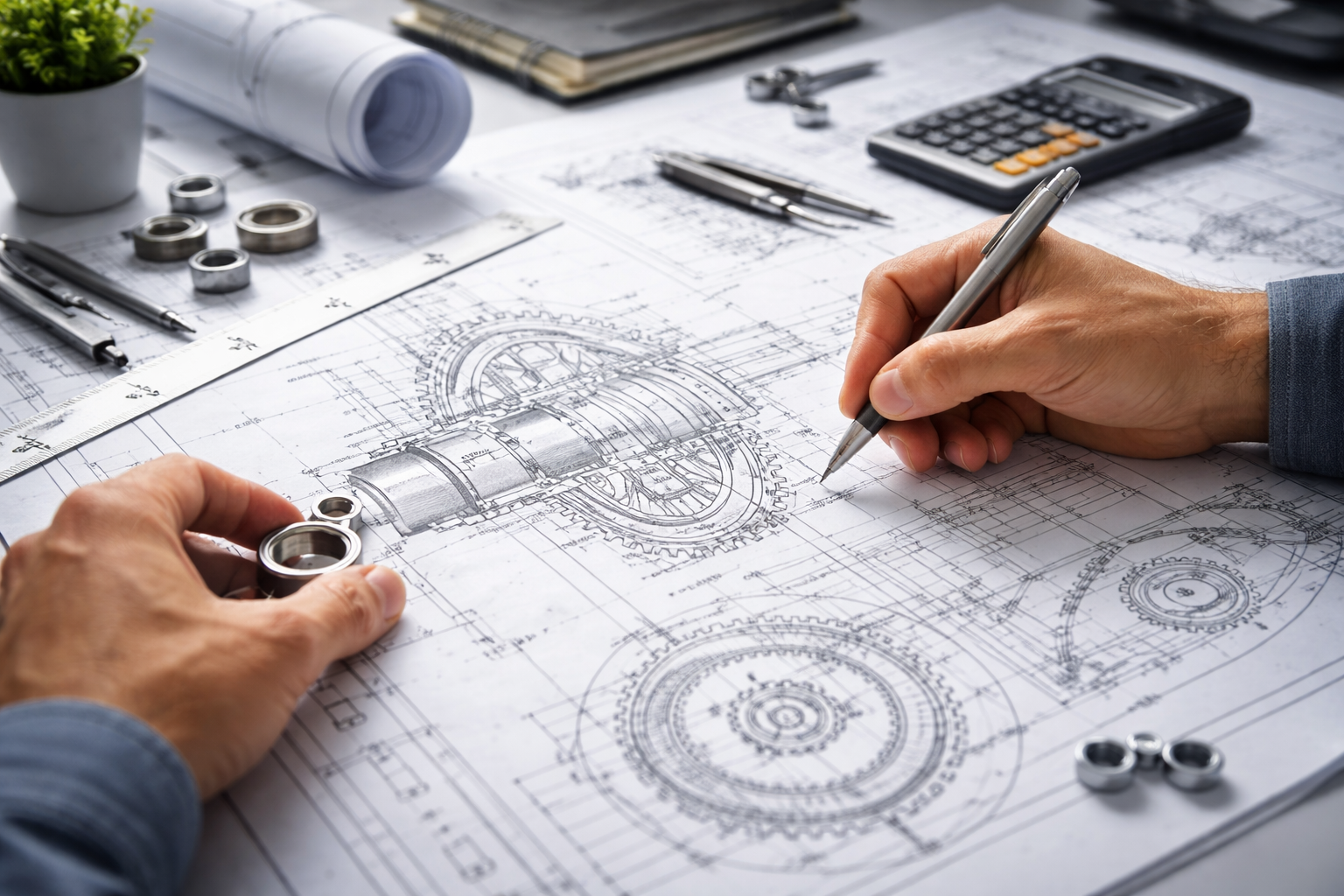
Every physical object that has ever been manufactured, from a bolt to a skyscraper started as a drawing. Engineering drafting is the discipline that turns design intent into the precise, standardised documents that make manufacturing possible.
If you have ever received a set of technical drawings from an engineering firm, worked alongside a design team, or commissioned fabrication work, you have already interacted with engineering drafting, even if you did not know what to call it. This guide explains what engineering drafting actually is, what it produces, how it works, and why it still matters in an era of 3D modeling and digital manufacturing.
What Is Engineering Drafting?
Engineering drafting is the process of creating precise, standardised technical drawings that communicate the design of a part, structure, or system to the people responsible for building it. These drawings, sometimes called technical drawings, engineering drawings, or blueprints, define geometry, dimensions, tolerances, materials, and surface specifications in a format that leaves no room for interpretation.
Unlike a sketch or a concept illustration, an engineering drawing carries legal and contractual weight. It is the document a manufacturer refers to when setting up a machine, a fabricator refers to when cutting and welding steel, and a contractor refers to when installing mechanical systems. If something is built incorrectly, the drawing is the reference against which the dispute is resolved.
Engineering drafting sits at the intersection of engineering and communication. Its job is not to be beautiful, it is to be unambiguous.
The shift from hand-drawn drafting to Computer-Aided Design (CAD) transformed the speed and accuracy of the process, but it did not change its fundamental purpose. Today, the vast majority of engineering drawings are produced using CAD software such as AutoCAD, SolidWorks, or CATIA, but the standards, conventions, and principles that govern what a drawing must contain have remained largely consistent for decades.
Get the difference between 2D vs 3D CAD Drafting and when to used each
Engineering Drafting vs Engineering Design: An Important Distinction
These two terms are often used interchangeably, but they describe distinct activities. Engineering design is the process of solving an engineering problem, deciding how something should work, what it should be made of, and what form it should take. Engineering drafting is the process of documenting that solution in a precise, communicable format.
In practice, the same person often does both. But understanding the distinction matters when you are commissioning work: if you have a resolved design and simply need it documented for manufacturing, you need drafting. If you need someone to help figure out the design itself, you need design engineering. SimuTecra provides both, which is why understanding where your project sits on that spectrum is the starting point of any engagement.
What Does an Engineering Drawing Actually Contain?
A well-produced engineering drawing is structured, not a freeform document. Every element has a defined purpose and a defined location. Here is what you will find on a standard engineering drawing and why each element exists:
| Drawing Element | What It Contains | Why It Matters |
|---|---|---|
| Title Block | Part name, drawing number, scale, revision, drafter, date, company name | Identifies the drawing and confirms you have the correct, latest revision |
| Revision Table | History of changes: revision letter, description, date, approver | Tracks every change made to the drawing over its lifetime |
| Orthographic Views | Front, top, side, and section views of the part | Communicates shape and geometry from multiple angles without ambiguity |
| Dimensions | Linear, angular, radius, and diameter measurements with units | Tells the manufacturer exactly how large every feature needs to be |
| Tolerances | Allowable variation on each dimension (plus/minus, limits, or GD&T) | Defines how precisely each feature must be made, controls fit and function |
| Material Callout | Material specification, grade, and sometimes heat treatment or finish | Tells the manufacturer what to make the part from |
| Surface Finish | Ra values, finish symbols, or text notes on specific surfaces | Controls how smooth or rough a surface needs to be for its function |
| Notes Section | General and specific notes: standards, treatments, inspection requirements | Captures any requirement that cannot be expressed graphically |
| BOM (assemblies) | List of all components: part number, description, quantity, material | Provides a complete parts list for assembly drawings |
The level of detail included on any given drawing depends on its purpose. A detail drawing for a machined part will be heavily dimensioned with tight tolerances. A general arrangement drawing for a process plant might show only positional relationships and overall sizes, with the detail left to subordinate drawings. Both are equally valid, the question is always whether the drawing contains everything the reader needs to do their job.
A Real-World Example: The Humble Pressure Vessel Flange
Consider a standard pressure vessel flange, a circular steel fitting used to connect pipes in industrial systems. A complete drawing package for that flange includes a detail drawing specifying the exact outer diameter, bore, flange thickness, bolt hole circle diameter, number and size of bolt holes, and surface finish on the sealing face. It will call out the material grade (say, ASTM A105), specify any heat treatment, and reference the applicable standard (ASME B16.5).
Without that drawing, the machinist is guessing. With it, the flange can be produced to the same specification anywhere in the world, by any competent machinist, in any country, and it will fit correctly when it arrives on-site. That universality is the entire point of engineering drafting.
The Main Types of Engineering Drawings
Engineering drawings are not one-size-fits-all. Different types of drawings serve different purposes at different stages of a project. The table below covers the most common types you are likely to encounter:
| Drawing Type | What It Shows | Common Use |
|---|---|---|
| Detail Drawing | A single component in full, all dimensions, tolerances, material | Machined parts, fabricated components |
| Assembly Drawing | How multiple parts fit together; includes BOM | Gearboxes, structural frames, product assemblies |
| GA Drawing | Overall layout and spatial arrangement of a system | Plant design, facilities, building services |
| Fabrication Drawing | Weld symbols, bend lines, cut profiles, material for fabricated items | Steel structures, sheet metal, pressure vessels |
| Schematic Drawing | System logic using symbols, not physical layout | Electrical, hydraulic, pneumatic systems |
| As-Built Drawing | What was actually constructed, updated after installation | Facilities management, renovation, maintenance |
| Shop Drawing | Contractor-produced drawing showing how they intend to build or fabricate | Construction, steelwork, glazing, joinery |
Most projects require more than one drawing type. A new industrial facility, for example, might require general arrangement drawings for overall layout, fabrication drawings for structural steelwork, schematics for electrical and hydraulic systems, and as-built drawings once construction is complete. Each drawing type feeds into the next stage of the project.
Drawing Standards: Why ASME, ISO, and DIN Exist
Engineering drawings only work as a universal communication tool if everyone reading them interprets them the same way. That is the job of drawing standards, they define exactly how dimensions should be presented, what symbols mean, how tolerances are expressed, and how views should be arranged.
The three major standards frameworks you will encounter are:
- ASME Y14.5 (American Society of Mechanical Engineers): The dominant standard in the United States and widely used in North America. Governs dimensioning, tolerancing, and GD&T notation. Most manufacturing and engineering firms in the US work to ASME standards unless a client specifies otherwise.
- ISO 128 / ISO 1101 (International Organization for Standardization): The international standard used across Europe, Asia, and most of the rest of the world. Similar in intent to ASME but with some differences in projection method, GD&T notation, and symbology. When working with international suppliers or clients, knowing which standard applies is critical.
- DIN (Deutsches Institut fur Normung): The German standard, now largely harmonised with ISO. Still referenced on drawings produced in Germany and sometimes seen in Central European manufacturing supply chains.
When commissioning engineering drawings, always specify which standard you require. A drawing produced to ISO first-angle projection cannot be read correctly by someone trained only on ASME third-angle projection, the views appear mirrored.
SimuTecra produces drawings to ASME, ISO, or client-specified standards. If you are not sure which applies to your project, the answer is usually determined by where the parts will be manufactured or which country the client is based in.
What Does an Engineering Drafter Actually Do?
The role of an engineering drafter is more than operating CAD software. A competent drafter interprets design intent from sketches, specifications, or engineer markups and translates it into precise drawings. They apply the correct dimensioning scheme, select appropriate tolerances based on fit and function requirements, add surface finish callouts, reference applicable material standards, and structure the drawing package so it can be read and used without ambiguity by the manufacturing team.
They also manage revisions, when a design changes, the drafter updates affected drawings, increments the revision level, records the change in the revision table, and reissues the affected sheets. In a production environment, drawing control is as important as drawing quality. An outdated drawing in the hands of a machinist is a manufacturing defect waiting to happen.
At SimuTecra, drafters work closely with engineers and clients through each revision cycle, maintaining a clear audit trail from concept through to final issued-for-construction drawings.
Frequently Asked Questions
| Question | Answer |
|---|---|
| Is engineering drafting still relevant with 3D modeling? | Absolutely. 3D modeling is a powerful design tool, but a 2D drawing package remains the standard deliverable for manufacturing. Fabricators, machinists, and contractors work from 2D drawings because they define the legal specification of what is to be made. In most projects, 3D modeling and 2D drafting are used together, the model is the design environment, the drawing is the manufacturing document. |
| What software do engineering drafters use? | The most widely used tools are AutoCAD (2D drafting, all industries), SolidWorks (mechanical and product design), CATIA (aerospace and automotive), Autodesk Inventor (mechanical), and Revit (building and infrastructure, used alongside AutoCAD for MEP and structural work). The right tool depends on the industry and the complexity of the work. |
| How long does it take to produce an engineering drawing? | It depends entirely on complexity. A simple machined part detail drawing might take two to four hours. A complex assembly drawing with a full BOM could take two days. A full drawing package for a structural steel frame or a process plant module could take several weeks. The most reliable way to estimate is to share your scope with a drafting partner and request a breakdown. |
| What industries use engineering drafting? | Engineering drafting is used in virtually every industry that involves physical construction or manufacturing: mechanical and product engineering, civil and structural engineering, architecture, oil and gas, mining, aerospace, automotive, marine, HVAC and building services, electronics manufacturing, and more. The specific drawing types and standards vary by industry, but the underlying discipline is the same. |
| What is the difference between a blueprint and an engineering drawing? | Technically, ‘blueprint’ refers to an older reproduction process that produced white lines on a blue background. The term has stuck as a colloquial term for any engineering drawing, even though modern drawings are produced digitally and printed on white paper. In professional practice, ‘engineering drawing’ or ‘technical drawing’ is the correct term. |
The Bottom Line
Engineering drafting is one of the oldest and most essential disciplines in engineering, and despite decades of technological change, its core purpose has not shifted: to communicate design intent precisely enough that anyone with the relevant skill can build the thing correctly, first time.
Whether you are a project manager reviewing a drawing package, a business owner commissioning fabrication work, or an engineer looking to understand what your drafting team actually produces, the fundamentals covered in this guide give you the foundation to engage with technical drawings with confidence.
The next step is learning how to read what is on them, which is exactly what the next article in this series covers.
Need Engineering Drawings You Can Actually Build From?
SimuTecra produces 2D drafting packages and 3D CAD models for manufacturing, fabrication, and construction clients worldwide. Every drawing is produced to your specified standard, ASME, ISO, or client-specific, and reviewed for accuracy before delivery.
Send us your project details and get a clear scope and quote, no obligation.
Leave a Reply