Engineering change management (ECM) is one of the most administratively intensive processes in product engineering, and one of the most consequential when it goes wrong. An engineering change that is not correctly propagated through the Bill of Materials affects every component in the affected product tree. An ECO whose regulatory re-qualification implications are not assessed sends non-compliant products to market. An engineering change notice that does not reach the production floor before the next build cycle results in non-conforming parts being manufactured to an obsolete drawing revision.
The administrative burden of ECM is substantial: drafting the technical justification for the change, identifying every affected drawing and BOM item in the product tree, assessing the form-fit-function impact, determining whether the change triggers regulatory re-qualification or customer notification requirements, updating all affected documents to the new revision, coordinating review and approval from all relevant stakeholders, and communicating the change to procurement, manufacturing, and quality before the effectivity date. On complex products with deep BOM trees and multiple regulatory certifications, a single ECO can generate weeks of administrative work.
AI is beginning to address every stage of this process. Large language models can draft ECO technical justifications from a brief change description, assess form-fit-function impact, identify regulatory re-qualification triggers from specified standards, generate affected items lists from described BOM structures, and draft the formal ECO documentation in the correct engineering register. PLM-integrated AI tools (PTC Windchill AI, Siemens Teamcenter AI, Dassault 3DEXPERIENCE AI) are automating BOM ripple analysis, change classification, and workflow routing. And the combination of AI-assisted ECM with well-structured PLM data is beginning to reduce ECO cycle time from weeks to days for routine changes.
| Who this guide is for: This guide is written for mechanical and product design engineers, configuration managers, and PLM administrators who initiate, process, or approve engineering changes. It covers AI assistance for every stage of the ECM lifecycle, from change request triage through to production effectivity communication, with specific tools, LLM prompt templates, and implementation guidance for teams at all PLM maturity levels. |
The Engineering Change Management Lifecycle
Engineering changes pass through a defined lifecycle from initial request to production effectivity. Understanding this lifecycle in detail is the prerequisite for understanding where AI adds value and where human engineering judgement remains essential.
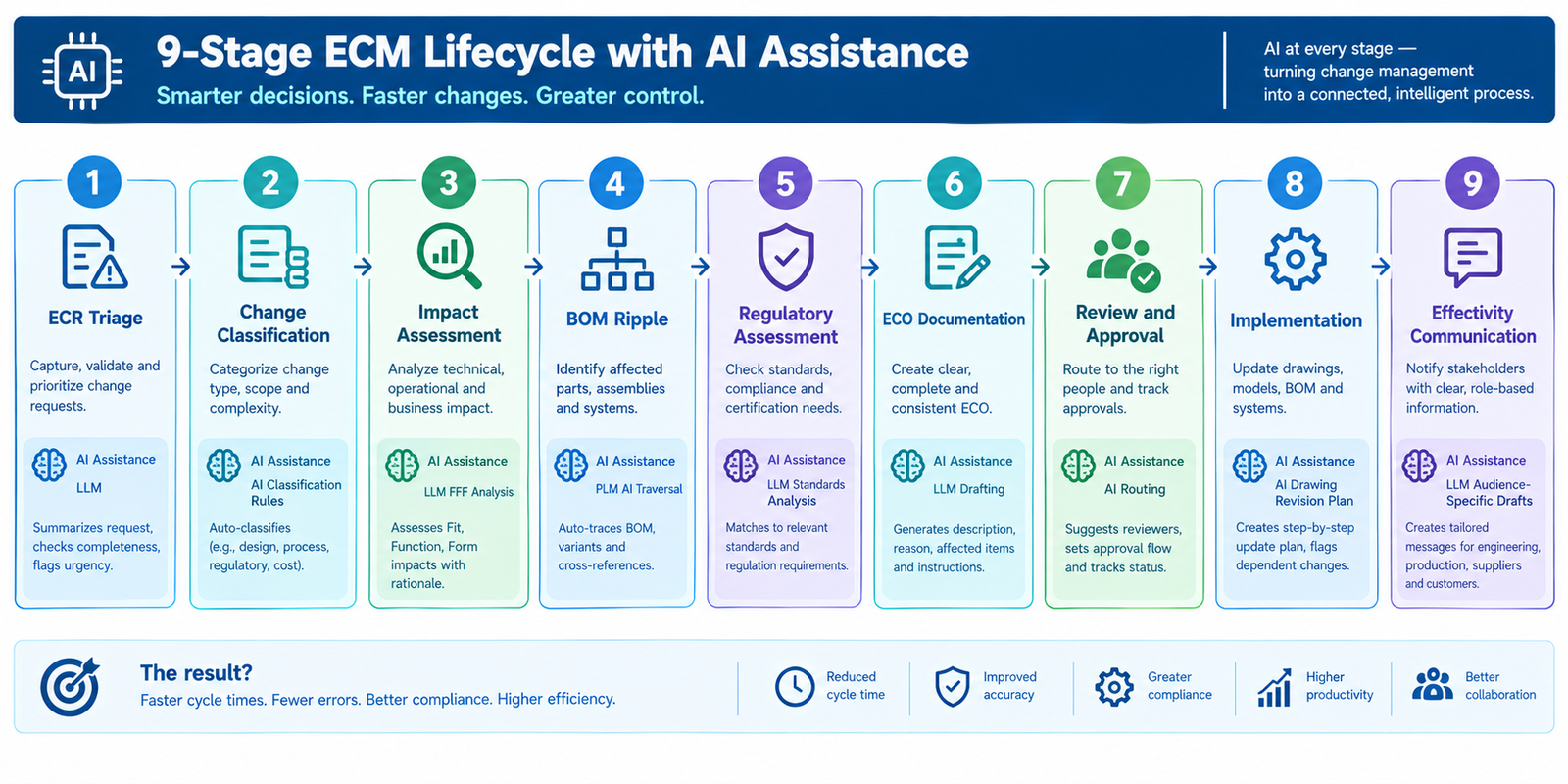
| ECM Stage | Activity | Traditional Time | Key Decision | Documents Generated |
| 1. Change initiation | Engineer, quality team, customer, or supplier identifies a need for a change and raises an Engineering Change Request (ECR) or Design Change Request (DCR) | 30 min – 2 hours | Is this a valid change request or can it be resolved without a formal change? | ECR / DCR form |
| 2. Change classification | Change is classified by type (correctional, improvement, cost reduction, obsolescence, regulatory) and scope (major/minor, safety-critical/non-safety) | 30 min – 4 hours | What is the change classification and what approval path does it require? | Change classification record |
| 3. Impact assessment | Technical assessment of form, fit, and function impact; interchangeability assessment; safety and reliability implications | 1 day – 2 weeks | What is affected by this change, and what are the consequences? | Impact assessment report |
| 4. Affected items identification | All drawings, BOM entries, specifications, test procedures, and work instructions affected by the change are identified | 4 hours – 3 days | Is the affected items list complete? Are there any second-order effects? | Affected items list |
| 5. Regulatory and customer assessment | Assess whether the change triggers regulatory re-qualification (CE, FDA, aviation authority), customer notification, PPAP re-submission, or concession requirements | 1 day – 1 week | What regulatory and customer obligations does this change create? | Regulatory impact assessment |
| 6. ECO documentation | Formal Engineering Change Order document is prepared with technical justification, change description, affected items, regulatory assessment, and approval routing | 1 day – 3 days | Is the ECO complete and technically justified? | ECO document |
| 7. Review and approval | ECO is reviewed and approved by all required stakeholders (design authority, quality, manufacturing, procurement, safety, customer if required) | 3 days – 6 weeks | Is the change approved to proceed? | Approved ECO, approval signatures |
| 8. Implementation | Drawings updated to new revision, BOM updated, affected work instructions and specifications updated, procurement notified for material changes | 1 day – 2 weeks | Have all affected documents been updated correctly? | Updated drawings, updated BOM, updated documents |
| 9. Production effectivity | Change is communicated to production with effectivity date or serial/batch number. Existing stock of affected parts is dispositioned (use as is, rework, scrap) | 1 day – 1 week | Is production ready to implement the change, and how is existing stock handled? | Effectivity notice, stock disposition record |
The total cycle time for a routine engineering change in a mature engineering organisation ranges from 2 weeks (simple drawing correction, no regulatory impact, one affected document) to 6 months (safety-critical change on a regulated product, multiple affected assemblies, customer notification and re-qualification required). The median cycle time across most manufacturing organisations is 4-8 weeks, a significant portion of which is administrative overhead that AI can reduce.
Why Traditional ECM Is Broken (and What AI Fixes)
| Traditional ECM Failure Mode | Engineering Consequence | What AI Fixes |
| Affected items list is incomplete | Drawings or BOM entries not updated to new revision; manufacturing builds to old design on some assemblies; assembly failures or non-conformances | AI BOM ripple analysis traverses the complete product tree automatically, identifying all parent and child assemblies affected by a component change, not just the immediate parent |
| Regulatory impact not assessed | Change is implemented without required re-qualification; non-compliant products shipped to market; regulatory enforcement action or recall | AI regulatory assessment reads the applicable standards and identifies which change characteristics trigger re-qualification, notification, or concession requirements |
| Change classification too conservative | Routine corrections classified as major changes requiring full approval cycle; ECO cycle time inflated by unnecessary approvals; engineering team bandwidth consumed by bureaucracy | AI change classification applies consistent criteria from the applicable standard (IATF 16949 major/minor, AS9100 major/minor, FDA significant/non-significant) rather than conservative individual judgement |
| ECO documentation incomplete or inconsistent | Approval board sends ECO back for rework; delay in approval cycle; inconsistency between ECO justification and change description | AI drafts complete ECO documentation from change description inputs, applying the correct format and ensuring consistency between sections |
| Change approved but not communicated to production | Production continues building to old revision; non-conforming parts manufactured after change effectivity date; scrap and rework | AI effectivity communication generates clear, supplier-ready and production-ready communication from the approved ECO, reducing the gap between approval and implementation |
| Change impacts not visible until implementation | Second-order effects (changes to one component affect clearances in adjacent assemblies) discovered during implementation rather than impact assessment; additional changes required | AI impact assessment reasons about second-order effects from assembly context description, flagging potential downstream consequences that the primary impact assessment may have missed |
Stage 1: AI for Change Request Triage and Classification
Engineering change requests arrive from multiple sources, field failure reports, customer feedback, cost reduction initiatives, supplier obsolescence notices, regulatory requirement updates, and internal design improvement proposals. The first ECM task is triage: distinguishing genuine change requests that require a formal ECO from issues that can be resolved through clarification, concession, or alternative means; and classifying valid requests by type and scope to determine the appropriate approval path.
AI for ECR Validity Assessment
LLMs can perform an initial validity assessment of Engineering Change Requests by reading the ECR description and answering a structured set of triage questions:
- Can this be resolved without a design change? Non-conformances that fall within existing tolerances may be resolvable through a deviation or concession rather than a formal design change. AI can assess whether the described non-conformance is within or outside the current drawing specification.
- Is this a drawing error or a design change? Corrections to drawing annotation errors (missing tolerances, incorrect GD&T notation, transposition errors) are typically classified differently from changes to the design geometry or material specification. AI can distinguish the category from the ECR description.
- Is this a warranty/field failure root cause change or a proactive improvement? Field failure-driven changes have different urgency, approval, and customer notification implications than cost-reduction or improvement changes. AI can classify the change driver from the ECR description.
- What is the scope of the change? A change to a single dimension on one drawing has a different scope from a material substitution affecting 50 parts across 12 assemblies. AI can assess initial scope from the change description.
AI for Change Classification (Major vs Minor)
Change classification, determining whether a change is major or minor, has direct implications for the approval path, the regulatory notification requirement, the customer notification requirement, and the PPAP/PSW re-submission requirement. Different standards define major and minor differently:
| Standard / Context | Major Change Definition | Minor Change Definition | AI Classification Approach |
| IATF 16949 (Automotive) | Changes affecting form, fit, or function; changes to materials, suppliers, processes, or manufacturing locations; changes requiring customer notification per customer-specific requirements | Corrections that do not affect form, fit, or function; cosmetic changes; documentation corrections with no physical change | LLM reads change description + affected part function description + customer CSR requirements; applies IATF 16949 criteria; flags customer notification triggers |
| AS9100D (Aerospace) | Changes that affect safety, airworthiness, or compliance with the original type certificate; changes to critical characteristics or key characteristics; changes to frozen design items | Changes within the approved design envelope; corrections to documentation errors; changes not affecting flight safety or regulatory compliance | LLM reads change description + product safety classification + design approval basis; identifies critical/key characteristics affected; flags airworthiness implications |
| FDA 21 CFR Part 820 (Medical) | Changes that could significantly affect the safety or effectiveness of the device; changes to materials in patient contact, sterility, biocompatibility, or performance specifications | Changes that do not significantly affect safety or effectiveness; corrections to labelling errors; process improvements with no design impact | LLM reads change description + device classification + FDA guidance on significant design changes; identifies potential safety or effectiveness impact |
| ISO 9001 / General Manufacturing | No mandated definition, organisations define major/minor in their quality management system | As above, organisation-specific | LLM applies the organisation’s defined criteria from their quality procedure; generates classification recommendation with justification |
Stage 2: AI for Change Impact Assessment
Change impact assessment is the most technically demanding stage of the ECM process and the one where missed assessments are most expensive. The impact assessment must answer: what physical, functional, and regulatory consequences does this change have, and what other parts, assemblies, specifications, and processes are affected?
AI for Form, Fit, and Function Impact Assessment
Form-fit-function (FFF) assessment is the standard framework for evaluating the engineering significance of a change:
- Form: Does the change alter the physical geometry, mass, or material of the part in a way that affects its dimensional compatibility with adjacent parts? A dimension change that moves a mounting hole affects form. A surface finish change on a non-mating surface may not.
- Fit: Does the change affect how the part interfaces with, mates to, or assembles with other parts? A diameter change that modifies a press-fit affects fit. A change to an internal feature of a housing that does not affect the housing’s external interfaces may not.
- Function: Does the change affect the performance, reliability, or service life of the part or the assembly it belongs to? A material upgrade that increases yield strength affects function (positively). A tolerance change that reduces the interference in a press-fit affects function (potentially negatively).
LLMs perform FFF assessment from a structured description of the change and the part’s function. The output classifies the change by FFF category and identifies the specific consequence in each category. This is most valuable for assessing second-order effects, the impact on the assembly and system level that is not obvious from the individual part change.
AI for Technical Risk Assessment
For changes with structural, thermal, or materials implications, AI can assist with preliminary technical risk assessment:
- Structural risk: A dimension change that reduces cross-sectional area requires a stress re-check. LLMs can estimate the first-order effect on section modulus and stress level from described geometry changes, flagging cases where a formal FEA re-run is required before ECO approval.
- Materials compatibility risk: A material substitution requires assessment of galvanic compatibility, temperature range, chemical compatibility with adjacent materials and process fluids, and regulatory compliance. LLMs perform this assessment from the material pair description and operating environment.
- Tolerance interaction risk: A dimension change that is within the current tolerance on the individual part may push the assembly tolerance stack-up into an unacceptable range. LLMs can assess the stack-up impact from the dimension chain description.
- Manufacturing process risk: A geometry change may introduce a new DFM violation for the manufacturing process (a thicker wall section that changes the injection moulding cycle, a tighter bore tolerance that requires a changed machining operation). LLMs can flag these process risks from the change description.
Stage 3: AI for BOM Ripple and Affected Items Analysis
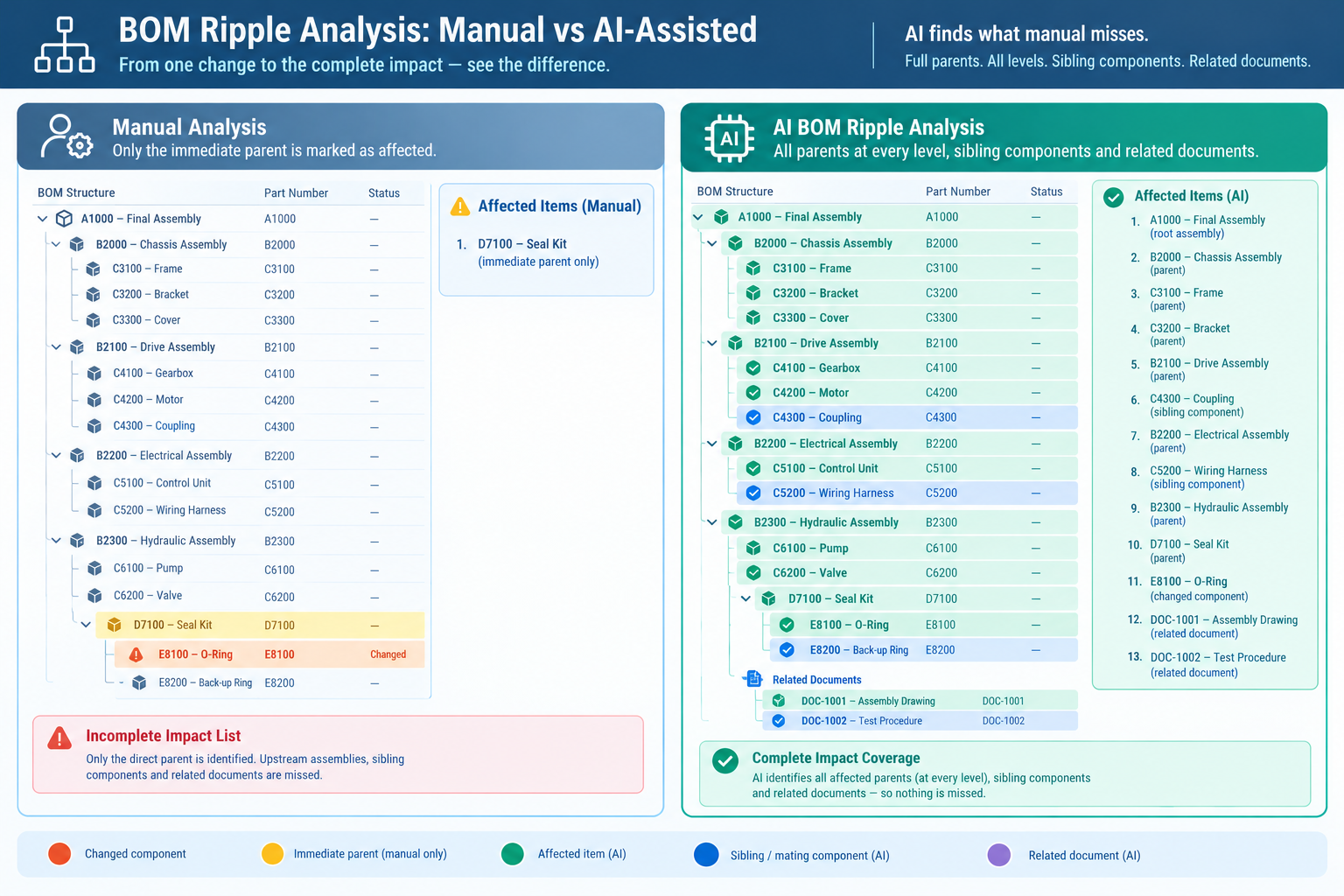
BOM ripple analysis, tracing the cascade of affected items from a component-level change up through the product tree to identify every drawing, BOM entry, specification, test procedure, and work instruction that requires updating, is the most time-consuming and error-prone stage of the ECM process in complex products. An incomplete affected items list is one of the most common causes of production non-conformances after a change is implemented: a drawing that was not updated to the new revision still exists in the production system, and parts are manufactured to the old specification.
How AI Approaches BOM Ripple Analysis
PLM-integrated AI tools (Windchill AI, Teamcenter AI, 3DEXPERIENCE AI with PLM data) traverse the product BOM tree automatically from the changed component, identifying all parents, siblings, and higher-level assemblies that reference the changed item. This is fundamentally a graph traversal problem, the BOM tree is a directed graph, and the AI traverses it from the changed node to find all connected nodes.
For teams without PLM-integrated AI, LLMs can assist with BOM ripple analysis when given a description of the BOM structure:
- Direct parents: All assemblies that include the changed component as a child BOM entry, these definitely require BOM revision update.
- Second-order parents: Assemblies that include the direct parent assemblies, these may require revision update if the change affects the top-level assembly’s form, fit, or function.
- Sibling components: Components that mate directly with the changed component, these may require re-checking of interface dimensions, clearances, and tolerances.
- Shared components: Components that are used in multiple product lines, the change affects all product lines using this component, not just the product tree where the change was initiated.
- Dependent documents: Specifications, test procedures, work instructions, acceptance criteria, and maintenance manuals that reference the changed component’s part number, revision, or specific characteristics.
The Affected Items List: What AI Generates
The AI-generated affected items list should cover:
| Document / Item Type | Why Affected | Update Required | Responsible Party |
| Changed component drawing | Component geometry, dimensions, or specification has changed | Drawing revision increment; updated dimensions/notes/GD&T; new title block revision and date | Design engineer / CAD designer |
| Parent assembly drawings | The changed component is referenced in the assembly; assembly drawing may show the affected interface or dimension | Check whether assembly drawing shows affected feature; update if so; revision increment | Design engineer / CAD designer |
| BOM (EBOM and MBOM) | Part number and revision must be updated in the engineering and manufacturing BOM | Update component revision in all BOM entries; check that quantities and notes are still correct | Configuration manager / PLM administrator |
| Component specification | If a component specification exists (material spec, performance spec, test spec), it may need updating to reflect the change | Review spec against change description; update if affected | Design engineer / quality engineer |
| Assembly work instructions | Manufacturing work instructions that reference the component’s specific characteristics (installation torque, orientation, inspection point) may need updating | Review work instructions for affected assembly steps; update if change affects manufacturing process | Manufacturing engineer |
| Incoming inspection criteria | If the changed component has incoming inspection criteria (dimensional check, functional test at goods receipt), these may need updating | Review incoming inspection plan; update dimensions or criteria affected by change | Quality engineer |
| Test procedures and acceptance criteria | If the changed component is tested as part of a qualification or production test, test procedures may reference the changed dimension or characteristic | Review test procedures; update references to changed characteristics | Test engineer / quality engineer |
| Customer-facing documents | If the changed component is referenced in a customer data package, customer drawing, or product specification submitted to the customer | Prepare customer notification package; updated customer drawing if applicable | Programme manager / customer quality engineer |
| PPAP/PSW documentation | If the part has an approved PPAP, the change may require PPAP re-submission (Level 1-5 per change classification and customer requirements) | Determine PPAP level required; prepare re-submission package | Quality engineer / PPAP team |
Stage 4: AI for Regulatory and Customer Notification Assessment
Regulatory and customer notification assessment is the ECM stage with the highest compliance risk if missed. Different regulatory frameworks have different triggers for what constitutes a change that requires re-qualification, notification, or approval before implementation. Applying these triggers incorrectly, either missing a required notification or over-triggering unnecessary re-qualification, has direct cost and schedule consequences.
AI for Regulatory Re-Qualification Trigger Assessment
LLMs with knowledge of the applicable regulatory frameworks can read a change description and assess which, if any, regulatory re-qualification requirements are triggered. The assessment must be based on the specific regulatory framework applicable to the product:
| Regulatory Framework | Change Trigger for Re-qualification or Notification | AI Assessment Approach | Risk if Missed |
| EU CE Marking (Machinery Directive 2006/42/EC, LVD, EMC) | Changes that affect the essential health and safety requirements (EHSR) the product was certified against; changes that affect the technical file; changes to safety-critical components or circuits | LLM reads change description + product EHSR checklist; identifies whether any EHSR in the technical file is affected; flags Notified Body notification requirement for high-risk categories (Annex IV) | Product placed on market without valid CE declaration; market surveillance authority enforcement action; product recall |
| FDA 21 CFR Part 820 (Medical Devices) | Changes that could significantly affect safety or effectiveness; changes to devices cleared under 510k or approved under PMA; design changes to materials in patient contact, performance specifications, sterility, biocompatibility | LLM reads change description + device classification + FDA guidance document ‘Design Changes’ (1997); assesses whether change requires 510k supplement or PMA supplement | Non-compliant device on market; FDA warning letter; Class I, II, or III recall depending on risk level |
| EASA / FAA (Aviation) | Changes to type design approved under type certificate; major design changes defined by CS-25 or FAR 25; changes to approved maintenance programme | LLM reads change description + STC/TC basis; applies EASA AMC 21.A.91 or FAA 14 CFR Part 21.93 major/minor change criteria | Flight safety non-compliance; airworthiness directive; grounding of aircraft type |
| ATEX / IECEx (Explosive atmosphere equipment) | Changes to certified equipment that affect the Ex protection concept; changes to dimensions of flameproof gaps, energy storage, surface temperature | LLM reads change description + ATEX certificate conditions; assesses whether change falls within ‘minor variations’ permitted without recertification | Equipment used in explosive atmosphere without valid certificate; explosion risk; regulatory enforcement |
| Pressure Equipment Directive / ASME BPVC | Changes to design pressure, temperature, or material in pressure-containing parts; changes to weld procedures or NDE requirements; changes that affect the pressure equipment category classification | LLM reads change description + current pressure vessel calculation basis; assesses whether recalculation to ASME UG-27 or PED Article 3 is required | Pressure equipment operating beyond its certified safe working pressure; catastrophic failure risk; regulatory enforcement |
| Critical AI Limitation in Regulatory Assessment: AI regulatory assessment identifies potential re-qualification triggers with high coverage but is not a substitute for a qualified regulatory affairs professional’s review on safety-critical or highly regulated products. Use AI assessment to ensure no trigger is overlooked in the initial assessment, and to prioritise which triggers require regulatory specialist review. For FDA, EASA, and ATEX applications, the final regulatory assessment must be made and documented by a person with the appropriate qualifications and professional accountability. |
Stage 5: AI for ECO Documentation Drafting
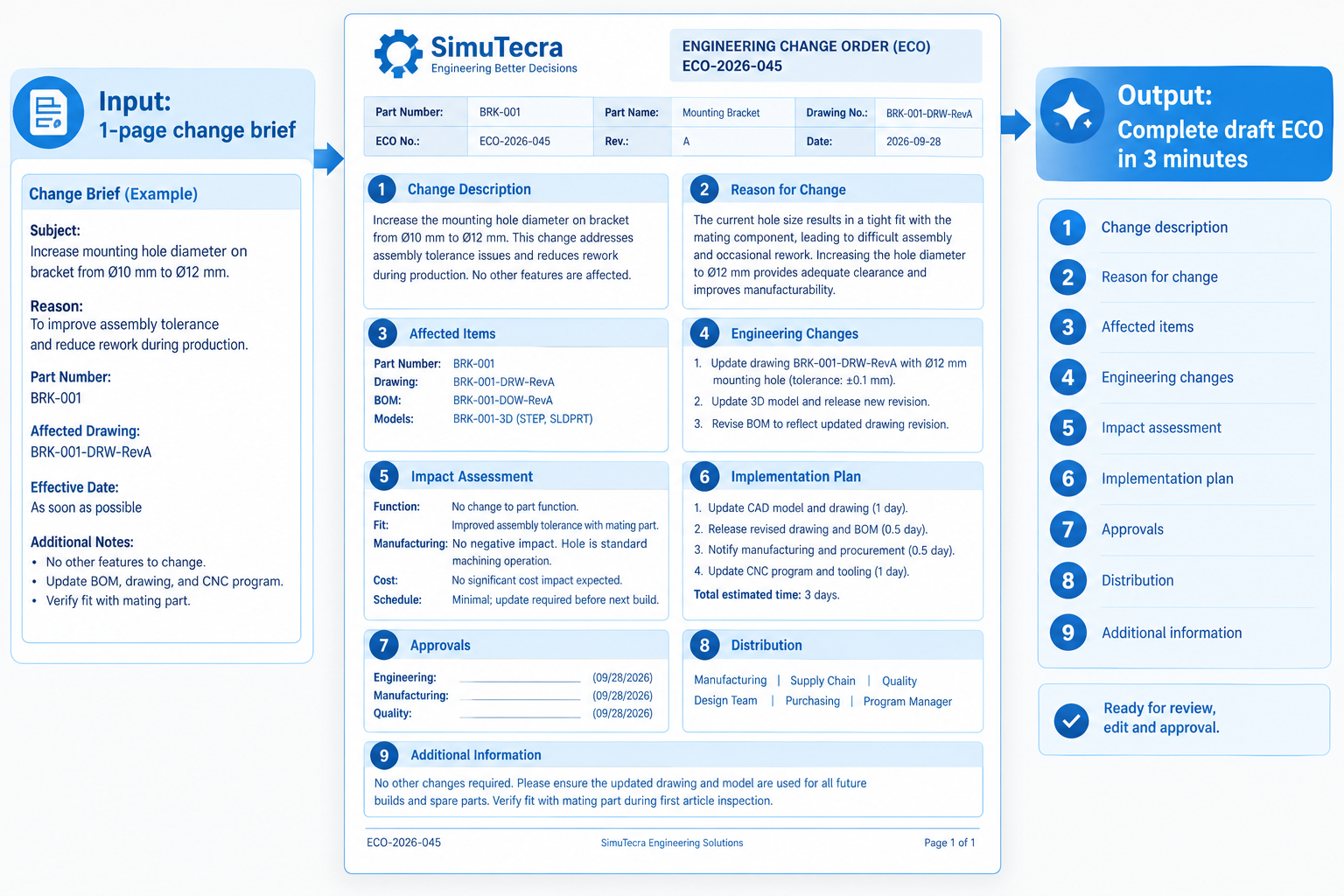
Engineering Change Order documentation, the formal record of what is changing, why it is changing, what it affects, and what approvals are required, is one of the most consistent AI productivity opportunities in engineering change management. ECO documents follow defined formats, require specific sections, and must be written in formal engineering language. LLMs can generate complete first-draft ECO documents from a structured set of inputs in minutes.
What a Complete ECO Document Contains
A formal ECO document for a typical manufacturing engineering organisation should contain the following sections. AI can draft all of them:
- Change identification: ECO number, date, initiator, affected part number(s), current revision, proposed revision, change type classification.
- Change description: A precise description of what is physically changing, the current state and the proposed state, with specific dimensional, material, or specification values for each attribute being changed.
- Reason for change: The root cause or business driver for the change: field failure root cause, cost reduction justification, obsolescence notification, regulatory requirement update, customer request, or design improvement.
- Technical justification: Engineering argument for why the proposed change satisfies all requirements: stress analysis results if structural, material property comparison if material change, tolerance analysis if dimensional, compliance evidence if regulatory.
- Form-fit-function assessment: Structured assessment of whether the change affects form, fit, or function, with interchangeability conclusion (interchangeable / not interchangeable with previous revision).
- Affected items list: All drawings, BOM entries, specifications, test procedures, and work instructions requiring update.
- Regulatory and customer assessment: Assessment of whether the change triggers regulatory re-qualification, customer notification, PPAP re-submission, or concession requirements, with conclusion and actions.
- Implementation plan: Effectivity date or serial/batch number, stock disposition instructions for existing inventory, training requirements for manufacturing personnel, supplier notification requirements.
- Approval routing: Required approvers (design authority, quality, manufacturing, procurement, safety, customer if required), approval status, and sign-off dates.
LLM ECO Documentation Generation Workflow
The most effective workflow for AI-assisted ECO documentation is:
- Engineer prepares a structured change brief: A one-page description of the change covering: what is changing (current vs proposed state with values), why the change is needed, the affected part number and revision, and the initial assessment of affected items.
- LLM generates the first-draft ECO: Using the change brief and the ECO section structure as a prompt, the LLM generates a complete first-draft ECO document with all required sections populated. See the prompt template in the LLM Templates section.
- Engineer reviews and validates: The engineer reviews each section for accuracy, adds specific numerical values not provided in the brief (revised dimension values, analysis results), and corrects any LLM errors in technical content.
- Specialists review applicable sections: The regulatory assessment section is reviewed by the regulatory affairs function; the manufacturing impact is reviewed by the manufacturing engineer; the quality impact is reviewed by the quality engineer.
- ECO is submitted for approval: The validated ECO is submitted through the PLM workflow for required approvals.
| Time Saving: ECO documentation drafting from scratch by a design engineer typically takes 2-6 hours depending on change complexity and organisational ECO format requirements. AI-assisted drafting from a structured change brief reduces this to 30-90 minutes: 15-30 minutes to prepare the change brief, 2-3 minutes for the LLM to generate the first draft, and 15-60 minutes for the engineer to review, validate, and complete the technical content. This is a 3-5x time reduction for the documentation stage alone. |
Stage 6: AI for Drawing and Document Update Planning
Once an ECO is approved, the implementation stage requires systematic updating of all identified affected documents to their new revision. This is a coordinated workflow that must ensure: every document on the affected items list is updated; every update correctly reflects the approved change (not an interpretation of the change); revision levels are incremented consistently; and the revision change is documented in the drawing title block or revision history table.
AI for Drawing Revision Planning
LLMs can generate a drawing revision plan from the approved ECO, a structured list of every change to be made to each affected drawing, in sufficient detail for a CAD designer to implement without ambiguity:
Prompt: ‘From the following approved ECO, generate a drawing revision plan for each affected drawing. For each drawing, list: (1) Drawing number and current revision. (2) New revision designation. (3) Every specific change to be made to the drawing (dimension values to change, notes to add/modify/delete, GD&T callouts to add/modify, title block fields to update, revision history entry text). Be specific, state the exact dimension that changes from what value to what value. ECO: [PASTE APPROVED ECO CONTENT].’
This output serves as the CAD designer’s implementation checklist, a specific, unambiguous task list that prevents the common mistake of implementing the change differently from what the ECO specified, or implementing it incompletely on one of the affected drawings.
AI for Work Instruction and Procedure Update Planning
Beyond drawings, ECOs frequently require updates to manufacturing work instructions, incoming inspection procedures, test procedures, and maintenance manuals. LLMs can review these documents (as PDFs or described in text) against the approved ECO and identify which specific passages, steps, or values require updating, generating a markup instruction for each document that directs the document owner to make specific changes.
Stage 7: AI for ECO Review, Approval, and Workflow Routing
ECO review and approval is the stage where the change is evaluated by all required stakeholders before implementation authorisation. The approval workflow depends on the change classification: a minor correction may require only design authority sign-off; a major change affecting a safety-critical system in a regulated product may require design authority, quality, safety, manufacturing, regulatory affairs, and customer approval before implementation can proceed.
AI for Approval Path Determination
AI can determine the required approval path from the change classification and the applicable quality management system (QMS) procedure:
- Minor correction (no FFF impact): Design authority approval only. No customer notification. No PPAP impact. Effectivity immediate.
- Minor change (minor FFF impact, interchangeable): Design authority + quality approval. Customer notification per CSR requirements. PPAP Level 1 (Design Record submission). Effectivity by date or batch number.
- Major change (significant FFF impact, not interchangeable): Design authority + quality + manufacturing + safety (if applicable) + customer approval. Full PPAP re-submission (Level 3 or Level 4 per customer). Effectivity by new part suffix or new part number.
- Regulatory-triggered change: All of the above plus regulatory affairs + Notified Body or regulatory agency submission as required by the applicable standard.
AI for ECO Review Comment Response
During the ECO approval cycle, reviewers raise comments that require a technical response from the initiating engineer. LLMs can assist with drafting professional technical responses to ECO review comments, the same way they assist with design review comment responses (see the AI-Assisted Design Reviews article). The prompt structure: ‘Draft a professional response to the following ECO review comment: [PASTE COMMENT]. My proposed resolution: [DESCRIBE HOW THE COMMENT WILL BE ADDRESSED]. The ECO section the comment refers to: [PASTE RELEVANT SECTION]. Write a formal response stating: whether the comment is accepted or accepted with modification, what specific change will be made to the ECO document, and the technical justification for the response.’
Stage 8: AI for Production Effectivity and Communication
Production effectivity, the communication of an approved change to the manufacturing floor, procurement, and the supply chain, with clear instructions on when the change takes effect and how existing inventory is handled, is the final ECM stage and the one where breakdown most directly causes non-conforming product to be manufactured.
AI for Effectivity Communication Drafting
LLMs can draft clear, unambiguous effectivity communications from the approved ECO for each audience that needs to receive them:
- Production floor communication: Plain-language description of what is changing, the effectivity date or serial/batch number, which work instruction or drawing revision to use from the effectivity date, and what to do with any parts in WIP that were started before the effectivity date.
- Procurement communication: Notification to procurement of any material or component changes, the effectivity date for the new specification, whether existing purchase orders need to be amended, and how to handle stock of the old specification material in the stores.
- Supplier notification: Formal engineering change notice to affected suppliers, with the changed drawing revision, the effectivity date, and any PPAP re-submission requirements.
- Customer notification: Customer-facing engineering change notice in the format required by the customer’s supplier quality requirements, with the change description, rationale, interchangeability assessment, and effectivity.
AI for Stock Disposition Planning
When an ECO changes the specification of a manufactured or purchased component, the existing inventory of the old specification requires a disposition decision: use as is (if the change is minor and the old specification product is still acceptable), rework (if the change can be applied to existing stock), scrap (if the change is fundamental and old specification parts cannot be used), or use until depletion (if the change is interchangeable and both old and new specifications are acceptable). LLMs can assist with stock disposition reasoning from the FFF assessment and the regulatory constraints, identifying which disposition options are permissible for the change type and regulatory context.
AI ECM Tools: PLM Platform Review
| PLM Platform / Tool | AI ECM Capability | ECM Stage Addressed | Integration | Best For |
| PTC Windchill AI (Atlas) | Natural language ECO search and retrieval; AI-assisted change impact analysis; BOM where-used traversal; automated change propagation suggestions | Stages 3, 4, 7, 8 | Native Windchill; Creo integration; REST API for custom integrations | Large aerospace, defence, and industrial manufacturing organisations using PTC Windchill for PLM |
| Siemens Teamcenter AI (Active Workspace AI) | AI change classification; BOM ripple analysis; affected items identification; natural language PLM data queries; AI-assisted change routing | Stages 1, 2, 3, 7 | Native Teamcenter; NX CAD integration; Polarion ALM integration for requirements traceability | Automotive, aerospace, and industrial manufacturing organisations using Siemens PLM suite |
| Dassault 3DEXPERIENCE AI (ENOVIA) | AI-powered change impact assessment; generative AI for ECO documentation; AI compliance checking against standards; connected BOM change propagation | Stages 2, 3, 4, 5 | Native 3DEXPERIENCE platform; CATIA, SolidWorks SOLIDWORKS Manage integration | Automotive and aerospace organisations using Dassault 3DEXPERIENCE ecosystem |
| Aras Innovator (open platform + AI) | Open architecture PLM with AI extensions; custom AI workflow automation; integration with external AI/LLM APIs | Configurable to any stage | REST API; connects to Azure OpenAI, Anthropic, and other LLM providers | Organisations wanting flexible PLM with custom AI integration without vendor lock-in |
| Arena PLM (PTC) with AI features | Cloud PLM with AI-assisted change management; automated BOM where-used; AI compliance tracking | Stages 3, 4, 7 | Cloud-native; integrates with SolidWorks, Fusion 360, Altium via API | SME and mid-market product companies needing cloud PLM with AI ECM without enterprise investment |
| LLMs (Claude, ChatGPT), standalone | ECO documentation drafting; change classification reasoning; regulatory trigger assessment; BOM ripple reasoning from description; stock disposition analysis; effectivity communication drafting | All stages (with described inputs) | No native PLM integration, works from described inputs and attached documents | All engineering teams regardless of PLM system; highest value for documentation-heavy ECM stages |
| Jama Connect AI / codeBeamer AI | AI requirements traceability; change impact on requirements; regulatory compliance assessment; test coverage analysis for changed requirements | Stages 2, 4, 7 | Integrates with SolidWorks PDM, Windchill, Teamcenter via API; Jira, Confluence | Regulated product companies needing AI-assisted requirements-to-change traceability for FDA, aerospace, or automotive compliance |
LLM Prompt Templates for Engineering Change Management
The following templates are ready to use in Claude or ChatGPT. Replace [BRACKETED] items with your specific change data.
Template 1: Change Request Triage and Classification
Triage and classify the following Engineering Change Request. ECR description: [PASTE ECR]. Affected component: [PART NUMBER, NAME, AND FUNCTION]. Product it belongs to: [PRODUCT NAME AND APPLICATION]. Applicable standard/quality system: [e.g. IATF 16949, AS9100D, ISO 9001, FDA 21 CFR Part 820]. Answer: (1) Is this a valid change request requiring a formal ECO, or can it be resolved through deviation, concession, or drawing clarification? Justify. (2) Change type classification: correctional (error fix) / improvement / cost reduction / obsolescence / regulatory / customer request. (3) Change scope classification: major (affects FFF, requires customer notification or PPAP) / minor (no FFF impact, documentation correction only). Apply the definition from the stated standard. (4) Initial affected items scope estimate: how many documents/drawings are likely affected? (5) Approval path required based on classification. (6) Any immediate actions required before the formal ECO process (safety hold, stop-ship, production hold).
Template 2: Change Impact Assessment
Perform a change impact assessment for the following engineering change. Change description: [DESCRIBE PRECISELY: what is changing, current value/state, proposed value/state]. Component function: [DESCRIBE]. Assembly context: [DESCRIBE HOW THIS COMPONENT INTERFACES WITH ADJACENT COMPONENTS]. Operating conditions: [DESCRIBE]. Assess: (1) Form impact: does the change alter the component’s physical geometry, mass, or envelope in a way that affects dimensional compatibility with adjacent components? Which specific interfaces are affected? (2) Fit impact: does the change affect how this component mates, interfaces, or assembles with other components? Which mating features are affected and how? (3)
Function impact: does the change affect the performance, reliability, or service life of the component or the assembly? Is the impact positive (improvement) or negative (potential degradation)? (4) Interchangeability conclusion: is the new revision interchangeable with the previous revision in all assemblies where it is used? (5) Second-order effects: what downstream consequences (assembly clearances, tolerance stack-ups, structural integrity, regulatory compliance) may be indirectly affected by this change? (6) Technical analyses required before ECO approval: which of the identified impacts require formal analysis (FEA re-run, tolerance stack-up recalculation, material property verification)?
Template 3: Regulatory Trigger Assessment
Assess the regulatory and customer notification requirements for the following engineering change. Product: [NAME AND APPLICATION]. Applicable certifications/approvals: [LIST: e.g. CE Marking under Machinery Directive 2006/42/EC, FDA 510k clearance K123456, ATEX certificate, customer PPAP approval]. Change description: [DESCRIBE CHANGE PRECISELY]. For each applicable certification/approval: (1) Does this change trigger the requirements for re-qualification, re-certification, or notification under the applicable regulatory framework?
Cite the specific article, clause, or guidance document that supports your assessment. (2) What is the required action: notify before implementation / submit for approval before implementation / update technical file / retest / resubmit PPAP / no action required? (3) What is the timeline: must action be completed before change implementation or can it be completed concurrently? (4) Who is responsible for completing the regulatory action? Provide a regulatory action summary table: Framework | Trigger? (Y/N) | Required Action | Timeline | Responsible Party.
Template 4: ECO Document Draft
Draft a complete Engineering Change Order document for the following change. Use the section structure: (1) Change Identification (ECO number: [NUMBER], date, initiator, affected part number(s), current revision, proposed revision, change type). (2) Change Description (precise current vs proposed state with specific values). (3) Reason for Change (root cause and business driver). (4) Technical Justification (engineering argument for the change; reference analysis results: [DESCRIBE AVAILABLE EVIDENCE]). (5) Form-Fit-Function Assessment (FFF impact and interchangeability conclusion).
(6) Affected Items List (all drawings, BOM entries, specifications, procedures requiring update). (7) Regulatory and Customer Assessment (re-qualification or notification requirements). (8) Implementation Plan (effectivity, stock disposition, supplier notification, training requirements). (9) Approval Routing (required approvers by function). Change data: Component: [PART NUMBER AND NAME]. Change description: [DESCRIBE]. Reason: [DESCRIBE]. Available technical evidence: [DESCRIBE ANALYSES OR TEST RESULTS]. Affected items identified: [LIST]. Regulatory certifications: [LIST]. Write in formal engineering language. Use ‘shall’ for mandatory requirements. Write in third person.
Template 5: Effectivity Communication to Production
Draft production effectivity communications for the following approved ECO. Audience 1 (production floor): write a clear, plain-language communication stating: what is changing on which part number; the new drawing revision; the effectivity date or serial/batch number; which work instruction applies from the effectivity date; and instructions for any WIP parts started before the effectivity date.
Audience 2 (procurement): write a procurement notification stating: which components or materials are changing; the new specification or drawing revision; the effectivity date for new orders; and instructions for existing stock and open purchase orders. Audience 3 (affected supplier, if any): write a formal Engineering Change Notice to the supplier stating: the changed part number and new revision; the change description; the effectivity date; any PPAP re-submission requirements; and who to contact with questions. ECO summary: [PASTE KEY ECO DATA: part number, change description, new revision, effectivity, stock disposition decision, PPAP requirement if any].
ECM AI Governance and Risk
AI in engineering change management requires explicit governance because ECM is a configuration control process with direct production quality and regulatory compliance implications. The following governance principles apply to all AI ECM applications.
| Governance Principle | Why It Matters | Implementation |
| All AI ECM outputs require engineer sign-off before entering the formal ECM record | AI-generated ECO documentation, impact assessments, and affected items lists may contain errors or omissions that have direct production and compliance consequences | No AI output enters the PLM system, the ECO approval workflow, or the affected items list without review and validation by the responsible engineer |
| Regulatory assessments require qualified professional review | AI regulatory trigger assessment covers known frameworks well but may miss nuances, recent guidance updates, or product-specific certification conditions that require specialist regulatory knowledge | Regulatory affairs professional reviews all AI regulatory assessments before ECO is submitted for approval; AI assessment is the starting point, not the final answer |
| BOM ripple analysis must be validated against PLM data | LLM BOM ripple analysis from described BOM structure is less reliable than PLM-integrated BOM traversal because the engineer’s description may be incomplete | Validate LLM-generated affected items list against actual PLM BOM data before finalising the ECO; use PLM-integrated AI tools for BOM traversal where available |
| AI-generated ECO documents must use verified numerical data | LLMs may fill in numerical values (dimensions, tolerances, material properties) from their training data rather than from the actual design data, introducing incorrect values into the ECO | Engineer must verify every specific numerical value in the AI-generated ECO against the actual drawing, specification, or analysis result; never accept LLM-generated numbers without checking the source |
| Document AI tool usage in regulated ECOs | For regulated products (FDA, EASA, ATEX), the ECM record may be subject to regulatory audit. Auditors are beginning to ask about AI tool usage in design and change records. | Document in the ECO or the ECM quality procedure which AI tools were used, for what purpose, and what human review was applied to AI outputs |
Frequently Asked Questions (FAQ)
What is AI for engineering change management?
AI in engineering change management (ECM) automates change request classification, impact assessment, BOM analysis, regulatory checks, ECO documentation, and effectivity communications. It can reduce administrative cycle time by 3–5× for documentation-heavy tasks while improving consistency and completeness, with engineers retaining final approval.
What is an Engineering Change Order (ECO)?
An Engineering Change Order (ECO) is a formal document that authorises and records changes to engineering designs, drawings, specifications, or BOMs. It documents the change rationale, affected items, implementation plan, approvals, and effective date, ensuring controlled configuration management and traceability.
How does AI assist with BOM ripple analysis in ECM?
AI assists BOM ripple analysis by identifying all components, parent assemblies, related documents, and manufacturing processes affected by an engineering change. PLM tools automate BOM traversal, while LLMs can analyze described BOM structures to identify direct and indirect impacts, including shared components across product lines.
Can AI assess regulatory compliance for engineering changes?
LLMs can identify potential regulatory compliance triggers for engineering changes across frameworks such as FDA, FAA/EASA, CE marking, and ATEX. AI assessments must be verified by qualified regulatory professionals, especially for safety-critical industries, before ECO approval.
How long does AI-assisted ECO documentation take vs manual?
Manual ECO documentation typically takes 2–6 hours, while AI-assisted drafting can reduce it to 30–90 minutes. AI speeds up change descriptions, technical justifications, and impact assessments, but engineers must verify the details and complete specialist sections.
What PLM systems have AI engineering change management features?
Major PLM platforms supporting AI-assisted engineering change management include PTC Windchill, Siemens Teamcenter, Dassault 3DEXPERIENCE, Arena PLM, and Aras Innovator. Their capabilities vary across change classification, BOM impact analysis, compliance checks, and ECO documentation. Claude and ChatGPT can also assist with documentation tasks without PLM integration.
How should AI be used in regulated ECM processes (automotive, aerospace, medical)?
AI can support regulated ECM processes by drafting ECOs, classifying changes, and identifying regulatory triggers. Every AI-generated output must be verified and approved by a qualified engineer, with AI usage documented in the ECM procedure and relevant records.
Conclusion
Engineering change management is one of the most universally recognised pain points in manufacturing engineering organisations, too slow, too bureaucratic, too incomplete, and too dependent on individual expertise to be consistently well-executed across all change types and all engineers. AI addresses these problems at the root: change classification and triage that applies consistent criteria rather than individual conservative judgement; BOM ripple analysis that traverses the complete product tree rather than the engineer’s memory of which assemblies use a component; regulatory trigger assessment that checks every applicable framework rather than the ones the engineer remembers; and ECO documentation that produces a complete, correctly formatted draft in minutes rather than hours.
The implementation path is straightforward. Start with AI ECO documentation drafting, it is the most immediately accessible AI ECM application, requires no PLM integration, and delivers immediate time savings. Add AI regulatory trigger assessment for any change with potential regulatory implications, the risk of missing a re-qualification trigger is too high for any organisation to leave to unaided memory. Add PLM-integrated AI for BOM ripple analysis when the organisation’s PLM data quality justifies it, AI BOM traversal is only as reliable as the BOM data it traverses. Build the complete AI-augmented ECM workflow over successive implementation cycles, governed by the principle that AI is a productivity tool within the quality management system, not a replacement for qualified engineering accountability.
The organisations that implement AI ECM systematically will close ECOs in days rather than weeks, with higher completeness, more consistent regulatory compliance, and less administrative burden on design engineers, freeing that engineering capacity for the design and analysis work that creates value, rather than the documentation work that records it.
Related Reading: How Engineers Use AI to Review CAD Models Faster | AI-Assisted Design Reviews for Mechanical Engineers | Using AI to Detect Design Errors Before Manufacturing | 50 Claude Prompts for Mechanical Engineers | 3D Modeling in CAD: The Complete 2025 Guide
Leave a Reply