A few years ago, the engineering software industry seemed to reach a collective agreement: AI was going to change everything. Vendors rewrote their marketing pages. Conference keynotes promised autonomous design systems that would shrink development cycles from months to days. Engineering managers were told to prepare for transformation.
It is now 2026, and the honest assessment is more nuanced than the pitch decks suggested. Some of what was promised is genuinely here, deployed in real workflows at real companies, producing real time and cost savings. A meaningful part of it is still vendor theater: capable in demos, limited in production, and often solving the wrong problems.
This article is written for engineers, engineering managers, and technical decision-makers who want a clear-eyed view of what AI is actually doing in engineering design today. Not what it might do by 2030. Not what a simulated benchmark shows. What is working right now, what is not, and what you should actually be paying attention to in your organization this year.
We draw on the SimScale 2026 State of Engineering AI Report, Autodesk’s State of Design and Make survey, Gartner’s 2025 hype cycle analysis, firsthand feedback from engineers, and published research to give you a ground-level view of the current state of the art.
1. The State of AI in Engineering Design: 2026 at a Glance
Before separating real from hype, you need a baseline picture of where the industry actually stands.
| Metric | Data Point | Source |
|---|---|---|
| Organizations using AI in at least one business function | 88% | McKinsey / Intuit survey, 2026 |
| AEC firms that have formally adopted AI | 27% | ASCE survey, late 2025 |
| AEC AI adopters planning to expand usage in 2026 | 94% | ASCE survey, late 2025 |
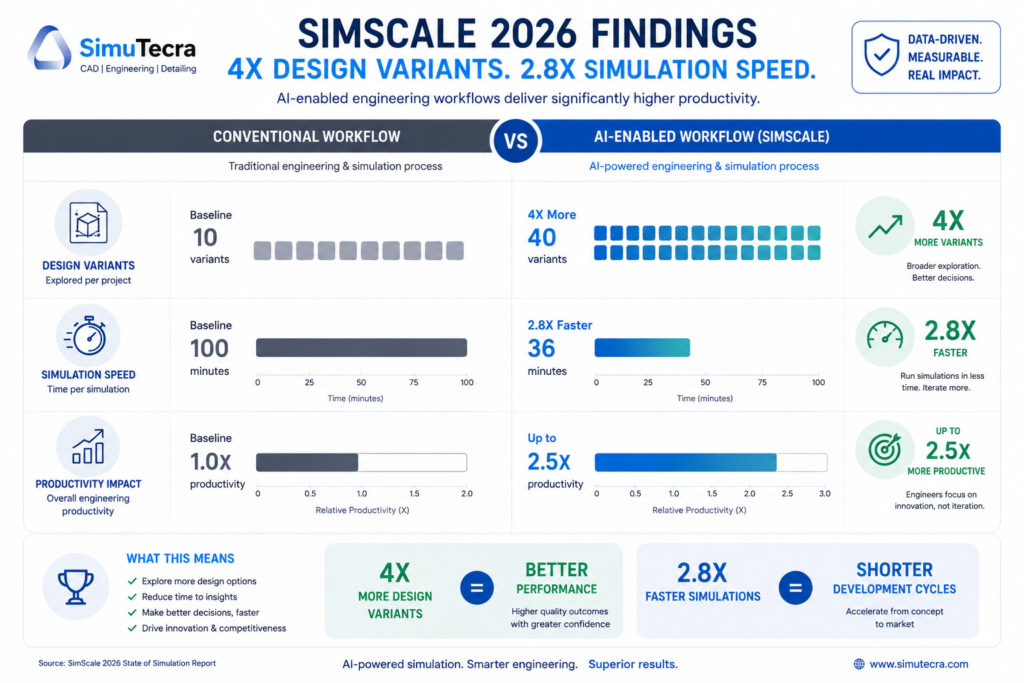
| Engineering teams using AI generating design variants per program | ~4x more than non-AI teams | SimScale 2026 State of Engineering AI Report |
| Simulation request speed-up for AI-enabled engineering workflows | 2.8x faster than conventional | SimScale 2026 Report |
| Top barrier to scaling AI in engineering | Data preparation and availability (74%) | SimScale 2026 Report |
| Organizations getting measurable ROI from AI projects (2025 MIT study) | 5% (95% report zero ROI) | MIT NANDA GenAI Divide Report, 2025 |
| Digital twin market projected value by 2030 | $150 billion (from $21B in 2025) | Industry analyst consensus |
These numbers tell a revealing story. Adoption is accelerating, particularly in engineering-heavy industries. But the gap between organizations that have installed AI tools and those generating measurable business impact from them remains enormous. The 95 percent figure from MIT’s NANDA report deserves direct acknowledgment: most AI projects in enterprise settings have not yet produced return on investment. That does not mean AI is failing. It means most organizations have not yet done the hard work of integrating AI meaningfully into real workflows.
The engineering firms and manufacturing organizations that are generating impact share a common pattern, noted in the SimScale report: they are embedding AI into core engineering workflows rather than running it as a parallel experiment. The ones still running AI ‘pilots’ are, in most cases, not generating results.
2. Understanding the Hype Cycle: Where Engineering AI Sits Right Now
Gartner’s 2025 Hype Cycle for AI is instructive. Generative AI, after dominating the Peak of Inflated Expectations in 2023 and 2024, is now beginning its descent toward the Trough of Disillusionment. This is not a disaster. It is a normal and healthy maturation. The technologies that survive the trough, and most of the genuinely useful ones do, emerge on the slope of enlightenment as practical, well-understood tools that deliver consistent value.
For engineering specifically, Autodesk’s State of Design and Make 2025 report found a meaningful drop in positive AI sentiment compared to the prior year. Fumihiro Ojima, general manager of digital innovation at Tokyu Construction, captured the shift clearly when he said the industry has come to understand that AI is suited to some things and not others, and that the initial impression of AI being able to do everything has passed.
That recalibration is healthy for the engineering profession. It creates space for a more honest question: not ‘what can AI do eventually?’ but ‘what is AI reliably doing right now in engineering workflows, and what should I actually invest in?’
| DATA: Gartner Trough Finding. Generative AI moved from Peak of Inflated Expectations toward Trough of Disillusionment in 2025. Technologies entering the trough typically reach practical productivity 2 to 5 years after initial peak hype. |
3. What Is Actually Working: AI Applications Delivering Measurable Value
Let us be direct. These are the areas where AI in engineering design is producing documented, repeatable, commercially meaningful results in 2026, not in lab conditions, and not in vendor demos.
Simulation Acceleration
This is arguably the most consequential real-world application of AI in engineering today. Traditional finite element analysis (FEA) and computational fluid dynamics (CFD) simulation runs are computationally expensive and slow. A complex thermal analysis might take 12 to 48 hours to run on conventional infrastructure. AI surrogate models, trained on prior simulation data, can approximate simulation results in minutes, sometimes seconds, at acceptable accuracy for early-stage design decisions.
The SimScale 2026 report found that engineering teams using AI-enabled simulation workflows process requests 2.8 times faster on average than those using conventional workflows. More significantly, these teams test nearly four times as many design variants per program. That is not marginal improvement. That is a structural change in what is practically possible within a given development timeline.
| REAL: Simulation surrogate models. AI-accelerated simulation is working in production environments now. Teams at aerospace and automotive companies are using it to explore design spaces that were previously computationally prohibitive. |
Automated Drawing Production
Autodesk’s Fusion has shipped an Automated Drawings feature that auto-generates 2D engineering drawings from 3D models, with automatic view selection, dimension placement, and basic annotation. Since launch, millions of automated dimensions and constraints have been applied. Engineers using it describe the feature as having moved from experimental to genuinely useful for routine drawing production over the past 12 months.
SolidWorks 2026 has introduced a Command Predictor (currently in beta) that anticipates the next modeling command based on session context, a Contextual Assistant that recommends workflow optimizations in real time, and a Fastener Recognition feature that identifies and mates hardware components automatically. These are not capabilities that transform the design process on their own, but they represent real, daily time savings in routine modeling work.
| REAL: Automated drawing generation. Autodesk Fusion’s Automated Drawings and SolidWorks’ Sketch AutoConstrain are in daily production use at engineering firms globally. Real time savings, not just demo capabilities. |
Topology Optimization
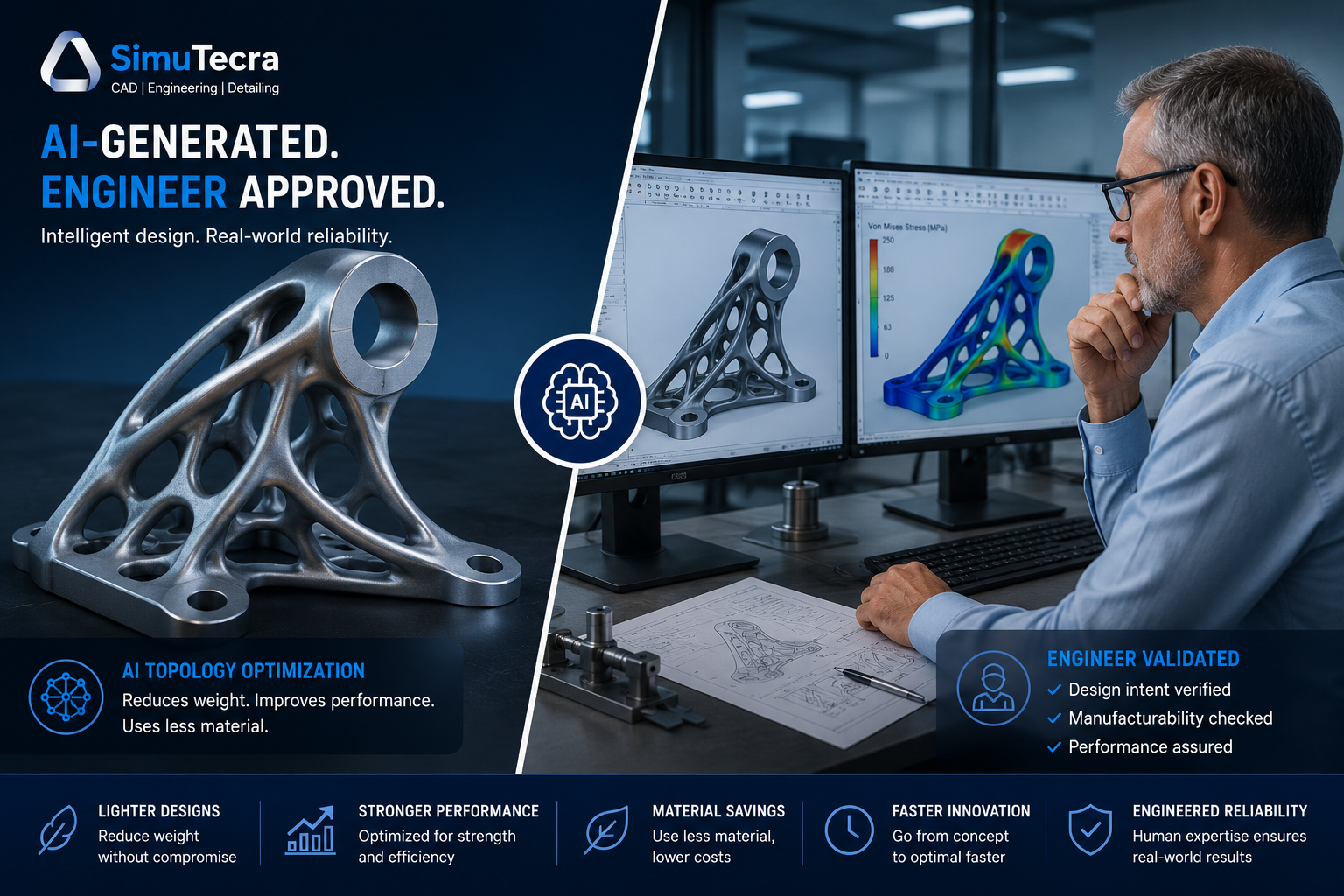
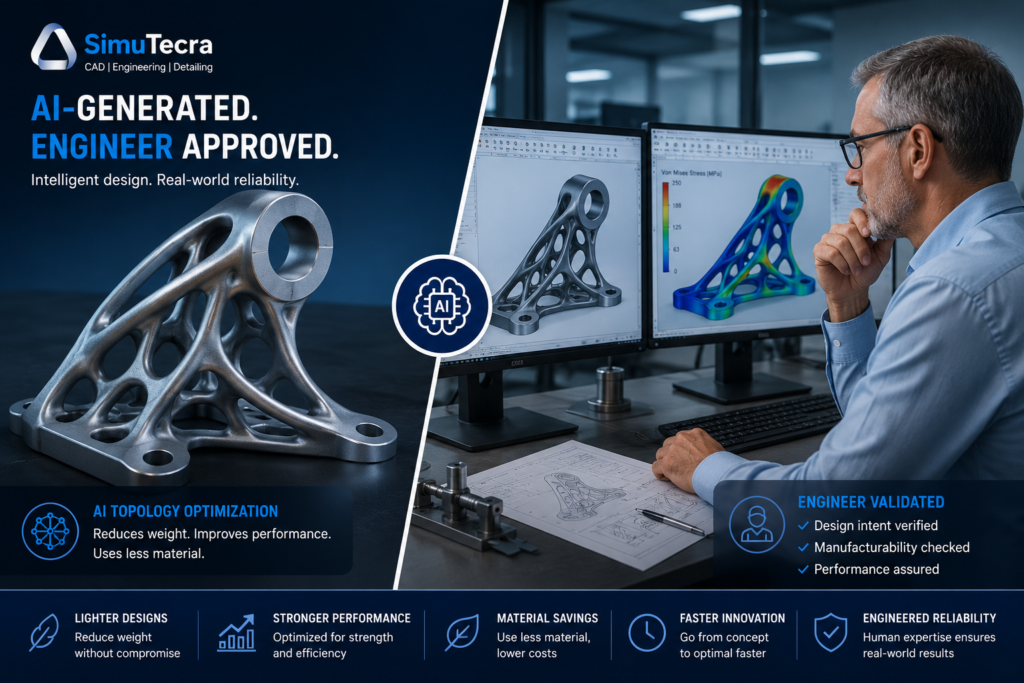
Topology optimization is the process of computationally determining the most efficient material distribution within a defined design space, given specified loads and constraints. This is not a new idea, but AI has meaningfully improved both the speed of optimization runs and the manufacturability of the resulting geometries.
Aerospace and automotive applications have been the primary beneficiaries. Airbus famously used topology optimization to redesign a cabin bracket, reducing its mass by 45 percent while meeting the same structural performance requirements. That specific project predates current AI tools, but it established the value proposition. Current AI-enhanced topology optimization in tools like Autodesk Fusion’s Generative Design, Siemens NX, and Altair OptiStruct is producing similar results with significantly shorter compute times and better integration with manufacturing constraints.
| REAL: Topology optimization. Working reliably for structural, thermal, and aerospace applications. Best results come from combining AI topology output with engineer-applied manufacturing feasibility judgment. |
Part Search and Design Reuse
One of the less glamorous but high-impact AI applications in engineering is intelligent part search. Most engineering organizations maintain libraries of thousands of existing parts, but engineers routinely create new parts that are near-duplicates of ones that already exist because finding the right existing part is harder than building a new one. AI-powered geometry search (tools like Leo AI and integrated PDM search in Siemens Teamcenter and PTC Windchill) allows engineers to search by shape similarity rather than name or part number.
This addresses a genuine bottleneck that generative design tools largely ignore. According to Leo AI’s 2026 analysis of the CAD workflow, the biggest time sink in engineering design is not generating new geometry from scratch. It is finding and reusing what already exists.
| REAL: AI-powered part search. Geometry-based part retrieval is delivering measurable productivity gains in organizations with large existing CAD libraries. High ROI with relatively low implementation complexity. |
Predictive Maintenance in Manufacturing
AI-driven predictive maintenance has moved firmly from pilot to operational deployment in manufacturing. Systems that analyze sensor data from production equipment to predict failure before it occurs are now standard infrastructure at large manufacturers in automotive, aerospace, and process industries.
A 2025 research analysis of 1,094 manufacturing companies in Visegrad Group countries found that companies deploying predictive maintenance algorithms generated higher operational profits and lower sales costs relative to those using conventional maintenance approaches. A separate 2025 publication in the American Journal of Advanced Technology and Engineering Solutions reported that AI-driven predictive maintenance for electrical systems now reaches 85 to 95 percent accuracy in failure prediction.
| REAL: Predictive maintenance. This is the most commercially mature AI application in engineering-adjacent domains. Production deployments with documented ROI exist across automotive, aerospace, energy, and process manufacturing. |
4. Generative Design: Genuine Breakthrough or Overhyped Feature?
Generative design is the poster child of AI in engineering, and it deserves honest examination. The concept, that you define your design constraints (loads, materials, manufacturing methods, cost targets) and an AI generates multiple optimized geometry options that meet those constraints, is genuinely powerful. It is also genuinely limited in ways that vendor marketing does not advertise.
Where Generative Design Delivers
For well-defined, single-objective design problems with clear constraints, generative design works well. Structural components that must meet specific load cases with minimum weight, under manufacturing constraints like casting or CNC machining: this is the sweet spot. Autodesk’s generative design in Fusion, SolidWorks’ generative capabilities, and Altair OptiStruct have produced documented weight reductions and performance improvements in aerospace, automotive, and industrial applications.
The SimScale report finding that AI-enabled engineering teams generate nearly four times as many design variants is substantially powered by generative design tools that can produce dozens of candidate geometries in the time it would take an engineer to produce one manually. That expanded design space exploration is real.
Where Generative Design Falls Short
The limitations are significant and are not often discussed in vendor materials. Dessia, a specialist in AI-based design engineering, published a direct 2026 analysis of what generative design still cannot do, and the list is instructive:
- Multi-objective tradeoffs requiring human judgment: Generative algorithms can optimize for a stated objective. They cannot resolve unstated tradeoffs, manage competing stakeholder priorities, or understand that a design needs to be manufacturable by a specific supplier’s existing tooling, not just theoretically manufacturable in principle.
- Context beyond the model: Generative design operates on the geometry and constraints you define. It has no awareness of supply chain realities, assembly ergonomics, serviceability requirements, cost of manufacturing change, or the political realities of getting a new design approved by a customer.
- Selection and judgment: Generative design produces candidates. It does not select the right one. That decision requires engineering judgment that weighs factors the system cannot model. The bottleneck shifts from generation to evaluation, and evaluation is still a human job.
- Novel design problems: AI-driven generative design is essentially extrapolating from patterns in training data and prior simulations. For genuinely novel engineering problems, outside the distribution of what the system has seen, the output quality degrades and engineer oversight becomes critical.
| HYPE: Generative design as autonomous design tool. Generative design is a powerful computational tool. It is not an autonomous design system. The claim that it eliminates the need for experienced design engineers misrepresents what the technology actually does. |
5. AI in Simulation and Digital Twins: The Most Consequential Development
If you want to identify the AI application in engineering with the greatest long-term structural impact, the combination of AI and digital twins is the leading candidate. And unlike many AI applications in engineering, this one has a solid foundation of peer-reviewed research, commercial deployment cases, and measurable outcomes.
What a Digital Twin Actually Is (and Is Not)
A digital twin is a continuously updated virtual model of a physical asset or system, connected to real-time data from sensors on the physical counterpart. The digital twin does not just represent the asset as-designed; it represents the asset as it actually exists and behaves in its current operational state. This is fundamentally different from a CAD model or a simulation model, both of which are static snapshots.
The combination with AI adds the capability to run predictive models against the digital twin: predicting how the physical asset will behave under future conditions, identifying early signs of degradation before failure, and optimizing operational parameters in real time. Published research in Frontiers in Artificial Intelligence (December 2025) describes how this architecture enables real-time monitoring, predictive maintenance, and intelligent process optimization in manufacturing environments.
Real Deployments and Outcomes
Digital twin deployments are no longer confined to aerospace primes and automotive OEMs with unlimited R&D budgets. Cloud platforms from Siemens (Teamcenter X), PTC (ThingWorx), and Ansys (twin builder) have made digital twin infrastructure increasingly accessible to mid-size manufacturers.
The Ansys 2026 R1 release, launched March 2026, introduces generative AI and the portfolio’s first agentic capabilities into simulation workflows. The release specifically addresses faster design exploration, validation earlier in development, and reduced reliance on physical testing. These are not theoretical roadmap items; they are shipping in the current product.
In civil infrastructure, published 2026 research in Spectrum of Engineering Sciences documents digital twin deployments using AI-based structural performance modeling for predictive maintenance of bridges and buildings, integrating IoT sensor data with BIM models to create assets that self-monitor and flag deterioration before it becomes a structural risk.
| REAL: AI-powered digital twins. This is the most technically mature and commercially deployed application of AI in engineering systems today. ROI cases exist across manufacturing, aerospace, energy, and civil infrastructure. |
Where Digital Twins Are Still Maturing
The implementation complexity is substantial. Building a functioning digital twin requires clean, structured sensor data (74 percent of organizations in the SimScale study cite data preparation as their top AI scaling barrier), integration between IT and OT systems, ongoing model maintenance as the physical asset evolves, and cybersecurity infrastructure to protect what is essentially a real-time data connection to critical equipment.
For organizations that have not yet built clean data infrastructure, the digital twin is not a starting point. It is a destination that requires significant foundational work first.
6. AI Copilots in CAD: What the Major Platforms Are Actually Shipping
Every major CAD platform now has an AI story. The critical question is whether the features being shipped are solving problems that engineers actually have in daily work, or whether they are impressive demos that engineers rarely reach for after the first week.
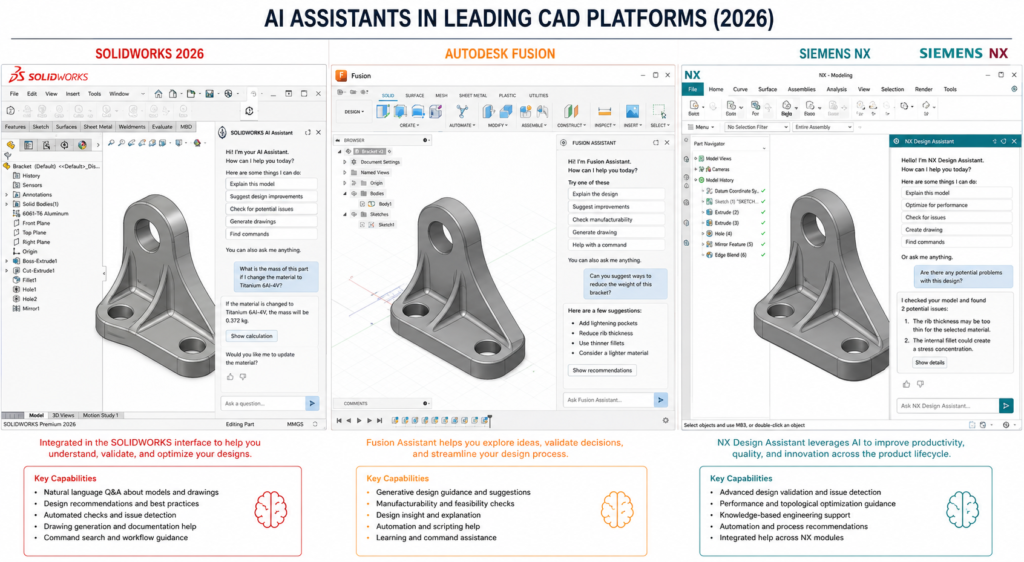
| CAD Platform | Key AI Features (2025-2026) | What Is Working in Practice | Honest Limitation |
|---|---|---|---|
| SolidWorks 2026 (Dassault) | AURA design companion, Command Predictor (beta), Fastener Recognition, Contextual Assistant, Generative Assembly | Sketch AutoConstrain, Fastener Recognition, and Selection Accelerators are in daily use; real time savings on routine tasks | AURA’s generative assembly is still beta; significant generation capabilities remain works-in-progress |
| Autodesk Fusion | Automated Drawings, Sketch AutoConstrain, Autodesk Assistant (GenAI copilot), Fusion MCP for third-party AI integration, Generative Design | Automated Drawings widely adopted; millions of dimensions auto-generated; MCP integration with Claude for natural language design actions | Generative Design valuable for constrained structural problems; limited for complex multi-discipline design |
| Siemens NX | Adaptive UI, AI Chat Copilot, AI-assisted meshing, generative design tools | Chat Copilot reduces documentation lookup time; adaptive UI improves workflow discovery | Full workflow automation still requires significant setup; best results require experienced NX users directing the AI |
| PTC Creo 12 / Onshape | AI-driven generative design with thermal physics integration, AI Advisor, Design Assistant, real-time Ansys simulation integration | Onshape AI Advisor useful for beginners; Creo’s generative design strong for mechanical-thermal combined optimization | Complex regulatory and standards compliance still manual; AI outputs require experienced engineer review |
| Ansys 2026 R1 | Generative AI, first agentic capabilities, AI-enhanced simulation, digital twin integration | AI-accelerated simulation workflows delivering 2-3x speed improvement in benchmarks; agentic features in early access | Full agentic automation requires clean data infrastructure most organizations do not yet have |
The pattern across platforms is consistent. Features that accelerate routine, well-defined tasks (auto-dimensioning, fastener recognition, documentation lookup, view generation) are genuinely useful and widely adopted. Features that promise to generate complex designs from high-level intent are more constrained in practice than their marketing suggests and require experienced engineers to evaluate, filter, and refine their outputs before anything is usable.
Leo AI’s 2026 analysis of the CAD tool landscape makes this point precisely: most AI CAD tools in 2026 solve problems engineers do not actually have, while leaving the painful ones untouched. Documentation chatbots, for instance, primarily help new users find commands. Experienced engineers already know the commands. The bottleneck they face is workflow context and institutional knowledge, not documentation lookup.
7. Predictive Maintenance and AI in Manufacturing: Real Outcomes, Honest Limitations
The Clear Successes
AI-driven predictive maintenance is the commercial success story of AI in engineering-adjacent domains. The application is well-suited to AI: large volumes of structured sensor data, clear ground truth labels (a machine either failed or it did not), and high economic value in predicting failure before it occurs.
Published research now consistently demonstrates prediction accuracy of 85 to 95 percent for failure events in electrical and mechanical systems. Industry deployments at automotive manufacturers, energy companies, and aerospace maintenance organizations have documented reductions in unplanned downtime of 30 to 50 percent, with corresponding maintenance cost reductions.
What Makes Predictive Maintenance Different from Other AI Applications
Predictive maintenance works in practice where many other AI engineering applications struggle because the problem is well-structured. The data is digital (sensor readings), the label is binary (failure/no failure), the business case is directly quantifiable (cost of downtime), and the human oversight model is clear (the AI flags, the maintenance engineer decides). This combination of clear problem definition, clean training data, and a well-designed human-in-the-loop process is the template for AI engineering applications that actually deliver ROI.
Honest Limitations
Not every manufacturing environment has the sensor infrastructure to make predictive maintenance viable. Older equipment may lack the connectivity to generate the data the models need. Environments with significant process variability can degrade model performance. And the maintenance scheduling integration, ensuring that flagged maintenance actions are actually acted on within the right window, requires operational discipline that is not automatically provided by the AI system.
| REAL: Predictive maintenance. ROI is documented and consistent across industries. This is the application to prioritize if you are looking for near-term, provable AI value in a manufacturing context. |
8. The Hype That Has Not Delivered Yet (And Why)
Intellectual honesty requires naming the capabilities that were widely promoted but have not materialized as advertised.
Fully Autonomous AI Design Systems
The vision of describing what you want in plain language and receiving a production-ready engineering design back has not been realized. This is not surprising to anyone who understands what engineering design actually involves: managing constraints that are never fully specified, resolving tradeoffs between competing stakeholder requirements, applying domain knowledge about manufacturing realities, supply chains, standards compliance, and product history. AI can assist at many points in this process. It cannot replace it.
| HYPE: Autonomous engineering design from natural language. No shipping product in 2026 can accept a high-level engineering brief and return a production-ready design without substantial expert human involvement. This capability may eventually arrive, but it is not here. |
AI Completely Eliminating Physical Prototyping and Testing
AI-accelerated simulation is reducing the number of physical prototypes needed and shifting testing earlier in the design cycle. It is not eliminating physical testing. Physical testing remains essential for safety validation, regulatory certification, and the discovery of failure modes that simulation models, however sophisticated, do not capture. Structural engineers still certify and stamp. Aerospace hardware still goes through qualification programs. Medical devices still require bench and clinical validation. AI makes the front end faster. It does not make the back end disappear.
| HYPE: AI replacing physical testing. AI simulation reduces but does not eliminate the need for physical validation. In regulated industries (aerospace, medical devices, structural engineering), this will remain true for the foreseeable future due to liability and certification requirements. |
AI Copilots Usable Without Engineering Expertise
Several CAD vendors have suggested that AI copilots will lower the barrier to entry so significantly that non-engineers can produce engineering-grade designs. This has not happened. The AI tools shipping today augment experienced engineers. They do not substitute for engineering knowledge. An AI assistant that generates a structural joint geometry means nothing to a user who cannot evaluate whether the result is appropriate for the application, the material, the manufacturing process, and the applicable standard. The expertise required to use AI engineering tools well has not decreased; it has shifted toward higher-order judgment.
| HYPE: AI democratizing engineering to non-engineers. AI tools reduce the mechanical burden of engineering workflows. They do not reduce the knowledge burden of engineering judgment. Output from AI design tools requires expert evaluation. |
Agentic AI Running Autonomous Engineering Workflows
Agentic AI, systems that autonomously plan and execute multi-step engineering tasks without continuous human oversight, is a genuine research direction and an area of active development. In 2026, it is arriving in early access form in tools like Ansys 2026 R1. But the CIO article on agentic AI in engineering workflows (February 2026) offers the most accurate framing: agents remain brittle and are currently reliable only in constrained, well-defined domains. The engineer of 2026 is spending less time on keyboard-level execution and more time directing AI systems, but the idea that agentic AI will autonomously execute complex engineering workflows end-to-end is still a 2028-and-beyond conversation.
9. Will AI Replace Engineers? The Honest Answer
This question generates significant anxiety and no shortage of confident predictions from people who are not practicing engineers. Here is what the actual data and documented trends say in 2026.
The Numbers Do Not Support a Replacement Narrative
The BLS projects 9 percent job growth for mechanical engineers through 2034. The digital twin market alone is projected to grow from 21 billion dollars to 150 billion dollars by 2030, and that growth will require more engineers to design, validate, and maintain the systems involved, not fewer. Germany’s Bitkom 2025 survey of 855 companies found 109,000 unfilled IT and engineering positions, with 42 percent of those companies expecting to need additional technical specialists specifically because of AI adoption. The Jevons Paradox is already visible: cheaper AI-assisted engineering is not reducing demand for engineers. It is making more engineering work economically viable.
The ASCE survey finding that only 27 percent of AEC firms have formally adopted AI, while 94 percent of adopters plan to expand, signals an industry approaching an inflection point. The firms moving first will have a structural competitive advantage in 2027 and 2028. They will not have fewer engineers. They will have engineers who are dramatically more productive.
What Is Changing Is What Engineers Spend Time On
The genuine transformation is in the nature of engineering work, not the existence of engineering jobs. The CIO analysis of agentic AI in engineering frames this clearly: the engineer of 2026 is moving from hands-on execution of routine design tasks toward directing AI systems, defining objectives and constraints, validating outputs, and making judgment calls that AI tools cannot make.
A mechanical engineer who previously spent 40 percent of their time creating standard 2D drawings from 3D models can now delegate much of that to automated drawing tools. That time shifts to design exploration, FEA interpretation, supplier communication, and the contextual judgment calls that are genuinely hard for an AI to make. The job has not disappeared. The ratio of creative to mechanical work has shifted.
The Risk Is Real But Concentrated
The risk to individual engineers is not uniform. Entry-level positions that consist primarily of routine, well-defined tasks are genuinely more exposed. Junior engineering roles at large companies that have already deployed AI tools are seeing reduced new-grad hiring. Senior engineers, those with domain expertise, stakeholder judgment, systems thinking, and the ability to validate AI outputs critically, are not at meaningful risk and in many cases are in higher demand.
The World Economic Forum’s Future of Jobs Report 2025 listed AI and big data as the fastest-growing skills category. Engineers who develop AI fluency in their specific technical domain in 2026 are positioning themselves as organizational leaders. The window for building that differentiated advantage is open now, but it is not going to stay open indefinitely.
| DATA: What this means practically. The engineers most at risk are those whose work consists entirely of tasks AI tools now automate reliably: routine 2D drafting, standard part modeling, documentation lookup. Engineers who combine domain depth with AI tool fluency are increasingly valuable. |
10. What Engineering Managers Should Actually Do in 2026
If you manage an engineering team or an engineering-dependent business, here is practical guidance based on what is working, not on what the industry hopes will be working by 2030.
- Start with simulation acceleration, not generative design.If you want near-term ROI from AI, invest in AI-assisted simulation. Teams using AI simulation workflows are generating nearly three times more design iterations at 2.8 times the speed. The productivity case is documented and the tooling is mature enough to deploy. Generative design is worth experimenting with for constrained structural applications, but it should not be your first AI investment.
- Fix your data infrastructure before buying AI tools.74 percent of organizations in the SimScale report cited data preparation as their top barrier. AI tools run on clean, structured, accessible data. If your CAD library is disorganized, your simulation results are inconsistently named, and your sensor data is siloed in proprietary formats, investing in an AI overlay will not help. Fix the foundation first.
- Pilot predictive maintenance if you have production equipment.This is the highest-confidence AI application in manufacturing. Mature tooling, documented ROI, clear human-in-the-loop model. If your organization has production equipment with connectivity, a predictive maintenance pilot has the best probability of delivering measurable results within a 6 to 12 month timeframe.
- Evaluate the CAD AI features your team already has access to.SolidWorks 2026, Autodesk Fusion, Siemens NX, and PTC Creo all include AI features in your existing license. Before buying new AI tools, audit what your current software already provides. Automated drawing generation, sketch autoconstraint, command prediction, and geometry search may be available today with no additional investment.
- Invest in AI fluency for your mid-level engineers.Mid-level engineers, experienced enough to evaluate AI outputs critically but adaptable enough to learn new workflows, are the optimal AI adoption target. The World Economic Forum identifies skill gaps as the primary barrier to AI-driven business transformation. Training your team to use AI tools effectively in your specific engineering domain will generate faster ROI than buying more software.
- Resist the pressure to over-invest in agentic AI right now.Agentic engineering workflows are a genuine future direction. In 2026, they are fragile in production environments and most valuable in narrow, well-defined tasks. Gartner recommends pursuing agentic AI only where it delivers clear, defined value. Identify one or two high-value, well-defined workflow automation candidates and pilot those, rather than pursuing broad autonomous engineering as an organizational initiative.
11. Real vs Hype: Quick-Reference Verdict Table
Based on research, vendor disclosures, and firsthand engineering practitioner feedback, here is our 2026 verdict on the major AI claims in engineering design:
| AI Application | Verdict | Evidence Basis | Practical Guidance |
|---|---|---|---|
| AI simulation acceleration | REAL | SimScale 2026: 2.8x speed, 4x design variants | Invest now; mature tooling, documented ROI |
| Automated 2D drawing from 3D models | REAL | Autodesk Fusion: millions of auto-dims applied | Adopt in current license; immediate daily time savings |
| Topology optimization for structural/aero | REAL | Documented weight reductions at Airbus, automotive OEMs | Useful for well-constrained, single-discipline problems |
| Predictive maintenance (manufacturing) | REAL | 85-95% failure prediction accuracy in peer-reviewed studies | Highest-confidence ROI application in manufacturing |
| AI-powered part search and reuse | REAL | Documented productivity gains at large CAD library orgs | High ROI, often overlooked; lower complexity than generative design |
| Digital twins with AI for asset monitoring | REAL (growing) | Deployed at scale in aerospace, energy, civil infrastructure | Requires data infrastructure investment; powerful when built correctly |
| Generative design as autonomous design tool | HYPE | Works for constrained structural problems; fails at multi-objective, context-rich design | Useful as a starting point generator; not a design replacement |
| AI eliminating physical testing | HYPE | Not supported; regulations and liability require physical validation | AI reduces prototype count; physical testing remains mandatory |
| AI copilots usable by non-engineers | HYPE | No deployed tool produces engineering-grade output without expert evaluation | AI augments engineering expertise; does not substitute for it |
| Full agentic engineering automation | HYPE (for now) | Ansys 2026 R1 early access; described as brittle outside narrow domains | Watch actively; not ready for broad deployment in 2026 |
| AI replacing engineers at scale | HYPE | BLS projects 9% growth; digital twin market growth drives more demand | Roles are transforming, not disappearing; AI fluency is the differentiator |
12. FAQ:
Is generative design the same as AI design?
No, though the terms are often conflated in marketing. Generative design is a specific application where an algorithm explores a defined design space to produce geometry that meets stated constraints (loads, materials, manufacturing methods). AI in engineering design is a broader category that includes simulation acceleration, predictive maintenance, drawing automation, digital twins, copilot assistants, and generative design. Generative design is one subset of AI’s applications in engineering, and the one that receives the most marketing attention.
Which CAD software has the best AI features in 2026?
This depends on your discipline and workflow. For mechanical product design, SolidWorks 2026 and Autodesk Fusion lead in practical, daily-use AI features. For simulation-heavy work, Ansys 2026 R1 is the most advanced. For BIM and AEC workflows, Autodesk Revit and Bentley’s AI-integrated civil tools are the market leaders. All major platforms have shipped meaningful AI features in the 2025-2026 product cycle, but the quality gap is wide between features that are in general release versus features that are still in beta or limited preview.
How much faster does AI actually make engineering design?
Context-specific, but the SimScale 2026 data is instructive: teams using AI-enabled workflows process simulation requests 2.8 times faster and generate nearly four times as many design variants per program compared to conventional teams. For routine drawing production tasks, automated drawing generation can reduce drafter time by 40 to 70 percent on standard deliverables. Topology optimization can reduce structural mass 20 to 45 percent compared to manually designed baseline components. These numbers come from real deployments, not benchmarks.
What is stopping AI from fully automating engineering design?
Several things that are not going to be resolved quickly. Engineering design requires managing constraints that are never fully specified in a brief, resolving conflicts between stakeholder requirements that contradict each other, applying judgment about manufacturing realities that are not in any database, complying with regulations and standards that change and require interpretation, and taking legal and professional liability for signed and sealed documents. Until AI systems can reliably navigate all of those dimensions, experienced engineering professionals will remain essential for design work that matters.
Should engineering firms invest in AI tools right now?
For simulation acceleration, automated drawing generation, and predictive maintenance: yes, now. These applications are mature enough to deliver ROI within a 6 to 12 month window for most organizations. For broader generative design and agentic AI applications: selective pilots are appropriate, but full investment should wait until your data infrastructure is solid and you have engineering staff trained to critically evaluate AI outputs. The organizations generating the most value from AI in 2026 are those that started with specific, well-defined applications and built systematic competency before scaling.
How is AI affecting the engineering job market in 2026?
AI is shifting the distribution of engineering work more than it is reducing the total volume of engineering employment. Entry-level roles focused on routine drafting and standard modeling are seeing more pressure. Senior engineers and specialists are in higher demand. The World Economic Forum identifies AI fluency as the fastest-growing skills requirement for engineering professionals. Engineers who develop practical AI tool skills in their specific domain in 2026 are building a differentiator that will compound over the next three to five years.
Conclusion:
The most useful frame for AI in engineering design in 2026 is neither the vendor promise nor the skeptic’s dismissal. It is the practitioner’s view: AI is a genuine and growing capability that is delivering measurable value in specific, well-suited applications while falling well short of its most ambitious marketing claims in others.
The SimScale data showing that AI-enabled teams generate nearly four times as many design variants is not a technology prediction. It is a current operational reality at the firms doing this right. The MIT NANDA finding that 95 percent of enterprise AI projects generate zero ROI is equally real, reflecting the majority of organizations that have bought AI tools without the foundational workflow integration needed to make them productive.
The difference between those two outcomes is not the technology. It is the discipline of identifying where AI genuinely helps, building the data and workflow infrastructure to support it, training the humans who work alongside it, and maintaining the engineering judgment that no current AI system can replace.
For engineers reading this in 2026: AI is not going to make your expertise irrelevant. It is going to make your expertise more valuable if you develop the fluency to direct AI tools effectively. The competitive window for building that advantage is open now. Do not wait for the technology to mature further before starting.
Want to go deeper on AI in your engineering workflow?
Explore our related guides on CAD software comparison, in-house versus outsourced CAD drafting, and version control for engineering drawings to build a complete picture of modern engineering operations for your organization.
Leave a Reply