Every time you buckle your seatbelt, turn on a fan, or ride an elevator, you are experiencing the work of a mechanical engineer. Mechanical engineering is one of the oldest and broadest disciplines in the engineering world, and it quietly underpins almost every product, machine, and system you interact with daily.
If you have ever wondered what mechanical engineering actually is, what mechanical engineers do for a living, or whether it might be the right career path for you, this guide covers all of it. We have written this from the ground up for beginners, so no prior technical knowledge is required. By the end, you will have a thorough understanding of the field, from its ancient roots to its role in shaping technologies like robotics, AI-driven design, and renewable energy.
What Is Mechanical Engineering?
Mechanical engineering is the branch of engineering that applies the principles of physics, mathematics, and materials science to design, analyze, manufacture, and maintain mechanical systems. In simpler terms, it is the discipline that focuses on how things move, how forces interact with structures, and how energy flows through systems.
From micro-scale medical devices to massive power plant turbines, mechanical engineering operates across an enormous range of scales and industries. It is often called the “mother of all engineering disciplines” because it was one of the first formalized branches of engineering and its foundational principles overlap with virtually every other engineering field.
| A simple definition: Mechanical engineering is the application of engineering principles and problem-solving techniques to design and manufacture anything that moves, generates energy, or requires structural support. |
According to the American Society of Mechanical Engineers (ASME), mechanical engineering is one of the broadest engineering disciplines and involves the design, production, and operation of machinery and tools.
A Brief History of Mechanical Engineering
Mechanical engineering did not begin in a university classroom. It began with human curiosity and the need to solve practical problems.
Ancient Origins
The roots of mechanical engineering stretch back thousands of years. Ancient civilizations in Egypt, Greece, China, and Mesopotamia all developed mechanical devices long before the term “engineering” existed. The Egyptians used ramps and levers to build the pyramids. The ancient Greeks produced remarkable mechanical inventions, including the Antikythera mechanism, often considered the world’s first analog computer.
Archimedes (287-212 BC) is one of the earliest figures we can point to as a proto-mechanical engineer. His work on levers, pulleys, and the screw pump laid conceptual groundwork that still informs engineering education today.
The Industrial Revolution: A Turning Point
The most transformative period for mechanical engineering was the Industrial Revolution, which began in Britain around the 1760s and spread rapidly across Europe and North America. Steam engines, textile machinery, and iron manufacturing processes transformed societies and created enormous demand for trained engineers who could design, build, and operate complex machines.
James Watt’s improvements to the steam engine in the late 18th century are widely credited as one of the most important engineering innovations in human history, setting the template for how mechanical systems could be designed to maximize efficiency.
The 20th Century and Beyond
The 20th century brought mechanical engineering into aerospace, automotive, nuclear, and eventually digital technologies. The development of the combustion engine transformed transportation. The space race pushed mechanical engineering to new extremes of precision and reliability. Computer-Aided Design (CAD) software, introduced commercially in the 1960s and 1970s, fundamentally changed how engineers conceived and communicated designs.
Today, mechanical engineering is at the intersection of traditional manufacturing, digital simulation, artificial intelligence, and sustainable energy systems. It has never been a more dynamic time to enter the profession.
Core Subjects and Fundamental Principles
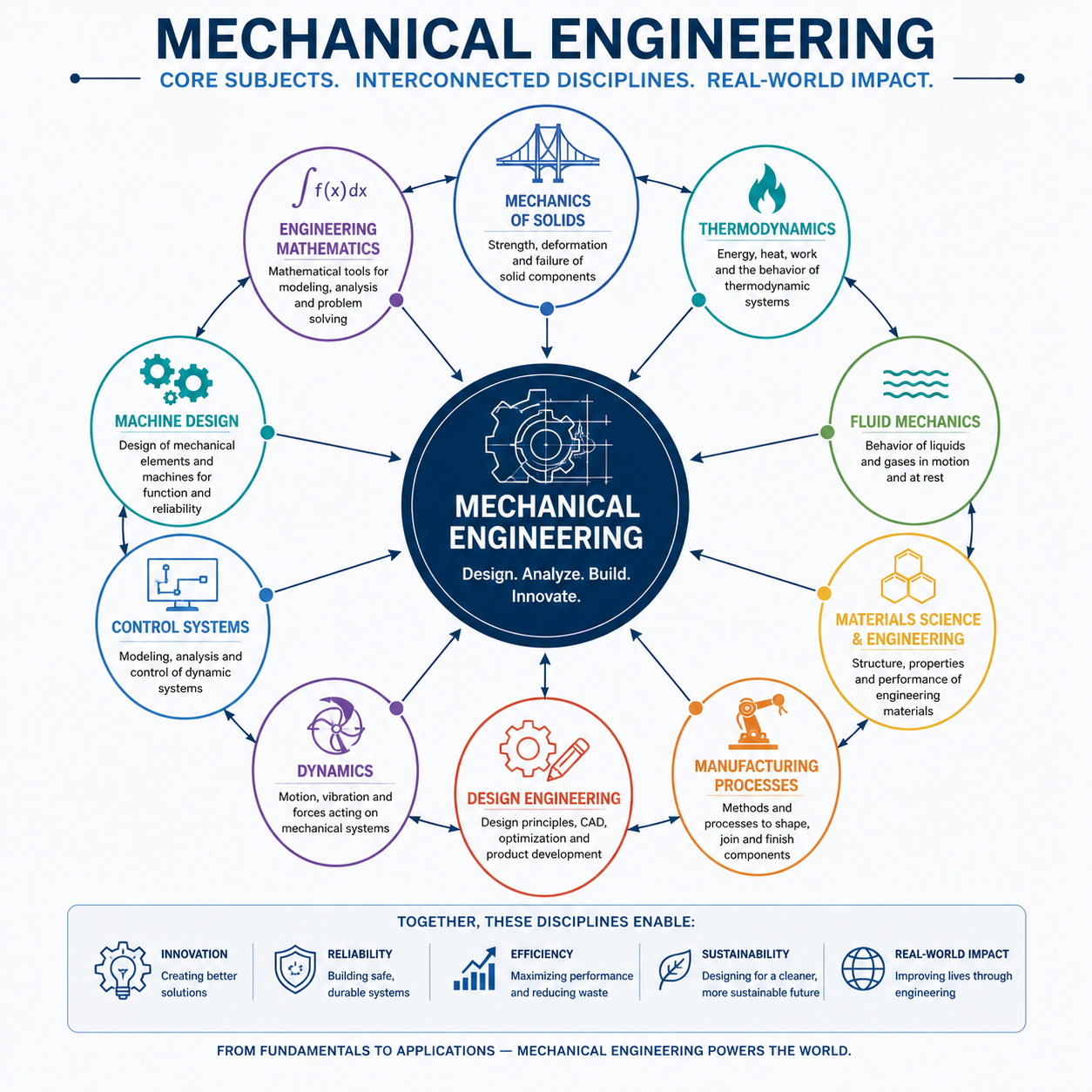
A mechanical engineering education is built on a set of core technical subjects. Understanding these areas gives you a sense of how broad and intellectually demanding the discipline really is.
Statics and Dynamics
Statics is the study of bodies at rest and the forces acting on them. Dynamics extends this to bodies in motion. These are the foundational mechanics courses that teach engineers how structures bear loads and how objects accelerate or decelerate under applied forces.
Thermodynamics
Thermodynamics deals with heat, energy, and how they convert between different forms. It is essential for designing engines, refrigeration systems, HVAC units, and power generation equipment. The laws of thermodynamics set hard physical limits on what any energy system can achieve.
Fluid Mechanics
Fluid mechanics covers the behavior of liquids and gases in motion and at rest. Mechanical engineers use fluid mechanics principles when designing pipelines, aircraft wings, pumps, and hydraulic systems.
Mechanics of Materials (Strength of Materials)
This subject examines how materials deform, stress, and fail under applied loads. It is critical for any engineer who needs to ensure a structure or component will not break under real-world conditions.
Heat Transfer
Heat transfer studies how thermal energy moves through conduction, convection, and radiation. Engineers apply these principles when designing cooling systems for electronics, engines, or industrial processes.
Manufacturing Processes
Understanding how things are made is just as important as designing them. Mechanical engineers study casting, machining, welding, additive manufacturing (3D printing), and composite fabrication to ensure designs can actually be built at scale.
Control Systems and Mechatronics
Modern mechanical systems often require automated control. Control systems engineering deals with feedback loops, sensors, and actuators that allow machines to regulate their own behavior. Mechatronics blends mechanical, electrical, and software engineering into a unified discipline.
What Does a Mechanical Engineer Do?
The day-to-day work of a mechanical engineer varies enormously depending on the industry, company size, and career stage. However, certain core activities are common across most roles.
- Designing components and systems using CAD software
- Running simulations to test designs before physical prototypes are built
- Analyzing data from tests, sensors, and field performance
- Collaborating with manufacturing teams to ensure designs can be produced efficiently
- Writing technical reports and design documentation
- Managing projects and coordinating with other engineering disciplines
- Improving existing products through redesign and optimization
- Ensuring designs comply with safety standards and industry regulations
In a typical week, a junior mechanical engineer might spend significant time in CAD software creating or modifying part drawings, attending design review meetings, running Finite Element Analysis (FEA) to check structural integrity, and communicating with suppliers about material specifications. A senior engineer or engineering manager might spend more time on strategic planning, budget oversight, and mentoring junior team members.
One of the most appealing aspects of the profession is its variety. A mechanical engineer working in the medical device industry faces completely different daily challenges from a colleague designing offshore wind turbines or automotive components.
Industries Where Mechanical Engineers Work
The breadth of mechanical engineering means that qualified engineers are in demand across a huge range of sectors. Below are the industries that employ the largest numbers of mechanical engineers globally.

| Industry | Typical Roles | Key Engineering Focus |
| Automotive | Powertrain engineer, chassis designer, NVH specialist | Engine efficiency, structural safety, emissions reduction |
| Aerospace & Defense | Structural analyst, propulsion engineer, systems engineer | Aerodynamics, heat management, reliability |
| Energy (Oil, Gas, Renewables) | Turbine engineer, pipeline engineer, wind turbine designer | Fluid mechanics, thermodynamics, materials |
| Manufacturing | Process engineer, tooling designer, quality engineer | DFM, lean manufacturing, automation |
| Medical Devices | Biomedical device engineer, prosthetics designer | Precision, biocompatibility, miniaturization |
| HVAC & Building Services | HVAC design engineer, energy consultant | Heat transfer, fluid flow, energy efficiency |
| Robotics & Automation | Robotics engineer, mechatronics specialist | Control systems, kinematics, actuators |
| Consumer Products | Product development engineer, R&D engineer | Ergonomics, manufacturing cost, durability |
Tools and Software Used in Mechanical Engineering
Modern mechanical engineers are expected to be proficient with a range of software tools alongside traditional analytical methods.
CAD Software
- SolidWorks: One of the most widely used parametric 3D CAD platforms in industry
- AutoCAD: The industry standard for 2D technical drawings and drafting
- CATIA: Used extensively in aerospace and automotive for complex surface modeling
- Fusion 360: Cloud-based CAD popular with startups and smaller engineering teams
- NX (Siemens): Favored for high-complexity mechanical and aerospace applications
Simulation and Analysis Software
- ANSYS: The leading platform for FEA, CFD, and multiphysics simulation
- MATLAB and Simulink: Used for mathematical modeling, control systems, and data analysis
- SolidWorks Simulation: Integrated FEA tools within the SolidWorks environment
- COMSOL Multiphysics: Specializes in coupled physics simulations
Project and Data Management
- PLM software (Teamcenter, Windchill): Manages product lifecycle data across large teams
- Microsoft Excel: Still heavily used for hand calculations, data analysis, and reporting
- Python: Increasingly used for automation, data processing, and scripting in engineering workflows
CAD and Simulation in Mechanical Engineering
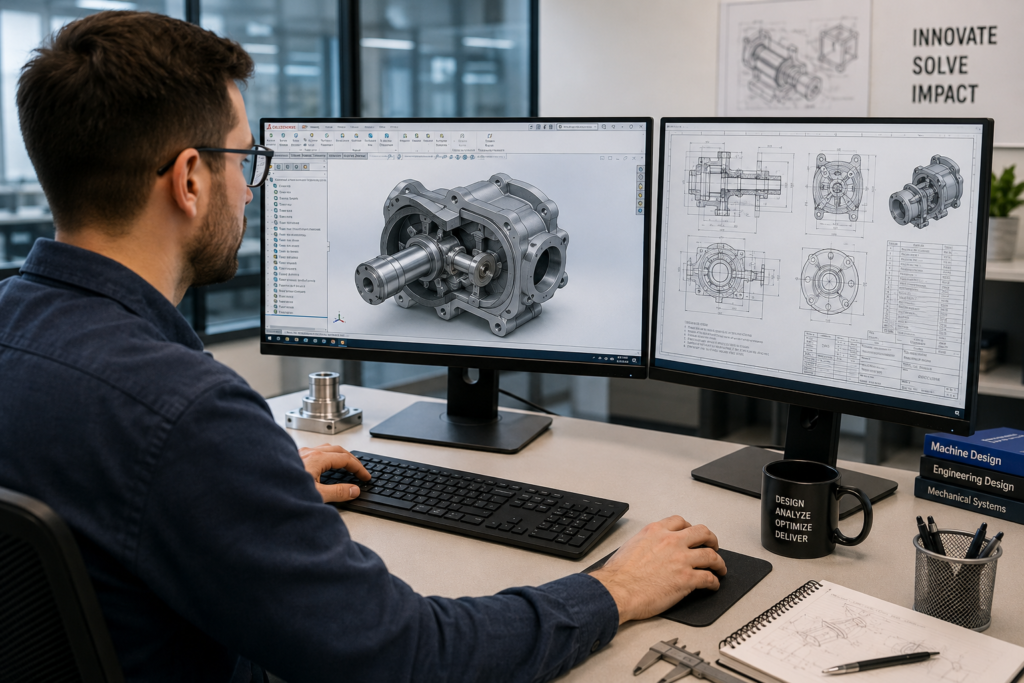
Computer-Aided Design (CAD) and simulation have transformed mechanical engineering practice more than almost any other development in the past 50 years. Before CAD, engineers produced every design by hand on drawing boards, a process that was time-consuming and made design changes expensive and slow.
Today, a mechanical engineer can create a fully parametric 3D model of a complex assembly, test it under simulated load conditions, check it for manufacturability, and generate engineering drawings, all before a single physical component is made.
Finite Element Analysis (FEA)
FEA is a computational technique that divides a physical structure into thousands of small elements and solves the governing equations of mechanics for each element. This allows engineers to predict where stresses will be highest, where deformation will occur, and whether a design will survive its intended loading conditions. FEA has made it possible to design lighter, stronger structures with significantly less physical testing.
Computational Fluid Dynamics (CFD)
CFD applies similar numerical methods to fluid flow problems. An automotive engineer can simulate airflow around a car body to reduce drag. An HVAC engineer can model airflow through a building to optimize comfort and energy use. CFD reduces the need for expensive wind tunnel testing and physical flow experiments.
Digital Twins
A digital twin is a real-time virtual model of a physical asset, updated continuously with live sensor data. Mechanical engineers increasingly use digital twins to monitor industrial equipment, predict maintenance needs, and optimize performance without interrupting physical operations. This technology is growing rapidly across manufacturing, energy, and infrastructure sectors.
Mechanical Engineering vs. Other Engineering Branches
| Feature | Mechanical Eng. | Civil Eng. | Electrical Eng. | Chemical Eng. |
| Primary Focus | Machines, motion, energy | Structures, infrastructure | Electricity, electronics | Chemical processes, reactions |
| Core Tools | CAD, FEA, thermodynamics | Structural analysis, geotechnics | Circuit design, signal processing | Process simulation, reaction kinetics |
| Typical Projects | Engines, robots, turbines | Bridges, buildings, roads | Power grids, microchips | Refineries, pharmaceuticals |
| Overlap With ME | Closely linked via mechatronics | Shared structural analysis methods | Shared in electromechanical systems | Shared in energy and thermal systems |
It is worth noting that the boundaries between engineering disciplines have blurred considerably in recent decades. A mechanical engineer working in electric vehicles needs a solid understanding of electrical systems. One working in biomedical engineering will collaborate closely with chemical and materials engineers. Cross-disciplinary competence is increasingly valued in the modern engineering workplace.
Education and Degree Options
Becoming a licensed mechanical engineer typically requires a formal university education, though the specific path can vary by country.
Undergraduate Degree (BEng / BASc / BS)
A Bachelor’s degree in Mechanical Engineering typically takes three to four years and covers the core technical subjects described earlier in this guide. Accredited programs from institutions recognized by bodies such as ABET (in the US) or the Institution of Mechanical Engineers (IMechE in the UK) are generally required for professional licensure.
Master’s Degree (MEng / MS / MSc)
A postgraduate Master’s degree allows engineers to specialize in a specific area such as robotics, aerospace systems, thermal engineering, or advanced manufacturing. It typically adds one to two years of study after an undergraduate degree and opens doors to more senior research and development roles.
PhD and Research Positions
For those interested in pushing the boundaries of the discipline, a PhD in mechanical engineering leads to careers in academic research, government research laboratories, or R&D leadership positions in industry.
Professional Certifications and Licenses
- Professional Engineer (PE) license (US): Requires passing the FE exam, gaining work experience, and passing the PE exam
- Chartered Engineer (CEng) status (UK): Awarded by institutions such as IMechE to engineers who meet experience and competency standards
- CAD and software certifications: SOLIDWORKS Certified Professional (CSWP), ANSYS certifications, and similar credentials are valued in many job markets
Mechanical Engineering Career Paths
One of the great strengths of a mechanical engineering degree is the range of career directions it opens up. The following paths represent common trajectories for mechanical engineers.
Design Engineer
Design engineers focus on creating new products or improving existing ones. They spend significant time in CAD software and work closely with manufacturing and procurement teams to bring concepts to life.
Manufacturing / Process Engineer
Manufacturing engineers focus on how products are made. They optimize production processes, reduce waste, improve quality control, and implement lean and Six Sigma methodologies on factory floors.
Structural / Stress Analyst
Stress analysts use FEA and hand calculations to verify that components and structures can withstand their operating loads. This role is common in aerospace, automotive, and civil-mechanical hybrid environments.
Research and Development (R&D) Engineer
R&D engineers work at the frontier of technology, exploring new materials, processes, and design concepts. These roles often exist within large corporations, government labs, or startups developing disruptive technologies.
Project Manager
Many experienced mechanical engineers transition into project management roles, using their technical background to oversee engineering projects, manage teams, and communicate technical requirements to non-engineering stakeholders.
Consulting Engineer
Independent or firm-based consulting engineers provide specialist technical advice to clients across multiple industries. This career path tends to suit experienced engineers who enjoy variety and problem-solving across different contexts.
Mechanical Engineering Salary and Job Outlook
Mechanical engineering consistently ranks as one of the highest-paying undergraduate engineering disciplines globally.
| Region | Average Starting Salary | Mid-Career Salary | Senior / Specialist Salary |
| United States | $65,000 – $75,000 | $90,000 – $110,000 | $120,000 – $150,000+ |
| United Kingdom | GBP 28,000 – 35,000 | GBP 45,000 – 65,000 | GBP 70,000 – 100,000+ |
| Germany | EUR 45,000 – 55,000 | EUR 65,000 – 85,000 | EUR 90,000 – 120,000+ |
| Australia | AUD 65,000 – 80,000 | AUD 95,000 – 120,000 | AUD 130,000 – 170,000+ |
| India | INR 400,000 – 600,000 | INR 800,000 – 1,500,000 | INR 2,000,000+ |
According to the US Bureau of Labor Statistics, employment of mechanical engineers is projected to grow steadily over the coming decade, with particularly strong demand in areas including renewable energy, advanced manufacturing, robotics, and medical devices. The global push toward decarbonization and electrification is creating entirely new categories of mechanical engineering work that did not exist even ten years ago.
Future Trends and Emerging Technologies in Mechanical Engineering
The mechanical engineering profession is evolving rapidly. Several major trends are reshaping what engineers need to know and what they will be working on over the next decade.
Additive Manufacturing and 3D Printing
Industrial 3D printing has moved well beyond plastics and prototypes. Metal additive manufacturing now enables the production of complex geometries that are impossible to machine, leading to lighter aerospace components, custom medical implants, and optimized heat exchangers. Mechanical engineers who understand both traditional manufacturing and additive processes are highly sought after.
Electrification and Energy Transition
The global shift toward electric vehicles, renewable energy systems, and hydrogen power is generating enormous demand for mechanical engineers with expertise in battery thermal management, wind turbine structural design, electric motor integration, and fuel cell systems. This is one of the fastest-growing areas in the profession today.
AI and Generative Design
Artificial intelligence is beginning to change how designs are created. Generative design tools use AI algorithms to explore thousands of potential design configurations based on engineering constraints and objectives, often producing optimized geometries that a human designer would not intuitively conceive. Mechanical engineers are increasingly expected to understand and direct AI-assisted design workflows.
Robotics and Autonomous Systems
The robotics industry is expanding rapidly into logistics, healthcare, construction, and agriculture. Mechanical engineers are central to the design of robotic actuators, end effectors, structural frames, and motion systems. Mechatronics expertise, which blends mechanical, electrical, and software skills, is particularly valued.
Sustainability and Life Cycle Engineering
Modern engineering practice increasingly demands that engineers consider the full environmental impact of their designs, from raw material extraction through to end-of-life disposal. Life cycle assessment (LCA) tools and circular economy principles are becoming standard parts of the mechanical engineer’s toolkit.
Advantages and Challenges of Mechanical Engineering
Advantages
- Exceptionally wide career options across virtually every industry
- Strong, consistent earning potential throughout a career
- Tangible, visible impact: mechanical engineers build and improve things that exist in the real world
- Cross-disciplinary skills open doors to roles in management, consulting, and entrepreneurship
- Growing demand driven by energy transition, automation, and medical technology expansion
- Strong international mobility: mechanical engineering qualifications are recognized globally
Challenges
- The undergraduate degree is mathematically and technically demanding
- Keeping technical skills current requires ongoing professional development
- Some manufacturing-adjacent roles face employment volatility linked to economic cycles
- Early career salaries, while solid, may lag behind finance or software engineering roles
- Project timelines and budget pressures can create significant professional stress
Frequently Asked Questions (FAQ)
What is mechanical engineering in simple terms?
Mechanical engineering is the branch of engineering that focuses on designing, building, and maintaining mechanical systems and machines. It applies physics, mathematics, and materials science to create everything from car engines to medical devices. If something moves, generates energy, or requires structural support, a mechanical engineer was likely involved in its creation.
What does a mechanical engineer do on a daily basis?
On a typical day, a mechanical engineer might use CAD software to create or modify designs, run simulations to test how components perform under stress or heat, attend design review meetings with cross-functional teams, write technical reports, and communicate with suppliers or manufacturing teams about production requirements.
Is mechanical engineering a good career?
Yes, mechanical engineering is widely regarded as an excellent career choice. It offers strong earning potential, job stability across multiple industries, opportunities for international work, and genuine intellectual challenge. The ongoing energy transition and growth in robotics and medical technology are creating new job opportunities that are expected to sustain demand for mechanical engineers for decades.
How many years does it take to become a mechanical engineer?
A Bachelor’s degree in mechanical engineering typically takes three to four years. In some countries (such as the UK with an MEng program), an integrated master’s qualification takes five years. Gaining full professional licensure or chartered status typically requires an additional three to five years of supervised work experience after graduation.
What is the difference between mechanical engineering and civil engineering?
Mechanical engineering focuses on machines, mechanical systems, and energy, whereas civil engineering focuses on structures, infrastructure, and the built environment. Mechanical engineers tend to work on products that move or convert energy, such as engines, turbines, and robots. Civil engineers design and oversee bridges, roads, buildings, and water systems. Both disciplines share some analytical foundations but apply them to very different problems.
What software do mechanical engineers use?
The most commonly used software includes SolidWorks, AutoCAD, and CATIA for 3D and 2D design; ANSYS and COMSOL for simulation and analysis; and MATLAB for mathematical modeling and data processing. Many engineers also use project and lifecycle management software such as Teamcenter or Windchill for managing large product development programs.
What is the average salary for a mechanical engineer?
Salaries vary significantly by country, industry, and experience level. In the United States, the median annual salary for mechanical engineers is approximately $95,000 to $100,000 according to Bureau of Labor Statistics data, with senior and specialist engineers commonly earning well over $120,000. In the UK, mid-career salaries typically range from GBP 45,000 to GBP 65,000.
Conclusion
Mechanical engineering is one of the most versatile, impactful, and intellectually rewarding careers available to anyone with an interest in how the physical world works. From the principles of thermodynamics that govern every engine ever built, to the AI-assisted generative design tools reshaping product development today, the discipline sits at the intersection of tradition and innovation.
Whether you are a student deciding what to study, a professional considering a career change, or simply someone curious about the engineering that shapes the world around you, mechanical engineering offers a rich and rewarding path. The problems are real, the impact is tangible, and the field is evolving faster than ever.
On this website, we publish in-depth guides on the tools, techniques, and concepts that mechanical engineers use every day. Whether you want to learn AutoCAD, master SolidWorks, understand FEA, or explore the latest advances in the field, you will find detailed, practical resources here.
Ready to go deeper? Explore our complete guide to AutoCAD Tutorials for Beginners and Professionals, or discover the Best CAD Software for Engineers to find the tools that professional mechanical engineers rely on.
Leave a Reply